Tampilkan postingan dengan label religious history. Tampilkan semua postingan

Senin, 12 September 2016

Acts of the Apostles and the riots of the Roman Peace


I am currently reading the New Testament more or less in the order that it was written. I began with the Acts of the Apostles, which discusses the missionary efforts of Jesus's followers after his ascension to heaven.
Taking the Acts as a historical document, I am very impressed by how chaotic social religious and political scene was in this era of "Roman peace." Many of you know that during this apostolic era was characterized by strong opposition to the new Christian movement by a variety of better established Jewish and Greek/Roman parties. It is remarkable how nervous the established powers seem to have been – how quickly they ran to the Roman authorities to denounce the new religious movement. There is a lot of actual fighting described or implied, and of course sometimes the opponents of the Christians got them imprisoned, beaten up, and murdered.
We have to wonder-- at least I do – whether the reaction by the established religious authorities was justified or completely out of proportion. Is there a big difference between these two alternatives? Either way it's not exactly happy days in the Eastern Mediterranean in the first century A.D.
You might well come away with a much more sympathetic understanding of Pontius Pilate, the Roman governor who did his best to stay out of the conflict between the established Jewish authorities in Jerusalem and Jesus's movement. It may have been commonplace to credit the Romans and their representatives with peace and reform, but if you were one of the governors mentioned in Acts, you probably felt that your office was like a wild horse, and you would be lucky to stay on it.

Jumat, 01 Juli 2016

Talking Erie Canal: Jack Kelly's Heaven's Ditch

Jack Kelly's Heaven's Ditch has the enticing subtitle "God, Gold and Murder on the Erie Canal." When I first saw it, I assumed that the important part of that phrase was "Erie Canal." I was wrong: the key word is "God."
The western arm of New York State was the stage for some of the most dramatic developments in the United States in the early 19th century. It was large and fertile and potentially one of the best routes connecting the Atlantic Coast to the new Midwestern states. The geographic advantages led ambitious engineers and politicians to dream of a huge artificial waterway, the largest in North America. The same kind of ambition, directed to a different goal, inspired a different kind of dreamer to build godly societies. Western New York became the incubator of many different religious and social movements. People poured into the region in high hopes of striking it rich. Some succeeded, others were disappointed, sometimes times again and again. But winners and losers alike refuse to be discouraged. Western New York, its economy energized by the building of the canal, nourished wild dreams. And among those dreams were dreams of salvation and the creation of a Christian society.
Elsewhere, I have seen this region called the Burnt-over district, a reference to the many religious revivals that sprang up here or came through. The young United States had had a fair number of skeptical irreligious people, with both ordinary people and people of ambition following the founding fathers in rejecting the established religions of the early American colonies. But in the wilderness areas being settled after 1800, there was a revival of enthusiastic Christianity.
Heaven's Ditch is rich in personality sketches and anecdotes that illustrate the religious flavour of social change that took place in the wilderness. No doubt this comes from contemporary newspapers, which the literate if not highly educated American public enthusiastically read. We learn about many self-appointed leaders who went from settlement to settlement preaching conversion to a born-again, Biblical Christianity. More often than not they taught ideas quite different from the mainstream Protestantism which had been dominant for so long. William Miller for instance became famous for predicting that the end of the world would take place sometime around 1843. His prophecies reached far beyond the districts around the Erie Canal. A famous and significant failure-turned-leader was Joseph Smith, the prophet of Mormonism. And there are many more. In the brand-new society by the canal there was a free market in preaching and teaching. It was possible to write a huge new biblical testament such as the book of Mormon, one revealed to you by angelic and magical means, and be seen not as a probable fraud, given your lack of biblical languages such as Hebrew, but as a wonder of the new do-it-yourself society.
Of course it was not all smooth sailing. Richer and more established members of society were very sceptical of the new religious leaders, who they saw as marginal characters with little legitimate qualification to teach or reconstruct society.
One of the most interesting conflicts of the 1820s and 30s was between the Masons and their opponents. The Masons were an old-fashioned movement, devoted to an Enlightenment-style skepticism. In the Revolutionary period many of the Founding Fathers and other patriots were Masons, and as time went on, many of the local leaders of society joined the organization. But as time went on, Masons came to be resented for their domination of local society. Their cult of secrecy was seen as a threat to republican liberty. And when the new revivalist Christianity began to grow, the religious movement of course opposed the Enlightenment Masons.
In September 1826, an apostate Mason named William Morgan was kidnapped by some of his former friends, who were angry with Morgan because he had published a book revealing many Masonic cult secrets. Morgan was never seen again, and no one who actually knew what had happened to him was willing to go public. Morgan's fate became a widespread popular mystery, and more. For critics of the Masons, it proved that the secret society saw itself as above the law. Outrage turned into a movement, and a new political party, the Anti-Masonic Party. The Morgan scandal was the beginning of a great decline of Masonry; as years went on Masons were seen not as an American Enlightenment movement, but as a dangerous conspiracy of vigilantes. The Anti-Masons went on to be a national party that contributed to the formation of the Whigs.
This is just a single example of how the new country on either side of the Erie Canal generated wild, enthusiastic projects which seemingly came out of nowhere but went on to contribute to the mainstream. (Even the Church of Jesus Christ of the Latter-Day Saints have to be regarded as such, given their nearly 200-year-long history and their prominence in the Mountain States.) And if American life and culture and politics seem wild and enthusiastic today, Jack Kelly's book reminds us that America comes by this kind of stuff honestly.
This is a very entertaining book, but I do miss a final discussion of how the Burnt-Over District settled down to be an unremarkable part of New York State.

Selasa, 21 Juni 2016

Is this America?

CBC's Radio program "The Sunday Edition" interviewed Rebecca Solnit and Andrew Solomon on the "Trump phenomenon" and violence in American politics. They were appalled, of course. Solomon said among other things
The gap has got wider and wider and wider ... The Trump phenomenon is so bewildering to the people who do not subscribe to it and feels so urgent to the people who do subscribe to it that I have the sense of a country and people who have no understanding of one other. Many friends of mine have said to me that "I thought I was an American but I don't know if I am if this is going on in our country." And I think that there is a real feeling that the sides are so far apart and that in particular the Republican side is so uninterested in compromise of any kind on any topic no matter how much such compromise might serve the public good I think ...the level of anger and frustration and alienation on both sides has escalated to a point that I have not seen in my lifetime.
I don't know how old Solomon is, but I wonder if he remembers the civil rights movement and the murders and the riots of the 1960s. He certainly does not remember the imposition of Jim Crow to put the African-American population of the South back in their place, but I am sure he has heard of it.

What this all reminds me of is the 1840s and 1850s, where besides the intense battle over the possible extension of slavery to the West, there was a strong anti-immigrant, anti-foreign religion, anti-intellectual movement best seen in the American Party, also known as the Know-Nothings. Of course, there were differences: back then the undesireable immigrants were Irish and German, and the bad anti-American religion was Catholicism. But what really reminds me of today was the possibly apochryphal origin of the name Know-Nothings: "I know nothing...except Americanism." Yes, this is America. Image: The Know-Nothings repel the invading papal hordes.

Senin, 29 Juni 2015

Biblical marriage

Quite possibly if you are interested in this issue, you've seen something like this. But Juan Cole's summary of what the Bible says about marriage is to the point:

But wackiest of all is the idea that the Bible sees marriage as between one man and one woman. I don’t personally get how you could, like, actually read the Bible and come to that conclusion (see below). Even if you wanted to argue that the New Testament abrogates all the laws in the Hebrew Bible, there isn’t anything in the NT that clearly forbids polygamy, either, and it was sometimes practiced in the early church, including by priests. Josephus makes it clear that polygamy was still practiced among the Jews of Jesus’ time. Any attempt to shoe-horn stray statements in the New Testament about a man and a woman being married into a commandment of monogamy is anachronistic. Likely it was the Roman Empire that established Christian monogamy as a norm over the centuries. The Church was not even allowed to marry people until well after the fall of the Western Roman Empire, since it was an imperial prerogative.

Ancient scripture can be a source of higher values and spiritual strength, but any time you in a literal-minded way impose specific legal behavior because of it, you’re committing anachronism. Since this is the case, fundamentalists are always highly selective, trying to impose parts of the scripture on us but conveniently ignoring the parts even they can’t stomach as modern persons.

1. In Exodus 21:10 it is clearly written of the husband: “If he takes another wife to himself, he shall not diminish the food, clothing, or marital rights of the first wife.” This is the same rule as the Qur’an in Islam, that another wife can only be taken if the two are treated equally.

2. Let’s take Solomon, who maintained 300 concubines or sex slaves. 1 Kings 11:3: “He had seven hundred wives of royal birth and three hundred concubines, and his wives led him astray.” Led him astray! That’s all the Bible minded about this situation? Abducting 300 people and keeping them immured for sex? And the objection is only that they had a lot of diverse religions and interested Solomon in them? (By the way, this is proof that he wasn’t Jewish but just a legendary Canaanite polytheist). I think a settled gay marriage is rather healthier than imprisoning 300 people in your house to have sex with at your whim.

3. Not only does the Bible authorize slavery and human trafficking, but it urges slaves to “submit themselves” to their masters. It should be remembered that masters had sexual rights over their property assuming the slave-woman was not betrothed to another, and so this advice is intended for concubines as well as other slaves. And, the Bible even suggests that slaves quietly accept sadism and cruelty from their masters: 1 Peter 2:18:
And there is more...

Image: Abraham's family. Don't get me started.

Senin, 02 Februari 2015

Rabu, 28 Januari 2015

A review of van Liere, Frans. An Introduction to the Medieval Bible

Sounds good to me -- see the end.

van Liere, Frans. An Introduction to the Medieval Bible. Cambridge: Cambridge University Press, 2014. Pp. xv, 320. $28.99. ISBN: 978-0521684606.

   Reviewed by Matthew Gabriele
        Virginia Tech
        mgabriele@vt.edu


Too often in our teaching and our research we (myself included) neglect the fundamental role the Bible played in medieval Latin culture. We tend to talk around it and only thereby hint at the ways--read, interpreted, even unconscious--in which the object saturated Europe and the Mediterranean during the Middle Ages. Perhaps this isn't entirely our fault. Perhaps the Bible was so fundamental a part of the background, so solid the foundation, that we have tended to miss what's right before our eyes. But in so doing we pass that myopia on to our students, reinforcing this too-common misconception. Ah, but there's a salve for this wound! Frans van Liere has written an engaging overview of the Bible, in all its medieval forms, that should quickly become a foundation upon which the undergraduate English-language study of the medieval West will build.

A brief introduction lays out the scope and aims of the book. Perhaps the most useful part of this introduction is a nice two-page overview on common "misconceptions" about the study of religion in the modern Academy--"useful" because the entire theme of the first several chapters can reasonably be summarized as "the medieval Bible is not what we today think the Bible to be" (2-3). Chapter 2, "The Bible as Book," deals with this analytical point by considering its material culture, from its earliest instances as a scroll to the more commonly-known codex. Here, van Liere offers a useful reminder that not all (not even most) Bibles in the Middle Ages were pandects. These partial Bibles were often divided by theme, used in the liturgy, and so common in part because of the prevalence of separate psalters. Chapter 3, "The Medieval Canon," and chapter 4, "The Text of the Medieval Bible," continue this line but from the perspective of content. Even if two codices had the same texts, they were not really the same. Books of the Bible could have different names in different codices and be placed in different orders. Lamentations could be included as part of Jeremiah. Maccabees might or might not be there, and even if it were there, it might be in one, two, three, or four books. Then, even beyond that, even if you were reading the same book in different codices, there was really no guarantee in the early Middle Ages that they said the same thing. Only by the ninth century did Jerome's become the most widely-used Latin translation, and even then the text was subject to consistent editorial "corrections" through the eleventh century. Only in the thirteenth century, thanks to the dissemination of "pocket" Bibles out of the University of Paris, did the text unwittingly move towards standardization.

Now, having thoroughly destabilized the text itself, van Liere introduces the reader to how medieval people made that unstable text move. Chapter 5, "Medieval Hermeneutics," and chapter 6, "The Commentary Tradition," explain how Scripture was interpreted and then disseminated. We start from the premise that "the idea that the Bible was absolutely true, and needed to be read according to its own hermeneutical rules, was not really challenged until...Spinoza" (113). That does not mean interpretations were stable, though, despite protestations from medieval exegetes that they were absolutely not novel in their readings. These readings are always culturally located. Allegorical readings defined early Christianity and were used as a means to define itself against Jews and against heretics, while the Victorines' literalism of the twelfth century created a new type of attentiveness to the periodization of sacred history. And these interpretations were created, read, copied, and transformed again and again. They spread in the early Middle Ages through stand-alone commentaries and florilegia and in the later Middle Ages through the Glossa Ordinaria. But they also spread in works we do not often think of as exegesis. Medieval historiography, for example, was dependent upon inserting contemporary or near-contemporary events into the arc of sacred history, becoming itself "a form of biblical exegesis" (156).

The final three chapters take us outside of the cloister and to moments of interaction between literate religious and the majority of the population. Chapter 7, "The Vernacular Bible," buries the confessional hobby-horse about the reading of the Bible in the Middle Ages by showing how the text in all of its translations circulated and was read outside a narrow clerical elite, even as it remained constricted in its reading audience, that latter fact in part due to the decreased authority vernacular translations had in comparison with the Vulgate. Chapter 8, "The Bible in Worship and Preaching," pairs well with chapter 9, "The Bible of the Poor?" These concluding chapters talk about how most people in the Middle Ages would have experienced the Bible--aurally and visually. Sermons were a form of exegesis in and of themselves and would have been the primary entryway for the laity to the world of Sacred Scripture. Art reinforced the messages of the sermons, which reinforced particular interpretations of passages, which solidified the unstable text. In other words, van Liere's book as a whole begins by destabilizing what we too often think most stable and concludes by demonstrating that art--in manuscript, in glass, in stone--was just the opposite: oftentimes seemingly ephemeral but truly a concretization of a long exegetical process that took into account the actual text, material culture of the codex, the translation in use, the interpretative strategies deployed in particular historical circumstances, and the cultural rhetoric used to disseminate the all of the above.

Overall, An Introduction to the Medieval Bible is a well-produced, affordable, thoughtful, and engaging work. It has useful appendices, including a fascinating "Comparative Canon Chart" (265-268) showing how the structure of the medieval Bible varied across different time periods, a thorough index, and most helpfully a brief but accessible list of resources for further study at the end of each chapter. It is clearly a book designed for teaching but, as I hope I have shown, is one done by a scholar who appears to see well how teaching and research complement one another. Van Liere's sensitive discussion of Haimo of Auxerre's commentary on Jonah (113-116), for instance, is richly textured; van Liere introduces us to the weight of tradition each exegete felt, from previous commentaries as well as a sense of fidelity to the "true" meaning of Sacred Scripture, but also shows the intellectual vigor inherent in that kind of work and how it created something new, even despite itself. And van Liere does all this with economy--an accessible four-page snippet that could find a home in any university course. In other words, this is the work of a scholar who knows his stuff and can convey it clearly to an audience outside of his specialty. That's a treasure. Buy this book. Use it in your teaching. Use it in your research too. Do it now.

Kamis, 26 September 2013

In Georgia in the Caucasus, a modern stylite monk revives living on a stone pillar

Here's the story (Radio Free Europe/Radio Liberty):
In an isolated part of the Caucasus, a monk is spending his days in prayer and silence atop a 40-meter pillar of limestone in western Georgia (near the town of Chiatura). The Katskhi Pillar was used by stylites -- Christian ascetics who lived atop pillars and eschewed worldly temptations -- until the 15th century when the practice was stopped following the Ottoman Empire's invasion of Georgia. For centuries the pillar was abandoned and locals could only look up at the mysterious ruins on its summit. Finally, in 1944, a mountain climber ascended the pillar, discovering the skeleton of a stylite and the remains of a chapel. Shortly after the collapse of communism and the resurgence of religion in Georgia, former "bad boy" Maxime Qavtaradze (now 59) decided to live atop the pillar in the way of the old stylites. “When I was young I drank, sold drugs, everything. When I ended up in prison.... It was time for a change. I used to drink with friends in the hills around here and look up at this place, where land met sky. We knew the monks had lived up there before and I felt great respect for them." In 1993 Maxime took monastic vows and climbed the pillar to begin his new life. "For the first two years there was nothing up here so I slept in an old refrigerator to protect me from the weather." Since then Maxime and the nearby Christian community have constructed a ladder to the top, rebuilt the chapel, and built a cottage where Maxime spends his days praying, reading, and "preparing to meet God." As a result of the interest in the site there is now a religious community at the base of the pillar. Men with troubled lives come to stay and ask for guidance from Maxime and the young priests who live at the site. The men are fed and housed on the condition they join the priests in praying for around seven hours per day (including from 2 a.m. until sunrise) and help with chores. (19 PHOTOS) Photos by Amos Chapple.

Senin, 15 April 2013

Creating enemies


 Tom Englehardt at Tomdispatch.com has long offered an analysis of the post-9/11 world emphasizes the need of the American security establishment for enemies to fight in the post-Cold War world. In his most recent essay, he discusses how elites who want to manipulate the public through fear must first manipulate themselves into believing their fear-based analysis.  This strikes me as of interest to historians of any era, for instance the Albigensian crusade of the 13th century. Some very good historians think there never was a Cathar heresy until heresy hunters invented it. For a long time, the origins of the great witch hunt have also been ascribed to a fear of Satan's ever-growing influence on earth, a fear of satanic power seen first in intellectual treatises, and only later in the actions of actual witch hunters. See what Tom Englehardt has to say on the subject.
So when the new Pearl Harbor arrived out of the blue, with many PNAC members (from Vice President Dick Cheney on down) already in office, they naturally saw their chance.  They created an al-Qaeda on steroids and launched their “global war” to establish a Pax Americana, in the Middle East and then perhaps globally.  They were aware that they lacked opponents of the stature of those of the previous century and, in their documents, they made it clear that they were planning to ensure no future great-power-style enemy or bloc of enemy-like nations would arise. Ever.
For this, they needed an American public anxious, frightened, and ready to pay.  It was, in other words, in their interest to manipulate us.  And if that were all there were to it, our world would be a grim, but simple enough place.  As it happens, it’s not.  Ruling elites, no matter what power they have, don’t work that way.  Before they manipulate us, they almost invariably manipulate themselves.
I was convinced of this years ago by a friend who had spent a lot of time reading early Cold War documents from the National Security Council -- from, that is, a small group of powerful governmental figures writing to and for each other in the utmost secrecy.  As he told me then and wrote in Washington’s China, the smart book he did on the early U.S. response to the establishment of the People’s Republic of China, what struck him in the documents was the crudely anti-communist language those men used in private with each other.  It was the sort of anti-communism you might otherwise have assumed Washington’s ruling elite would only have wielded to manipulate ordinary Americans with fears of Communist subversion, the “enemy within,” and Soviet plans to take over the world.  (In fact, they and others like them would use just such language to inject fear into the body politic in those early Cold War years, that era of McCarthyism.)
They were indeed manipulative men, but before they influenced other Americans they assumedly underwent something like a process of collective auto-hypnotism in which they convinced one another of the dangers they needed the American people to believe in.  There is evidence that a similar process took place in the aftermath of 9/11.  From the flustered look on George W. Bush’s face as his plane took him not toward but away from Washington on September 11, 2001, to the image of Dick Cheney, in those early months, being chauffeured around Washington in an armored motorcade with a “gas mask and a biochemical survival suit" in the backseat, you could sense that the enemy loomed large and omnipresent for them.  They were, that is, genuinely scared, even if they were also ready to make use of that fear for their own ends.
Or consider the issue of Saddam Hussein’s supposed weapons of mass destruction, that excuse for the invasion of Iraq.  Critics of the invasion are generally quick to point out how that bogus issue was used by the top officials of the Bush administration to gain public support for a course that they had already chosen.  After all, Cheney and his men cherry-picked the evidence to make their case, even formed their own secret intel outfit to give them what they needed, and ignored facts at hand that brought their version of events into question.  They publicly claimed in an orchestrated way that Saddam had active nuclear and WMD programs.  They spoke in the most open ways of potentialmushroom clouds from (nonexistent) Iraqi nuclear weapons rising over American cities, or of those same cities being sprayed with (nonexistent) chemical or biological weapons from (nonexistent) Iraqi drones.  They certainly had to know that some of this information was useful but bogus.  Still, they had clearly also convinced themselves that, on taking Iraq, they would indeed find some Iraqi WMD to justify their claims.
In his soon-to-be-published book, Dirty Wars, Jeremy Scahill cites the conservative journalist Rowan Scarborough on Secretary of Defense Donald Rumsfeld’s growing post-invasion irritation over the search for Iraqi WMD sites.  “Each morning,” wrote Scarborough, “the crisis action team had to report that another location was a bust.  Rumsfeld grew angrier and angrier.  One officer quoted him as saying, ‘They must be there!’  At one briefing, he picked up the briefing slides and tossed them back at the briefers.”
In other words, those top officials hustling us into their global war and their long-desired invasion of Iraq had also hustled themselves into the same world with a similar set of fears.  This may seem odd, but given the workings of the human mind, its ability to comfortably hold potentially contradictory thoughts most of the time without disturbing itself greatly, it’s not.
A similar phenomenon undoubtedly took place in the larger national security establishment where self-interest combined easily enough with fear.  After all, in the post-9/11 era, they were promising us one thing: something close to 100% “safety” when it came to one small danger in our world -- terrorism.  The fear that the next underwear bomber might get through surely had the American public -- but also the American security state -- in its grips.  After all, who loses the most if another shoe bomber strikes, another ambassador goes down, another 9/11 actually happens?  Whose job, whose world, will be at stake then?
They may indeed be a crew of Machiavellis, but they are also acolytes in the cult of terror and global war.  They live in the Cathedral of the Enemy.  They were the first believers and they will undoubtedly be the last ones as well.  They are invested in the importance of the enemy.  It’s their religion.  They are, after all, the enemy-industrial complex and if we are in their grip, so are they.

Selasa, 18 Oktober 2011

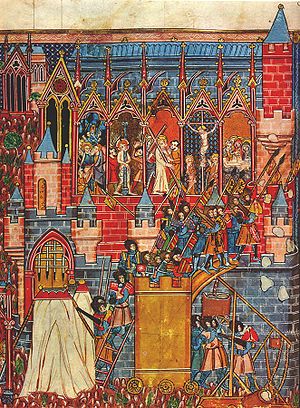
The taking of Jerusalem, 1099


People often wonder how medieval Christians could have taken part in holy war, given Jesus's well-known pacifistic pronouncements.  Here are excerpts from a lecture I gave yesterday on the taking of Jerusalem, which ended in a massacre, which touches on the issue:
Here’s what Tyerman (page 31) says about a famous Christian account of the massacre: 

Raymond of Aguilers… who witnessed the fall of Jerusalem in 1099, described the ensuing massacre on the Temple Mount: "it is sufficient to relate that in the Temple of Solomon and the portico crusaders rode  in blood to the knees and bridles of their horses."  What ever the atrocities performed that day, Raymond was quoting Revelations 14:20 "and the winepress was trodden without the city and the blood came out of the winepress even to the horse bridles."

Comments? [No comments from students.]

Here are my comments.   Massacres of garrisons and the civil  population of fortifications and cities that had resisted for a long time were pretty common in medieval times.   According to the laws of war (or the customs of war) those who resisted, even if they were not armed and had no authority or say in the waging of war, brought the consequences of such resistance upon themselves.  It was kind of a no-win situation because people who surrendered too quickly to a threat of siege might invite the revenge of their rulers if the rulers won the war eventually.   But to focus on the other situation: we've already seen in this course that a siege was a hard task and a dangerous one even for the people outside.  I sometimes joke that it is no real joke that sieges came down to who caught dysentery first, the people outside in their squalid camps, or the people inside crowded together in bad conditions.   Besiegers died in significant numbers in a hard siege, and the numbers went up significantly if there were a number of unsuccessful assaults.  Besiegers became targets for missiles thrown at them from above, and insults meant to break the morale and boost morale on the other side.  When besiegers swarmed into a city through a gap in the walls or by the treachery of the tower commander, that they were not in a good mood all.  All the anger fear and hardship came together in a murderous rage and perhaps a sudden feeling of invulnerability.   Like hunters, they fell upon their prey, animate and inanimate.

Further remark is necessary in the case of Jerusalem, however.   Modern observers from the historically Christian environment often expressed wonder that the religion of peace and my kingdom is not of this world could have inspired warfare.   Forgetting entirely about Muslim and Jewish accounts of the slaughter of Jerusalem, we can see just from Christian accounts that not only did nominal Christians take part in mass murder like anyone else, they felt more justified in doing so in this case because they had scriptural authority behind them.  Those who took part and had read their Bible knew that this was God's will.
Two further points:
  1. Any important and popular religion contains a multitude of contradictory elements that can be used to justify all sorts of actions.
  2. People who study religion or are particularly pious or are opposed to some specific religion often act like a person or group can be completely characterized as "Christian" or "Muslim" or "Shiite" or whatever.  Not so.  Those Crusaders at Jerusalem liked to think of themselves as Christians, bound by the law of God, but also as warriors, subject to the customs of war. This should be obvious, but the way people talk, it clearly isn't.
  Image:  A medieval illustration combines the taking of Jerusalem with the Crucifixion.

Kamis, 01 September 2011

More ominously from Syria

Again from Anthony Shadid:
Abdullah represents what the government insists it is fighting. He is a Salafist, an adherent to a puritanical Islam, though he disavows the term. To him, Salafists bear arms, and he understands that the moment he and others fire a bullet in Homs or anywhere else, the regime will have the justification it covets to crush them with even more force. But there was no question of his devotion to a state that adheres to Islam as its foundation, and he dismissed the comparatively liberal rhetoric of some Islamic activists, like the Muslim Brotherhood. “They want to satisfy the West, and they don’t want to satisfy Muslims,” he told me the next morning. “They say, ‘We’re a modern Islam.’ But there’s no such thing as modern Islam. There’s Islam, and there’s secularism.” We debated the imposition of religious law and whether Christians and Muslims could intermarry. For the first time since I met him, Abdullah grew angry at me, when I suggested that no Christian or Alawite would subscribe to his vision of the state he would build in the wake of the revolution. He quickly cooled, aware that he shouldn’t show his emotions. At one point, he even suggested that however he might feel, however draconian he believed religious law should be, he was still a minority in the opposition. As much as the activists here talk of unity in the face of government oppression, I often felt as I did in Iraq in those early months after the American invasion in 2003. The more people denied their differences, the more apparent they became. For Iyad, Abdullah and others, there was deep anger at Hezbollah, the Lebanese Shiite movement that has baldly supported the Syrian regime. That anger had spilled into chauvinism against Shiite Muslims, intensifying the hostility they already felt for Alawites. They understood the importance of nonviolence, but even Abdullah admitted that if Assad fell, sectarian vendettas would erupt in the countryside. One of the young men warned darkly that events “were headed toward violence.”

Kamis, 31 Maret 2011

Holy Ignorance

Keith Kahn-Harris at Times Higher Education summarizes the argument of Olivier Roy's new book:
Religion was supposed to fade away in a secularising, globalising modernity, and in the post-9/11 period, proponents of secularism are often angry and bewildered at the persistence of religion. For both militant Richard Dawkins-style atheists and the more cautious supporters of a strictly secular public sphere, responsibility for the failure to secularise is placed at the door of a sinister resurgent religious militancy and a failure of liberal nerve to resist this resurgence. Secularity itself is, it would seem, never the problem.
But as Olivier Roy argues in Holy Ignorance, religious fundamentalism and secularising modernity are much more closely linked than is often appreciated. In fact, it is not just that "secularization has not eradicated religion", he argues, but that secularisation has worked as "we are witnessing ... the militant reformulation of religion in a secularized space that has given religion its autonomy".
Roy's methodology relies on an investigation of the complex and changing relationship between culture and religion to produce a panoramic but subtle overview of the place of religion in a globalised world. His argument is that, whereas in the past there was a close, even symbiotic, connection between religion and culture, in modernity they become decoupled. This is not an inevitable and uniform process, and Roy draws on a vast number of examples and case studies that show how religion and culture interrelate. He is particularly interested in practices of conversion because as religions bring in new adherents they are forced to confront alien cultures...
Holy Ignorance does not rely on an essentialist view of particular religions, but on a wider argument about the place of religion in a secularising modernity. Secularisation denies and undermines religion's symbiotic connection to culture and in the process religions become "formatted" or standardised, so that they come to resemble each other. So, for example, the roles of Jewish rabbis, Catholic priests and Muslim imams become similar.
As religion breaks free from its local manifestations, it becomes more easily transplanted to other locations. Fundamentalist forms of religion do this most successfully. Unanchored in the constraints of tradition and local culture, fundamentalism recognises no limitation and hence comes to view everything outside itself as pagan and impure. This is the "holy ignorance" that Roy identifies and warns us of.
Holy Ignorance's modest length suggests that there is some over-simplification and Roy's thesis awaits and requires serious empirical examination. But, if nothing else, this extraordinary book's disturbing message - that secularism may be religious fundamentalism's best friend - is worth taking very seriously.

Jumat, 18 Maret 2011

Do we still want to be fighting the Crusades?


CHAPEL HILL -- During a visit to the Oakbrook Preparatory School in South Carolina last month, Rick Santorum, the former U.S. senator from Pennsylvania and a 2012 Republican presidential hopeful, fired a salvo against "the American left," this time for its failure to understand the crusades and its hatred of Christendom.
"The idea that the crusades and the fight of Christendom against Islam is somehow an aggression on our part is absolutely anti-historical," Santorum is quoted as saying. "And that is what the perception is by the American left who hates Christendom. They hate Christendom. They hate Western civilization at the core. That's the problem."
The ridiculousness of playing the blame game for the crusades more than 1,000 years after the fact should speak for itself. Santorum, however, is not the first person to evoke medieval holy wars as part of a "Clash of Civilizations" between Islam and the West. Especially since 9/11, fear-mongers have darkly proclaimed that the crusades provide a history lesson about the age-old and inevitable struggle between Christians and Muslims.
Santorum's defense of the crusades echoes others who insist that Muslim aggression, including the seizure of Jerusalem in the seventh century, demanded an armed Christian response. By calling for the First Crusade in 1095, Pope Urban II declared a Just War for the protection of Christians and the recovery of what rightfully belonged to them. (Never mind the fact that Muslims had ruled over the Holy Land for more than 400 years by that point, longer than the United States has been in existence.)
It is hardly "anti-historical" to see that both Christians and Muslims perpetrated horrible acts of violence in God's name during the era of the crusades. Ironically, Santorum himself sounds like medieval popes who described the world as one of "Christendom versus Islam" to rally their supporters.
In his sermon that launched the crusades, Urban roused listeners to action by describing alleged crimes against Christians by Muslims, including the slaughter of pilgrims, the rape of virgins, the defilement of churches and other unspeakable acts - many of which were exaggerated or fabricated. One can almost hear him saying "you're either for us or against us."
Yet other popes maintained diplomatic relations with Muslim rulers. European merchants traded with Muslims in luxury goods and even weapons. Christian clerics engaged in religious debates with their Muslims counterparts. Crusaders negotiated truces with the so-called infidels, forging alliances with certain Muslim kingdoms against other ones.
Upon closer inspection, the world of the crusades, much like our own, breaks down into a constellation of individual and collective actions, political decisions and moral choices - relating to how people define themselves through their religious faith, as well as how they treat others who believe differently from them.
By accusing the American left of hating Christendom, moreover, Santorum identifies his real enemy, a fifth column who despise Christianity and Western civilization so much that they will even stoop to blaming Christian aggression for the crusades. In the same address, he also declared that the separation of church and state in the United States has had "disastrous consequences" for our nation.
Apparently, "the left" needs to realize that they are not living in a modern civil democracy, but in Christendom, facing the same enemies as the crusaders!
Here, we might draw a history lesson from the crusades. Despite their reputation for fighting Muslims, crusaders also turned their swords against other Christians, whom they defined as heretics. Santorum echoes these sentiments with his comments about the American left being the problem.
As the crusades teach us, when religion infuses politics, defining "us" and "them," swords (or in this case dangerous words) are invariably turned inward toward the enemy within.
Not to mention, implicit in Santorum's defense of the Christendom and the crusades is the sense that the crusaders left unfinished business for America to complete, a disturbing proposition that recalls the polemical language of the past that less responsible Christians and Muslims labored to create. That, Mr. Santorum, is "the problem."
In the light of recent developments, Santorum's priorities are (once again, he's done this before) amazingly misdirected.  Misdirected?  Rather, on target for a medieval holy warrior.

Image:  Pope Innocent III, who declared crusades on everyone he could think of, including Markward of Anweiler, "another Saladin" and "an infidel worse than the infidels."

Minggu, 02 Januari 2011

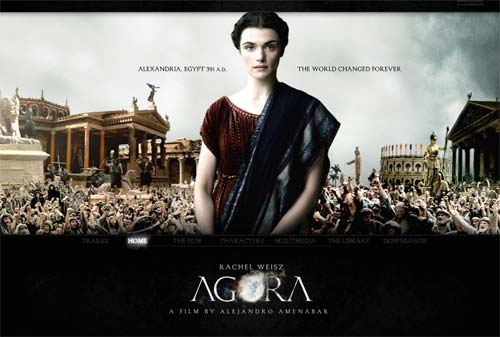
Agora (2009)


This is a seriously good movie.

I haven't heard much unmixed praise for this film, not a lot of commentary at all, and I think it deserves better. So here are my observations.

You should know that the story concerns the 4th century Alexandrian philosopher Hypatia. As a woman philosopher she was an oddity, as an educated pagan she lived in an increasingly hostile environment. Alexandria was a major center for both Christians and pagans, and the two groups were competing for control of the city. The Christians were winning -- they had the support of Theodosius, the eastern emperor who eventually banned pagan observances. The conflict in Alexandria was quite violent at times. This is one of the times that the Library of Alexandria, a pagan institution, is supposed to have been destroyed. More certain is that Hypatia attracted the hostility of the Christian party, and was killed by a mob. It's a depressing story, and one that could easily be butchered.

There are three important aspects to the movie. One is its degree of success in evoking late fourth-century Alexandria. I give Agora very high marks indeed on this. Visually, the evocation of the city, with its mixture of Greek and Egyptian elements, is stunning and flawless. The dialogue likewise does nothing to throw the viewer back into the 21st century, while avoiding pseudo-historical cuteness. That is a harder trick than the mere statement might indicate.

Second is the depiction of the religious conflict between Christians on one hand and Jews and pagans on the other. This is certainly what has made distributors very reluctant to show Agora in most of North America, because the Christians don't come out of it looking good. I, however, have read a lot of late ancient ecclesiastical history, some fair amount of it on the turbulent Alexandrian developments of the era, and I found this account believable. Rioting monks were a staple of Alexandrian religious life, even in purely intra-Christian disputes.

Third is the scientific story. The film proposes that Hypatia came to reject the Ptolemaic view of an earth-centered universe, with the complex series of epicycles to make planetary movements correspond to the predictions of Ptolemy's theory. Instead, says the movie, she became convinced that a more elegant solution was possible, a heliocentric one. Because predictions based on circular orbits won't work, she, like Kepler, comes up with the notion that planets moved on elliptical orbits.

I don't think that there is any evidence that Hypatia did any of this, but that doesn't bother me. But I was sure before I saw Agora that the filmmakers would do a terrible job of this part of the film.

They didn't. Indeed, that part of the plot works very well indeed. Hats off to them. And particularly to the bright guy or gal who suggested intercutting images of the Earth from space in a few appropriate places.

This is a serious, good movie.

Sabtu, 06 November 2010

I feel this way about the Early Modern sometimes

Dr. Beachcombing:

Beachcombing’s first thought on reading this was just how glad he is to not have lived in the seventeenth century. The Middle Ages did bigotry with style, whereas modernity manages tolerance tolerably well. The early moderns though fall between two stools – even the likeable Gage [the English Dominican, Thomas Gage (obit 1656) who traveled to the New World in the first quarter of the seventeenth century] converted to Catholicism and back again to Anglicanism and then worked with that monster Oliver Cromwell towards the end of his life.

You will want to read this post. It's got chocolate.

Image:   Guy Fawkes, a 17th century sort of guy. Er, fellow.

Selasa, 03 Agustus 2010

Rabu, 21 Oktober 2009

A very important point in my understanding of religion and its history

Over there at MEDIEV-L, we were discussing Islam, and someone mentioned Karen Armstrong, the prominent writer on religious issues. This clause was a side remark in a long argument:

...the question is not who armstrong thinks is a "real representative" of a religion that is not hers ...
And that impelled me to say this:
And for me that opens up another question: even if the religion is yours, do you get to say who is the real representative of that religion? You may think you are an X, and that all Xs believe such and such, and Y is the best representative that belief or practice, but somebody else somewhere in time and space has an equally strong contrary belief about what Xs say and do and believe, with plenty of evidence to back themselves up. If we are talking as historians and scholars, both persons' claims are ahistorical. What would be objectively verifiable is that there are certain tendencies and disagreements within religion X, and that any definition of religion X includes and excludes people who may or may not think of themselves as X.
Reader, if you care about what I have learned in decades of historical studies, this is one of the most important things.

Sabtu, 18 Juli 2009

Rafsanjani's Friday sermon in Tehran: the flexibility of religion and ideology

Juan Cole published this morning a meaty analysis of Friday's sermon in Tehran by former Iranian president Rafsanjani. Rafsanjani in my view is a smart opportunist, not a radical, but the kind of guy who always survives the revolution and makes billions in the process (he is in fact now a billionaire). His position as successful profiteer and governmental insider puts him in a difficult position. Whatever may be the totality of his motivations may be, he certainly does not want the Islamic Republic to blow up. Thus he argues for an interpretation of the revolution of 1979 that will allow for compromise and unity between the angry reformists and the intransigent hardliners. Juan Cole explains the religious theories involved (the complete post is here):

The reform movement and its allies among pragmatic conservatives have developed a narrative about Khomeinist Iran. They allege that it is ultimately democratic, and that the will of the people is paramount. It is popular sovereignty that authorizes political change and greater political and cultural openness. Precisely because democracy and popular sovereignty are the key values for this movement, the alleged stealing of the June 12 presidential elections by Supreme Leader Ali Khamenei for his candidate, Mahmoud Ahmadinejad, is intolerable. A crime has been committed, in their eyes. A social contract has been violated. The will of the people has been thwarted.

The hard liners hold a competing and incompatible view of the meaning of Khomeini's 1979 revolution. They discount the element of elections, democracy and popular sovereignty. They view these procedures and institutions as little more than window-dressing. True power and authority lies with the Supreme Leader... in this view ... a kind of philosopher-king, who can overrule the people at will. The hard liners do not believe that the election was stolen. But they probably cannot get very excited about the election in the first place. Khamenei and his power and his appointments and his ability to intervene to disqualify candidates, close newspapers, and overrule parliament are what is important. From a hard line point of view, the election is what Khamenei says it is and therefore cannot be stolen.

Rafsanjani desired in his sermon to lay a Khomeinist foundation for the more democratic view. He began by underlining his own role in the revolution and the establishment of the Republic, and his position as a witness to the values of Khomeini. He said Khomeini discouraged the anti-Shah activists of the 1960s and 1970s from terrorism. Instead, he urged a direct appeal to the people in their villages and mosques, and responsiveness to their desires. He represents Khomeini as saying, if the people are with us, we have everything.

Rafsanjani is saying that the 1978-79 revolution was not Leninist. It was not the work of a small vanguard of activists. It was broad and popular and therefore inevitably, he implies, had something of a democratic character.

The authoritarian view of governance in Shiite Islam is anchored by Misbah-Yazdi and his ilk in the theory of the Imamate. Shites believe that the Prophet Muhammad was both temporal ruler and divinely inspired prophet. After him, his relatives also exercised both functions. His son-in-law and first cousin, Ali, is held by Shiites to be the first Imam, the divinely-appointed vicar of the Prophet. But Rafsanjani quotes a Shiite text showing that the Prophet Muhammad said that even Ali could only rule the people with their consent, and without it he should not try. Rafsanjani is reimagining the Imamate not as infallible divine figures succeeding an infallible prophet, but rather as an institution depending on an interaction between God's appointee and the people he is intended to shepherd.

Another piece of evidence for the popular character of the Islamic Republic, Rafsanjani says, is Khomeini's own haste to establish lay, elected institutions and to implement a republican constitution. He maintains that Khomeini actually strengthened some of the popular institutions when he made suggestions for revision of the draft constitution. Even having a constitution is a bow to popular sovereignty, he implies, and he contrasts the haste with which revolutionary Iran established a rule of law and popular input into government with the slowness of these processes in countries such as Algeria.

... But Rafsanjani's point is that even the Supreme Leader, whom some see as a theocratic dictator, derives his position from the operation of popular sovereignty.
Note that Rafsanjani's theory of the Islamic Revolution, like that of many reformers, is democratic without being seculer. It is a theory that grows out of Islam and the Iranian Shi'ite tradition, or at least is being reconciled with that tradition. Ditto for the hardline position. Despite the sweeping innovations brought in by Khomenei, specifically clerical rule and the idea that there can be a Supreme religious Leader in the here-and-now, important foundation stones for the hardline view are identified by its followers with the oldest manifestations of Islam and the Shi'ite traditions of the leadership of the family of Ali (and of the Prophet).

If have not picked a side in this quarrel and adopted a religious, Islamic justification for your position, it is hard to say that either of these positions is "more authentic." Both positions have evolved over the last 30 years, and especially the past couple of months. It might be very hard for a learned Iranian Shi'ite of 200 years ago to recognize either as Shi'ism. Note what Juan Cole says about Rafsanjani's presentation, which he backed up with his authority as an eyewitness to the Revolution, the foundation of the Islamic Republic and the role of Khomeini in both:

So is what Rafsanjani is saying about Khomeini and Khomeinism true? Probably only partially. Khomeini is notorious for having rejected popular sovereignty as a principle. But he did put an elected president and parliament into the constitution, and he surely knew what would follow.
One might say that Rafsanjani, the Iranian Thermidorian, is making it up as he goes along. On the other hand, who knows what Khomeini might say today?

The whole situation reminds me of an insight I had nearly two decades ago, when I was reading a short history of world Buddhism. As I went through the book I realized that somewhere, sometime, just about any religious position you could imagine had been defined by somebody as "true Buddhism." I think this dawned on me when I found out that one influential Buddhist had said that true Buddhism meant that no one should be a monk and everyone should get married.

Thinking about this situation, I eventually came to the conclusion that the inherent variety of human experience and dispositions means that any religious tradition that has any degree of success in recruiting and maintaining itself over time has to contain contradictory elements, and be open to new interpretations. Otherwise it will become completely irrelevant and die out.

This further means that the kind of wild and careless generalizations that are often made about religion and culture and their consequences for today, -- e.g. what political structures will result from Confucian or Roman Catholic or Mormon traditions -- should be treated with the utmost suspicion. (Phil Paine has written about this recently.) A very particular instance is Iran today. A week's diligent reading will tell you quite a bit about what Iranian Shi'ites have valued in the past. Faced, however, with a live Iranian Shi'ite, you or I or Juan Cole will not know what she or he thinks, unless we ask. And even then, what that means for his or her future actions will remain to be seen. As Charles Kurzman might say, when life is no longer going along its routine groove, who knows what will happen next, what you will do next? You make it up as you go along, using existing materials in whatever way seems possible or necessary.

Image: Rafsanjani, photo from Wikipedia.