Tampilkan postingan dengan label Rome. Tampilkan semua postingan

Senin, 12 September 2016

Acts of the Apostles and the riots of the Roman Peace


I am currently reading the New Testament more or less in the order that it was written. I began with the Acts of the Apostles, which discusses the missionary efforts of Jesus's followers after his ascension to heaven.
Taking the Acts as a historical document, I am very impressed by how chaotic social religious and political scene was in this era of "Roman peace." Many of you know that during this apostolic era was characterized by strong opposition to the new Christian movement by a variety of better established Jewish and Greek/Roman parties. It is remarkable how nervous the established powers seem to have been – how quickly they ran to the Roman authorities to denounce the new religious movement. There is a lot of actual fighting described or implied, and of course sometimes the opponents of the Christians got them imprisoned, beaten up, and murdered.
We have to wonder-- at least I do – whether the reaction by the established religious authorities was justified or completely out of proportion. Is there a big difference between these two alternatives? Either way it's not exactly happy days in the Eastern Mediterranean in the first century A.D.
You might well come away with a much more sympathetic understanding of Pontius Pilate, the Roman governor who did his best to stay out of the conflict between the established Jewish authorities in Jerusalem and Jesus's movement. It may have been commonplace to credit the Romans and their representatives with peace and reform, but if you were one of the governors mentioned in Acts, you probably felt that your office was like a wild horse, and you would be lucky to stay on it.

Minggu, 10 April 2016

"Two Worlds Become One: A 'Counter-Intuitive' View of the Roman Empire and 'Germanic' Migration" by Guy Halsall

This is an interesting re-interpretation of the "migration" period, part of a debate that has contemporary resonances and which has been going on for decades now.

Here is the abstract:

Abstract

The Roman Empire and barbaricum were inextricably linked throughout the Roman Iron Age. By late antiquity, Germanic-speaking trans-Rhenan areas were inundated with imperial influence. Migration was two-way and in various forms, all of which, including large-scale ‘folk movement’, were normal: part and parcel of the imperial frontier’s dynamics. The counter-intuitive conclusion is drawn from this that the relationship between the existence of a formal frontier and significant migration is quite the opposite of the one we have grown used to imagining. The collapse of the frontier took with it the mechanisms for migration. Therefore I have to modify my 2007 epigram that ‘the end of the Roman Empire produced the Barbarian Invasions and not vice versa’. The end of the Roman Empire put an end to the barbarian migrations. This conclusion helps us contribute more responsibly to modern debate on migration. It also contributes to a discussion of the formation of Germany. The end of migration changed the political dynamics of the regions between Rhine and Baltic. The latter became more inward-facing and from these, eventually, emerged ‘Germany.’

Here is the complete text

Jumat, 29 Maret 2013

Was the Roman Empire drowned in a bathtub?


Recently, I was at the conference Shifting Frontiers X, a leading late antiquity conference in North America.  At the conference George Benton and Richard Burgess gave an interesting talk on the changing role of gold in late antiquity. Here is an excerpt of the abstract reproduced with permission.

From the time of the introduction of the solidus by Constantine the use and perception of gold were changed radically in the Roman Empire. Silver, hitherto the dominant metal for the making of high-volume coinage, was demoted to use in decoration and gifts, while gold, whether as a unit of account or, increasingly, as bullion minted in solidi, dominated economic exchange. The massive scale of gold use is amply attested in literary sources and papyri, as well as archaeologically in the form of hoards. What remains less clear is whether there was actually more gold circulating… A largely ignored study that used proton activation analysis (PAA) provides tantalizing evidence that a new source of gold became available in the 350s.… This new supply enabled the empire to move to sort of gold standard. With this model in place of the changing use of gold, we are not a position to revisit the earlier trace elementanalyses with new hypotheses. At which minted the gold edge of the empire, was the new goal available in both the East and the West? Where were the mines?

And much of the actual paper was a discussion of which techniques might be feasible for testing coins nondestructively for trace elements like platinum. Best of luck to this project.

For my part, the paper implied that the fall of the Western Empire might be a sort of Grover Norquist scenario, in which all the new extremely high-value money accumulated in the hands of the ultra-rich, and the Imperial government became small enough to be drowned in a bathtub.

Jumat, 16 September 2011

Not to be missed: conjuring up Rome in AD 600


Dr. Beachcombing imagines the near-ghost town it must have been:

Let’s take the lowest sensible estimate for classical Rome – half a million – and the highest for Rome c. 600, about 50,000. That means that the population has not only been decimated, but that it had been decimated nine times over. And what is more these heirs of Rome (as fashionable ‘late antique’ historians call them) were resident in an echo box; a city that they no longer had the technology to repair, let alone recreate, where nine out of every ten residences were empty, where three and four story buildings gradually keeled over into the streets and where the Parthenon and the Coliseum looked down mockingly on the little people below, not so much dwarfs on giants’ shoulders, as blue-bottles buzzing around a cow’s backside.

Then, remember, perhaps the actual population of Imperial Rome was more like a million and the population of Rome c. 600 was more like  ten thousand, a hundredth of what it had been. The psychopathic Anglo-Saxon guard, the tourist from Scythia and the Pope and his tiny administration could shout as loud as they wanted and no one would have heard them in their ghost town. No one was listening, not even the red baked tiles made in a happier age.
I have recently lived across the river from Detroit...so this is evocative.  Detroit is not, however, quite so echoic.

Parthenon presumably should be Pantheon (above).

More on ancient population estimates in a later post.

Sabtu, 16 Juli 2011

Guy Halsall asks...


Why do we need the barbarians?


My contribution to these sessions is essentially to sum up by asking you one big question: why do we need the barbarians?  For it seems that we really do need the barbarians.  The answer was found, or at least suggested, in 1904 by C.P. Cavafy in his famous, much quoted, poem “Waiting for the Barbarians” (even quoted, inexplicably, in the names of chic jewellery boutiques in the 7me arrondissement in Paris, as left):

“Because night has fallen and the barbarians haven’t come
And some of our men just in from the border say
There are no barbarians any longer.

“Now what’s going to happen to us without the barbarians?
Those people were a kind of solution.”

He was right; the bigger question, a hundred years on from Cavafy, is probably ‘a solution to what?’  As far as I can see, the problem which they solve cannot be ‘why did the Roman Empire fall?’  The barbarians’ role in any analysis of the Empire’s collapse must surely be sought under ‘consequences’ or ‘effects’ or – perhaps better – ‘components’, rather than under ‘causes’.  If one looks at the matter in simple descriptive terms, the number of provinces or amount of territory actually conquered by barbarians during the fifth century is minimal.  Note that the general move, in the colour scheme adopted in these maps [a reference to the PowerPoint Slides, I'm afraid, but they were simply the maps in Barbarian Migrations], is rarely from white to black, from Roman rule to barbarian rule, but from white to some shade of grey, either as a federate kingdom or as an area simply where the write of the Ravennate court did not run.>


Lots more, from what was a contentious paper at the Leeds conference this past week.

Minggu, 05 Desember 2010

Sunday morning, and Explorator comes to my mailbox...

...full of archaeological goodies.  Thanks, David Meadows!

One of the nice things about this e-mail news compilation is that it supplies me with links to the little stories.

For instance, I don't get excited about the power, wealth and claims to divinity of Greco-Egyptian queens, but who would not want to see this amazing coin/medallion on Sunday morning?

And I find it pleasant to have nonsense about "Roman Chinese" systematically dealt with.

I'm grateful both to David and the originating sources.

Jumat, 26 November 2010

More good reading from Phil Paine: "identity," slavery, and genocide

The misuse of identity:

...I tend to get most on my high horse when I feel that some stu­pid or wicked notion is being smug­gled into our sub­con­scious by a turn of phrase or an implied definition.

This is exactly the case with the cur­rently accepted use of the word iden­tity. You see this word used all the time, and phrases like “iden­tity pol­i­tics” are assumed to have an eas­ily rec­og­niz­able mean­ing. I’ve just been read­ing a spate of archae­o­log­i­cal papers which rou­tinely refer to “iden­tity” inter­change­ably with eth­nic­ity. These papers, from a vari­ety of aca­d­e­mics, con­stantly repeat phrases like “nego­ti­at­ing their iden­tity” — inane jar­gon which the field has bor­rowed from soci­ol­ogy, and which is now firmly entrenched. Archae­ol­ogy is impov­er­ished by this kind of rub­bish, and drifts away from sci­en­tific rigour.

When some­one casu­ally refers to reli­gious affil­i­a­tion, or to eth­nic­ity, or nation­al­ity, or gen­der, as being their “iden­tity,” there is an implicit assump­tion that mem­ber­ship in large, for­mally defined or orga­nized groups of peo­ple is the essen­tial char­ac­ter­is­tic of an “identity.”

Now, I find this a pro­foundly wrong, and extremely offen­sive assump­tion. Your iden­tity, as far as I’m con­cerned, and as I’ve believed through­out my life, is that which makes you uniquely your­self. My “iden­tity” is com­posed of those things which refer to me and only me, expe­ri­ences that occured to me alone, pas­sions and ambi­tions that are mine, pri­vate sym­bols that only I under­stand, inner expe­ri­ences that belong only to me. These unique, indi­vid­ual char­ac­ter­is­tics form, all together, my Iden­tity. No char­ac­ter­is­tic that I share with some arbi­trary group of other human beings, or that is demanded of me by some col­lec­tive mush, or imposed on me by some pro­claimed Author­ity, can con­sti­tute my iden­tity. Cer­tainly no group that I am merely asso­ci­ated with by acci­dent of birth can ever be my iden­tity. I find the idea that any­one would con­sider their iden­tity to be, say, Nor­we­gianess, or their skin colour, a pro­foundly dis­gust­ing notion. It is to aban­don indi­vid­u­al­ity entirely, to crush and erase iden­tity, not to describe it.

This is a par­tic­u­larly creepy kind of creep­ing col­lec­tivism. The mean­ing of the word iden­tity has been dis­torted, per­verted, inverted. I don’t believe such things are ran­dom acci­dents. There are always pow­er­ful forces that seek to oblit­er­ate respect for, and recog­ni­tion of, the indi­vid­ual human being. If you can pur­suade peo­ple that their “iden­tity” is noth­ing more than their mem­ber­ship in a col­lec­tive blob, that there is noth­ing specif­i­cally notable or sig­nif­i­cant about them­selves, then half the work of enslave­ment has been accom­plished.
Amartya Sen has made a similar point in a recent book Identity and Violence, but his point was that reducing people to a single group identity led not just to enslavement, but genocide.

Similarly, this, from Chimamanda Adichie:


Update: Guy Halsall, anxious to elbow his way into this august company of great minds, recommends that anyone interested in this topic read his book Barbarian Migrations and the Roman West, 376 - 568, especially chapters 2 and 14; I would add that you might also want to be interested in barbarian migrations and "the fall of the Roman Empire." Seriously, though, I read Guy's book last month and it is quite fine, and the theme of multiple identities (as opposed to singular, essentialist ones) is surely there. This is not quite what Phil was talking about, but it is interesting and advances the historical debate on the "transformation" of Rome.

Sabtu, 13 November 2010

The Sack of Rome, AD 410: what do historians and archaeologists think now?

Some of them got together in Rome earlier this month to talk about the subject.  I wasn't there, but Guy Halsall was, and he reports at length. 

Some excerpts I liked:

After these preliminaries, Arnaldo Marcone gave a lengthy run-down of the symbolic importance of Rome in imperial sources from the Battle of Adrianople onwards and then, more interestingly, Carlos Machado spoke on 'The Roman Aristocracy Before and after the Sack'.  What Machado showed quite graphically was a dramatic shrinking of horizons in the interests and indeed the geographical make-up of the Roman senatorial aristocracy after 410.  He also, very interestingly, pointed up the factional divides within the senate and highlighted their absolutely central involvement in the events of 408-410, making clear the complicity of some of the most powerful noble families in events such as the raising up of the usurper Attalus.  What I thought was interesting, from a personal point of view, was just how little connection there was between the Roman aristocracy (in its composition and in the areas it served in) and Gaul (especially) and Spain.  Links with North Africa were extensive, perhaps unsurprisingly, but so too were links with the East.

After coffee it was the turn of the revisionist 'terrible twins', which is to say Michael Kulikowski and me.  I spoke on the subject of 'Goths and Romans'.  I'll post the whole text anon.  For now, suffice it to say that most of it was a distillation of the relevant bits of Barbarian Migrations and the Roman West but with some revisions and developments.  These can be summarised thus:
1: The Gothicness of Alaric's forces may have stemmed largely from continued widespread recruitment north of the Danube, rather than from Goths settled in the Empire after 376
2: The nature of the foederati was new but not unprecedented but in the precise circumstances of the period 395-410 (the heated - and sometimes bloody - debate on the presence of barbarian troops inside the Empire) meant a closer bond between commander and soldiers
3: The title rex has a more specific resonance and particular appropriateness to a commander of foederati in rebellion
4: Kingdoms, far from being an objective, are the default option if nothing better can be obtained.  'Kingdoms are for losers'
5: Honorius' role is much more decisive than people give it credit for being

Michael's paper likewise drew on his body of work to critique the notions of barbarian migration, especially in its recent manifestations, and to show (in similar but far from identical ways to my paper) how the specific circumstances of the period led to a tense and dangerous focus on the commanders of armies of barbarian recruits and their relationships with the court.  Michael built on this a discussion of the traditional Roman means of defending Italy and how these were quite irrelevant to the situation in 408-10.  He then used post-colonial theory to reconstruct Alaric's career in terms of a subaltern mimicking of the dominant culture but one where sudden changes in the situation and the lack of precedent for his position meant that in some points of crisis, unable to obtain what he wanted from the inside, he had to fall back on 'playing the part' assigned to him within the ideological order - that of rampaging barbarian - and to attacking the system from the outside, with dramatic results.  I hope this is not too crude a synopsis.  It was very interesting and I agreed with most of it, even if I had some problems with some elements (I think that Michael would probably say the same about my paper).
 ...
The conference's last session was I think set up to be something of a play-off between Peter Heather and Walter Pohl, representing the schools of 'Fall of Rome' and of 'Transformation of the Roman World' respectively.  I didn't hear most of Peter Heather's presentation but from what I did hear and from what emerged in questions, it was exactly the same line that he has been arguing since 1991, without modification or any real reflexion.  The Roman Empire was brought down by the exogenous pressure of barbarian incursions produced by the Huns (an idea first expressed by St Ambrose of Milan in the 380s, incidentally).  From what heard it was clear that Heather hasn't had anything new to say on the subject of Goths and Romans for twenty years.  In questions he declared that the world was irreparably changed by 420; if he meant that and it wasn't a slip of the tongue, then I think that that is just empirically wrong.  In 420 I would say that the West was on the verge of complete restoration under Constantius III and that had the emperor not dropped dead of pleurisy then next year things would probably have been very different indeed (see, Barbarian Migrations and the Roman West, p.).  What brought down the Roman Empire?  Pleurisy.  ... As I always, not entirely jokingly, tell my first-years. 

Walter refused to play the part scripted for him and instead presented a useful summing up, and a view that pointed out how Heather and Ward-Perkins had essentially misconstrued the position of those who don't believe that barbarians conquered the Roman Empire, by claiming that they don't believe there was any violence. ('Transformation' is not the same as 'continuity', said Andrea Giardina in discussion afterwards.)  The process - and the debate - was more subtle and more complex than that.  That apart he did a very fine job of conciliation, and so the whole event drew to a close.
Plenty more, not easily re-summarized, where that came from!
 

Kamis, 23 September 2010

Dr. Beachcombing reflects on supercentenarians in Roman imperial times

So good:
How reliable are these Roman figures? Well the census in question will have been made in good faith. Whether it was answered in good faith is, of course, though another question. Yes, each respondent took an oath and was expected to give age, residence, name of father or patron and a valuation of their property. But given the teeth of the Imperium a Roman Beachcombing would have crossed his fingers and lied about everything, especially how much he had paid for his villa and his Syrian dancing girls.

As to these excessive ages the most comfortable explanation is that we have frequent cases of confused memory and a culture where modern obsessions with birthdays and age was quite unlike our own. Note how many round numbers there are – possibly Pliny rounding up and down, a telling act in itself.

But if true what lives they would have led! Marcus Aponius, for example, would have been born in 66 BC when Roman armies were devastating Asia Minor. He would have been eleven when the news arrived that the legionaries had done the impossible and crossed to mythical Britain. He would have been twenty two when Caesar was stabbed to death in Rome. He would have been thirty three when Augustus made himself the first Roman Emperor and the news came that Mark Anthony and Cleopatra had chosen suicide over dishonour. He would have been a mere whippersnapper at 80 when Augustus finally kicked the bucket. He would have been over a hundred when mad, bad and sensuous Caligula became Emperor…. And a hundred and thirty odd in the year of the Four Emperors when Rome almost tore himself apart.

Oh what stories he would have told!

Or perhaps not…

Beachcombing has always been struck by the fact that super-centenarians tend not to remember the ‘big’ events but rather stick to the minutiae of their own lives – the birth of a child, the death of a husband, the sale of a house, being short-changed by the green-grocer… Forget honey and vitamin pills, this is probably why they live so long. Certainly, Beachcombing suspects that when he is celebrating 140 it will be first kisses and Mrs B announcing a pregnancy that will stand out, while exploding skyscrapers and invasions and counter-invasions in the Middle East fade deservedly into the ether.

Selasa, 03 Agustus 2010

Selasa, 22 Juni 2010

Carnivalesque returns, and brings us Antioch

Carnivalesque, the carnival of early history blogs, is back -- over at Cranky Professor. And the first of its links takes us to Zenobia: Empress of the East, whose author Judith Weingarten, a fan of all things associated with the Eastern Empire, left in May to travel to Hatay (or Antakya), the city that now arises from the spot where the ancient Antioch once stood. To let us abandoned readers share in some of the fun she looks at an interesting Turkish initiative to reconstruct the old city. It is some challenge, because the current incarnation of the settlement is entirely modern -- if you stretch the idea of modern just a little bit. Certainly there is nothing there to suggest a city that once thought of itself as Rome's rival.

Apparently that has not stopped the Turkish scholar, Dr Kayhan Kaplan of the Department of Landscape Architecture at Mustafa Kemal University in Hatay, who at this site has posted reconstruction of what the old city may have looked like, from four different angles. It looks like the site is entirely in Turkish, but you don't have to read Turkish to enjoy this.

As Judith Weingarten points out, there are limits to this kind of reconstruction, but it gives people something to argue about, and progress is possible:
Needless to say, archaeologists and historians are going to argue about his recreations for a good many years. In fact, Antiochepedia has already thrown down the gauntlet on nine points of topography (e.g., were the river branches narrower? should the island's southern tip be more pointed? that kind of stuff). For the rest of us, it is simply stunning and gives us a real "feel" of ancient Antioch.
I agree entirely with Antiochepedia: "In the good old days, Dr Kaplan might have been cheered along the Colonnaded Street for this job!"

There is more good stuff at Zenobia, and at Cranky Professor for that matter.

Image: Antioch as depicted on the Peutinger map, a medieval copy of a Roman original.

Rabu, 16 Juni 2010

Fellini's Roma (1972)

I haven't seen a lot of Fellini movies, and I certainly missed this one when it first came out. It may be just as well -- I don't know if I would have appreciated it back then. A couple of nights ago, on the other hand, I found it mesmerizing, something I had to watch and enjoyed watching just as a fascinating object. Such movies had more appeal to me than when I was younger.

One does not have to be a genius to see that there must be a large amount of autobiographical reflection in this movie. There are scenes that might be from Fellini's childhood, More from the wartime era, and quite a few from 1972 or thereabouts. There is no plot, just a certain number of realistic but satirical scenes and others that are more fantastic.

One scene I could not find on the web somebody described to me long ago. I was glad to finally see it. The camera follows an official through the perpetually under-construction Roman subway system, during which he complains about how hard it is to make any progress when there are so many archaeological finds in the way, some of which are so significant that the tunnels have to be rerouted. Then the workers detect a great hollow space along the current route. They break through into the space and find it is a Roman villa whose walls are covered with brilliantly preserved paintings of Roman men and women. And then... and then... as workers and officials and out-of-town visitors all watch, the outdoor air corrodes the paintings, and they suddenly and completely disappear.

Then there is this indescribable scene::


This movie also had a lot of shots of the richest and cleanest and most spectacularly dressed hippies I have ever seen, hanging around the fountains of Rome (and in one scene being beaten up by cops while older rich people watch). Were they for real?

Kamis, 25 Maret 2010

Benefactors of humanity


More than once in the past I have said that Roger Pearse is a benefactor of humanity. It still seems to be true. Why is he our benefactor? He has taken it upon himself translate or commission translations of a great many early Christian works which have until now been available only to people who could read the original languages. Some people think that's fine -- if you don't know ancient Greek you would not understand these sources anyway -- but that's not my attitude, nor is it Roger's. As someone who has studied late antiquity and read a lot of obscure Christian literature from that era, I am in awe of Roger's generosity. The translations that he posts and otherwise gives away are not a complete substitute for the originals, but they make available part of the cultural and religious legacy of early Christianity to many new people.

I was inspired to say something about Roger by a blog post he published today, just one of the interesting posts of his that I've read since I discovered he had a blog. the Post announces a new translation of Hippolytus's Chronicon, one of the very first world chronicles written by Christian, in this case a third century Roman clergyman who eventually was martyred. (He is sometimes considered the first antipope.) In an earlier incarnation I had to know something about Hippolytus; it would have been nice to have this translation then.

But one of the interesting things about this new translation is that it is not, as far as I can tell, one of Roger's projects! There is another benefactor of humanity out there and this person is named T. C. Schmidt. Thank you very much, T.C.!

Image: Hippolytus being martyred, dragged behind a horse, from the Wikipedia entry on him.

Minggu, 13 Desember 2009

Syme's Roman Revolution


David Meadows provided this link to a new review of a 70-year-old classic: Ronald Syme's The Roman Revolution. I read this as background material early in my teaching career, because people I respected had vaguely referred to it as a classic. And it was indeed a great book, one that felt fresh decades after publication.

Here's a bit of Steve Donoghue's appropriately well-written review:
Watching how Syme handles all his sources –watching the intricate, hitherto unseen connections and uprootings that he effects by sifting through everything so carefully (he’ll find a passing comment in an epic poem that sheds light on legionary cooking techniques, or a well-known paragraph from Cicero that can be read in a startling new way) – is at once humbling and exciting, and it’s no wonder The Roman Revolution has cast such a long shadow. The subject matter – the carefully-implemented plan by which Octavian took sole, personal control of the Roman Empire (and the equally careful plan to prevent the Romans from realizing the full import of what he was doing) – has been taken up many times by many historians in the ensuing seventy years. Syme’s masterpiece is in all their bibliographies, and most of those later histories of Augustus or the end of the Roman Republic would have been unthinkable had not Syme so impeccably paved the way.

The sobering fact is how little any of those later books manage to offer even a small amplification of Syme. Even now, The Roman Revolution is the first, best modern history of Rome’s preventable and misunderstood transition from Republic to Empire. Surely a Penguin Classic of it is finally in order?

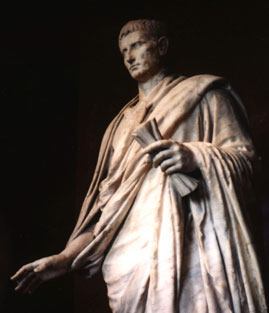
Image: Gaius Octavius, disguised as a conservative senator.

Senin, 19 Oktober 2009

Le Siècle de Libanios : littérature, culture et société du IVe siècle après J.-C. dans l'Orient méditerranéen

On the off chance one of my readers has both a reading command of French and an interest in the cultural, political, and intellectual life of the late 4th century AD, I include this link. Have fun, o lucky reader.

Minggu, 20 September 2009

Book review Sunday: Europe's Barbarians AD 200-600, by Edward York

Leonard Lipschutz over on MEDIEV-L contributes this:
Last month Edward James, author of The Franks (1988) published an outstanding new scholarly work, Europe’s Barbarians AD 200-600 (2009). The first chapters provide an up-to-date chronological survey, and analytical chapters expertly review current debates, on ethnicity, archaeology, reception by Rome, migration, assimilation, conversion and government. The bibliography is super.

At p. 50 he calls movements of Visigoths and Vandals, movements of “barbarian peoples,” showing reluctance to depart completely from old paradigms. But in the analytic portion, at p. 172, he caves in, stating: "My own conclusion would be that the break-up of the Western Roman Empire occurred because, in the different provinces, local populations began to give their allegiances to local warlords, rather than to the emperor, because those warlords were more effective as protectors and patrons. Not all these warlords were barbarians, but the majority were, because of the domination of barbarians within the Roman army." At the end of the book he states that he has not addressed directly the role of barbarians in the collapse of the western empire. Indeed, he does avoid saying anything about Heather’s Huns thesis. But James seems to anticipate further paradigm changes than he has conceded: "We tend to laugh or sneer at the simplicities or distortions of past views of the barbarians; sooner or later, this will be the fate of this book too."

Regarding ‘warlords’ it would be helpful to have a bold admission that the original forces of Alaric, Geiseric or Clovis, usually described as peoples or tribes, were in fact mercenary armies recruited on Roman soil and named for the ethnic origin of their leader. Regarding ‘the break-up,’ most likely it was not Huns, but a Roman struggle for power in 405 that set off a series of events leading directly to the break-up. When Stilicho finally hired Alaric, in that year, to support his intended attack on the east, the great eastern minister Anthemius responded in kind by hiring Radagaisus and Godegisil to raise armies in Pannonia and create a diversion in the west. Goffart made such a suggestion on p. 79 of Barbarian Tides (2006), and I think that interpretation will ultimately prevail.


Edward James' The Franks was a really good book which I would recommend to anyone with an interest.

Jumat, 26 Juni 2009