Mohenjo Daro is one of the sites associated with the very ancient Indus Valley Civilization, which is roughly contemporaneous with the earliest Mesopotamian civilizations. They had writing but we can't read it. Thus when somebody decided to produce a movie, named Mohenjo Daro, about this long-ago era, they had to make just about everything up. The news here is that they seem to have done a good job! At least according to AE Larsen, a scholar who runs a historical movie blog An Historian Goes to the Movies . Have a look at the trailer above. It's gorgeous! Oh, yes, Larsen reminds me that the remake of Ben Hur is imminent. It looks good, too.
Tampilkan postingan dengan label movies. Tampilkan semua postingan
Tampilkan postingan dengan label movies. Tampilkan semua postingan
Sabtu, 20 Agustus 2016
Selasa, 28 April 2015
The new Avengers movie: How your studies in Late Antiquity helped you understand Joss Whedon's plight
This is wonderful, wonderful. Thanks, Salon and Mr. O'Hehir:
It might be accurate to say instead that superhero cinema has reached a decadent plateau, a long-term steady state of self-nourishing bigness and reverberant meaninglessness. Whedon moves on from the Marvel empire not as its Augustus or its Spartacus, but more like one of the later, non-terrible Christian emperors who won some battles, made some reforms and convinced everybody that the glory of Rome would endure forever. Was it worth doing? That depends on what you think of Rome.
Senin, 24 Maret 2014
The Square (2013) – an intense look at the Egyptian revolution

The Square (meaning, Tahrir Square) is an Egyptian movie that follows several people from Cairo through their political journey through the recent upheavals in their country. The filmmakers caught several eloquent and serious people to be their subjects, to show through their debates and ruminations what kind of different ideals have been present in this remarkable historical moment.
I have been thinking recently that nobody knows what's going on in Egypt, and I feel that more strongly now, if a bit more hopefully. All the possibilities are there, good and bad. And if you ever thought that people outside of "the West" could not possibly understand democracy and human rights, here's your refutation.
Of course there are no guarantees that they will achieve a worthwhile democracy, but many of them know that they want it and it's not so different from what many people in Canada and elsewhere want.
As of today The Square is available on Netflix and I highly recommend it.
Jumat, 17 Agustus 2012
Nevsky, by Ben McCool and Mario Guevera
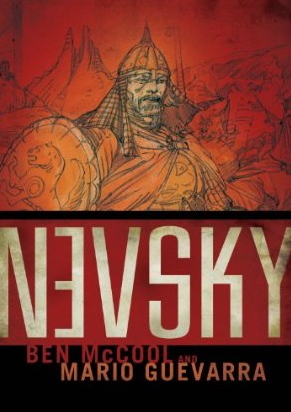
In our time artists have a lot of choices of which genre they will use to tell stories that inspire them. One common strategy has been to take tales that originate in comic books or graphic novels and fill them out by using all the resources of the movies. The Marvel superhero saga dominates film production these days. A somewhat different example can be seen in the transformation of a popular graphic novel,300, into a film whose artistic roots are unapologetically in comics.
Here we have an example of other artists going the other direction: taking an epic film and turning it into a book that can be held in one's hands. I would be interested, sometime down the pike, to know how successful, commercially and artistically, this project is, how popular it turns out to be with the target audience.
This is certainly a labor of love. It is a faithful rendering of the 1938 film Alexander Nevsky, one of the most famous products of Sergei Eisenstein's filmmaking genius. There is no effort to disguise how much the authors owe to the original version of this story. In fact, quite a bit of space is devoted to telling the reader about both the historical Alexander Nevsky and his interpreter, Eisenstein.
Alexander Nevsky was a 13th-century Russian warrior who was remembered for fighting for Mother Russia against two dangerous enemies, and East (the Mongol Golden horde) and West (the Teutonic Knights). In the late 1930s the story seemed both relevant and useful to Eisenstein and the Soviet regime that employed and often abused him. Japan loomed in one direction, Nazi Germany in the other. Whatever the facts of the historical Nevsky, he was needed as a symbol of Russian/Soviet determination in the face of daunting odds.
A story of great courage and heroism defeating treason and cruelty was right up Eisenstein's alley. If you like your heroes unsullied and your enemies black as black can be, Eisenstein is your man. The successful conjuring up of such figures makes the movie unforgettable once you see it. And the stark contrast is clearly what has inspired the two creators to take on this remarkable project.
Of course, the success of Nevsky will depend to a very great extent on its artistic appeal to aficionados of the genre. I'm not really in that crew. To my eye it looks pretty good. The art combines rich colors, heavy shading, and the occasional use of odd angles to emphasize some aspect of a scene.
I have to wonder whether this book will result in a new audience finding Eisenstein's films.
Senin, 30 April 2012
Love scenes from Egyptian cinema, 1920s to 60s
Not exactly puritanical:
From Arabist.net with this commentary:
From Arabist.net with this commentary:
A wonderful video in the context of calls for strict censorship in state television and cinema in Egypt. More generally speaking, some of these kissing scenes from the 1940s-60s are more passionate than many scenes of the last 20 years.
Minggu, 25 Maret 2012
Panem Spring

I have become more sensitive to the difference between acceptable and extraordinary editing of video, and how much it affects the final work, and this film was clearly going to be first rate in that department.
And as the film went on, it had acting that was so good that it wasn't like acting at all.
And it was full of references, obscure but coherent, to the history of the future, that made it seem real.
(For instance: the representative from the Capitol wants the assembled people of District 12 to applaud the Tributes, but the people give a silent salute that surely, surely goes back to the original rebellion. This, people, is why you have the original author involved in the making of the film.)
One theme that really hit the mark for me was the attention paid to the back-room deals that had as much affect on the outcome as the actions of the contestants or the outright manipulations of the people who ran the Games.
I've read lots and lots of SF dystopias not amazingly different in principle from this story, but this was really fresh and artistically successful nonetheless.
Side note: Did anyone else find it rather pathetic that one of the chief technological wonders hogged by the Capitol ruling class are trains that are no faster than ones that already exist on other continents? Not to mention the dependence on coal...Clean Coal, no doubt.
Senin, 16 Januari 2012
A Scandal in Belgravia

Kamis, 08 Desember 2011
End of term anxiety? and historical movies

Today was the last class meeting this term for my course on the History of Islamic Civilization. It was the due date for a term paper, too. So many students had asked for one or two day extensions that I rather expected a very low attendance and very few papers handed in. (I actually don't mind giving extensions, not when I've heard credible reports from numerous students that they are swamped at end of term.)
Imagine my surprise when the vast majority showed up with essays in hand! Was it just end of term anxiety that made them think they needed those extensions?
The class did me the courtesy of watching one of my favorite movies, The Man Who Would Be King (1975), which I used in place of a lecture on "the West's advantage," i.e. what factors led to European dominance of the globe by the 19th century. The movie doesn't really have much profound to say about that subject, but it has its virtues, besides being fun. First, it portrays the confidence (arrogance?) that Westerners eventually enjoyed, and implies the lack of confidence that might inflict the people on the other side of the confrontation. Second, after lots of discussion of the rise and fall of Middle Eastern and Central Asian empires in the course of the term, the class got to see a dramatic, schematic depiction of the rise of one tiny empire.
I have a short list of movies in my head which I think of as "history as it really works" or "what you won't learn from your classes or textbooks." These are not necessarily realistic historical movies -- prominent on the list is The Life of Brian -- but they do cut through the crap, or at least provide an opening for a laugh of recognition of some truth or other. The Man Who Would Be King could easily encourage more mythological thinking as anything else. It's a movie about Freemasonry, for goodness sake. But for its tracing of the rise and fall of "Uta the Terrible," and for the figure of Billy Fish, it makes my list of movies that have something to say about history.
Jumat, 18 November 2011
Dog sweat!
The very occasional blog IranWrites reviews the movie Dog Sweat.
...
Not long into the film, I felt that I had an urge to scream, “Say something for God’s sake!” when immediately the facial expression of an actress shuts me up, saying, “What is there to say. Don’t you see?”No, I don’t see if there is no talk, no laughter, no crying, no discussions, no debates, no complaints, no questions, no answers, not a single complex sentence. But why?“We are in strange land my dears, where language has gone through a massive transformation. Language as the medium for communication has lost its function where communication has lost its place in the society and culture, where the efforts are made to hide rather than reveal, where one must divert rather than to direct, where one has to misguide rather than to guide; then words are better forgotten if one has to lie,” I’m whispering to myself.Lips do not kiss, hands do not touch, gazes are afraid to connect. It is not restraint but hiding. There is no need for censorship since there is not even any desire for of any sort expression. There is still an outcry for an “empty nest,” an empty room, a dangling key to an empty apartment. It seems that finding “that key” is the ultimate goal, though I’m not so sure that there is anything but darkness behind the closed door. Even passion is absent …But little by little, I learn to hear them. I learn their language. It is very simple, their facial expressions, sweet faces with bitter and sad expressions, tell us of boredom, aimlessness, hopelessness, very gently and good-naturedly. But beneath those bitter expressions on those faces, those cold faces, those deadly silences, one can see the residue of some drive, of some hope and some faint and colorless shadow of something that might once have been a dream or fantasy.They narrate their own story, as if the film were a documentary and had been made spontaneously, with actors and actresses, without script, on stage thriving to tell their stories. It seems they have something to say only if they find someone to listen, if they feel safe, if they find privacy, if they know how....
Rabu, 26 Oktober 2011
A taste of Bollywood
I think I've posted this here before, but it is worth repeating. You may want to turn on the captions.
Sabtu, 19 Maret 2011
Sherlock (2010)

Image: Benedict Cumberbatch as Holmes.
Minggu, 02 Januari 2011
Agora (2009)
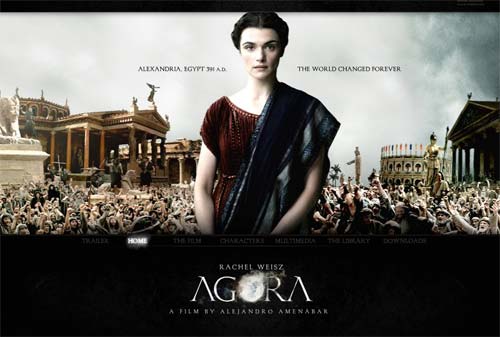
This is a seriously good movie.
I haven't heard much unmixed praise for this film, not a lot of commentary at all, and I think it deserves better. So here are my observations.
You should know that the story concerns the 4th century Alexandrian philosopher Hypatia. As a woman philosopher she was an oddity, as an educated pagan she lived in an increasingly hostile environment. Alexandria was a major center for both Christians and pagans, and the two groups were competing for control of the city. The Christians were winning -- they had the support of Theodosius, the eastern emperor who eventually banned pagan observances. The conflict in Alexandria was quite violent at times. This is one of the times that the Library of Alexandria, a pagan institution, is supposed to have been destroyed. More certain is that Hypatia attracted the hostility of the Christian party, and was killed by a mob. It's a depressing story, and one that could easily be butchered.
There are three important aspects to the movie. One is its degree of success in evoking late fourth-century Alexandria. I give Agora very high marks indeed on this. Visually, the evocation of the city, with its mixture of Greek and Egyptian elements, is stunning and flawless. The dialogue likewise does nothing to throw the viewer back into the 21st century, while avoiding pseudo-historical cuteness. That is a harder trick than the mere statement might indicate.
Second is the depiction of the religious conflict between Christians on one hand and Jews and pagans on the other. This is certainly what has made distributors very reluctant to show Agora in most of North America, because the Christians don't come out of it looking good. I, however, have read a lot of late ancient ecclesiastical history, some fair amount of it on the turbulent Alexandrian developments of the era, and I found this account believable. Rioting monks were a staple of Alexandrian religious life, even in purely intra-Christian disputes.
Third is the scientific story. The film proposes that Hypatia came to reject the Ptolemaic view of an earth-centered universe, with the complex series of epicycles to make planetary movements correspond to the predictions of Ptolemy's theory. Instead, says the movie, she became convinced that a more elegant solution was possible, a heliocentric one. Because predictions based on circular orbits won't work, she, like Kepler, comes up with the notion that planets moved on elliptical orbits.
I don't think that there is any evidence that Hypatia did any of this, but that doesn't bother me. But I was sure before I saw Agora that the filmmakers would do a terrible job of this part of the film.
They didn't. Indeed, that part of the plot works very well indeed. Hats off to them. And particularly to the bright guy or gal who suggested intercutting images of the Earth from space in a few appropriate places.
This is a serious, good movie.
Kamis, 30 Desember 2010
Mongol: The Rise of Genghis Khan (2007)

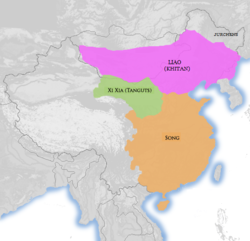
If the fall of the Tangut kingdom is your emotionally resonant moment in history, this is the movie for you. A combination of Russians, Mongolians, Kazhaks, and Germans have invested a lot of money and talent on the intuition that there are millions of moviegoers just like you.
Just in case you have never heard of the Tangut kingdom, this destruction, if you believe the movie, was the turning point in the early life of Genghis Khan. Its destruction begins and ends the movie; in between there is a rather curious account of the early years of the great conqueror, when he is repeatedly betrayed, defeated, robbed of all his meager wealth, and enslaved. The only positive elements in the story are his relationship with his wife, and his relationship with a blood brother who is not always on his side. Oh, he is also faithful to the Mongol code, which other people give lip service to but ditch whenever it is convenient. Thus Temugin's (Genghis' ) rough early years. He plays by the rules, everybody else cheats. But don't worry, he will undoubtedly return in a later movie (if financing is available) to teach the Mongols law. In the meantime, he looks soulful, and does not send away his wife, whom he chose when he was nine, even though there is a reasonable doubt about the paternity of her son. (She was kidnapped by his enemies and who knows what happened then.)
A whole bunch of cultural buttons are being pushed here, but if you're not a Central Asian it's not exactly clear what they are.
This may come across as a negative review, but actually it is a well made movie. It's just not Robin Hood. For the non-Central Asians among us, the most remarkable feature of the film may be the vast landscapes which fill the screen for the entire two hours.
Minggu, 26 Desember 2010
Selasa, 26 Oktober 2010
More on St. Crispin's Day

Jumat, 10 September 2010
Original mind at work
Anyone can burn a book, or threaten to. How many can write stuff this good?
Selasa, 03 Agustus 2010
Agora preview
John Emerson alerted me to this. Could it be any good? Could it stir up a huge controversy?
Rabu, 16 Juni 2010
Fellini's Roma (1972)
I haven't seen a lot of Fellini movies, and I certainly missed this one when it first came out. It may be just as well -- I don't know if I would have appreciated it back then. A couple of nights ago, on the other hand, I found it mesmerizing, something I had to watch and enjoyed watching just as a fascinating object. Such movies had more appeal to me than when I was younger.
One does not have to be a genius to see that there must be a large amount of autobiographical reflection in this movie. There are scenes that might be from Fellini's childhood, More from the wartime era, and quite a few from 1972 or thereabouts. There is no plot, just a certain number of realistic but satirical scenes and others that are more fantastic.
One scene I could not find on the web somebody described to me long ago. I was glad to finally see it. The camera follows an official through the perpetually under-construction Roman subway system, during which he complains about how hard it is to make any progress when there are so many archaeological finds in the way, some of which are so significant that the tunnels have to be rerouted. Then the workers detect a great hollow space along the current route. They break through into the space and find it is a Roman villa whose walls are covered with brilliantly preserved paintings of Roman men and women. And then... and then... as workers and officials and out-of-town visitors all watch, the outdoor air corrodes the paintings, and they suddenly and completely disappear.
Then there is this indescribable scene::
This movie also had a lot of shots of the richest and cleanest and most spectacularly dressed hippies I have ever seen, hanging around the fountains of Rome (and in one scene being beaten up by cops while older rich people watch). Were they for real?
Senin, 14 Juni 2010
A clip from Teodora, imperatrice di Bisanzio (1954)
The legends of the Empress Theodora were pretty extreme back in the 6th century, back when she was alive. But you can always count on a modern filmmaker to add more:
Here's another short piece:
The actor playing Theodora was Wilma Aris; I don't know who played Justinian, but he looked the part.
Thanks to Paul Halsall for the tip.
Here's another short piece:
The actor playing Theodora was Wilma Aris; I don't know who played Justinian, but he looked the part.
Thanks to Paul Halsall for the tip.
Rabu, 19 Mei 2010
Robin Hood (2010)
 Here is a joke that I heard the Kalamazoo conference.
Q. A bunch of medievalists go to see Robin Hood. How many of them bitch about the inaccuracies?
A. twice as many!
I was not particularly in a hurry to see this film and I wasn't excited about it, because I have seen so many versions of Robin Hood. On the other hand I am a sucker for Ridley Scott films, and members of my family went while I was in Kalamazoo and told me that the movie was very entertaining. I decided to go today. And I found that liked it quite a bit.
If anybody reacts to this post at all, I expect that some of them will exclaim, "what about King John burning Magna Carta?" Well, one can say that he sort of did, didn't he? Just not literally, and not while all his barons were standing around looking at him. I'm just glad Magna Carta got into a movie in the first place, even anonymously. Name another medieval movie where Magna Carta is mentioned. Go on, I'm waiting.
Here in point form are some things I really liked about this actual as opposed to the ideal Robin Hood movie.
- Like Kingdom of Heaven, the whole thing had the air of reality when it came to material objects, clothing, armor, and landscapes. Anybody who knows anything about what people wore in the time of King John to point to many details that were wrong, but the feel of the thing was very good.
- Some of the panoramic views, especially of the ships, were very good; actually better than that.
- It had more than one woman it in a speaking role, , and none of them were androgynous, mysterious, hardly human beauties like the android in Blade Runner. Came close to this standard. For Ridley Scott, this shows a certain amount of restraint.
- One of the best interpretations of Marion in any Robin Hood. Of course I'm influenced by the fact that Cate Blanchett played the part, and she has that filmmaking genius which makes almost any part better and strangely convincing.
- Loved the the surprise ending. I guess Ridley Scott knew that I didn't want just another run through the traditional post-Walter Scott story.
- A lot of people went around speaking French at appropriate times.
- Robin Hood in Barnsdale stood.
Oh yes, the music was the usual British folk takeoff, but I love that stuff and it was was well done. Great Big Sea rules!
Update: I forgot William Marshal! Is this his first appearance in a big-time movie, or was he in Lion in Winter? If he was it was a small role.
Langganan:
Postingan (Atom)
Weekly
-
This announcement speaks for itself: Dear Colleagues, After two decades teaching medieval art history and doing photography for my own use,...
-
From the Guardian: Leading foreign academics from the LSE acting as expert advisers to the UK government were told they would not be asked ...
-
A new translation of this fascinating treatise on horsemanship by a fifteenth-century king. This interview with Jeffrey Forgeng comes from...
-
 ...if you are very, very rich. (Most mss. of this age and quality are in national or university libraries and are not for sale at any price...
-
For those who found the conclusion of this post rather cryptic, here is what Bernard of Clairvaux said in his treatise In Praise of the New...
-
I have always loved maps and history. Growing up in the USA in the early 60s, the Southeast Asian war gave me the opportunity to learn geog...
-
Two experts in the Middle East have been more useful to me than most of the more prominent ones. They are Juan Cole and Joshua Landis. If yo...
-
An excerpt from a recent book,Thanassis Cambanis’s Once Upon a Revolution: An Egyptian Story : A few days after the end of Ramadan, on Aug...
-
I just discovered this book, which came out a couple of years ago, thanks to Brad DeLong, who provided a link to a pre-print to chapter 9, ...
-
During my years with the Good Duke I have run across a number of surprising and amusing personal names: Bliomberis Loup and his brother, fo...