During my years with the Good Duke I have run across a number of surprising and amusing personal names: Bliomberis Loup and his brother, for instance (follow the "names" label to find him).I don't recall this classic name of an English knight involved in the Duke of Lancaster's chevauche in 1373:Sir Jean Bulle.
Tampilkan postingan dengan label Middle Ages. Tampilkan semua postingan
Tampilkan postingan dengan label Middle Ages. Tampilkan semua postingan
Jumat, 31 Maret 2017
Jumat, 17 Maret 2017
Did the Irish save civilization? The reviewers of the Medieval Review weigh in
 The Medieval Review Flechner, Roy, and Sven Meeder, eds. The Irish in Early Medieval Europe: Identity, Culture and Religion New York: Palgrave Macmillan, 2016. Pp. 288. $39.99. ISBN: 978-1-137-43059-5. Reviewed by Alexander O'Hara University of St Andrews alexanderjohara@gmail.com
 One needs to be wary in reading and assessing this book. There is much good in it with some fine contributions, but it is deeply flawed.The editors Roy Flechner and Sven Meeder seek to debunk so-called myths: in this case the influence of Irish monks and scholars in early medieval Europe.In a previous publication, Flechner suggested that Saint Patrick was a tax dodger, arguing that he came to Ireland as a tax exile to avoid the fiscal burdens his decurion father would have bequeathed him. Flechner manages to sound convincing despite the fact that the imperial tax system was obsolete in Britain by the time Patrick came to Ireland, while blithely dismissing Patrick's own testimony in his two surviving written accounts. We see a similar deconstructionist vein at work in this volume which seeks to present "an academization of the debate" vis-à-vis the more gullible work of previous scholars of a "bygone golden age when religious piety and intellectual endeavor could coexist happily...one would like to steer away from crippling biographical reverence and engage in some debunking of myths" (1). The first myth to be debunked is that of the image of Ireland as an island of saints and scholars, which the editors claim only gained currency from the seventeenth century onwards and which they pass off as an early modern phenomenon. This is false. Already from the seventh century Irish monks who travelled to the Continent were self-consciously shaping this image of their homeland. It can be seen in the poem on Ireland, written probably by one of Columbanus' Irish monks, which the Italian monk Jonas of Bobbio inserted at the beginning of his Life of Columbanus and in Jonas' comment that the Irish flourished in Christianity more than any other people. The perception of Ireland and the Irish as a holy island and people can be followed like a thread from Jonas to Bede's comments on Ireland at the beginning of his Ecclesiastical History to Ermenrich of Ellwangen's riff on Bede's comments in which the island is presented as an allegory of the universal Church and in the poetry of Irish religious émigrés like Colman nepos Cracavist and Bishop Donatus of Fiesole. The perception of Ireland as an insula sanctorum was not invented by seventeenth-century émigré Irish Franciscans or by nineteenth-century Catholic revivalists, but is a perception that we find already in the early medieval sources. Despite the agenda of the editors, the volume is saved by some fine contributions. The scope of the volume is comprehensive with short chapters (indeed the brevity of the chapters is one of the laudable features of the book, as is its affordable price) that encompasses communication networks, religious exile, Irish monasticism on the Continent, especially in relation to Columbanus, biblical exegesis, penance, the liturgy, science, scholarship, ethnicity, and book production. ... Meeder's bizarre statement that insular influence at St-Gall was minimal, is also found in his co-authored chapter with Roy Flechner where they write about the abbey of St-Gall that: "it does not appear that the Irish origin of their patron saint was a significant factor in the institutional identity of the abbey" (203). One wonders what sources they have been reading, given the rich hagiographical corpus on the patron saint that survives from the early medieval community. One need only read Walahfrid Strabo's Life of Gall, Notker Balbulus' Martyrology, or Ermenrich of Ellwangen's Letter to Abbot Grimald to realize that Meeder and Flechner present not only a false impression of the source material, but a skewed and inaccurate interpretation. Also problematical are their comments on Columbanian monasticism. Their statement that the Luxeuil monk Agrestius "made slanderous remarks about fellow Irish inmates" (195) is nowhere found in Jonas' Life of Columbanus--Agrestius attacked the monastic practices and the legacy of Columbanus, not the Irish monks, most of whom had left for Bobbio with Columbanus upon his expulsion in 610. Similarly: "the Gallic episcopacy is depicted as hostile both by Columbanus and his hagiographer Jonas. In the rhetoric of the hagiography and of Columbanus's letters...the Easter controversy is portrayed as a major bone of contention" (198). While this is true for Columbanus's letters, it is not true for Jonas, who mentions nothing about the Easter controversy, because it had been such a contentious issue, and is careful not to overtly criticize the Gallic episcopacy as they were now key patrons of the communities. The trajectory of Gallic monasticism prior to Columbanus gave no indication that a revolution in monastic foundation would take place in conjunction with secular elites in the second half of the seventh century and their attempts to play down Columbanus' role as a catalyst in this regard is unconvincing. While social trends and the formation of new elites at this time complimented and facilitated the new wave of monastic foundation, it was by no means an inevitable development without the influence of Columbanus and his Frankish monastic successors. Indeed, running throughout Meeder's and Flechner's chapter is subtly disguised racism masquerading as historical objectivity which can be detected in such remarks as "hard to swallow for some proud Irishmen", "we meet another proud Irishman" (205), the aforementioned "Whether originality, when it is present, can be directly linked to a scholar's Irish heritage is a matter of contention" (240), and in their attempt at every opportunity to minimize the distinctiveness of Irish influence on the Continent. Their eagerness in debunking myths leads them to questionable historiographical methodology and a failure to engage with the sources on their own terms. While there is much to recommend in this book, it needs careful handling, as I hope this review has shown.Image: I'd guess that this is a maximalist view.
Jumat, 10 Februari 2017
Chivalry and the Ideals of Knighthood in France...by Craig Taylor
 By coincidence I am reading this book for the second time, just as this review from the Medieval Review comes out. I highly recommend the book. Craig Taylor is always good. Taylor, Craig. Chivalry and the Ideals of Knighthood in France during the Hundred Years' War. Cambridge: Cambridge University Press, 2013. Pp. 345. £82.00(hb); £21.99(pb). ISBN: 978-1-107-04221-6. Reviewed by Thomas K. Heebøll-Holm University of Southern Denmark thee@sdu.dk The story of French chivalry and its miseries during the Hundred Years' War is an ever fascinating and puzzling one. With this book Craig Taylor breaks important ground by showing how much French knighthood in this period was shaped by and, in turn, shaped developments in the chivalrous ideology as well as by the changing military reality of the fourteenth and fifteenth centuries. While indebted to Maurice Keen's and Richard W. Kaeuper's studies of high and late medieval chivalry, Taylor refines these paragons' more general studies of medieval knighthood by concentrating on a specific time period and region, namely Valois France during the Hundred Years' War. France during this time period is especially fertile ground for such a study. Not only was it the epicenter of chivalry, but during the Hundred Years' War the French knighthood experienced a number of military catastrophes which forced French warriors and writers to critically examine and discuss the causes of these calamities and how one could remedy them. This debate is a treasure trove for historians looking to get a firmer and more nuanced picture of the muddled concept of late medieval chivalry. Indeed this concept is one of those that all think they know and consider to be simple, yet upon closer inspection find confusing, slippery and self-contradictory. It is an immensely demanding task that Taylor has undertaken. It is also one which he resolves splendidly. Taylor approaches the topic by a combined study of the practice and ideology of knighthood as it appears in various types of late medieval narratives such as chansons de geste, biographies, didactic manuals and political, legal and moral treatises. Through nine chapters (including an introduction, a chapter on the texts and their context and a very brief conclusion) Taylor takes the reader through seven core values of French chivalry during the Hundred Years' War. These were honor, prowess, loyalty, courage, mercy, wisdom and prudence. While these have been separated for pedagogical reasons, Taylor immediately acknowledges that they were not isolated values, but should be seen as part of what I am tempted to call the chivalric kaleidoscope. They were interdependent and inseparable parts of a whole. However the weighing of the relative importance of the values changed with the individual writer's personal convictions and situation as well as his/her specific historical context. In the introduction, Taylor presents and discusses the guidelines of his study. It is interesting to note that the late Middle Ages presents a new phenomenon in medieval literary production, namely that the knights themselves begin to write down their own experiences of chivalry and war. While this certainly does not remove the classic problem of to what degree medieval writing was dictated by genre conventions and socio-cultural expectations, it at least brings us closer to the military experience of the warriors, and Taylor's take on this problem is both prudent and thought provoking. These texts reflect not only practical changes in late medieval martial culture. They are also a goldmine for the historian as through them we gain access to the combatant's thoughts and recollections (flawed and biased as they may be) instead of having to rely on ecclesiastical middlemen who may have had neither interest in, or knowledge of the practical reality of knighthood. A topic which Taylor pays particular attention to is the medieval debate over chivalry and the right behavior of knights and men-at-arms. Essentially this debate came down to the difficult question of how to reconcile a proud military ethos and aggression with Christian values of humility, piety and salvation. Taylor makes the important remark that texts do not just mirror reality. They also have an influence of their own and thus enter a reciprocal relation with social reality, where texts form men and men write texts. In the following chapter "Texts and contexts," Taylor concentrates more narrowly on the historical and literary context of the narrative sources analyzed in the book. Contrary to the practical and structural reasons for the French defeats as presented by modern military historians, contemporary writers argued that the reasons for the defeats were cowardice and moral laxity due to the corrupting effects of court life (among others). Consequently, they advocated for a reform of the mores of the knighthood especially by the adoption of the values and discipline of the Romans of antiquity. This emphasis on the Romans was, as Taylor shows, in no small part due to the fact that many writers implicitly or explicitly served royal Valois interests. To these kings, the Roman models of chivalry that focused on self-sacrificing loyal service to the sovereign and the commonweal were echoed in the military reforms from Charles V onwards--and vice-versa. In chapter 2 Taylor deals with the central issue of chivalric honor. On the basis of philosophical, anthropological and historical theories of honor, Taylor produces a good and nuanced discussion which is firmly grounded in contemporary sources and contexts. In particular, the chapter contains thought provoking discussions of the relationship between masculinity and knightly honor and between honor and reputation. As Taylor shows, there was a continuous and reciprocal interplay between the chivalric values of society and those of writers of chivalric reform. He furthermore refreshingly argues that honor is not merely a societal tyranny of expectations and values. Rather, individuals knights can and do have agency. By their actions they entered a continuous (re-)negotiation of chivalric values with society. Chapter 3 deals with what Richard W. Kaeuper has termed "the fundamental quality of knighthood," namely prowess. [1] As with honor, prowess is a difficult concept to grasp, not least because it, to a large extent, was propagated by writers with no personal experience of war. Moreover its portrayal of the brutality of war was dominated by genre over reality. Indeed, at the heart of prowess lay violence--just when used in the service of a higher cause (ideally crusades, but increasingly also in service of king and country), but criminal when used by lower orders against their superiors. Unfortunately most medieval war lay in the grey area between these two, and interestingly Taylor combines this discussion of right prowess with the one on loyalty. Here it seems that contemporary Frenchmen drew inspiration from Roman military ideals where the loyalty to commonweal and crown could discourage acts of vainglorious prowess as only actions against the common enemy ought to be considered as "true" honor conferring prowess. The cousin of prowess, courage, is discussed in chapter 4. While written sources discuss these issues, they are difficult to use in historical analyses and they are very much dependent on conventions and literary stylings. Moreover they serve various practical issues such as encouraging group cohesion, leadership and discipline. In this chapter, Taylor touches upon the possibility of doing emotional history in regards to medieval warriors, but reaches the safe, if somewhat conservative conclusion, that emotions though characterized by universal triggers in their display of emotions are not human constants, but rather wholly shaped by society and culture. To this reviewer, this discussion is a bit lacking as Taylor flirts with but eventually shies away from the possibility of conducting emotional history on the basis of these sources. Though he acknowledges the promising prospects of studying the antonyms of courage, fear and cowardice, Taylor in the end resigns himself to a fleeting treatment of these two. Chapters 5 and 6 deal with mercy. In chapter 5 the topic is mercy towards other soldiers while chapter 6 concerns mercy towards civilians and non-combatants. In regards to soldiers, Taylor provides an important corrective to the romantic notion that knights spared each other out of feelings of chivalry and nobility. Rather knightly mercy towards peers was the result of the prospect of rich ransom-money. Moreover, more lowly soldiers could not expect spared since they could not pay for their liberation and in fact were reviled by the nobility. In regards to civilians, treatment was also mostly dependent on social status. While theologians and priests celebrated restraint and mercy towards civilians, the fact remained that most medieval knights treated their social inferiors with disdain. Furthermore, structural problems lay behind the more general and continuous pillaging and ravaging of soldiers on civilians. Simply put, lack of pay caused soldiers to prey on civilians. Though the Valois kings repeatedly tried to enforce discipline in the royal armies, by 1450 Charles VII's Compagnies d'ordonnances were still reputed to be mostly manned by ruffians and pillagers. Chapter 7 deals with the virtues of wisdom and prudence. In the research these virtues have traditionally been seen as the antithesis to knightly ones, yet Taylor admirably proves wrong. Chivalric culture in fact placed great emphasis on age, experience and prudence and many contemporary writers were openly critical of rashness and inexperience. Moreover, during the fourteenth and fifteenth centuries more and more French commanders collected written accounts of the experience of veteran warriors (contemporary as well as Roman) thereby suggesting a greater interest and emphasis amongst them for written advice. In regards to this, Taylor suggests that this rising interest was due to the defeats the French suffered in the Hundred Years' War. Interestingly, Taylor observes the same phenomenon in England in the 1440s when English reversals of fortune in earnest set in. This chapter is followed by a brief concluding chapter that sums up the book's major results. This is an impressive book. One of its most important contributions is its demonstration of how inspiration from the Roman Empire was by no means an isolated Italian "renaissance" phenomenon. Throughout the book, Taylor demonstrates how these ideas came to the fore in France simultaneously with Italy and how they influenced and indeed pushed chivalric ideals from a more Arthurian, "feudal" model to a "republican" Roman one. Although imperial Rome had long been one of many ideals for the European knighthood (see for instance John of Salisbury's Policraticus), then the roving bands of routiers and self-serving knights in the late middle ages caused a yearning with many writers for this Roman republican ideal of fighting for the commonweal as the highest honor for a warrior. Another feat that Taylor should be lauded for is his insistence on treating the narrative source material in its historical context. This means that Taylor studies chivalry as a dynamic genre responding to current situations instead of a fossilized monolith--as it is all too often treated in research as well as in many popular presentations. If I were to voice one criticism, it would be that, although Taylor discusses the complicated issue of routiers and their relationship with and role in chivalric ideology, his treatment of this issue is never quite to the satisfaction of this reviewer. While they on the one hand were part of the chivalric elite then at least a number of the English routier captains were indisputably of non-noble background--a fact that profoundly disturbed writers such as Jean le Bel and Geoffroi de Charny. However, this is a really minor issue. In sum, this is a piece of impressive and lucid scholarship. It is well written and presents a refreshing discussion of chivalry, war, society and literature in late medieval France. Furthermore, it is also pedagogical. This reviewer has used the book with considerable success in his teaching. Thus not only do I recommend it for its research qualities, but also for its approach to a topic that is in fact much harder to grasp for students than they usually anticipate. This book ought to be consulted by anyone interested in late medieval chivalry in ideology as well as in practice. -------- Note: 1. Richard W. Kaeuper Chivalry and Violence in Medieval Europe (Oxford: Oxford University Press, 1999), 130.
Kamis, 26 Januari 2017
Courtesy
I have been talking recently to several people who share my interest in the chivalric virtues of courtesy and franchise. My methodology has been pretty crude, largely restricted to looking at scholarly dictionaries in English and French, and reflecting on my own experiences of those languages (but mainly English).
It makes sense to me to trace courtesy back to "court" meaning an enclosed space, a farmyard or a courtyard. The same word designates a judicial institution, so the court is an enclosed space under the control of some kind of superior authority. Go back to that recent article on the British kingdom of Rheged and the reconstruction of its capital in northwestern England. There is exactly one building in that royal settlement that is big enough to have a court(yard).


Court can also mean the business that takes place in such a space, or the institutions that provide the context for legal business.
But legal and political business are not the only things that take place in an enclosed space under superior authority. The people who have such authority also have the wealth and prestige to support a distinct culture. Says Froissart in his description of the court of Foix:
David M. Parry would have us think about court culture in connection with Trump. Is America growing a court culture? Ask Alexis de Tocqueville. (Someone worth reading any time if you haven't done so already.)In short, everything considered, though I had before been in several courts of kings, dukes, princes, counts, and noble ladies, I was never at one which pleased me more, nor was I ever more delighted with feats of arms, than at this of the count de Foix. There were knights and squires to be seen in every chamber, hall and court, going backwards and forwards, and conversing on arms and amours. Every thing honourable was there to be found. All intelligence from distant countries was there to be learnt; for the gallantry of the count had brought visitors from all parts of the world. It was there I was informed of the greater part of those events which had happened in Spain, Portugal, Arragon, Navarre, England, Scotland, and on the borders of Languedoc; for I saw, during my residence, knights and squires arrive from every nation. I therefore made inquiries from them, or from the count himself, who cheerfully conversed with me.
 `
`Sabtu, 24 Desember 2016
Another review of Charny's Men-at-Arms
http://deremilitari.org/2016/12/steven-muhlberger-charnys-men-at-arms-questions-concerning-the-joust-tournaments-and-war-hass/
Steven Muhlberger, Charny’s Men-at-Arms: Questions Concerning The Joust, Tournaments and War (Hass)
Steven Muhlberger
charny’s men-at-arms: questions concerning the joust, tournaments and war
(freelance, 2014) 111 pp. $25.00
Written around 1350, Geoffrey de Charny’s Questions Concerning the Joust, Tournaments and War (Les demandes pour la joute, les tournois et la guerre) consists of a series of questions – twenty relating to jousting, twenty-one to the tournament, and ninety to war – presented by the great French knight to King Jean II for the purpose of discussion among the members of the king’s new Order of the Star. As the questions found in the work remain unanswered, however, the document is often overlooked by scholars in favor of Charny’s more thorough and insightful composition; the Book of Chivalry (Livre de chevalerie). [1] Steven Muhlberger first took up the challenges presented by the Questions in 2003 with the publication of his Jousts and Tournaments: Charny and the Rules for Chivalric Sport in Fourteenth-Century France. [2] As the title suggests, the work examines only the first two sections of the text, and – but for five questions relating to jousting and the tournament – leaves the larger section on war for future comment. In this current volume Muhlberger brings his discussion of the Questions to its conclusion; but this is not merely a supplement to his earlier work. Employing his deep knowledge of medieval chivalry, the author has combined new material with a re-assessment of his previous scholarship, and the result is an enjoyable work that provides an enticing glimpse into the world of 14th Century knighthood.
Charny’s Men-at-Arms begins with Muhlberger establishing the historical context of the Questions by briefly introducing the reader to the life and career of Charny himself and the reform initiative that was the Order of the Star. He continues with the contextual discussion by showing the Questions to be part of a broader genre of writing about war; such as: Laws of Arms, Laws of War, disciplinary and administrative ordinances, etc. This latter discussion is important in helping to identify Muhlberger’s revised purpose of the Questions as being a prelude to legislation regarding the law of arms that was never enacted. (22) Chapter Three discusses the first two sections of the text – jousts and tournaments, and, as these were the core subjects of his 2003 volume, it is here that some overlap would be expected. However, Muhlberger’s re-assessment of his old discussion in light of more recent scholarship in the field – he specifically credits the works of David Crouch and Noel Fallows [3] – results in a discussion that is largely new. Older points of discussion – such as the importance of the horse – if they remain, have been edited and rearranged to fit the new narrative, with the new (questions about rank on the tourney field in light of new role of squires) and old information fitting together seamlessly.
Muhlberger’s new discussion about the questions concerning war is contained in Chapters Four through Seven. He begins with an examination of terms as a means of determining whom Charny was targeting as Men-at-Arms. Chapters Five to Seven examine the Questions themselves, and, given no answers to the queries, he uses frequency to identify what topics the Men-at-Arms thought were important. What emerges is the predominance of practical considerations; such as those involving plunder/booty or capture. Not strictly relying on frequency, however, Muhlberger also manages to identify a pattern between those above (questions which seek concrete gains or rights of warfare) and questions in which his intended audience was asked to define honorable behavior and chivalric terminology. The author’s final discussion concerns those topics (clerical sense, duels, heraldry, siege warfare) that receive little or no mention in the text. For a work like the Questions this is an important discussion as it shows its limitations, and thereby better frames the discussion and what information may be gleaned from the text itself and what may not. The volume is completed by Muhlberger’s translation of Charny. The translation is again based on the edition of Anthony Michael Taylor, but, unlike his effort from 2003, he has omitted the corresponding French text. For reasons of comparison (given the author’s new conclusion regarding the purpose of the Questions), an edition of an Ordinance of Richard II from 1385 has been included.
Overall, there is much to like about Charny’s Men-at-Arms. It is a handsomely produced and easily readable volume. The author’s translation of the original text is faultless; although there is still no information regarding the original Charny manuscripts and their dissemination. [4] Yet, it is Muhlberger’s introductory discussion that particularly stands out. Erudite, insightful, and often entertaining, he is also necessarily cautious with a text that requires deft handling. Indeed, one of his particular strengths is his recognition of the limitations of the text, and working within them to extrapolate out the considerable amount of information that he does without falling into the trap of over-speculation. In so doing he makes accessible a composition that had been overlooked and shows its merit. Moreover, this skill makes this work of particular appeal to teachers introducing students to primary texts, while at the same time contributing valuably to the scholarship of chivalry and the era of the Hundred Years War.
Jeff Hass
Franciscan University
Franciscan University
[1] Richard W. Kaeuper and Elspeth Kennedy, The Book of Chivalry of Geoffroi de
Charny: Text, Context, and Translation. Philadelphia, 1996.
Charny: Text, Context, and Translation. Philadelphia, 1996.
[2] Reviewed for this site by Andy King.
[3] David Crouch, Tournament. Hambledon and London, 2005.
Noel Fallows, Jousting in Medieval and Renaissance Iberia. Woodbridge, 2010
Noel Fallows, Jousting in Medieval and Renaissance Iberia. Woodbridge, 2010
[4] Both the production values and lack of manuscript information had received mention
in King’s review.
in King’s review.
THIS ENTRY WAS POSTED IN BOOKREVIEW. BOOKMARK THE PERMALINK.
Selasa, 06 Desember 2016
A discovery: Ilan Mitchell-Smith's Between Mars and Venus: Balance and Excess in the chivalry of the late-medieval English romance
 A friend of mine alerted me to the existence of a PhD dissertation (Texas A&M) on chivalry and masculinity. I have just had a quick look, but the dissertation touches on some subjects of great interest: for instance, medieval masculinity being more complex than a bipolar spectrum between more masculine and less. In particular, Mitchell-Smith argues that masculinity did not simply equate to violence. He also explores the difference between chivalric behavior and chivalric identity. If you are interested, you can read the dissertation online. Image: A less-obvious chivalric pursuit (but note the helm and the heraldry). From the Manesse Codex.
The value of late medieval clothing
 A review (in the Medieval Review) by Sharon Farmer of Daniel Lord Smail's Legal Plunder: Households and Debt Collection in Late Medieval Europe has this interesting fact about the value of clothing in the 14th and 25th centuries:
 Smail also concludes that moveable goods constituted a much larger proportion of a household's value than we might have expected. He estimates that in the average household of the period, moveable goods constituted about three fifths of total household wealth. Most surprising of all is the relative value of clothing items vis-à-vis landed wealth. As Smail states, "the median price of a plot of agricultural land in 1350 could be paid off with a dozen fairly nice tablecloths, and a very high-end houppelande [an outer garment] in 1420 was worth more than double the median price of a field" (60). Because small goods stored so much value, because they could be sold off or given away more quickly than a piece of land, and because they enabled their owners to display their prestige on their backs and at their tables, they came to play a major role in personal and household thesaurization.Image: from the early Dutch oil painter van der Weyden.
Jumat, 02 Desember 2016
Death by overexertion, an English duel of 1380

Some of you probably know that I am writing a source reader -- a book that combines medieval documents with modern commentary -- on the subject of judicial duels. These were considered to be the most dramatic "deeds of arms" by contemporaries and modern re-enactors are very interested in them. My book in fact was inspired by Will McLean's collection of sources in his blog, and he will be credited as co-author.
This book includes an account of an English duel between as squire,Thomas Katrington, and Sir John de Annesley. Annesley, the knight accused Katrington, who had commanded a castle in France, of treason, because, said Annesley, he had surrendered it to the French when he had the resources to defend it. After a certain amount of political back and forth among major players, including Duke John of Gaunt, a duel was arranged. There was so much public interest that the crowds who attended were said to exceed those at the recent coronation of Richard II.
An interesting point is the way the duel ended. It was said to be half an hour long, and very strenuous, with the weapons of either man being destroyed so that (I think) they were fighting on foot with daggers. They ended up both lying on the ground with Katrington on top. The question then arose, what next?
Soon after [Annesley, the knight] was raised up, without any support he eagerly went to the king, while the squire [Katrington]who had been raised, was not able to stand nor go anywhere without the support of two men; and therefore, he was put upon a chair, and he remained there quietly. The knight therefore came to the king and asked him, and his nobles, that he would grant him the grace, he should be put in the same place as before, with the squire on top of him... he realized that the squire was nearly at his last breath from the excess of [labor] and heat, and the weight of arms which had almost taken the vital spirits from him.
In the meantime the squire, lacking breath, suddenly fell off the chair, as if dead, among those who stood around him. Many therefore took care of him, pouring wine and water over the man; but nothing helped at all, until his arms and all of his clothing were removed . This being done it proved that the knight was the victor and the squire defeated. After a long delay, however, the squire's spirit began to revive, and opening his eyes he began to raise his head, and terribly began to look at all of those standing around ; when this was announced to the armored knight, (for the knight had not taken off his armor from the beginning of the fight) he approached the squire and called him a false traitor, and asked if he dared to repeat the duel. Since [Katrington] indeed had neither sense nor breath to answer, it was announced that the fight was over and that each should return to his own place. The squire therefore was soon carried to his bed, and he began to rave; and persisting in his madness, the next day, about the ninth hour, he breathed forth his spirit.
In addition, a short piece from Froissart (book III, chapter 7; also late 14th century):
A squire of Navarre was there slain, called Ferdinand de Miranda, an expert man at arms. Some who were present say the bourg d'Espaign killed him, others that he was stifled through the heat of his armour.
Rabu, 19 Oktober 2016
The Book of Horsemanship by Duarte I of Portugal, translated by Jeffrey L. Forgeng
 A new translation of this fascinating treatise on horsemanship by a fifteenth-century king. This interview with Jeffrey Forgeng comes from Boydell and Brewer's newsletter on their line of medieval history books, the Medieval Herald. Anyone interested in how horses and knights related to each other in the later Middle Ages should have a look. The Book of Horsemanship by Duarte I of Portugal Translated by Jeffrey L. Forgeng Jeffrey L. Forgeng is curator of Arms and Armor and Medieval Art at the Worcester Art Museum, and Adjunct Professor of History at Worcester Polytechnic Institute.
 Dr Forgeng, welcome back to the Medieval Herald! Coming so soon after the publication of The Art of Swordsmanship yours is by far the quickest return appearance we’ve had. Does this mean that you were working on your latest publication, The Book of Horsemanship, alongside The Art of Swordsmanship? I actually finished the initial version of the Art of Swordsmanship more than a decade ago, when I was curator at the Higgins Armory Museum. The museum closed in 2013, and its final years were very challenging for me: writing books was therapeutic, being one of the few things in my life over which I had some control. But what I couldn’t control was the pace of publication, so by the time the Armory closed I had a prodigious backlog of largely completed books. Somehow the backlog started to clear quickly after that: I had two books come out in 2015, two more this year, and I anticipate another in 2017. When did you first encounter the Livro do Cavalgar? As the curator of a collection of armor, I am naturally interested in resources that help me interpret these objects for the public. Some years ago a translation of Duarte’s book came out, and I bought a copy. The translation wasn’t accurate enough for me to use it, but there was enough there to make it obvious that the book offered a remarkable window into the material culture of chivalry. Its author is Duarte I, king of Portugal – did he write it during his reign? Duarte produced most of the book while he was still crown prince, prior to 1433. As early as the 1410s, when he had only just turned 20, Duarte was playing a significant part in his father’s government, and that role increased over time, but he still found time to work on the book amidst his administrative duties. His first foray into government, helping to administer the country while his father was preparing an expedition to the Moroccan port of Ceuta, brought on a major bout of depression. The Book of Horsemanship seems to have been partly motivated by this episode. Duarte tells us that writing the book helped him occupy his mind constructively during times when his mind might otherwise focus on unhealthy thoughts—I can relate, since translating the work played a similar role in my life. But once Duarte came to the throne he had to set the book aside for a number of years, picking it up again to finish the remaining chapters sometime around 1437. Was it published and widely read at the time? Remarkably, no. One might imagine that a book by the king would be well stewarded after his death, but the sole surviving copy seems to have left the country with his widow Eleanor in 1440. The manuscript passed into the holdings of Eleanor’s family, the Aragonese royal house, ending up in the family’s palace in Naples. It was either plundered or purchased by the French crown around 1500, making its way to Paris, where it now resides in the Bibliothèque Nationale. For all those centuries, the Portuguese remembered that Duarte had written a book on horsemanship, but it wasn’t rediscovered until 1804. How much do we know of Duarte? What sort of man was he and did he make a successful king? Anyone who reads The Book of Horsemanship will be struck by Duarte’s intelligence and insight. He’s steeped in medieval scholastic culture, yet his insights have a freshness that speaks across the centuries. As a king he was an able administrator, but he seems to have lived under the shadow of his father. In 1437 he tried to repeat his father’s military success with an attack on Tangier, but the expedition was a disaster: the attack failed, and Duarte’s youngest brother was captured, dying in prison a few years later. Duarte himself succumbed to the plague in 1438—though I suspect the stress of the Tangier expedition was a factor as well. The final chapters of the Book of Horsemanship may have been written while Duarte was anxiously awaiting news from Tangier. They are very different from the rest of the book: rushed, breathless, and distracted, and the text breaks off rather abruptly at the end. The Book of Horsemanship is much more than a guide to riding, it seems to touch on all aspects of equestrianism. Duarte must had had a deep affinity with horses and have held them to be of great significance. In the past I have always assumed that knights had a strong bond with their warhorses, but Duarte has made me reconsider that. His attitude to the horse is utilitarian: he rarely says “the horse,” almost always a besta, “the animal.” From at least the 1500s equestrian authors have said much about horse psychology, but the subject rarely comes up in The Book of Horsemanship. For Duarte, the horse appears to be comparable to a car today—an object you take reasonable care of, but not something in which you necessarily have any emotional investment. Do you think that modern riders could still benefit from Duarte’s coaching? Duarte is a spectacularly insightful analyst of the psychology of riding, addressing crucial questions like fear, confidence, and pedagogy... The work is singularly important because it’s the sole surviving contemporary source on the definitive skill of the medieval knight. Why do you think this is the only example when many more swordfighting manuals still exist? Combat manuals are relatively easy to generate: you just have to think of scenarios and come up with possible responses. The permutations are infinite, modular, and easy to illustrate. To write a really good book on horsemanship takes a mind like Duarte’s, capable of seeing through the surface to grasp the underlying principles—while still keeping an eye on material details like whether you should buckle your jousting helmet in front or in back first. What among Duarte’s advice struck you as most telling of the man himself? Duarte has a great discussion about how to cultivate and display confidence on horseback. After a lengthy theoretical discussion about confidence, he offers a few specific tricks: if your horse is acting up, he says, deliberately adjust your clothing, as if you were more concerned about the angle of your hood than about your horse. People will think you are a confident horseman, and you’ll start to feel more confident in yourself. But he’s quick to reassure the reader that this kind of deliberate display won’t lead to a habit of lying! May we ask what your future projects are? Any more translations? I actually undertook the Duarte translation as a waypoint in a long-term project to translate Pedro Monte’s Collectanea. Monte was a Spanish knight working in Italy around 1500s: the Collectanea is a Latin translation by Monte himself of his Castilian treatise on martial arts, sports, military equipment, horsemanship, and other topics important to a knight. But Monte’s Latin is dreadful, and the multiple linguistic layers make this the single most difficult translation I’ve ever done. Duarte has been a huge help: he is another Iberian addressing similar topics from a similar perspective. Coming back to Monte, I find him much easier to understand, and in fact I’m only months away from having the translation ready for press. The Book of Horsemanship by Duarte I of Portugal Translated by Jeffrey L. Forgeng 7 colour & 3 b/w illus.; 184pp, 9781783271030, £25/$45, hardback
Minggu, 09 Oktober 2016
Review of Woolgar, C. M. The Culture of Food in England 1200-1500

Reviewed by Paul Freedman
Yale University paul.freedman@yale.edu
No longer a neglected field, the study of medieval food has flourished recently. At one time it was the dearth of food, outright famines or food-supply problems that occupied the attention of historians, but taste preferences, the food styles of the Middle Ages and the development of cookbooks are now being investigated as part of an expansion of interest in material culture and in food history generally. Scholars such as Massimo Montanari, Bruno Laurioux and Trude Ehlers have enriched our knowledge of the international and regional fashions and practices in medieval cuisine while the basic standards of living have been explored by Pere Benito for Catalonia or Christopher Dyer for England. A virtue of this new and wide-ranging book by C. M. Woolgar is its treatment of both the effort and business of obtaining food and the manner of cooking and serving it. Food shortages and the difficulties of weather, war and low crop yields are considered, but so are banquets and less extravagant manifestations of festive aesthetics and appreciation. Medical literature and advice is included as are the flexible interpretations of monastic dietary regimens, but the emphasis here is on the gustatory experience of ordinary people, ordinary people with enough prosperity to have some choice in what they consumed, to be sure, but not necessarily nobles.
Woolgar does not rely exclusively on court cookbooks, accounts of great feasts or other evocations of princely entertainments. Those celebrated events, however, influenced the tastes of the other classes, down to the merely modestly well-off. Woolgar emphasizes that while certain effects such sculpted entremets such as edible castles or giant pies, or peacocks cooked and sewn back into their skin and feathers were beyond the reach of all but a tiny elite, aristocratic tastes for highly-spiced food and wine or consumption of game or lampreys were adopted by their social inferiors. Cloves and nutmeg might be prohibitively expensive, but cinnamon was widely used and pepper became so common by the mid-fifteenth century as to be associated pejoratively with the higher peasantry.
Limited to England, the book does not provide a wide-angle view of medieval cuisine as a whole, nor does it concern itself much with regional differences. It is, however, a thorough and fascinating study in depth, imaginatively using sources especially archaeology, household accounts and coroners' records. In an earlier book, The Great Household, Woolgar looked at the aristocratic way of life, including dining, on the basis of the physical remnants of grand houses and castles as well as the records of purchases for these households. Here particular use is made of the records left by officers in charge of supplying the kitchens of ecclesiastical as well as noble houses, showing the organization of large-scale buying a few times a year, more frequent opportunities afforded by regional fairs (especially for luxuries such as dried fruit or spices), and the everyday supplements from markets and urban retailers. Such purchases were in addition to basic commodities such as wheat, malt or meat supplied by dependent tenants or storage centers set up to supply itinerant courts.
New here is the use of evidence of unnatural death to reconstruct what snacks people were munching on or what food-seeking activities they were engaged in just before they accidentally drowned, fell or were burned or scalded to death. The coroners' inquiries provide snapshots of daily life, serene but retrospectively grisly prologues to tragedy. Children and the elderly fell into wells and ditches intending to get a drink of water (43), the consumption of water being more common than historians usually believe. Hot water was also hazardous and we can see brewing and boiling of vegetables in large cauldrons going on through the accounts of unfortunate mishaps (35-36). The results of drunkenness, hunting accidents and falling out of orchard trees are common food-related incidents immortalized by coroners' rolls.
Food has always served as a marker of social distinction, not just dividing those who have more than enough to eat from those who are hungry, but also within the category of the affluent, those who occupy various stages of privilege. Divisions within the comfortable classes were codified less by formal sumptuary laws than by arrangements for banquets whose various tables featured different numbers and types of dishes depending on the social quality of those invited. The exhaustive details of carving and ceremonial are presented here as evidence for a food culture that was regulated, formal but at the same time convivial. In common with the Victorian banquet. the medieval feast featured an intimidating display of precious metal, elaborate décor, fancy dress and remarkable and copious food—but it was organized in an entirely different fashion. Tables were movable and rooms were used for various purposes other than simply dining. Musical and theatrical entertainment was more important than in the nineteenth century. Woolgar is particularly innovative in describing the culinary festivities of regional guilds, particularly in Stratford-on-Avon, whose feasts were ample, immense even, but not as refined or exotic in terms of the actual food served as at those arranged for the aristocracy.
Woolgar mentions aspects of dining that the reader will very likely have wondered about without ever knowing quite the answer: how much meat was consumed in monasteries and with what justification for straying from the Benedictine Rule's austerity; where dining took place (meat-eating was often kept separate in monastic communities), how much in the way of vegetables, fruit, cheese (all considered beneath the notice of court cooks and chroniclers) were consumed by the affluent and in what forms, when spices first became de rigueur (after the 1270s), or the introduction of beer with hops as opposed to the domination of ale.
Woolgar shows diners having a good time together. Food was an important form of social distinction and entertainment. Medieval ceremoniousness in comparison with modern habits is part of an overall regime of commensality. Although not in every respect enviable, the medieval centuries constitute a world in which all chickens were free range, people knew where their food came from, and the company at the table was exempt from some of the distractions that today interfere with our pleasure in dining.
Rabu, 05 Oktober 2016
Review of Will a Frenchman Fight? ed. Steven Muhlberger Deeds of Arms, 4.
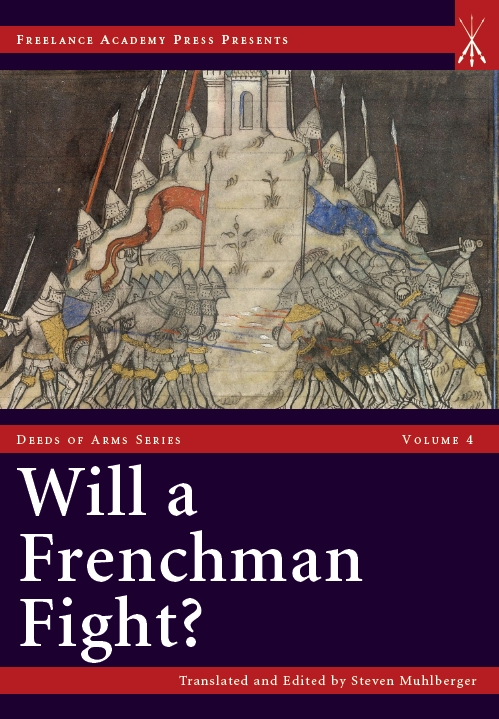 I'm grateful for this positive review but I wish the reviewer had said more about the main theme of the book, the often conflicting demands of military effectiveness and individual honor in the minds of men at arms of the time.
Muhlberger, Steven, ed. and trans. Will a Frenchman Fight?. Deeds of Arms, 4. Wheaton, IL: Freelance Academy Press, 2015. Pp. viii, 102. $24.95. ISBN: 978-1-937439-17-0.
Reviewed by Katherine Hodges-Kluck
University of Tennessee, Knoxville
kthomp41@vols.utk.edu
Will a Frenchman Fight? is Steven Muhlberger's third contribution to the Deeds of Arms Series. This sourcebook focuses on the great chevauchée, or raid, led by Thomas of Woodstock, first earl of Buckingham, through French territory in 1380-81. The book opens with an 18-page introduction, followed by selections of Froissart's Chroniques and Cabaret d'Orville's 1429 Chronicle of the Good Duke. As Muhlberger explains, Cabaret received his information from the French knight Jean de Châteaumorand, who recollected the events of his youth. Together, therefore, these chronicles provide two contemporary perspectives on the raid. The book concludes with a short bibliography for further reading.
The 1380-81 chevauchée was a response to duke of Brittany Jean de Montfort's call for aid after he was exiled for opposing the French king's attempts to exert royal jurisdiction over the ducal succession in Brittany. Will a Frenchman Fight? does an excellent job of highlighting the precarious situation which de Montfort faced. Out of favor with Charles V of France and charged with treason, the duke turned to the English for assistance, only to be thwarted by his own lords who refused to accept foreign support against their fellow countrymen. The introduction and primary sources in Will a Frenchman Fight? highlight these overlapping and frequently conflicting layers of leadership and allegiances, which in turn shaped France's military response to the rebellious de Montfort and his would-be English allies.
Muhlberger's introduction begins by outlining some of the major events of the four decades leading up to Buckingham's raid, including the Black Death, the English victory at Poitiers, the capture of the French king Jean II, and the Jacquerie rebellion. Muhlberger effectively demonstrates the economic pressures that shaped Edward III's and Parliament's military decisions on the one hand, and Charles V's struggles to "re-establish royal authority" in France on the other (5). The rest of the introduction then breaks down the sequence of events for the chevauchée and discusses the varied motivations of the French and English soldiers involved in it. The author assumes some basic knowledge of the first phase of the Hundred Years War, and the major players involved. It is not until midway through the introduction, for instance, that the reader learns that Buckingham is the "son of the King of England" (13), and only in the color plate of Buckingham's coat of arms in the middle of the book that the reader finds the earl's full name and titles.
The primary source section of the book presents the events of the chevauchée in chronological order, following the English on their march through enemy territory, their largely unsuccessful attempts to engage their enemy in battle during the winter months, and finally their retreat back to the coast. The primary texts have been thoughtfully selected to highlight the nuances of the complicated political, as well as tactical, situations posed by the English presence in France. As the book's title suggests, the sources shed light on "a variety of different kinds of combat and different motives for fighting" (3). In particular, they depict the tensions between 1) open pitched battles like those of Crécy and Poitiers, which favored the English; 2) the pragmatic but unpopular scorched-earth tactics employed by both the French and the English armies at the expense of the French populace; and 3) the desire of individual knights and squires on both sides of the conflict to demonstrate chivalric honor through individual combat.
The sources are divided into eight sections, throughout which chapter numbers and titles from the original texts are included as subheadings. Six of the sections are drawn from Froissart, while the remaining two (which are relatively short by comparison) are from Cabaret's chronicle. In the first section, titled "Buckingham's Campaign Begins," Froissart describes the exchange of ambassadors between Brittany and England, and Edward III's subsequent plans for an armed expedition into France. The chronicler discusses the deployment of troops, the effects of international alliances on events, and the capture of prisoners of war. The next section, "The Confrontation at Troyes," describes the skirmishes between French and English forces outside that city. The third section, "The Deeds of Arms at Toury and Marchenoir," follows the English army's travels into Brittany and the reception that the English received in various towns along the way, a reception that ranged from lukewarm to outright hostile. This section also includes Froissart's account of the death of Charles V. In "Buckingham in Brittany," Froissart shows the complicated political situation facing Jean de Montfort. He also describes the siege of Nantes and the coronation of the child king, Charles VI. The next passage, "The Siege of Nantes," is drawn from Cabaret's chronicle. It describes how the French defenders of the city used a variety of tactics to drive back and defeat the English besiegers. The next two selections, both titled "The Deeds of Arms at Vannes," give first Froissart's and then Cabaret's descriptions of individual combats between some of the knights and squires of the two armies. The final section, "Nicholas Clifford and Jean Boucinel," turns again to Froissart's text, outlining the peace concluded between Jean de Monfort and Charles VI, the English retreat out of Brittany, and an individual chivalric combat between Clifford and Boucinel.
While English translations of portions of Froissart's Chroniques have long been available, Cabaret's chronicle is less familiar to English readers, and this book makes a welcome contribution by including passages from it (though one wishes they were longer). Muhlberger's translations are clear and appealing to readers of all levels. This book should be a popular one for use in college classrooms, as it is accessible, attractive, affordable, and offers many topics of potential discussion.
The weaknesses of the book are largely structural. There is no index, and although Muhlberger defines specialized terms such as a outrance within the text (17), a glossary of such terms, as well as of important names, would make the book more user-friendly. Moreover, the two maps that the book reproduces (France at the Treaty of Brétigny in 1360 and at the death of Charles V in 1380), while in full color, are antiquated--one dates to 1877--and rather difficult to read. The book would benefit from a map that clearly plotted the route taken by the English army during the raid and the locations of important cities and skirmishes specifically mentioned in the text. It would also be useful to have in-text references to the images in the color plates at the center of the book.
Ultimately, this source reader presents a detailed view into an exciting yet lesser-known episode of the Hundred Years' War. Rather than placing attention on the famous battles like Crécy, Poitiers, and Agincourt, Will a Frenchman Fight? shows the more common side of war: one marked by short skirmishes, inconclusive raids, prolonged sieges, individual desire for honor, bad weather and disease, and the vicissitudes of fortune and politics.
******
Sabtu, 30 Juli 2016
William Marshal
Some insight on the character of William Marshal. He is lying on his deathbed:
The Marshal called to John of Earley
and said "Shall I tell you surprising thing?"
"Yes my Lord, but do not tire yourself out."
"I don't know what it all means
But in truth I can tell you this,
That for the last three years or even longer,
As far as I know, I haven't had
Such a great lords to sing
As I've had these last three days;
I can truly say as much,
But I don't know that it will please God."
John replied: "My Lord, do sing
For the love of God, if you're capable
Of giving yourself to that. The heart would take comfort
In your body and that would be a good thing,
For your joy would be restored.
It please God, it would be helpful
For it might bring back your appetite."
"Be quiet, John," the earl said,
"Such a song would do me no good at all,
For the people here, I believe,
Would think I was a madman.
Most of them would think, hearing me sing
That I was out of my mind."
He would not sing, nor could he.
Then Henry Fitz Gerold said:
"My lord, in the name of our God of glory,
Send for your daughters,
And they will sing some piece
That will do you good and comfort you."
The daughters were sent for and they duly appeared,
For they were glad to obey his commands.
"Matilda, you be the first sing,"
He said. She had no wish to do so,
For her life at the time was a bitter cup,
But she had no wish to disobey
Her father's command.
She started to sing Since she wished to please her father,
And she sang exceedingly well
Giving a verse of a song
In a sweet, clear voice.
"Joan, sing on as best you can!"
She sang one verse from a routrouenge,
but timidly.
"Don't be bashful when you sing," said the earl,
"For, if you are, you will not perform well
And the words will not come across in the right way;
the words you've just sang certainly didn't."
So the marshal taught her
How to sing the words.
Once the song was finished, he said to them:
"My daughters, go in the name of Christ
Who guards and protects all those who believe in him;
I pray to him to grant you his protection."
As was fitting, they took their leave.
Once they had left his bedside,
He said: "There are five of my daughters,
I believe. If all of them hold together,
So it please God, it could well be
That great good could come of it."
-- From the S. Gregory translation of the History of William Marshal, Anglo- Norman Text Society
The Marshal called to John of Earley
and said "Shall I tell you surprising thing?"
"Yes my Lord, but do not tire yourself out."
"I don't know what it all means
But in truth I can tell you this,
That for the last three years or even longer,
As far as I know, I haven't had
Such a great lords to sing
As I've had these last three days;
I can truly say as much,
But I don't know that it will please God."
John replied: "My Lord, do sing
For the love of God, if you're capable
Of giving yourself to that. The heart would take comfort
In your body and that would be a good thing,
For your joy would be restored.
It please God, it would be helpful
For it might bring back your appetite."
"Be quiet, John," the earl said,
"Such a song would do me no good at all,
For the people here, I believe,
Would think I was a madman.
Most of them would think, hearing me sing
That I was out of my mind."
He would not sing, nor could he.
Then Henry Fitz Gerold said:
"My lord, in the name of our God of glory,
Send for your daughters,
And they will sing some piece
That will do you good and comfort you."
The daughters were sent for and they duly appeared,
For they were glad to obey his commands.
"Matilda, you be the first sing,"
He said. She had no wish to do so,
For her life at the time was a bitter cup,
But she had no wish to disobey
Her father's command.
She started to sing Since she wished to please her father,
And she sang exceedingly well
Giving a verse of a song
In a sweet, clear voice.
"Joan, sing on as best you can!"
She sang one verse from a routrouenge,
but timidly.
"Don't be bashful when you sing," said the earl,
"For, if you are, you will not perform well
And the words will not come across in the right way;
the words you've just sang certainly didn't."
So the marshal taught her
How to sing the words.
Once the song was finished, he said to them:
"My daughters, go in the name of Christ
Who guards and protects all those who believe in him;
I pray to him to grant you his protection."
As was fitting, they took their leave.
Once they had left his bedside,
He said: "There are five of my daughters,
I believe. If all of them hold together,
So it please God, it could well be
That great good could come of it."
-- From the S. Gregory translation of the History of William Marshal, Anglo- Norman Text Society
Selasa, 17 Mei 2016
The brutal men at arms of the Good Duke
Faithful readers and good friends know that I've been working for a while on a translation of the Chronicle of the Good Duke, a French biography of the Duke of Bourbon dating from about 1429. The events covered by the Chronicle are actually older than that. One of the most interesting things about this document is that it was written by a young person consulting with a prominent man at arms of the Duke of Bourbon's retinue, whose memory stretched back half a century and more. The man at arms was Jean de Châteaumorand, who understandably had a high opinion of his former master and his compatriots who fought the wars against the English back in the golden days of chivalry. In Châteaumorand's telling they were a pretty neat bunch and there were lots of good stories about their worthy deeds in the French wars and elsewhere. I currently have a collaborator on this project, Phil Paine, whose Middle French is much better than mine. He sent me up page of corrections recently that contained a very interesting story that shows the men at arms of the Good Duke in a less flattering light.
The Duke of Bourbon and the Poitevins left there, and they went before a place called le Faon, which was not encircled by trenches,where it would have water. And so the place was strongly assaulted, but it was not taken on that day, except only the lower courtyard, where many good men were wounded. For there was there a Franciscan who was wondrous at firing the arbelest, with which he killed four gentlemen, and he was said to be the finest arbelister in Poitou, and well provisioned [with amunition]. And on the next day, the Poitevins and Bourbonnois assailed the keep in a fierce and strong assault, and those within defended themselves, and the Franciscan let fire [again], but it was such an energetic effort that the fortress was taken, and many men killed within, save for the Franciscan-arbelester, who had removed his habit and fled to his monastery. And then the whole army asked “where is the Franciscan?”, and it was alleged that he was in the church, on his knees before the altar. And so Sir Jean de Roye hastened there, because the Franciscan had killed, by his shooting, one of his squires. And he took the Franciscan, along with his habit, and went to hang him from a tree, doing so circumspectly, so that the Duke did not know about it. And the Duke of Bourbon left le Faon.Here we see a course of action approved by the entire army but which other people might see as disgraceful. The killing of the Franciscan might harm the Duke of Bourbon's reputation so Châteaumorand is careful to say that the Duke knew nothing about the hanging of the clerical Archer. Why might others disapproved? The telling of the tale makes it clear that the Franciscan was taken out of church and hanged. It looks to be that privileges of the clergy both in the case of the Archer and the church he was found in had been violated. Other observers could see this as an atrocity or a war crime. But John the Châteaumorand, Jean de Roye and the rest of the Army were angry and felt truly justified in hunting down and hanging the Archer. Very likely they saw the Archer as stepping outside of his role as a clergyman and taking on illegitimately the role of the combatant. He was trying to have things both ways, combatant and privileged noncombatant. The may be something more to it. It's well-known that men at arms did not see archers as their equals, even if they took part in combat as part of organized armies. It could be that Châteaumorand and his friends saw the archer as a low class sharpshooter who had no right to be so effective and kill their friends.
Jumat, 06 Mei 2016
On the Road in the Hundred Years War -- stories of 14th century warfare from Froissart
From Steve Muhlberger and Stonebunny Press
A New book in a new series:Would you like to hear what the knights of the Hundred Years War had to say about their personal experiences of the conflict? Jean Froissart, the era's greatest fan of chivalry, devoted his life to interviewing the knights who participated in the war and to create his vast, vivid Chronicle. On the Road in the Hundred Years War shows us Froissart in his natural environment, crossing war-torn France, and talking with the warriors who knew the history of the country they passed through and the men who had fought there. On the Road (volume 1 of the new series Tales from Froissart) brings to life the military camps, the princely courts and the inns where those who followed the wars gathered and talked of their way of life. This volume is available in Kindle format and in paperback. The print version is very reasonably priced and the Kindle version is much, much cheaper. Both are illustrated (print interior is black and white, other illustrations are in color). Available in print: https://www.amazon.ca/Road-Hundred-Years-War/dp/0994755651 or http://www.amazon.com/Road-Hundred-Years-Tales-Froissart/dp/0994755651? ie=UTF8&qid=1462548915&ref_=tmm_pap_swatch_0&sr=8-1 Available in Kindle: https://www.amazon.com/Road-Hundred-Years-Tales-Froissart- ebook/dp/B01F5LNDIE?ie=UTF8&keywords=froissart%20on%20the%20road%20steve %20muhlberger&qid=1462548456&ref_=sr_1_fkmr0_1&sr=8-1-fkmr0 or https://www.amazon.ca/Road-Hundred-Years-Tales-Froissart-ebook/dp/B01F5LNDIE
On the Road in the Hundred Years War -- stories of 14th century warfare from the chivalric historian Jean Froissart.
Minggu, 28 Februari 2016
How many at the combat of 30?
As many of my readers know, there was an arranged battle or deed of arms between two garrisons in Brittany in March 1352. The garrison commanders supported different claimants for the ducal title. The civil war was part of the wider Hundred Years War between rival claimants to the kingdom of France, and like the wider war it was going no place. Out of boredom or frustration, the commanders agreed to have an even number of their men meet halfway between the castles and fight to the finish – death or captivity. But what was that even number? And what was the total number of participants?
Well, 30+30 equals 60, right?
The problem is that various accounts imply that there were 30 men on a side in addition to the commander himself. Were there 31 on a side for a total of 62?
About 100 years ago, H.R.Brush edited the most detailed account, a product of Brittany and therefore written by someone well acquainted with the battle, and he concluded that there were 30 participants on either side. In my article, my chapter in the book deeds of arms, and in my source reader on the combat, I followed Brush.
But, at about the same time that I finished my source reader (called the Combat of 30, volume 2 of my series Deeds of Arms) , Michael Jones wrote an article called "Breton soldiers from the battle of the 30 (26 March 1351) to Nicopolis (25 September 1396)," which appeared in Adrian R. Bell et al., eds., The Soldier Experience in the 14th century (Boydell Press, 2011). Jones was very interested in the careers of Bretons in the first half of the Hundred Years War, and the best examples he could find were the men at the combat of the 30. He followed them as closely as he could, and he was able to find a quite a bit about them, at least about those on the pro-French side.
And he came to the conclusion that there were 31 on a side.
I have not gone through his list systematically hecking It against Brush's (in Modern Philology).
I'd love to farm this out to Will McLean but alas he is not available.
Kamis, 07 Januari 2016
The Race for Paradise: An Islamic History of the Crusades, by Paul M. Cobb
Cobb, Paul M. The Race for Paradise: An Islamic History of the Crusades. Oxford: Oxford University Press, 2014. Pp. 335. $31.95. ISBN: 978-0-19-935811-3.
Reviewed by Steven Muhlberger
Nipissing University (retired)
steve.muhlberger@gmail.com
I approached reviewing this book not as a specialist in the Crusades (I am not) but as someone who has taught the Crusades numerous times in the last thirty years in medieval and world history surveys, in a survey of Islamic civilization, and in an undergraduate course on Crusade and Jihad. I have had some experience of hunting for appropriate books that would help me explain the this period from the Muslim point of view, but not much luck in finding ones that are suitable in content and availability (and, yes, price).
The next time I teach that material, however, I will know where to go for a good discussion of what the Crusades looked like from the point of view of "the crusaded," to use Paul Cobb's phrase. I do not think there is any book on the market today as good as this one for showing the effects of the Crusades on the Muslim-ruled Middle East. It is a good solid narrative history that looks outwards from Syria and cities of the Dar-al-Islam ("the Abode of Islam") rather than at Jerusalem from France and Rome.
Paul Cobb comes to this material very well prepared to discuss events from the Islamic point of view. He has written on Abbasid Syria and post-Umayyad Spain, and both translated and written a monograph on Usama ibn Munqidh, whose Book of Contemplation has long been valued for its autobiographical reflections on Crusade-era Syria. Cobb is very familiar with the work of Muslim scholars and litterateurs and the cultural environment in which they worked.
And it is our good fortune that he has the ability to convey his understanding to non-specialists. Cobb has a gift for explaining. I was very impressed early on in the book with his explanation of the difference between Sunni and Shiite traditions in the Middle Ages, and similarly how well he explained the decentralized structure of political life in the era of the Seljuks, the Fatimids, the Ayyubids and the Ottomans. His discussion of the use of the word jihad in the period in question is, as it must be, careful and clear. The ability to introduce such basic matters to the reader is the most important test that a writer addressing a general audience faces. Cobb passes this test with flying colors.
The book is organized chronologically around military and political events with occasional diversions into historiographic questions or descriptions of cultural change. Cobb sticks very closely to his announced focus on Islamic history. Events and personalities that did not directly affect the Muslim world are deemphasized. The Fourth Crusade gets one paragraph. The role of the papacy, neglected by most Muslim writers, is hardly noted in the Race for Paradise. Frederick II, an active crusader and King of Sicily and as such the ruler over the Muslim minority on that island, gets much more coverage than his rival Innocent III, even though the pope in question was perhaps the most important architect of the Christian theory of holy war and its implementation. For this reader, familiar with the usual general accounts of the Crusades, it was a salutary exercise to follow along in Cobb's wake.
Cobb's performance as a narrative historian is not perfect. The same details that help him build a full and convincing picture of Islamic history sometimes feel like items in an unending catalogue of campaigns' battles, and political intrigues. But he is a far better and livelier writer than many scholars. Cobb's language is up-to-date and relaxed. He does not hesitate to break the unwritten rule that forbids scholars to use slang unless it is nearly a century old. On the other hand he does not overdo it by committing himself to phraseology that might prove to be entirely ephemeral.
Cobb's narrative history from the Islamic point of view is a very valuable resource. Yet he goes beyond this to discuss historiographical questions that are very much alive in the scholarly community, and also of interest to general readers who might pick up the book. He rejects the idea that Muslim observers had no appreciation for crusading as a unified phenomenon. He does believe that Christian religious motivations were hardly appreciated by most Muslims who discussed the aggression of the Franks. However, he argues that the dominant Muslim line of reasoning for the origins of the crusade was the fact that Franks were by nature an aggressive people. A number of Middle Eastern observers saw the wars of the Franks as an intensification of that inherent aggression. The attacks on Sicily and Muslim Spain after 1060 were for them an important prelude to the Jerusalem campaign of the 1090s. All of this Frankish aggression on a variety of fronts was of a piece. The unifying factor for these writers was the failure of the Muslim community with its many internal divisions to deal with this Frankish threat. It should be pointed out that just as Cobb's Muslim sources give the Sicilian and Spanish wars an important place in their analysis, so does Cobb emphasize those wars. The way he integrates the "western front" with the conflicts in the Middle East and Eastern Mediterranean is one of the best parts of his treatment.
Similarly, readers will find a very good discussion of the term jihad. Cobb believes that modern scholars sometimes overemphasize the contrast between greater or spiritual jihad and lesser or military jihad. Cobb argues that it is certainly the case that most discussions of jihad in the Crusading era referenced military activity against the infidel. But he also rejects the idea that jihad simply meant militarism. Jihad sprang from the duty of Muslims to "command the good and forbid the wrong." Whether that duty required a military response on the part of the faithful in any given case was a complicated question; the complications are very nicely handled in the book.
There is no full bibliography, but the "bibliographic sketch" and the endnotes provide quite adequate guidance for non-specialist readers.
To return to the Race for Paradise as a teaching resource. Will it be useful for students? This will depend on the exact goals of the course and how prominently the internal dynamics of the Muslim Middle East will be in it. Cobb's clear language and the book's very reasonable price make student use a real possibility. But Cobb's book certainly belongs on the bookshelf of anyone who teaches the Crusade, and on the shelves of every university library where the Crusades are taken seriously as part of the history curriculum.
Langganan:
Postingan (Atom)
Weekly
-
This announcement speaks for itself: Dear Colleagues, After two decades teaching medieval art history and doing photography for my own use,...
-
From the Guardian: Leading foreign academics from the LSE acting as expert advisers to the UK government were told they would not be asked ...
-
A new translation of this fascinating treatise on horsemanship by a fifteenth-century king. This interview with Jeffrey Forgeng comes from...
-
Byron York talks to dedicated, long-time Romney supporters right after the concession speech: A few hours earlier, across the street at the...
-
 ...if you are very, very rich. (Most mss. of this age and quality are in national or university libraries and are not for sale at any price...
 -
Two experts in the Middle East have been more useful to me than most of the more prominent ones. They are Juan Cole and Joshua Landis. If yo...
-
I have always loved maps and history. Growing up in the USA in the early 60s, the Southeast Asian war gave me the opportunity to learn geog...
-
I just discovered this book, which came out a couple of years ago, thanks to Brad DeLong, who provided a link to a pre-print to chapter 9, ...
-
...full of archaeological goodies. Thanks, David Meadows! One of the nice things about this e-mail news compilation is that it supplies me ...
-
I have been reading the magazine Foreign Policy recently, and despite the fact that is understandably American-centric, it does tend to take...