Tampilkan postingan dengan label food. Tampilkan semua postingan

Minggu, 09 Oktober 2016

Review of Woolgar, C. M. The Culture of Food in England 1200-1500


Reviewed by Paul Freedman
Yale University paul.freedman@yale.edu
No longer a neglected field, the study of medieval food has flourished recently. At one time it was the dearth of food, outright famines or food-supply problems that occupied the attention of historians, but taste preferences, the food styles of the Middle Ages and the development of cookbooks are now being investigated as part of an expansion of interest in material culture and in food history generally. Scholars such as Massimo Montanari, Bruno Laurioux and Trude Ehlers have enriched our knowledge of the international and regional fashions and practices in medieval cuisine while the basic standards of living have been explored by Pere Benito for Catalonia or Christopher Dyer for England. A virtue of this new and wide-ranging book by C. M. Woolgar is its treatment of both the effort and business of obtaining food and the manner of cooking and serving it. Food shortages and the difficulties of weather, war and low crop yields are considered, but so are banquets and less extravagant manifestations of festive aesthetics and appreciation. Medical literature and advice is included as are the flexible interpretations of monastic dietary regimens, but the emphasis here is on the gustatory experience of ordinary people, ordinary people with enough prosperity to have some choice in what they consumed, to be sure, but not necessarily nobles.
Woolgar does not rely exclusively on court cookbooks, accounts of great feasts or other evocations of princely entertainments. Those celebrated events, however, influenced the tastes of the other classes, down to the merely modestly well-off. Woolgar emphasizes that while certain effects such sculpted entremets such as edible castles or giant pies, or peacocks cooked and sewn back into their skin and feathers were beyond the reach of all but a tiny elite, aristocratic tastes for highly-spiced food and wine or consumption of game or lampreys were adopted by their social inferiors. Cloves and nutmeg might be prohibitively expensive, but cinnamon was widely used and pepper became so common by the mid-fifteenth century as to be associated pejoratively with the higher peasantry.
Limited to England, the book does not provide a wide-angle view of medieval cuisine as a whole, nor does it concern itself much with regional differences. It is, however, a thorough and fascinating study in depth, imaginatively using sources especially archaeology, household accounts and coroners' records. In an earlier book, The Great Household, Woolgar looked at the aristocratic way of life, including dining, on the basis of the physical remnants of grand houses and castles as well as the records of purchases for these households. Here particular use is made of the records left by officers in charge of supplying the kitchens of ecclesiastical as well as noble houses, showing the organization of large-scale buying a few times a year, more frequent opportunities afforded by regional fairs (especially for luxuries such as dried fruit or spices), and the everyday supplements from markets and urban retailers. Such purchases were in addition to basic commodities such as wheat, malt or meat supplied by dependent tenants or storage centers set up to supply itinerant courts.
New here is the use of evidence of unnatural death to reconstruct what snacks people were munching on or what food-seeking activities they were engaged in just before they accidentally drowned, fell or were burned or scalded to death. The coroners' inquiries provide snapshots of daily life, serene but retrospectively grisly prologues to tragedy. Children and the elderly fell into wells and ditches intending to get a drink of water (43), the consumption of water being more common than historians usually believe. Hot water was also hazardous and we can see brewing and boiling of vegetables in large cauldrons going on through the accounts of unfortunate mishaps (35-36). The results of drunkenness, hunting accidents and falling out of orchard trees are common food-related incidents immortalized by coroners' rolls.
Food has always served as a marker of social distinction, not just dividing those who have more than enough to eat from those who are hungry, but also within the category of the affluent, those who occupy various stages of privilege. Divisions within the comfortable classes were codified less by formal sumptuary laws than by arrangements for banquets whose various tables featured different numbers and types of dishes depending on the social quality of those invited. The exhaustive details of carving and ceremonial are presented here as evidence for a food culture that was regulated, formal but at the same time convivial. In common with the Victorian banquet. the medieval feast featured an intimidating display of precious metal, elaborate décor, fancy dress and remarkable and copious food—but it was organized in an entirely different fashion. Tables were movable and rooms were used for various purposes other than simply dining. Musical and theatrical entertainment was more important than in the nineteenth century. Woolgar is particularly innovative in describing the culinary festivities of regional guilds, particularly in Stratford-on-Avon, whose feasts were ample, immense even, but not as refined or exotic in terms of the actual food served as at those arranged for the aristocracy.
Woolgar mentions aspects of dining that the reader will very likely have wondered about without ever knowing quite the answer: how much meat was consumed in monasteries and with what justification for straying from the Benedictine Rule's austerity; where dining took place (meat-eating was often kept separate in monastic communities), how much in the way of vegetables, fruit, cheese (all considered beneath the notice of court cooks and chroniclers) were consumed by the affluent and in what forms, when spices first became de rigueur (after the 1270s), or the introduction of beer with hops as opposed to the domination of ale.
Woolgar shows diners having a good time together. Food was an important form of social distinction and entertainment. Medieval ceremoniousness in comparison with modern habits is part of an overall regime of commensality. Although not in every respect enviable, the medieval centuries constitute a world in which all chickens were free range, people knew where their food came from, and the company at the table was exempt from some of the distractions that today interfere with our pleasure in dining.

Sabtu, 09 April 2016

The state of affairs, April 2016

My various projects, including this blog, are progressing only slowly. I am undergoing medical treatment at the Hamilton General Hospital in Hamilton, Ontario. It's nothing to be alarmed about, but being away from home does make it difficult to work on my translations.

A couple of years ago another health problem gave me the opportunity to see London, Ontario, a place known to me only as the location of bad winter weather. Now I am seeing more of the city of Hamilton than I have seen before. It has the reputation of being a dirty industrial city, but as is the case in many another place in the Great Lakes region, a lot of the old factories have closed. Nonetheless, it doesn't seem that Hamilton's economy is suffering all that much. (Ditto for Canada as a whole, surprisingly. Unemployment is dropping significantly EVEN IN ALBERTA!)

One of the wonders of Hamilton is a bar/restaurant on James St. called Mezcal Tacos Tequila, which features a large number of tequilas and an amazing style of what might be called Mexican fusion. It is some of the best restaurant food I have ever eaten. And it is relatively cheap. If you live close to Hamilton, run don't walk to Mezcal.

I am also passing the time by listening, through You Tube, to my classic music, music on either side of 1970. In particular I am playing the Jefferson Airplane's

amazing early-morning set at Woodstock.

It has long been fashionable to make fun of Woodstock but it was the site of an amazing effloresence of music. Perhaps equally astonishing is the high quality of audio and video recording that was accomplished in what was a weather disaster. Here's to the sound engineers, cinematographers and all the other hardworking people who preserved this wonderful music.

Selasa, 24 November 2015

A Feast for the Eyes: Art, Performance and the Late Medieval Banquet, by Christina Normore

From the Medieval Review (online book review source): Normore, Christina. A Feast for the Eyes: Art, Performance and the Late Medieval Banquet. Chicago: University of Chicago Press, 2015. Pp. viii, 261. $55.00. ISBN: 978-0-226-24220-0.
Reviewed by Claire Sponsler
University of Iowa
claire-sponsler@uiowa.edu
In February of 1454 in the city of Lille, Philip the Good, duke of Burgundy, sponsored a banquet whose purpose was to promote a crusade against the Turks who in the previous year had captured Constantinople. Although the propaganda effort failed (the crusade was never undertaken), the banquet itself made quite an impression, as well it might, given that it featured among other entertainments an actor dressed in white satin to represent the Church of Constantinople, entering the hall on an elephant led by a giant Saracen; twenty-four musicians who played their instruments inside a gargantuan pie; and marvelous automata that included a tiger battling a serpent in a desert landscape and a boy riding a golden-horned stag, the two singing a duet as they circled the tables set up for the banqueters. The Feast of the Pheasant, as this astonishing event came to be called, made it into the historical record in unusually detailed form, most notably in the Memoirs of Olivier de la Marche and the Chroniques of Mathieu d'Escouchy, and while it is not the only banquet discussed by Christina Normore, it serves as a running example of the complexities of feasting in late medieval culture--her topic in this multilayered and ambitious book.
It might initially seem odd that an art historian would choose banquets as an object of study, but that, as Normore stresses, is exactly the point, both for art history and for the cultural history of medieval Europe. By focusing her eye on feasts, Normore demonstrates what the history of art stands to gain by broadening its scope beyond the traditional high arts of painting, sculpture, and architecture in order to take in a form that is usually relegated to the so-called, and lesser, decorative arts. What the cultural history of medieval Europe reaps, even more importantly, is a less anachronistic (because less constrained by modern categories of aesthetic activity and notions of individual talent) and hence more accurate view of the insistently mixed-media and collaborative arts of late medieval and early modern Europe, such as feasting, that drew together politics, ethics, religion, and other spheres of social life under the guise of entertainment.
Because Normore is an art historian, it is no surprise that she approaches her subject matter chiefly through the visual and provides detailed close readings of the objects and representations found in lavish feasts, while also turning to other pictorial sources such as manuscript illuminations to underscore her claims. The generous use of illustrations in the book lets the reader track Normore's analysis and offers a tantalizing glimpse of late medieval banqueting in action.
But this book moves well beyond the analysis of discrete visual objects. Normore signals her ambitions by setting feasting within the larger context of festivity more generally, a move that allows her to examine the wide array of activities that took place at banquets, activities that combined the culinary, visual, and performing arts into one complex whole. More specifically, her aim is to demonstrate that feasting "helped form a culture deeply invested in discernment" (3), and thus aided in the creation of a court culture grounded in the exercise of aesthetic judgments.
After an introductory chapter aptly titled "Setting the Table," which does the work of laying out the general argument and considering the interpretive issues surrounding a study of feasting, Normore begins in the first chapter, "Between the Dishes," by asking what, exactly, an entremet was, charting the term's ambiguity when used by fourteenth- and fifteenth-century Francophone authors, for whom the word's semantic range included performances, material objects, and foodstuffs. Normore argues that entremets "complicate the separation between media" and, because their production required the collaboration of many different craftspeople, they complicate the separation between "makers" as well (42). Here as elsewhere, Normore is keenly alert to the difficulties of terminology and definition, to the limits of an approach based on a modern taxonomy of artistic forms, and to the need to read with rather than through the material evidence that survives to tell us about these important cultural occasions.
Echoing her claim that the feast was more than just visual display, she pays attention to the sounds and smells of banqueting, as well as to the impact on those who participated. The next four chapters take up various aspects of the way feasts shaped late medieval elite society, by looking at the relationship between banquets and those who participated in or observed them (chapter two, "Spectator-Spectacle"), the success with which feasts intervened in the political sphere (chapter three, "Efficacy and Hypocrisy"), and the meaning of lavish banquets within the ethically-charged notion of magnificence (chapter four, "Dining Well"). The last of those chapters rejects the tendency of modern scholars to equate magnificence with overabundance and instead considers how feasts could function as places "where virtue could be practiced and learned" or as locations where dining could make visible "key concepts of systematic ethics" within a courtly milieu (104). Chapter five, "Stranger at the Table," turns from politics and ethics to an inquiry into feasting's aesthetic ends, particularly in its use of strange and wondrous displays that provided courtly society with "marvels to think with," as Normore cleverly puts it (138).
Readers hoping for an up-close look at one feast will be grateful for the final chapter, "Wedding Reception." Focusing on a specific example, the first night of banqueting that celebrated the marriage of Charles the Bold and Margaret of York in 1468, this chapter aims to strike a balance between anthropologically-oriented studies of feasting as a general social practice and historically-grounded analyses of individual banquets. Normore argues that while it is only within the broad context of late medieval marriage and gift exchange that the complex symbolic and sensory nature of the 1468 banquet can be understood, nonetheless "the specific iconographic and sensual program" (165) of this particular event had distinctive meaning for the marriage at hand: the feasting may have gestured toward all marriages, but it spoke directly to Charles and Margaret's. The conclusion to this chapter serves as a kind of last word for the book as a whole: "the creators of the feast, from the planners to the final participants, worked not only with a particular iconographic program but also within a shared understanding of the proper behavior, values, and aesthetic modes of wedding banquets in particular and feasting in general" (191). In a sentence that drives the book's point home, Normore insists that only when the individual and the general are brought together "can we truly begin to appreciate how and why banqueting captured the imaginations and influenced the actions of late medieval men and women" (193).
By pointing to the complex cultural and artistic interactions of the banquets devised for the Burgundian court, A Feast for the Eyes makes a welcome and sophisticated addition to an emerging body of work on the persistent mixing of media that characterized the public culture of late medieval Europe. Returning representational forms and recreational activities that have now been slotted into separate disciplinary niches--art, music, literature, theater, politics, religion, food--to their thoroughly entwined states in late medieval culture, Normore joins a new wave of cutting-edge work in medieval studies. As resolutely as its subject, A Feast for the Eyes escapes scholarly categories and invites the appreciation of a wide range of readers.


Kamis, 24 Oktober 2013

Culinary despair in the USA

Squarely Rooted disses Cincinnati Chili over at Brad DeLong's blog:

For the mercifully unacquainted, "Cincinnati chili," the worst regional foodstuff in America or anywhere else, is a horrifying diarrhea sludge (most commonly encountered in the guise of the "Skyline" brand) that Ohioans slop across plain spaghetti noodles and hot dogs as a way to make the rest of us feel grateful that our own shit-eating is (mostly) figurative. The only thing "chili" about it is the shiver that goes down your spine when you watch Ohio sports fans shoveling it into their maws on television and are forced to reckon with the cold reality that, for as desperately as you might cling to faltering notions of community and universality, ultimately your fellow human beings are as foreign and unknowable to you as the surface of Pluto, and you are alone and always have been and will die alone, a world unto yourself unmarked and unmapped and totally, hopelessly isolated.

There's more!

(I have no personal experience of Cincinnati Chili, but I love a good rant.)

Rabu, 13 Maret 2013

What the Irish ate before potatoes

Bon Appetit magazine says milk, butter and curds in dizzying variety:


There was drinking milk, and buttermilk, and fresh curds, and old curds, and something called "real curds," and whey mixed with water to make a refreshing sour drink. In 1690, one British visitor to Ireland noted that the natives ate and drank milk "above twenty several sorts of ways and what is strangest for the most part love it best when sourest." He was referring to bainne clabair, which translates as "thick milk," and was probably somewhere between just straight-up old milk and sour cream. And in the 12th century, a satirical monk (this is Ireland, after all), wrote a fake "vision" in which he traveled to the paradise of the Land of Food, where he saw a delicious drink made up of "very thick milk, of milk not too thick, of milk of long thickness, of milk of medium thickness, of yellow bubbling milk, the swallowing of which needs chewing." And many British tacticians, sending home notes on how best to suppress local rebellions, noted that the majority of the population lived all summer on their cows' milk, so the best way to starve out the enemy would just be to kill all the cows.


And the introduction of the potato was part of the impoverishment of the Irish people.


There was drinking milk, and buttermilk, and fresh curds, and old curds, and something called "real curds," and whey mixed with water to make a refreshing sour drink. In 1690, one British visitor to Ireland noted that the natives ate and drank milk "above twenty several sorts of ways and what is strangest for the most part love it best when sourest." He was referring to bainne clabair, which translates as "thick milk," and was probably somewhere between just straight-up old milk and sour cream. And in the 12th century, a satirical monk (this is Ireland, after all), wrote a fake "vision" in which he traveled to the paradise of the Land of Food, where he saw a delicious drink made up of "very thick milk, of milk not too thick, of milk of long thickness, of milk of medium thickness, of yellow bubbling milk, the swallowing of which needs chewing." And many British tacticians, sending home notes on how best to suppress local rebellions, noted that the majority of the population lived all summer on their cows' milk, so the best way to starve out the enemy would just be to kill all the cows.


Senin, 21 Mei 2012

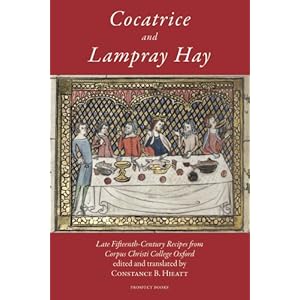
A review of Constance Heiatt's most recent book on medieval cookery: Cocatrice and Lampray Hay


Reproduced from the excellent review source, The Medieval Review 
Hieatt, Constance B. ed. and trans. Cocatrice and Lampray Hay: LateFifteenth-Century Recipes from Corpus Christi College Oxford.
Totnes: Prospect Books, 2012. Pp. 176. GBP30.00/$60.00. ISBN: 978-1-903018-84-2.
 Reviewed by Melitta Weiss Adamson     The University of Western Ontario     melitta@uwo.ca

For nearly four decades the study of food in medieval England has beeninextricably linked with the name Constance B. Hieatt.  Her 1976 bookPleyn Delit: Medieval Cookery for Modern Cooks, which she co-authored with the late Sharon Butler, became a best-seller.  Apaperback edition in 1979 was followed by a completely revised secondedition in 1996 with Brenda Hosington as her collaborator.  In 1985,Hieatt and Butler published Curye on Inglysch, and in 1988appeared Hieatt's edition of An Ordinance of Pottage.  TheLibellus de Arte Coquinaria, published in 2001, was the resultof her collaboration with the late Rudolf Grewe.  To the books fromthis period must be added many shorter pieces which appeared inSpeculum, Medium Aevum, and elsewhere.  In addition tomaking more of the medieval manuscripts available in scholarlyeditions and translations, and offering modern adaptations for many ofthe recipes, Hieatt soon recognized the need for a comprehensive listof extant culinary manuscripts from medieval Europe and collaboratedwith Carole Lambert, Bruno Laurioux and Alix Prentki on the 1992Répertoire des manuscrits médiévaux contenant des recettesculinaires, which is included in the book Du manuscrit à la
table
edited by Carole Lambert.  The Répertoire remains to
this day one of the most important reference works for medievalEuropean cookbook manuscripts.  With a good number of the extantculinary manuscripts from England accessible in print by the beginningof the new millennium, Hieatt set out to collate the various versionsof individual recipes and in collaboration with the late Terry Nutterand Johnna H. Holloway published the Concordance of EnglishRecipes: Thirteenth Through Fifteenth Centuries in 2006, which she
followed two years later with her book A Gathering of MedievalEnglish Recipes containing editions of various shorter culinary
manuscripts and a supplement to the 2006 Concordance.
With Cocatrice and Lampray Hay Constance Hieatt returns to amanuscript she and the late Sharon Butler had first begun totranscribe around 1980, but put aside on account of its manydifficulties (22).  Corpus Christi College Oxford MS F 291 is amanuscript from the end of the fifteenth century, written in MiddleEnglish and possibly originating from Norfolk (10).  Its recipes,unlike most in the earlier cookbook manuscripts from England and thecontinent, are very detailed and provide quantities for manyingredients.  The dishes usually serve between sixteen and eightydiners (20).  The recipe titles in the table of contents on fols. 1v-2v correspond largely but not completely with the recipes that followon fols. 3r-68r.  The main differences are due to some recipe titlesomitted in the table of contents, and two sheets now missing from thecodex.  All in all, Hieatt calculates that the cookbook likely oncecomprised 101 recipes of which 99 are extant today, most of themwritten in one hand (10-11, 19).  For each recipe, the editor providesthe transcription of the original text, a modern English translation,and a commentary which in most cases also contains notes for moderncooks who would like to interpret the dishes.  Since she does notoffer modern adaptations of the recipes complete with exact quantitiesand cooking instructions, the notes are geared more towards theexperienced cook than the novice.  Although many recipes havecounterparts in other manuscripts, the Corpus Christi College cookbookis not directly related to any of those recipe-collections, as Hieattpoints out (11).  What becomes clear from reading her comments to therecipes is that vocabulary, some of which not found anywhere else,confused instructions, and scribal errors pose the biggest problems toour understanding of the manuscript today.  We are fortunate thatConstance Hieatt decided to publish the recipe collection late in hercareer when she had the extant cookbook tradition of medieval Englandat her fingertips and was able to solve more of the problems than anyof her peers or she herself at an earlier time would have been ableto.  The book concludes with a supplement to the Concordance of2006 which combines the new material from the Corpus Christi Collegemanuscript with that contained in the 2008 supplement of AGathering of Medieval English Recipes (145-172).  Future users
will therefore only need to consult one supplement to theConcordance rather than two.  As in the 2006Concordance, Hieatt also provides a helpful "Glossary of RecipeTitles Used as Lemmas and Cross-Index of Variant Titles" at the end(173-176).
The cuisine reflected in the ingredients and recipes of the CorpusChristi College manuscript is that of a wealthy household.  Pepper,cinnamon, saffron and salt are the standard seasonings; honey in morethan half of the recipes, together with the ubiquitous figs and datespoint to a preference for sweetness.  Other prominent ingredients arealmond milk and grated bread used as a thickener.  The cookbook startson a flamboyant note with a recipe for "cocatrice," or basilisk, afabulous creature half piglet and half chicken (Recipe 1), and endswith a recipe for apple sauce (Recipe 99).  Hieatt describes the orderof the recipes in the collection as "quite eccentric" and detects "nodiscernable overall rationale" (11).  And yet, the collection doesfall into various sections which may point to different medievalsources from which it was compiled and/or various attempts to sort therecipes.  Many of the first thirteen recipes would have been suitablefor a banquet as a sotelty or surprise dish such as the aforementioned"cocatrice" or the skillfuly stuffed chicken (Recipe 4) or stuffedmackerel (Recipe 5).  Following the group of pastries under thesubheading "Baken Mete" (Recipes 14-19), we find two recipes forkeeping foodstuffs for extended periods of time, namely pea pods(Recipe 20), and venison (Recipe 21).  The recipe for "Lampray Hay"opens a long list of fast-day recipes (Recipes 22-55) featuring a vastarray of fish and seafood interspersed with some fruit and vegetabledishes, and a group of four pastry dishes (Recipes 48-51) under thesubheading "Baken Mete for Lentyn."  That "Lampray Hay" containsneither lampray nor hay causes Hieatt to surmise that we may bedealing with a "deliberate joke" (58).  The seventeen recipesfollowing the Lenten dishes are for meat dishes and various pottages(Recipes 56-72).  While most of these are standard recipes also foundin other collections, the five subsequent dishes and dish names notfound anywhere else leave even an expert such as Constance Hieattmystified (Recipe 73-77).  Quite the opposite is the case with thenext set of eight recipes starting with the popular "Morterews"(Recipe 78), "Mawmone" (Recipe 79) and "Blawmanger" (Recipe 80) andending with the simplest of cabbage recipes (Recipe 85).  The editoris unable to place the next recipe with the rather distasteful name"Capoun in Urinele" (Recipe 85) in the medieval English cookbooktradition but vaguely remembers having seen such a recipe before.  Infact, chicken cooked in a glass is a standard recipe in Italiancookbooks of the Liber de coquina tradition where it issometimes referred to as "de gallina implenda" or "gallina cocta incarafia."  The subsequent recipe for "Two Cunnyngs of One" (Recipe 87)in the Corpus Christi College collection also points to an Italianconnection.  The idea of skinning an animal, albeit not a rabbit but adove, roasting the carcass, stuffing the skin with other meat andserving both side by side, is found in the fifteenth-century CuocoNapolitano as Recipe 67, and interestingly followed there by a
recipe for chicken in a carafe (Recipe 68 in the 2000 edition andtranslation by Terence Scully).  In her comments to Recipe 87, Hieattmakes reference to a recipe for two capons from one that is containedin another manuscript from England but does not mention the Neapolitanparallel.  The final set of twelve recipes in the Corpus ChristiCollege cookbook brings an assortment of dishes ranging from pottages,fish and seafood dishes, to gruel, a pudding, pie, tart, and applesauce, all of which may well have been later additions (Recipes 88-99).
Cocatrice and Lampray Hay is Constance Hieatt's latest book onmedieval food but it will not be her last.  Prior to her passing inDecember 2011, she worked on the draft of another book entitled TheCulinary Recipes of Medieval England, which will be published
posthumously.  With her editions, translations, adaptations,concordances, and in-depth studies of medieval and early moderncookery, this prolific scholar has given us tremendous tools withwhich to study early European culinary history.  Now it is up to thenext generation to continue the work and bring the picture that hasemerged thanks to her tireless efforts into an ever sharper focus.Constance Hieatt will be missed by many.

Sabtu, 28 April 2012

Toronto street food -- is there yet hope?


I have lived in Bonfield longer than any other place, but there is part of my soul that is Torontonian -- the result of having been there as a grad student in my 20s. Those were truly formative years.  The result of this connection is that I see T.O. as a microcosm, so full of human  possibilities, so often falling short.  Recently the emphasis has been on falling short, as the city seems to have been infected by the world-wide wave of mean, destructive small-mindedness.

Then I read this article on the movement to bring good street food to the city.  A place known for its extraordinary variety of food ought to have a fleet of trucks serving any number of  different styles of fast food, but small-mindedness has made it nearly impossible to run such a business.

Then comes Suresh Doss to remind longer-settled Torontonians of a simple truth:  more variety is good for everybody.  Specifically, good food trucks bring customers to the bricks-and-mortar restaurants they are parked outside.  As Doss works to make possible legal food truck havens, support among established restauranters grows.

I get a small laugh from the fact that Doss is an immigrant and yeah, a computer engineer.

Minggu, 15 Januari 2012

After 35 years

It was about 35 years ago that I was introduced to the joys of chocolate croissants in Toronto.  I'm pretty sure they were sold in only a few places, like the P'tit Gourmet, a really neat delicatessen specializing in French food.

Finally, chocolate croissants have reached Bonfield, Ontario.  Not exactly a French-style croissant, more like a North American crescent roll.  But not bad.

And get this, city people.   It costs 75 CENTS.  The one cheap thing for sale on the entire planet.

Sabtu, 09 Juli 2011

Miscellaneous York

Most oppresive monument in York: a very fine medieval style pillar commemorating -- the South African (Boer) War. I have passed it many times this week and it bugs me every time. Perhaps because it reminds me of more recent colonial wars? I have found the new statue of Constantine-as-Caligula and its slouching treatment is pretty creepy, but the South African War monument gets under my skin.

New lows in British food: the chip butty. Which is chips on a burger-style bun. Hey, it's cheap and filling! And to think I was once shocked by beans on toast for dinner.

Rabu, 16 Februari 2011

Cheese, Pears and History in a Proverb

I don't think anyone will mind if I repost this charming review from The Medieval Review.

Montanari, Massimo. Cheese, Pears, and History in a Proverb.
New York: Columbia University Press, 2010. Pp. 128. $26.50/£18.50.
ISBN: 978-0-231-15250-1.

 Reviewed by Paul Freedman
      Yale University
      paul.freedman@yale.edu


Even in an age of narcissism and first-person journalism it isn't
customary for reviewers of scholarly literature to put themselves
forward before getting around to reviewing the book at hand.
Nevertheless I feel compelled to say at the outset that this short
study (90 pages plus bibliographic references), for all that its
subject is completely new to me, encapsulates almost uncannily my own
interests over the last few years as it concerns gastronomy
(especially its social symbolism), seigneurial representations of the
peasantry (along with some attention to peasant opinions of their
masters as well), and the peculiar power and durability of proverbs.
Montanari starts out as if he is going to offer a micro-history of one
somewhat puzzling maxim, but the book turns into something
considerably more complex as it describes the reversibility and
circularity of our perceptions and articulations of reality.

Along with the late Jean-Louis Flandrin, Massimo Montanari has been a
pioneer in the study of medieval as well as modern cuisine.  He has
discussed changing fashions in food and how these tastes were shaped
by considerations of social distinction. Food conveyed social claims
and status in the Middle Ages and this remains true now even if the
specific items have taken on new symbolic meanings.  One era's fish
waste might be another's caviar; organ meats and root vegetables are
suddenly chic after decades of lowliness.

We begin with an old but still current Italian aphorism: "Do not let
the peasant know how good cheese is with pears".  The ensuing
investigation analyzes this bit of advice whose actual meaning is not
at all clear, despite the widespread popularity of the saying
throughout Italy and similar formulations elsewhere in Europe.
Proverbs are usually supposed to be distillations of folk or lower-
class wisdom. Sancho Panza is given to proverbial observations, so
much so that the usually oblivious Don Quixote curses him and asks for
sixty thousand devils to take him away along with his irritating
sayings.  Sam Gamgee doesn't annoy Frodo to the same degree in Lord
of the Rings
, although he makes frequent down-to-earth gnomic
observations, sometimes citing his father's authority for them. Yet
the humorous warning about cheese and the pears expresses contempt for
ordinary people voiced by a person of superior rank even if
historically its use was not limited to the privileged classes but
rather was always well-known to peasants.

The combination of pears and cheese is hardly counter-intuitive nor an
intrinsic mystery. As early as the thirteenth century a French saying
asserts that God never made such a blessed marriage (Onques Deus ne
fist tel mariage / Comme de poire et de fromage
). Montanari notes
that in 2007, a town in Friuli famous for its cheese was twinned with
one in Emilia-Romagna noted for pears. The first introduction of an
anti-peasant aspect to this pairing comes in the late sixteenth
century: "May you never know, peasant, what it is to eat bread, cheese
and pears" (Non possa tu mai villano sapere / Cio ch'è mangiar
pane, cacio e pere
).

However tasty pears and cheese are, setting them side-by-side is odd
for a proverb with explicit class implications because cheese was a
typical peasant food while pears were aristocratic delicacies.
Montanari devotes the first part of the book to the medieval attitudes
towards the two items.  Cheese was avoided by the upper classes as a
crude and unhealthful peasant staple until the fifteenth century when
in Italy a fashion for dressing up simple dishes and hierarchical
ranking of certain cheeses as prestigious made cheese more common in
aristocratic entertaining.  Noble consumption of cheese remained
distinct from peasant patterns since for the latter cheese was a main
ingredient of a meal while for the well-off, cheese and fruit
comprised a small course to close a meal.

Unlike cheese, pears were always considered desirable, as were all
tree fruit.  They are, or at least seemed to be, particularly
delicate, easily bruised and spoiled and so prized for their
fragility.  In fact, however, some varieties are tough enough to be
stored in winter, but these hardy fruit were avoided by those with
some choice in the matter.  Pears were commonly gifts made between
nobles, so that for example the Gonzaga dukes of Mantua gave away
their own early-ripening precoce di Moglia pears to their
friends.

Different in social cachet, pears and cheese were nevertheless equal
objects of medical disapproval, cheese because of its heaviness and
supposed indigestibility (common to most peasant fare such as beans or
root vegetables), and pears because of their humorally cold nature
which endangered the stomach. Doctors reluctantly allowed the
consumption of cooked fruit while cheese also achieved a grudgingly
accorded medical respectability.  Cheese came to be seen as variable
in its properties and so capable of being matched with different
personal temperaments as argued by Pantaleone da Confienza in his
late-fifteenth century Summa laticiniorum whose composition
marks the advance of cheese into elite consideration.

The turning point of Montanari's intricate book is the introduction of
the social differentiation of gastronomic taste.  The notion of fixed,
class- appropriate foods is particularly important to the seigneurial
image of the lowly, even bestial rustic.  It's not only that peasants
depend on porridge, dairy products or onions for their sustenance, but
that this is their "natural" fodder.  Even when given the opportunity
to consume better fare they cannot tolerate refined food any more than
nobles can readily digest the crude provender of agricultural
laborers.  There are many medieval stories about well-off peasants who
marry into the upper classes and cannot adapt themselves to the diet
appropriate to their new status.  Montanari cites the example of the
wily Bertraldo, a successful rustic who met a bad end at court because
of the exquisite food he had to eat.  Once he fell ill he begged the
doctors to bring him beans simmered with onions and turnips cooked
under ashes, but as they did not comply, he died.  Other examples have
a happier ending as the upstart peasant's wasting indigestion is
suddenly relieved when he is provided with beans and peas with soaked
bread, or cheese, or leeks and onions.

Taste and social status are, in fact, malleable and shifting despite
the efforts of medieval anecdotes to present food preference as fixed
by nature and class.  On a basic level it would seem that cheese is a
rustic staple while pears are an aristocratic fancy, but the ascent of
cheese to a position of gustatory prestige shows that reputations can
change.  The real fear seems to have been that the more successful
peasants would be able not only to tolerate but enjoy things deemed
inappropriate to their rank.  The proverb about the pears and cheese
expresses a common noble and urban dislike of peasants not so much in
their traditional rural squalor but as socially mobile and newly
enfranchised.

The proverb is a bit more complicated, however.  It is not as if the
peasants didn't know what pears were, after all.  Medieval and early
modern rustics were responsible not only for cheese-making but for
taking care of fruit trees as well.  Pears were not like spices,
purchased as imported luxuries and so relatively (but by no means
completely) unavailable to the lower orders.  Even if peasants had
somehow discovered that cloves were delicious, they could hardly have
done anything with this knowledge, while if they knew how felicitous
the matching of pears and cheese was, they would start stealing,
holding back or otherwise appropriating the pears in their custody.

There are still additional layers to this seemingly simple saying and
in a final section Montanari shows us something about the flexibility
of this maxim and indeed of all proverbial wisdom despite, or because
of the aphorisms' pithily authoritative statements of the way the
world is.  It is not enough to find out the "origin" of a saying but
to see who says it, who can say it and with what polyvalent
overtones.  If the peasants already know about pears and cheese, then
in their enunciation the proverb has a rather amusing set of meanings
that might range from the fatuousness of upper-class claims to special
knowledge to expressing the comic degradation of worldly wisdom too
widely disseminated (consider the fate of the modern American cliché
that the three most important price factors in real estate are
"location, location, location," which once counted as serious advice
but is now risible).

This brief summary of the ins and outs of Montanari's argument only
peels the skin off the proverbial pear.  Cheese, Pears, and
History
is a marvelous book whose brevity reveals twists and
surprises in its carefully reasoned observations and conclusions.

Image:  Blue cheese, pears...and choclate!  From Coffeeandvanilla.com.

Sabtu, 25 September 2010

The 10th century nun diet

A lot of intelligent people know more about diet and nutrition than I do, so I will merely comment on the following information from Jonathan Jarrett's blog.  It seems there is a forged charter that gives the total amount of food supposedly consumed by nuns in  a monastery with a certain number of nuns in it.  Divide one dicey number by another dicey number and you get what supposedly was the daily intake of the ninth or 10th century nun:

  • 1,440 g of bread
  • 1.38 l of wine
  • 70 g of cheese
  • 133 g of dry vegetables
  • 16 g of salt
  • 0.6 g of honey (which I guess was used in accumulated dollops)
Verdon (or perhaps Rouche) [scholars Jarrett has consulted]  calculates that this is 4,727 calories and says that the required daily intake is 2,400. That was France in 1975, and a rapid websearch suggests that UK women are advised by the National Health Service to keep calories down to 2000 a day. Of course, there is a big difference in how many calories the nuns were burning in just not freezing for at least half the year, but Verdon is presumably still right when he observes that this diet was seriously lacking in protein and vitamins.
So what do you say, informed eaters?

PS:  Historians of earlier eras are often forced to look at documents that were forged by institution trying to nail down what they thought were their historic rights.

Image:  Escapee nuns eating fast food.

Sabtu, 15 Mei 2010

Professor Martha Carlin's Home Page -- food and other medieval subjects

I ate dinner with Martha Carlin of the University of Wisconsin-Milwaukee last night and among other subjects we discussed was her use of my Tales from Froissart website for some of her medieval history classes. She mentioned that she had links to a lot of sources on her academic home page.

Boy, does she ever!

And of sources related to food and culinary history, she has a mountain. I had no idea, and probably you don't either, how much is available.

Minggu, 21 Februari 2010

"The customer is always right" goes out the window in France

Or to be fair to what is really a very large country, one corner of France.

I have to admit I was somewhat shocked by the stupidity/rabble rousing revealed in this news report from Al Jazeera English. When you hear that Muslims in Europe will not integrate with the older population, remember this.


Where are those terrifyingly threatening backward baseball caps, anyway?

Jumat, 16 Oktober 2009

Review of The Medieval Cook by Henisch

From TMR, a great source for timely reviews:

Henisch, Bridget. The Medieval Cook. Woodbridge, Suffolk:
Boydell Press, 2009. Pp. 245. $47.95. ISBN: 9781843834380.

Reviewed by Gina L. Greco
Portland State University
grecog@pdx.edu


Studies of cookery in the Middle Ages, whether scholarly or popular,
have focused on the production and procurement of ingredients, the
preparation and presentation of dishes, and the organization and
conventions of meals. The Medieval Cook examines these same
topics from the perspective of the different women and men in the
kitchen--peasant housewives, street stall vendors, hired caterers and
master chefs. The result is an accessible overview of medieval
culinary practice that will entertain and inform the general public.

Chapter 1, "The Cook in Context," offers an impressionistic survey of
positive and negative attitudes towards cooks and their craft, culled
from a rich variety of sources including Latin exercise books, royal
account books, biblical commentary, Arthurian romance, plays, and
children's games, supported with careful secondary research. The next
two chapters, "The Cottage Cook" and "Fast Food and Fine Catering,"
present different types of amateur and professional cooks, the tasks
they performed, materials they used, and challenges they encountered.
Chapters 4 and 5 explore the diverse expectations and economic
realities cooks addressed, whether preparing meals for the immediate
household in "The Comforts of Home," or entertaining guests on a
lavish scale in "The Staging of a Feast." Throughout these chapters
Henisch continues to draw from an assortment of historical, literary,
and scholarly documents to illustrate her vignettes. The final
chapter, "On the Edge: the Cook in Art," canvasses visual
representations of cooks and their tools uncovered in the margins of
manuscripts, woodcuts, and sculpture. Notes are followed by a Select
Bibliography, Selection of Medieval Recipes, Suggestions for Further
Reading, and an Index.

Each chapter is divided into many short sections, one to seven pages
in length, the majority under four pages. These units, covering such
varied topics as "Hospitality," "Cook and Physician," "Methods and
Equipment," "Eggs," "Street Snacks," "Pie Makers," "Provisioning,"
"Crisis Control," "Economy and Discipline," and "Hell's Kitchen,"
offer the reader savory tidbits and easy entry into the world of the
medieval kitchen. Chapter titles, however, do not give adequate clues
to the content, and readers looking for a discussion of a particular
topic will regret that the table of contents does not outline these
section titles. While an adept user of the Index can navigate the
material, that task would have been greatly facilitated by a list. Of
course, these decisions are often based on a press's editorial
practice, and it is probably unfair to expect such detail in a volume
not intended as a reference work.

Henisch's focus on the cook as both historical person and fictional
character allows her to paint engaging, anecdote-rich sketches
appropriate for a book aimed at a general audience. However, this
organizational choice does occasion a certain amount of duplication
since in each different context--that of the home cook, the
professional cook, the family meal, the feast--many of the same topics
are by necessity revisited. In some cases, identical textual examples
and citations are fully repeated. For example, a reference to Gawain's
bleak mood when denied the pleasure of good food, including the direct
quote "ther he fonde noght hym byfore the fare that he lyked," is used
on p. 3 to illustrate the connection between food and mood, and then
the same the reference and quote reappear on p. 107 to make a similar
point. In a volume this short (200 pages of text, plus back matter),
the editor should have identified and eliminated such reiterations,
especially when the argument could have been supported by a fresh
quotation selected from a new source.

Another drawback to the book's structure is that the rapid movement
between brief chapter sections leaves little room for analysis, and as
a result there is no overarching argument to the volume. To be fair,
the author's stated aim is more descriptive than analytic: "to
consider medieval cooks in the context of time and circumstance, to
show how they were presented in the art and commentary of the period,
how they functioned, and how they coped with the limitations and
expectations which faced them in different social settings" (ix).
While an extensive amount of textual evidence is presented to that
effect, the author seems to take those sources at face value, when a
more critical reading might reveal a deeper and more nuanced
understanding of the context. For example, following the description
of a young woman kneading dough "for her playser and disporte"
presented as a rare "glimpse of the lady of the house at work,"
Henisch simply concludes: "She was really enjoying herself" (111-112).
This quick judgment ignores the fact that the scene is gleaned from a
moral tale juxtaposing a good niece, rewarded for her
affectionateness, with a bad niece, punished for her vanity. Given the
context, which would value moral truth over realism, the attentive
reader would expect the good girl to embody societal notions of female
goodness. The pleasure the character finds in domestic tasks might
therefore reveal much about her society's expectations and values, but
whether that means real women found true delight in what can be back-
straining work remains open to debate. This anecdote is followed
immediately by a section entitled "The Balancing Act," in which
comments on the "grim picture of the domestic misery for a husband
cursed with a feckless wife" (113) again beg the question of what grim
reality the housewife may have faced.

The comprehensive endnotes (531 for 200 pages of text) suggest that
the volume is intended for an academic as well as popular audience.
Scholars, however, will find little new material in The Medieval
Cook
, which recycles a large number of textual and visual
references from the author's 1976 book, Fast and Feast: Food in
Medieval Society
. The passage from Sir Gawain and the Green
Knight
mentioned above, for example, had already appeared in
Fast (71). Of the nineteen illustrations included in The
Medieval Cook
, six are repeats from Fast and several others
were also discussed, although not reproduced, there. Not only is a
substantial amount of material found already in the author's earlier
work, but it was often presented that first time in a fuller context
that provides more satisfying insight. Unfortunately, the student or
scholar cannot easily turn to that more developed exploration since in
the numerous instances of reused exempla that I detected, not once did
the endnotes indicate that the passage had been cited previously.
While the lack of cross-referencing will not disturb the general
reader--in fact, such heavy notations would have been off-putting to
many--it does diminish the volume's utility to the academic community.
Henisch's own conclusion offers a fitting summary of The Medieval
Cook
's strengths and weaknesses: "With patience and close
attention, it is possible to form a vivid, if not entirely coherent,
impression of their craft, a patchwork pieced together from bright
scraps and stray sightings" (202). While specialists will regret the
lack of a coherent argument, the general audience will be seduced by
the lively medley of cooks and kitchens the book presents

Selasa, 08 September 2009

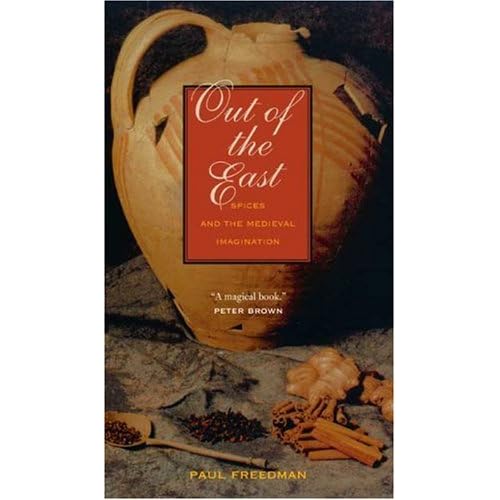
Out of the East: Spices and the medieval imagination, by Paul Freedman


This book was a real treat, and not just because much of it was about food and dining. It's one of the best-written medieval/early modern history books I have read in a long time, and one of the most original.

If you have ever eaten, tried cooking or just read about aristocratic food in the Middle Ages -- and aristocratic food is almost all we know about -- you already are aware that medieval feasts included a lot of highly spiced foods. The spices used in "savory" dishes then are hardly ever used today except perhaps in desserts; some, like grains of paradise and zedoary are hardly known. There has been some good scholarly work in recent years as to why medieval cooking and modern European differ so much; Terence Scully, for instance, has explained the connection between the ancient and medieval medical theories involving the four humours and medieval recipies and feast design. But Paul Freedman's book probably is accessible to more readers while actually covering a great deal of novel material.

One very interesting subject Freedman covers is how the appeal of some of the favorite exotic spices faded dramatically when European merchants gained direct, routine access to them. People still wanted cloves and nutmeg, but they no longer thought of them as powerful, almost spiritual substances. And when it became known that grains of paradise came from the mundane West Africa (precisely, "the Grain Coast") and not the earthly paradise, Europeans slowly lost interest in them.

There is much more in this book -- lots about early European exploration and the role of spices in motivating it -- and I highly recommend it to anyone who finds this review in the least interesting.

Update: Phil Feller directs us to an NPR interview with Freedman.

Sabtu, 20 Juni 2009