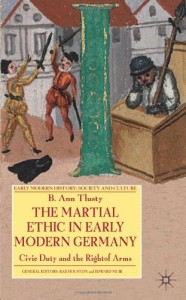
B. Ann Tlusty’s The Martial Ethic in Early Modern Germany is one of those books that simultaneously delights and frustrates the reviewer: Delight, for the immense wealth of valuable material it contains, coupled with admiration for the author; frustration, because of the sure knowledge that one is unlikely to ever write a work as good. Then again, few scholars do: Tlusty bases her argument on an intimate knowledge of city archives, especially those of Augsburg and with an emphasis on judicial records, but incorporates a wide number of other sources, both archival and published. These are masterfully synthesized into a nuanced and far-reaching argument that addresses core questions in the historiography of early modern Europe. Martial Ethic, in other words, a definitive work of history, one that deserves to stand beside works on the history of violence and arms in Europe such as those of Ute Frevert and Kevin McAleer for modern Germany and François Billacois, Peter Blastenbrei, Trevor Dean, Robert Nye, and Pieter Spirenberg for the rest of Europe (1) and which ought to be on comprehensive exam reading lists and incorporated into survey courses on later medieval and early modern Europe. It has already achieved well-merited renown amongst the Historical European Martial Arts crowd, but seen from the perspective of Martial Ethic, the Fechtbücher (records of fencing teaching) seem like footnotes to the greater trends and ideas brought out by Tlusty.And there is lots more...However, like all great history, Martial Ethic is not an apolitical work. By this I do not mean that Tlusty’s objectives or arguments are in any way directed towards making a modern political argument, but rather that they resonate with an important contemporary concern—namely the American debate over firearms. This is unavoidable for two reasons: the fact that (as Tlusty points out) American gun culture owes some of its genetic material to Germany, and the fact that the historian’s ever-present obligation to make the past relevant to the present naturally guides us towards subjects of broader interest. While Tlusty’s main aim is to make a contribution to the literature of violence and the growth of the state in premodern Europe, she is certainly cognizant of contemporary resonance. In the same way, it is the reviewer’s obligation to tease out the broader implications of the work under consideration. Therefore, I will first discuss the structure and arguments of Tlusty’s book and what they mean for the historical discipline, and then editorialize on their relevance to modern society.
Selasa, 03 Februari 2015
Kamis, 23 Agustus 2012
The Sultan's Organ, by John Mole
John Mole noticed my personal and professional interest in Islamic history and sent me a most interesting book, The Sultan's Organ, a book that is not salacious in the least, concerns an Englishman, Thomas Dallam, who around 1600 transported a gift from Queen Elizabeth and a number of her merchants trading with Turkey to the Ottoman Sultan: a massive organ that not only played music but was festooned with mechanical figures.
It's a good read.
I've often thought from other reading that through most of history has been little difference between a sailor and a pirate. This account clearly confirms that impression with regard to the Elizabethan era.
There is also some really down to earth description of the daily life of a traveler: the search for provisions on an infertile Mediterranean island that results in the searchers finding only some garlic for sale – garlic that their fellow travelers are very interested in acquiring once they hear of it;. or the amazing story of how these English travelers, spending the night in an abandoned house, almost scare themselves to death because they mistake a loose garter for an attacking snake.
John Mole has written a number of other books, which can be acquired on his website here. One that appeals to me is his story of being "a potato oligarch in the new Russia." You can read the first page here and see why I am considering following up.
Rabu, 18 Juli 2012
The Duel in Early Modern England: Civility, Politeness, and Honour, by Markku Peltonen
There are a few things I didn't like about this book, and one of them is a common feeling I have these days about academic work in general. This author, like others, is so intent on citing as much evidence as possible that the reader can get overwhelmed. Critics of dueling in England made such and such an argument against the practice – and then we see every single time the point was made by every single author made it. This may not be literally true but it sure feels that way. I think that this book was far too encyclopedic for its own good. But then this may just be me; I used to be, and probably still am, the kind of person who reads big serious books word by word. Even though I can after many years in academe follow many arguments without doing that, I still feel a bit guilty about skipping over material. On the other hand, might it not be worth considering a change in academic practice? This book, which focuses on the written debate about dueling, could have been a lot zippier and still met the intellectual needs of most of its audience.
A final small gripe is that Peltonen doesn't seem to be very interested in what came before and what came after his period. Where early modern attitudes came from and why they dispersed are things I would like to know more about. Perhaps the author was smart to leave these aside; the book might have been truly vast if he had tried to master all the relevant sources and modern debates about them. Anyway, if you have a serious interest in dueling, this is well worth looking at. I'm glad it showed up in our library, where it sits next to my recent Royal Jousts.
Rabu, 16 Februari 2011
Cheese, Pears and History in a Proverb
Montanari, Massimo. Cheese, Pears, and History in a Proverb.
New York: Columbia University Press, 2010. Pp. 128. $26.50/£18.50.
ISBN: 978-0-231-15250-1.
Reviewed by Paul Freedman
Yale University
paul.freedman@yale.edu
Even in an age of narcissism and first-person journalism it isn't
customary for reviewers of scholarly literature to put themselves
forward before getting around to reviewing the book at hand.
Nevertheless I feel compelled to say at the outset that this short
study (90 pages plus bibliographic references), for all that its
subject is completely new to me, encapsulates almost uncannily my own
interests over the last few years as it concerns gastronomy
(especially its social symbolism), seigneurial representations of the
peasantry (along with some attention to peasant opinions of their
masters as well), and the peculiar power and durability of proverbs.
Montanari starts out as if he is going to offer a micro-history of one
somewhat puzzling maxim, but the book turns into something
considerably more complex as it describes the reversibility and
circularity of our perceptions and articulations of reality.
Along with the late Jean-Louis Flandrin, Massimo Montanari has been a
pioneer in the study of medieval as well as modern cuisine. He has
discussed changing fashions in food and how these tastes were shaped
by considerations of social distinction. Food conveyed social claims
and status in the Middle Ages and this remains true now even if the
specific items have taken on new symbolic meanings. One era's fish
waste might be another's caviar; organ meats and root vegetables are
suddenly chic after decades of lowliness.
We begin with an old but still current Italian aphorism: "Do not let
the peasant know how good cheese is with pears". The ensuing
investigation analyzes this bit of advice whose actual meaning is not
at all clear, despite the widespread popularity of the saying
throughout Italy and similar formulations elsewhere in Europe.
Proverbs are usually supposed to be distillations of folk or lower-
class wisdom. Sancho Panza is given to proverbial observations, so
much so that the usually oblivious Don Quixote curses him and asks for
sixty thousand devils to take him away along with his irritating
sayings. Sam Gamgee doesn't annoy Frodo to the same degree in Lord
of the Rings, although he makes frequent down-to-earth gnomic
observations, sometimes citing his father's authority for them. Yet
the humorous warning about cheese and the pears expresses contempt for
ordinary people voiced by a person of superior rank even if
historically its use was not limited to the privileged classes but
rather was always well-known to peasants.
The combination of pears and cheese is hardly counter-intuitive nor an
intrinsic mystery. As early as the thirteenth century a French saying
asserts that God never made such a blessed marriage (Onques Deus ne
fist tel mariage / Comme de poire et de fromage). Montanari notes
that in 2007, a town in Friuli famous for its cheese was twinned with
one in Emilia-Romagna noted for pears. The first introduction of an
anti-peasant aspect to this pairing comes in the late sixteenth
century: "May you never know, peasant, what it is to eat bread, cheese
and pears" (Non possa tu mai villano sapere / Cio ch'è mangiar
pane, cacio e pere).
However tasty pears and cheese are, setting them side-by-side is odd
for a proverb with explicit class implications because cheese was a
typical peasant food while pears were aristocratic delicacies.
Montanari devotes the first part of the book to the medieval attitudes
towards the two items. Cheese was avoided by the upper classes as a
crude and unhealthful peasant staple until the fifteenth century when
in Italy a fashion for dressing up simple dishes and hierarchical
ranking of certain cheeses as prestigious made cheese more common in
aristocratic entertaining. Noble consumption of cheese remained
distinct from peasant patterns since for the latter cheese was a main
ingredient of a meal while for the well-off, cheese and fruit
comprised a small course to close a meal.
Unlike cheese, pears were always considered desirable, as were all
tree fruit. They are, or at least seemed to be, particularly
delicate, easily bruised and spoiled and so prized for their
fragility. In fact, however, some varieties are tough enough to be
stored in winter, but these hardy fruit were avoided by those with
some choice in the matter. Pears were commonly gifts made between
nobles, so that for example the Gonzaga dukes of Mantua gave away
their own early-ripening precoce di Moglia pears to their
friends.
Different in social cachet, pears and cheese were nevertheless equal
objects of medical disapproval, cheese because of its heaviness and
supposed indigestibility (common to most peasant fare such as beans or
root vegetables), and pears because of their humorally cold nature
which endangered the stomach. Doctors reluctantly allowed the
consumption of cooked fruit while cheese also achieved a grudgingly
accorded medical respectability. Cheese came to be seen as variable
in its properties and so capable of being matched with different
personal temperaments as argued by Pantaleone da Confienza in his
late-fifteenth century Summa laticiniorum whose composition
marks the advance of cheese into elite consideration.
The turning point of Montanari's intricate book is the introduction of
the social differentiation of gastronomic taste. The notion of fixed,
class- appropriate foods is particularly important to the seigneurial
image of the lowly, even bestial rustic. It's not only that peasants
depend on porridge, dairy products or onions for their sustenance, but
that this is their "natural" fodder. Even when given the opportunity
to consume better fare they cannot tolerate refined food any more than
nobles can readily digest the crude provender of agricultural
laborers. There are many medieval stories about well-off peasants who
marry into the upper classes and cannot adapt themselves to the diet
appropriate to their new status. Montanari cites the example of the
wily Bertraldo, a successful rustic who met a bad end at court because
of the exquisite food he had to eat. Once he fell ill he begged the
doctors to bring him beans simmered with onions and turnips cooked
under ashes, but as they did not comply, he died. Other examples have
a happier ending as the upstart peasant's wasting indigestion is
suddenly relieved when he is provided with beans and peas with soaked
bread, or cheese, or leeks and onions.
Taste and social status are, in fact, malleable and shifting despite
the efforts of medieval anecdotes to present food preference as fixed
by nature and class. On a basic level it would seem that cheese is a
rustic staple while pears are an aristocratic fancy, but the ascent of
cheese to a position of gustatory prestige shows that reputations can
change. The real fear seems to have been that the more successful
peasants would be able not only to tolerate but enjoy things deemed
inappropriate to their rank. The proverb about the pears and cheese
expresses a common noble and urban dislike of peasants not so much in
their traditional rural squalor but as socially mobile and newly
enfranchised.
The proverb is a bit more complicated, however. It is not as if the
peasants didn't know what pears were, after all. Medieval and early
modern rustics were responsible not only for cheese-making but for
taking care of fruit trees as well. Pears were not like spices,
purchased as imported luxuries and so relatively (but by no means
completely) unavailable to the lower orders. Even if peasants had
somehow discovered that cloves were delicious, they could hardly have
done anything with this knowledge, while if they knew how felicitous
the matching of pears and cheese was, they would start stealing,
holding back or otherwise appropriating the pears in their custody.
There are still additional layers to this seemingly simple saying and
in a final section Montanari shows us something about the flexibility
of this maxim and indeed of all proverbial wisdom despite, or because
of the aphorisms' pithily authoritative statements of the way the
world is. It is not enough to find out the "origin" of a saying but
to see who says it, who can say it and with what polyvalent
overtones. If the peasants already know about pears and cheese, then
in their enunciation the proverb has a rather amusing set of meanings
that might range from the fatuousness of upper-class claims to special
knowledge to expressing the comic degradation of worldly wisdom too
widely disseminated (consider the fate of the modern American cliché
that the three most important price factors in real estate are
"location, location, location," which once counted as serious advice
but is now risible).
This brief summary of the ins and outs of Montanari's argument only
peels the skin off the proverbial pear. Cheese, Pears, and
History is a marvelous book whose brevity reveals twists and
surprises in its carefully reasoned observations and conclusions.
Image: Blue cheese, pears...and choclate! From Coffeeandvanilla.com.
Sabtu, 06 November 2010
I feel this way about the Early Modern sometimes
Beachcombing’s first thought on reading this was just how glad he is to not have lived in the seventeenth century. The Middle Ages did bigotry with style, whereas modernity manages tolerance tolerably well. The early moderns though fall between two stools – even the likeable Gage [the English Dominican, Thomas Gage (obit 1656) who traveled to the New World in the first quarter of the seventeenth century] converted to Catholicism and back again to Anglicanism and then worked with that monster Oliver Cromwell towards the end of his life.
You will want to read this post. It's got chocolate.
Image: Guy Fawkes, a 17th century sort of guy. Er, fellow.
Senin, 27 September 2010
Jumat, 17 September 2010
Natalie Zemon Davis!
Speaking partly from her own experience, Professor Davis will explore ways that the practice of history has changed, examining historical comparison through local figures (a male and female writer from different parts of the world in 1400) and through cultural crossing (how techniques in healing and justice transferred from Africa to a slave colony).
Natalie Zemon Davis is among the most widely known and influential historians in the academy. Her work on the social and cultural history of early modern Europe has reached readers far outside the university setting, perhaps most famously with The Return of Martin Guerre (1983) and most recently with Trickster Travels: a Sixteenth-Century Muslim between Worlds (2008). Earlier this year she received the Holberg International Memorial Prize in recognition of her lifetime achievement.
The lecture is free of charge and all are welcome.
Sabtu, 28 Agustus 2010
"An honest to God Elizabethan psycho" and a fascinating reading list about literacy
Thanks to Dr. Beachcombing, I got to read about said Elizabethan psycho, Sir Richard Grenville, who
... was of so hard a complexion that, as he continued among the Spanish Captains, while they were at dinner or supper with him, he would carouse three or four glasses of wine; and, in a bravery, take the glasses between his teeth, and crush them in pieces, and swallow them down, so that oftentimes the blood ran out of his mouth, without any harm at all to him: and this was told me, by diverse credible persons that, many times, stood and beheld him.To see what kind of excesses eating wineglasses can lead to, I refer you to this post.
If, however, you are in a less excitable mood, Stephen Christomalis provides the world with his reading list for a grad course on writing systems and literacy. Now if I could just pull myself away from this screen, I could indulge myself in such treats as
John Defrancis, The Chinese Language: Fact and Fantasy.Enough to make your mouth water, isn't it? Beats reading debates on the fragile economy.
While the title suggests that it is more generally on language, the core of the book is on the nature and social context of the Chinese characters, ranging from basic semiotic issues to modern romanization efforts, and the gross misunderstandings most Westerners have of the script.
Minggu, 04 Juli 2010
The mass grave of 51 military horses
Sabtu, 10 April 2010
Natalie Zemon Davis will be at Nipissing University in September
Mark your calendars: the exact date is September 24.
Davis is one of the most eminent historians in Canada, or even North America as a whole today. She is famous for taking difficult sources and putting flesh on them dry bones. Perhaps her most well-known project was interpreting the story of a 16th-century French imposter, Martin Guerre -- a project that produced a book on the case itself, an article on her methodology, and
a movie recreating the story. Like many another historian teaching early modern Europe, I have sometimes used the Martin Guerre material in class. Others, I am sure, have used more recent books -- because Davis is someone interested and skilled at communicating with people who aren't scholars as well as those who are.
It's quite an honor to have Davis accept the History Department's invitation to speak. Take advantage of this opportunity to hear her if you can. More details as available.
Oh, yes, when we are talking about eminence and reaching a broader public, there is this recent honor to make the point.
Senin, 04 Januari 2010
Simplicius Simplicissimus: a forgotten classic
I have taught my year-long course on early modern European history 1400-1800 maybe 10 different times. From the beginning I was aware that there was a classic novel of the 30 years war called Simplicius Simplicissimus, written in German not long after the events it describes. The book is considered a valuable resource for people studying the war and the experience of soldiers in it. I never had time to get hold of it myself, since it wasn't in any of the University libraries that I frequented.
I have temporarily relocated for my sabbatical and now have been able to put my hands on the book. And you know, it is really good. It is a typical 17th-century satire where the hero is a fool, which is to say that he has a clear-eyed view of what other people do and why they do it, and the same for himself, for whom he makes no excuses. Simplicius starts out as a poor orphan, and travels through society rising and falling in wealth and status, mostly depending on his luck at any given time.
A book like this has a real chance of being absolutely deadly to modern tastes. But somehow it isn't, at least not in this translation by George Shulz-Behrend from 1965. The prose is clean and light with no fake archaic flavor. In fact, it has a real contemporary feeling, meaning fresh and contemporary by the standards of the middle 60s. Not so long ago even if you weren't born then. Despite the fact that it exposes the sins and foibles of all sorts of people, it isn't brutal as it so easily could be.
The main fault of the book is that the author, Johann Jakob Christoffel von Grimmelshausen, throws in more digressions that I care for with the result that the book is about 20% too long and sort of runs out of steam rather than ending properly.
Image: the cover page of the 1669 edition.
Minggu, 13 Desember 2009
Dictionary of Traded Goods and Commodities, 1550-1820
British History Online has webbed a searchable version of this reference work, for serious research or serious fun.
Image: Market Hill in St. Edmundsbury, 1700.
Sabtu, 10 Oktober 2009
Fencing: A Renaissance Treatise, First English translation, edited by Ken Mondschein
Camillo Agrippa’s widely influential Treatise on the Science of Arms was a turning point in the history of fencing. The author — an engineer by trade and not a professional master of arms — was able to radically re-imagine teaching the art of fencing.
...
His treatise was also a microcosm of sixteenth-century thought. It examines the art, reduces it to its very principles, and reconstructs it according to a way of thinking that incorporated new concepts of art, science and philosophy.
Contained within this handy volume are concrete examples of a new questioning of received wisdom and a turn toward empirical proofs, hallmarks of the Enlightenment. The treatise also presents evidence for a redefinition of elite masculinity in the wake of the military revolution of the sixteenth century. At the same time, is offers suggestive clues to the place of the hermetic tradition in the early-modern intellectual life and its implications for the origins of modern science.
Camillo Agrippa’s Treatise on the Science of Arms was first published in Rome in 1553 by the papal printer Antonio Blado. The original treatise was illustrated with 67 engravings that belong to the peak of Renaissance design. They are reproduced here in full.
Recent
Weekly
-
This announcement speaks for itself: Dear Colleagues, After two decades teaching medieval art history and doing photography for my own use,...
-
I have always loved maps and history. Growing up in the USA in the early 60s, the Southeast Asian war gave me the opportunity to learn geog...
-
From the Guardian: Leading foreign academics from the LSE acting as expert advisers to the UK government were told they would not be asked ...
-
A new translation of this fascinating treatise on horsemanship by a fifteenth-century king. This interview with Jeffrey Forgeng comes from...
-
...if you are very, very rich. (Most mss. of this age and quality are in national or university libraries and are not for sale at any price...
-
I am in the middle of this very interesting book. You might expect that the book would have a lot to say about the history of dividing blac...
-
In 1388, the Good Duke (Louis of Bourbon) was campaigning on the German frontier. As he besieged a castle, one of the duke's servants, ...
-
Mcleans reports : And then there’s Patrick McGovern, an archaeologist at the University of Pennsylvania who, after analyzing the residue tha...
-
I was reading one of Uncle John's trivia books -- which are designed with bathroom readers in mind -- about harmonicas. It listed Ameri...
-
Two experts in the Middle East have been more useful to me than most of the more prominent ones. They are Juan Cole and Joshua Landis. If yo...