Book Review: “Deeds of Arms” by S. MuhlbergerWes von Papineäu JUNE 19, 2015CATEGORIES: ADULT SWORDPLAY, PROGRAMS, SWORD NEWSTAGS: BOOK REVIEW DEEDS OF ARMS HUNDRED YEARS' WAR JOUSTING MEDIEVAL MUHLBERGER “They are stories about stories.” [1] It does my heart good when I hear competent people say that they’ve recreated the essence of some medieval martial art event to the best of their ability, because they followed the descriptions of medieval combat “exactly” from period texts. It’s a good … start. But what if the reference book is not completely correct about the event it describes? What if the author had written a version of the event he witnessed that was “flavoured” by a political or social leaning? What if he wrote of an event based on his interview of someone who had (allegedly) witnessed the event? And even if the author penned a totally neutral recollection of an event, did he truly understand the nuances of the combat that he was witnessing? (Think of when you as sword scholars see swordplay on television, and your “recollection” of what went on compared to that of your swordless peers). This is the conundrum that the eminently qualified and respected medieval historian Muhlberger brings to our attention in well-documented and easy-to-read detail. A Broad Overview In the first half of the book, Muhlberger focusses on the period of the Hundred Years’ War following the battles of Crécy and Poitiers (1350-1400). Using period recollections of “deeds of arms” (conflicts fought by prearrangement and within agreed upon limits), Muhlberger explains how tales of combat came to be so important for 14th century French literature … and for the medieval man-at-arms’ “sense of self”. [2] More importantly for us, he goes on to describe just how period writings concerning these events were influenced by a great variety of political, social or personal influences on the writers during this period. (Apparently, even back then, authors expected to be paid for their original work. Who knew?) With the aid of this information, Muhlberger guides us to a more careful consideration of how we interpret what really happened in any particular mêlée within the context of medieval politics and culture. This is not a “fight book”, and it is not a history of historical duels; but it is a description of how period authors wrote about “deeds of arms”, and why the styles they used were fashionable. The book is divided into sequentially supporting chapters, each of which I found could stand alone as independent studies in their own right.Chapter-by-Chapter First we learn of the risks undertaken by men-at-arms when one actually engages in physical combat, both in duels and war. (We do get a nod to select fight books here.) [3] The reader is introduced to the concept of “formal duels”, and extant variations on the theme. Next, Muhlberger gets into the meat of his proposal with his examination of writings featuring the combat of “Thirty against Thirty” in 1351, examining in detail the confusion and discrepancies in recollection caused by passing time and the use of second hand accounts — and how sometimes the story of an event became more important that the actual event. The chapter entitled “Will a Frenchman fight?” is most illuminating, demonstrating unequivocally that while the French Royal Army of 1380 was not famous for seeking battle, there were lots of French men-at-arms throughout the land ready to remind Englishmen that (to paraphrase a great film) “[their] mothers were hamsters and [their] fathers smelt of elderberries” … and were willing to back that challenge with one-on-one cold steel. “Deeds of and Careers in Arms” describes how our protagonists built wealth and reputations during deeds of arms, and how the chroniclers of those deeds became our first “spin doctors”, worthy of employment in any modern PR company. To finish, we are presented with period impressions of the four royal jousts conducted between the years of 1389 and 1390 during the “good peace” … though the intensity of combat during one tournament appeared to be equal to the combat seen in any war. In Conclusion A reading of Deeds of Arms would serve well anyone trying to recreate historical events in modern times. Any historical reference that a modern scholar may wish to use as “canon” is apt to be slanted in its representation of any past event — even if written with the very best of “neutral” intent and desire for accuracy. Read the old manuscripts, yes. But remember that when we are looking for guidance on how things happened in medieval times, a manuscript only tells us of one person’s recollection of “historical truth” and that any manuscript — regardless of its detail and “accuracy” — must be interpreted as part of a greater regional and situational historical record. Read. Consider. Validate. Sources 1. Muhlberger, Steven. Deeds of Arms – Formal Combats in the Late Fourteeth Century. (Highland Village Texas: Chivalry Bookshelf, 2005) 4. 2. Muhlberger. Deeds of Arms. 3. 3. Muhlberger. Deeds of Arms. 23.
Jumat, 06 Januari 2017
Jumat, 02 Desember 2016
Death by overexertion, an English duel of 1380
Some of you probably know that I am writing a source reader -- a book that combines medieval documents with modern commentary -- on the subject of judicial duels. These were considered to be the most dramatic "deeds of arms" by contemporaries and modern re-enactors are very interested in them. My book in fact was inspired by Will McLean's collection of sources in his blog, and he will be credited as co-author.
This book includes an account of an English duel between as squire,Thomas Katrington, and Sir John de Annesley. Annesley, the knight accused Katrington, who had commanded a castle in France, of treason, because, said Annesley, he had surrendered it to the French when he had the resources to defend it. After a certain amount of political back and forth among major players, including Duke John of Gaunt, a duel was arranged. There was so much public interest that the crowds who attended were said to exceed those at the recent coronation of Richard II.
An interesting point is the way the duel ended. It was said to be half an hour long, and very strenuous, with the weapons of either man being destroyed so that (I think) they were fighting on foot with daggers. They ended up both lying on the ground with Katrington on top. The question then arose, what next?
Soon after [Annesley, the knight] was raised up, without any support he eagerly went to the king, while the squire [Katrington]who had been raised, was not able to stand nor go anywhere without the support of two men; and therefore, he was put upon a chair, and he remained there quietly. The knight therefore came to the king and asked him, and his nobles, that he would grant him the grace, he should be put in the same place as before, with the squire on top of him... he realized that the squire was nearly at his last breath from the excess of [labor] and heat, and the weight of arms which had almost taken the vital spirits from him.
In the meantime the squire, lacking breath, suddenly fell off the chair, as if dead, among those who stood around him. Many therefore took care of him, pouring wine and water over the man; but nothing helped at all, until his arms and all of his clothing were removed . This being done it proved that the knight was the victor and the squire defeated. After a long delay, however, the squire's spirit began to revive, and opening his eyes he began to raise his head, and terribly began to look at all of those standing around ; when this was announced to the armored knight, (for the knight had not taken off his armor from the beginning of the fight) he approached the squire and called him a false traitor, and asked if he dared to repeat the duel. Since [Katrington] indeed had neither sense nor breath to answer, it was announced that the fight was over and that each should return to his own place. The squire therefore was soon carried to his bed, and he began to rave; and persisting in his madness, the next day, about the ninth hour, he breathed forth his spirit.
In addition, a short piece from Froissart (book III, chapter 7; also late 14th century):
A squire of Navarre was there slain, called Ferdinand de Miranda, an expert man at arms. Some who were present say the bourg d'Espaign killed him, others that he was stifled through the heat of his armour.
Senin, 23 Mei 2016
Reviews of Royal Jousts and the Combat of the Thirty (De Re Militari)
MAY 23, 2016
Royal Jousts at the End of the Fourteenth Century, Deeds of Arms series 1
The Combat of the Thirty, Deeds of Arms series 2
ed. and trans. by Steven Muhlberger
(Freelance Academy Press, 2012) i- viii, 88 pp., $24.95; ii- viii, 83 pp., $24.95
Over the past fifteen years Steven Muhlberger has established himself as one of the leading authorities on medieval chivalry. His scholarly oeuvre has not only made an important contribution to the larger field, but in many ways has blazed a new trail through his focus on case-studies of particular events, individuals, and texts. [1] The two works reviewed herein, Royal Jousts at the End of the Fourteenth Century and The Combat of the Thirty, fit this mold and are part of a series on formal deeds of arms (faits d’armes) published by Freelance Academy Press, one that has already received the approbation of scholars. [2] These two volumes, and the series as a whole, will be especially attractive to scholar-teachers who can use them to great effect in the classroom, while also offering a useful introduction for graduate students and researchers who wish to study for the first time formal deeds of arms and their important role in the chivalric culture of late medieval Europe.
In the first volume in the series, Royal Jousts, Muhlberger examines four historical jousts held in 1389-1390. Three of the jousts were organized by the French and one by the English: the Joust at St. Denis (May 1389), the Joust accompanying Queen Isabella of Bavaria’s entry into Paris (August 1389), the Joust at St. Inglevert (March-April 1390), and the Joust at Smithfield near London (October 1390). These jousts were meant to celebrate both armes (arms, i.e., prowess, bravery, valor, etc.) and amour (love). In addition, they served the propagandistic purposes of two young kings, Charles VI of France and Richard II of England, who sought to both secure a lasting peace between their kingdoms after decades of war and to encourage and reward the chivalric energy and violence of their knights and men-at-arms. These two seemingly contradictory impulses could be reconciled in such formal combats.
The first part of Royal Jousts consists of an introduction and succinct historical study of the jousts. Muhlberger aptly sets the stage for each and duly notes their larger implications. Indeed, Muhlberger usefully points out that formal deeds of arms, including jousts, “were taken extremely seriously [by contemporaries:] they were war, diplomacy, or domestic politics in a different form”, suggesting that they were far more than simply a means to satisfy the romantic fancy of a small segment of late medieval society. (12) Muhlberger also includes a critical, albeit concise, discussion of the relatively limited available sources, emphasizing caution in their use: “we should not[…] mistake interest and enthusiasm for diligent, accurate reportage”. (3) The limitations of these sources are all the more important because the accounts of these jousts, especially the joust at St. Inglevert, have generally been utilized by scholars to “stand[…] in for every unrecorded jousting match of the later Middle Ages”. (6) Muhlberger’s English translations of the various texts that discuss each of the four jousts and an appendix, which attempts to score the 137 courses run by the French champions at St. Inglevert, complete the volume.
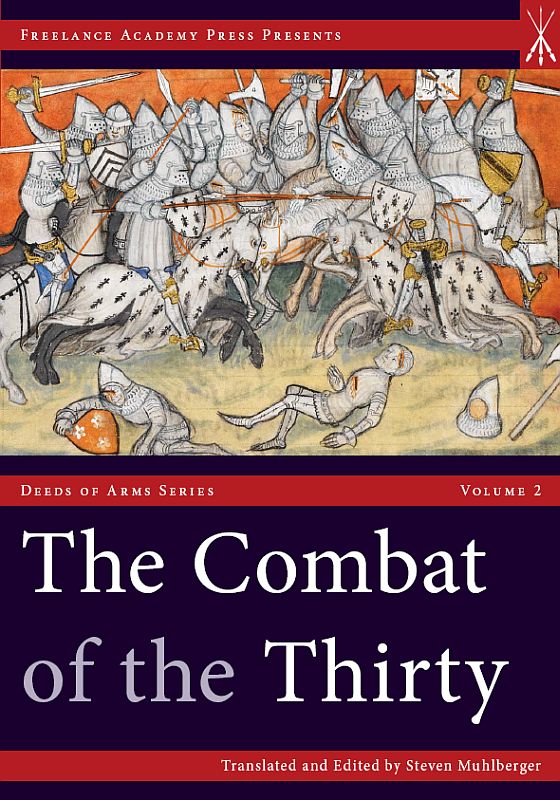
In the second volume, The Combat of the Thirty, Muhlberger examines a different kind of formal deeds of arms, a pre-arranged battle between two groups of strenuous warriors. In this particular battle, generally known as the Combat of the Thirty, two groups of thirty men fought in an open field in Brittany on March 27, 1351. Each group represented one of the garrisons of two nearby castles (Josselin and Ploermel) and the battle was apparently occasioned by the promise of the captain of one of the sides that “we will go to an open field and there we will fight as long as we can endure it”. (1) The Combat of the Thirty was in many ways a decidedly local (i.e., Breton) affair, while at the same time serving as a microcosm of the larger conflict between the French and English during the Hundred Years War, although it was not officially sanctioned by the leadership on either side. Indeed, the Combat of the Thirty divided opinion among contemporaries, while at the same time acquiring a lasting (and contested) legacy that has continued to the present.
The Combat of the Thirty is organized in a fashion similar to Royal Jousts. The first part consists of a brief, but illuminating historical introduction to the Combat of the Thirty and its place in both the history of the Hundred Years War and of Brittany as a region. Muhlberger also attempts to answer several sensible questions: “Why did sixty men risk themselves in a fight to the finish on that spring day in Brittany six and a half centuries ago? Why did it attract attention and praise in its time? Why does it interest us still?”. (2) His answers shed light on some of the nuances of chivalric culture in the mid-fourteenth century and the important role formal deeds of arms played in it. The introduction also includes a useful discussion of the extant and often conflicting sources that treat the Combat of the Thirty. The second part of the volume contains Muhlberger’s translations of these texts. Finally, the volume also contains two appendices. In the first, Muhlberger reconstructs, as much as is possible, a list of the combatants on both sides, as well as their heraldic devices. Historians of the Hundred Years War will no doubt recognize several of the participants, especially Robert Knolles, Hugh Calveley (Calverley), Jean de Beaumanoir, and Yves (Yvain) Charruel. The second appendix, composed by Douglas Strong, offers a short analysis of the armor of the English and Breton combatants.
In summary, Royal Jousts and The Combat of the Thirty will offer researchers, scholar-teachers, and students alike a stimulating and enlightening introduction to two different kinds of formal deeds of arms: jousts and a pre-arranged battle between two groups of chosen combatants. Muhlberger’s historical introductions and analysis in both volumes are succinct and informative. Likewise, the translations in both works are approachable and accurate. These translations will prove especially useful in the classroom, not least because they will allow students to compare different accounts of the same events. They will also serve as an entry point for those interested in investigating these formal deeds of arms in greater detail, even if specialists and non-specialists alike will lament the lack of footnotes and more expansive analysis. These very minor points, however, take nothing away from the overall quality of the volumes. Finally, this reviewer would be remiss to not give credit to both the author and the publisher for producing two books that are beautifully illustrated and, more importantly, eminently affordable.
Peter W. Sposato
Indiana University Kokomo
psposato@iuk.edu
Footnotes:
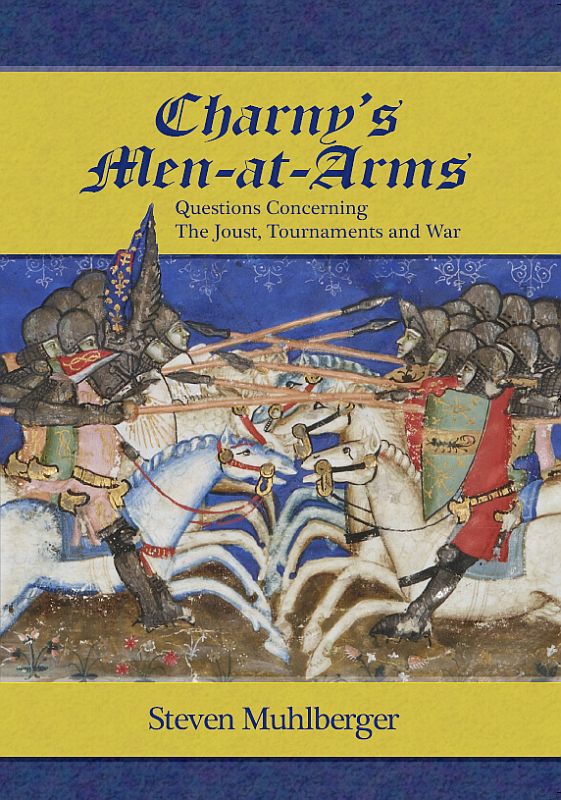
[1] Prominent among Muhlberger’s other publications on chivalry are: Jousts and Tournaments: Charny and the Rules for Chivalric Sport in Fourteenth-Century France (Chivalry Bookshelf, 2002); Deeds of Arms: Formal Combats in the Late Fourteenth Century (Chivalry Bookshelf, 2005); and Charny’s Men-at-Arms: Questions Concerning the Joust, Tournaments, and War (Freelance Academy Press, 2014).
[2] The series includes: Noel Fallows, The Twelve of England, Deeds of Arms 3 (Freelance Academy Press, 2013) and Steven Muhlberger, Will a Frenchman Fight, Deeds of Arms 4 (Freelance Academy Press, 2015). For the positive reception of The Twelve of England, see the review by Dr. Samuel Claussen on the De Re Militari website- http://deremilitari.org/2016/04/noel-fallows-the-twelve-of-england-claussen/.
Jumat, 24 April 2015
Antoine de la Sale, Jean de Saintré. My review of a new translation
Rabu, 11 Maret 2015
A twelfth-century description of a judicial duel on horseback
it is time for you to fight like men,
the Campeador's men will not fail in anything.
If you come off he field well, you will have great honor,
if you are defeated, don't blame us,
for everyone knows that you went looking for it.-
Now the infantes of Carrión are repenting,
for what they did they are filled with regret,
they wouldn't have done it for all there is in Carrión.
All three of the Campeador's men are armed,
King don Alfonso went over to see them,
the Campeador's men said,
-We kiss your hands as king and lord,
that you be field judge for them and for us,
help us fairly, allow no wrongs.
Here the infantes of Carrión have their band,
we know not what they will plan or what they won't,
in your hand our lord placed us,
protect our rights, for the love of the Creator.-
At that moment the king said, -With all my heart and soul.-
They bring them their horses, good ones and swift,
they blessed the saddles and mount confidently,
the shields that are well reinforced at their necks,
in their hands they take the shafts of the sharp lances,
these three lances have their own pennons,
and around them many fine men.
They now went out to the field where the markers were.
All three of the Campeador's men are in agreement
that each one of them should strike his adversary hard.
Behold at the other end the infantes of Carrión,
very well accompanied, for there are many relatives.
The king gave them judges to tell them what's right and what isn't,
that they not dispute with them about who is or isn't right.
When they were in the field King don Alfonso spoke,
-Hear what I say to you, infantes of Carrión,
this combat you might have had in Toledo, but you refused.
These three knights of my Cid the Campeador
I brought them safely to the lands of Carrión,
be in the right, don't commit any wrongs,
for whoever wishes to commit a wrong, I will severely prohibit it,
in all my kingdom he will not be welcome.-
Now it begins to grieve the infantes of Carrión.
The judges and the king point out the markers,
all those around them left the field,
they showed clearly to all six of them how they are laid out,
that there whoever went outside the marker would be defeated.
All the people cleared out around there,
that they not approach the markers by any more than six lance lengths.
They drew lots for field position, now they divided the sun equally,
the judges got out from between them, they are face to face,
then the Cid's men came at the infantes of Carrión
and the infantes of Carrión at the Campeador's men,
each one of them concentrates on his target.
They clasp their shields before their hearts,
they lower their lances along with the pennons,
they lower their faces over the saddlebows,
they struck their horses with their spurs,
the ground shook where they were riding.
Each one of them has his mind on his target,
all three on three have now come together,
those that are nearby think that at that moment they will fall dead.
Pedro Bermúdez, he who challenged first,
met with Fernán González face to face,
they strike each other's shield fearlessly.
Fernán González pierced the shield of Pedro Bermúdez,
he hit only air, he did not strike flesh,
in two places his lance shaft broke cleanly apart.
Pedro Bermúdez remained steady, he did lose his balance from it,
he received one blow, but he dealt another,
he broke the boss of the shield, he split it in two,
he went through it entirely, it didn't protect him at all,
he stuck his lance into his chest, it didn't protect him at all.
Fernando wore three layers of mail, this helped him,
two of them broke on him and the third held up,
the padded tunic with the shirt and with the mail
out from his mouth the blood came, his saddle-girths broke,
not one of them was of any use to him,
over the croup of the horse he was thrown to the ground.
In this way the people thought he is fatally wounded.
The other dropped the lance and the sword he took in hand,
when Fernán González saw it, he recognized Tizón,
rather than wait for the blow he said, -I am defeated.-
The judges granted it, Pedro Bermúdez let him be.
Martín Antolínez and Diego González struck each other with their lances,
the blows were such that both lances broke.
Martín Antolínez took his sword in hand,
it lights up all the field, it is so clean and bright,
he gave him a blow, he hit him a glancing blow,
it broke away the top of the helmet,
it cut away all the helmet straps,
it tore off the mailed hood, and reached the coif,
the coif and the hood all were ripped away,
it cut the hairs on his head, and it reached well into the flesh,
one part fell to the ground and the other remained.
When precious Colada has struck this blow,
Diego González saw that he would not escape with his soul,
he turned his horse to face his opponent.
At that moment Martín Antolínez hit him with his sword,
he struck him broadside, with the cutting edge he did not hit him.
Diego González has sword in hand, but he does not
use it,at that moment the infante began to shout,
-Help me, God, glorious Lord, and protect me from this sword!-
He reined in his horse and, dodging the sword,
rode it outside the marker, Martín Antolínez remained on the field
. Then said the king, -Come join my company,
by all you have done, you have won this battle.-
The judges grant it, that he says the truth.
Both men have won, I'll tell you of Muño Gustioz,
how he fared against Asur González.
They strike each other on their shields with such great blows,
Asur González, rugged and valiant,
struck the shield of don Muño Gustioz,
through the shield he broke his armor,
the lance hit only air, for it did not strike flesh.
This blow struck, Muño Gustioz struck another one,
through the shield he broke his armor,
he broke through the shield's boss,
it could not protect him, he broke through his armor,
he hit him on one side, not near the heart,
he thrust his lance and the pennon right through his flesh,
pushing it through the other side an arm's length,
he gave it a twist, he tipped him from the saddle,
when he pulled back on the lance he threw him to the ground,
the shaft came out red as did the lance-tip and the pennon.
Everyone thinks that he is mortally wounded.
He repositioned his lance and halted over him, said Gonzalo Ansúrez,
-Don't strike him, for God's sake!
He is defeated since this is finished.-
Said the judges, -This we hear.-
The good king don Alfonso ordered the field cleared,
the arms that remained there he took them.
The Campeador's men left fully honored,
they won this combat, thanks to the Creator.
Great is the grief through the lands of Carrión.
The king sent my Cid's men at night,
so that they not be attacked or have fear.
Like prudent men they ride day and night,
behold them in Valencia with my Cid the Campeador,
they left the infantes of Carrión in disgrace,
they have fulfilled their duty that their lord demanded of them,
my Cid the Campeador was pleased by this.
Great is the shame of the infantes of Carrión,
whoever scorns a good lady and then abandons her
may such befall him or even worse.
Rabu, 04 Maret 2015
Buy these books!
First, there is "Royal Jousts". This book describes famous jousts of the 14th century as described by people who took part in them. This is the time when the kings of France and England competed not just on the battlefield but also in their sponsorship of chivalric sports. The best part of the book is the description of the jousts at St. Inglevert in the 1390s. It's famously described by Froissart, but other people wrote up the event too. I've included those other descriptions. If you are curious about what jousting meant to knights of the time, this is your book.
The third book is "Charny's men-at-arms." Geoffroi de Charny is the famous knight of the 1350s, among other things the first owner of the shroud of Turin. He was a trusted advisor of King John II of France and took part in John's efforts to revitalize chivalry in his kingdom. One project that Geoffroi de Charny participated in was an effort to revive knowledge of the "law of arms" that governed the relations between knights and knights (or "men at arms"). With the King's encouragement, Charny put together a list of questions about how the law of arms applied to jousting tournaments and warfare. Interestingly, he did not include or record any answers to those questions. So "Charny's questions"as they are usually called doesn't give us a codified legal document, but rather a list of things that practical warriors worried about – ransoms, who was qualified to fight in tournaments, and various questions of honour.
Let me also urge you to suggest to your local public library or academic library that they buy them books for their collections. These are not just books for scholars. Scholars will like them, but so will people of a variety of back grounds interested in some of the most colourful aspects of the Middle Ages.
Buy these books at Freelance Academy Press.
Minggu, 18 Januari 2015
"Tournament Culture in the Low Countries and England" by Mario Damen
Hannah Skoda, Patrick Lantschner and R. L. J. Shaw eds., Contact and Exchange in Later Medieval Europe. Essays in Honour of Malcolm Vale (Woodbridge 2012) 247-266.
And also at:
https://www.academia.edu/1760499/Tournament_Culture_in_the_Low_Countries_and_England.
It is particularly interesting for its discussion of non-noble participation in 15th century tournaments in the Burgundian lands.
Senin, 02 Juni 2014
Unhelmed
Selasa, 22 April 2014
Jumat, 04 April 2014
The Deeds of Arms series -- don't miss "Royal Jousts."
In the meantime, it's possible to read about deeds of arms in the series. I just got my royalty statement for last year (thank you, readers), and I found it surprising that though many people have bought The Combat of the Thirty, only a few have bought Royal Jousts at the End of the Fourteenth Century. It’s comparable in interest, for students of chivalry, to the book on the Thirty, and it includes a chivalric festival as famous as the Thirty, the joust at St. Inglevert.
Those of you who want to know what knights of the late 14th century thought was cool, this is a book you should have. Like all the productions of Freelance Academy Press, it’s very pretty. When you finish this volume, you will be ready and anxious to read Charny’s Men at Arms.
Ps. If you don't have any of the series, FAP has a great sale price for all three.
Kamis, 05 September 2013
Le Tournoi de Chauvency
But if you want to read about the poem, there is now this detailed treatment, just recently reviewed in The Medieval Review (but not yet on their website):
Chazan, Mireille, and Nancy Freeman Regalado, eds. Lettres, musique et société en Lorraine médiévale: Autour du Tournoi de Chauvency (Ms. Oxford Bodleian Douce 308). Series: Publications romanes et françaises. Geneva: Droz, 2012. Pp. 583. Euros 78.00 or $96.00. ISBN-13: 9782600014656.
And if you want to hear a musical composition based on the poem there is this on YouTube.
Jumat, 22 Februari 2013
The remarkable book by Sebastien Nadot, Le spectacle des joustes
For the period covered, the 15th century, it is the most thorough book I know. It compares to Noel Fallows' equally thorough book on Iberian jousting -- though the books are quite different, since they rely on different sources. Likewise it is quite a bit fuller than my Jousts and Tournaments, though again availability of the sources accounts for much of that.
What I like about Nadot's treatment is that he is interested in all aspects of the phenomenon: the fighting, the riding, the symbolism, the facilities built, the role of judges and heralds, the role of politics, everything.
Recommended for serious students of formal deeds of arms. And it doesn't cost the earth.
Further update: Nadot has another book from 2010, available at Amazon Canada. All I know is the title, "Break the Lances:"
ROMPEZ LES LANCES : CHEVALIERS ET TOURNOIS AU MOYEN-ÂGE.
Sabtu, 09 Februari 2013
Deeds of arms and me
Over this decade or so, I have generated a lot of material entitled "Deeds of Arms," because, well, it's all about deeds of arms. Is there room for confusion? Yes! So here's a brief guide to the various works of that name.
I started by reading all of Froissart's Chronicles in the 1805 Thomas Johnes translation, and typing stories that caught my eye into web pages so I could share them with friends and strangers. I didn't call this collection Deeds of Arms, fortunately -- I called it Tales from Froissart.
Somewhat later I started collecting and translating chronicle accounts of formal combats. This was the first Deeds of Arms. Soon after I followed up some footnotes and found archival documents relevant to the history of formal deeds of arms. These I collected under the name Deeds of Arms -- from the Archives.
In 2003 my book Jousts and Tournaments: Charny and the rules for chivalric sport in fourteenth-century France came out. It included my translation of Geoffroi de Charny's questions on jousting and the tournament. At the moment this book -- which avoided the dread phrase in the title, you'll notice -- is out of print, but worry not, a more complete and accurate treatment and translation of Charny's Questions is coming out.
By 2005 I felt I knew a bit about deeds of arms in general and in that year my book Deeds of Arms: Formal combats in the late fourteenth century, emerged in print. It treated the period when Froissart was writing so much about war and chivalry. Can't get away from that man... The book is still in print.
After that I had another idea -- a series about...deeds of arms. It was a kind of an extension of the first collection, a series of thematic source collections in print and illustrated. Factors not under my control derailed this project for a number of years, but thanks to Freelance Academy Press, that series, Deeds of Arms, is now a reality. I am the series editor and the editor/translator of the first two volumes. There will be more from me, but we've already lined up other contributors.
And the book design is excellent...a Freelance Academy Press specialty.
Jumat, 08 Februari 2013
Jousting in Frankish Greece, from the Chronicle of Morea
1016. The prince sent his messengers throughout all Romania and all the islands, ordering them to announce that seven crusaders who had come from the Holy Land were challenging all the knights who wanted to come and joust with them to win and lose horses. The jousts were to last twenty days and were to be held at the city of Corinth. Then he had armor made as required for seven knights, sewn with a crest of golden shells on precious green silk. Then he had suitably noble lists constructed . When the jousts began, the local knights jousted, each in turn, with the visitors.
1017. Then Prince Philip of Savoy came and jousted nobly, as did all the knights of his house. When the Duke of Athens, the most powerful man after the prince and the best rider, saw how noble the jousts were, he said he would lack nothing if he could joust with William Bouchart, because Lord Bouchart was considered one of the best jousters in the West. The duke said to prove himself, he would joust in such a way that he would charge straight on at Lord Bouchart and his horse, even if he should die.
1018. Then the duke covered himself with good layers of cloth all over his body and underneath that he armed himself with the best furs he could have. But he could not do so secretly enough that the marshal did not know about it. And when the marshal knew about it, he told Lord William Bouchart that he ought to arm and outfit himself exactly like the duke, because the duke was going to charge him head-on. Lord William replied that God would not be pleased if such dishonor were attributed to him, and he would not arm himself to die other than as simply as he had in jousting with the other knights.
1019. It happened like this: the duke entered from the visitors' side, nobly accompanied,and Lord William from the locals'. When they were in the row inside the lists, during the first joust they had, Lord William intended to spare the duke first because of the duke’s nobility and rank, and second because he was not used to jousting like the duke of Athens was doing. He left him in the list.
1020. But the duke, who wanted in the worst way to charge him, came galloping so audaciously that Lord William could not avoid him. The duke managed to point his horse's head straight toward Lord William with the result that the knights fought body and chest against one another, and their horses too—head to head, so hard that the head of Lord William's horse was smashed into its body between the two shoulders and collapsed on the ground together with the knight.
1021. But the lord, who knew the profession, did not want to leave the saddle bow until the judge ruled whether he was without a horse or not. The duke’s horse crashed into the wooden barriers. As he was about to pummet down with the duke, the knights and other men who were there around the lists in a great crowd, ran there and looked under the duke’s horse, and they forcefully dragged him out by his shoulders and arms..
…..
1022. . . . to enter the lists like someone who thinks he will die ignobly. When the marshal saw that the knight did not seem to be coming toward him, he accomplished his four laps and then went back to his tents, very angry because the count would not come joust with him and lost his resolve and the great will he had to fight with him.
1023. Lord William Bouchart had known for certain that the horse Lord John rode to the jousts was one of the best in the country and that the Lord had acted as though the horse was injured because of how much he feared the marshal. And when it got toward evening, Lord William managed to get the horse, mounted on it completely unarmed and galloped about, going in and out of the lists yelling at the top of his voice: Look here at the horse who is not able to go to the jousts!
1024. This act caused serious accusations to be made against Lord John of Nivelet. And after this joust, everone who came as a local jousted with all who came as visitors, until the jousts were finished, because there were more than 1000 to joust with the locals.Based on: Jean Longnon, Jean, ed. 1911. Livre de la conquest de la Princée de l'Amorée, Chronique de
Senin, 04 Februari 2013
An interim review of Sebastien Nadot’s Le spectacle des joustes
Jumat, 01 Februari 2013
Combat of the Thirty -- my new book
Out today!
I have collected and translated the most important accounts of this famous 14th century deed of arms, and Doug Strong has contributed an appendix on the armor.
A pretty book and a bargain!
Rabu, 23 Januari 2013
Jumat, 04 Januari 2013
Le spectacle des joutes Sport et courtoisie à la fin du Moyen Âge, by Sebastien Nadot
Avec une préface d’Adeline Rucquoi.
2012 Domaine : Histoire médiévale Collection : Histoire Format : 15,5 x 24 cm Nombre de pages : 354 p. Illustrations : Couleurs ISBN : 978-2-7535-2148-3 Disponibilité : en librairie Prix : 18,00 € |
Selasa, 04 September 2012
Martial art
One of the chief activities is SCA style combat, which uses rattan weapons to make possible a vigorous style of fighting. I don't think that the SCA style can honestly be called an historical one; it evolved from some logical but mistaken assumptions about the effects of weapons and armor. Thanks to intelligent and scholarly martial artists we know a lot more about late medieval combat at the very least.
But SCA combat has its virtues. You can stage a hard-hitting analog of medieval combat with a minimum of serious injuries. Many SCA fighters have never broken a bone, even after many years of competition. And it has a certain aesthetic appeal.
This aesthetic element was brought home to me on the weekend. I was discussing various combat systems that now exist with someone who fences in the "cut and thrust" style, in which real steel swords are used. He and I both agreed that we did not see the point of certain modern jousters and martial artists who have adopted medieval styles, who use something like medieval weaponry and medieval techniques, but scorn dressing up in medieval costume, since what they are doing is in their minds a purely modern thing. The two of us didn't see the point. It may or may not make any sense to fight in a medieval or pseudo–medieval style just for the fun of it, but to do the same thing in 21st century dress and high tech armor just has no meaning for me at all.
And that same day I was lucky enough to see the fruits of medieval aestheticism, SCA style. One of our standard fighting activities involves a small earth and wood fort that we built some years back. One of the challenges of using it is coming up with scenarios that make a certain tactical sense, even though the number of fighters involved is seldom over 20. On Saturday afternoon, some good scenarios were devised and played over and over until everyone was good and tired.
It may be the fact that I am now retired from fighting for good and all, but I found this fighting to be really quite amazing. To my educated eyes, everybody involved looked like they really knew what they were doing. That struck me because with few exceptions, the fighters were what passes for average in our corner of the SCA. There were no famous knights, except one, and he is not nearly as famous as he deserves to be as a master of the pole weapon. There were also a number of quite new fighters, and they picked up on the clues of their more experienced neighbors like there was nothing to it. For me, it was an impressive and moving moment.
Making iron at the event, 2006.
Senin, 20 Agustus 2012
One of the best things I've written
Last night and this morning I reread something I wrote a while back that I think is really very good, in its conception, its analysis, and in its expression as an effective piece of writing.
It wasn't "Democracy's Place in World History," which I wrote back in 1991 with Phil Paine; I hope that article did some good in the world, and I think it did. No, not that.
It wasn't my first book, the Fifth-century Chroniclers, a solid piece of work on how contemporaries understood what we think of as the fall of the Roman Empire. I got some good compliments on that, and I know it's one of those specialized studies that has a long scholarly half-life, maybe a century or so.
What gave me such satisfaction?
It was the chapter called "Will a Frenchman fight?" In my book Deeds of Arms. In what could almost stand as an article by itself, I tackled what for me is perhaps the most important passage in Froissart, the one which discusses the deeds of arms done at Vannes in 1381. Some of you will remember them – French and English champions fighting on foot, climaxing with an Englishman thrusting his lance into an off–target area of his opponent and disgracing himself. To understand what was going on in this passage, I had to read all of Froissart's Chronicles (and much more) to see the big picture, what Froissart and his audience thought was chivalric and what they did not. I had to be able to explain not just these deeds of arms, but many more depicted by Froissart and other way medieval writers.
And I think I succeeded. It's a good feeling.
Some readers may know that I am the editor of the Deeds of Arms series that Freelance Academy Press is putting out. (Volume 1, Royal jousts at the end of the 14th century is already in print. ) I hope in ayear or so to make a book called Will a Frenchman fight? available in that series. It won't be a duplicate of the analytical chapter I have just been talking about: instead, it will be a collection of the original accounts of those famous deeds of arms and the campaign through France that they were part of, introduced by yours truly.
In the meantime, the volume on the Combat of the Thirty should be out very soon, including a full modern translation of the best account, plus much more. Stay tuned.
Recent
Weekly
-
This announcement speaks for itself: Dear Colleagues, After two decades teaching medieval art history and doing photography for my own use,...
-
From the Guardian: Leading foreign academics from the LSE acting as expert advisers to the UK government were told they would not be asked ...
-
A new translation of this fascinating treatise on horsemanship by a fifteenth-century king. This interview with Jeffrey Forgeng comes from...
-
...if you are very, very rich. (Most mss. of this age and quality are in national or university libraries and are not for sale at any price...
-
For those who found the conclusion of this post rather cryptic, here is what Bernard of Clairvaux said in his treatise In Praise of the New...
-
I have always loved maps and history. Growing up in the USA in the early 60s, the Southeast Asian war gave me the opportunity to learn geog...
-
Two experts in the Middle East have been more useful to me than most of the more prominent ones. They are Juan Cole and Joshua Landis. If yo...
-
I just discovered this book, which came out a couple of years ago, thanks to Brad DeLong, who provided a link to a pre-print to chapter 9, ...
-
An excerpt from a recent book,Thanassis Cambanis’s Once Upon a Revolution: An Egyptian Story : A few days after the end of Ramadan, on Aug...
-
During my years with the Good Duke I have run across a number of surprising and amusing personal names: Bliomberis Loup and his brother, fo...