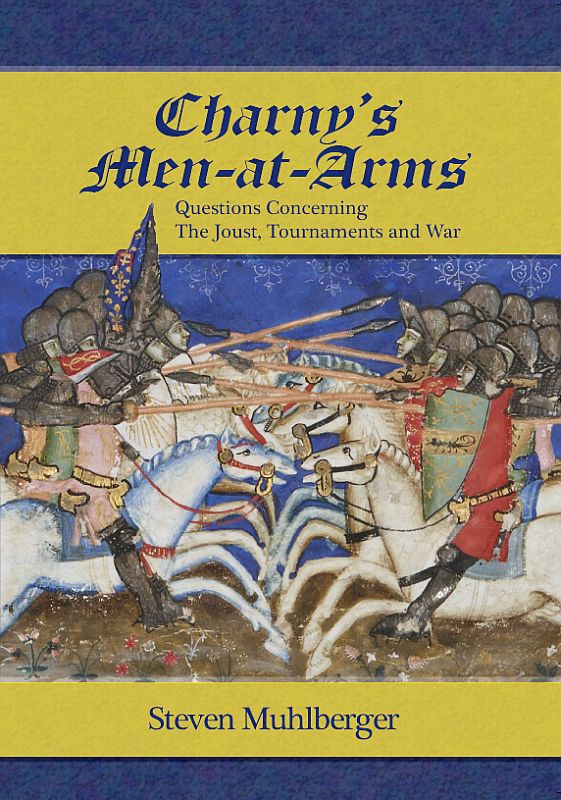
Geoffroi de Charny's son, also called Geoffroi
 By coincidence I am reading this book for the second time, just as this review from the Medieval Review comes out. I highly recommend the book. Craig Taylor is always good. Taylor, Craig. Chivalry and the Ideals of Knighthood in France during the Hundred Years' War. Cambridge: Cambridge University Press, 2013. Pp. 345. £82.00(hb); £21.99(pb). ISBN: 978-1-107-04221-6. Reviewed by Thomas K. Heebøll-Holm University of Southern Denmark thee@sdu.dk The story of French chivalry and its miseries during the Hundred Years' War is an ever fascinating and puzzling one. With this book Craig Taylor breaks important ground by showing how much French knighthood in this period was shaped by and, in turn, shaped developments in the chivalrous ideology as well as by the changing military reality of the fourteenth and fifteenth centuries. While indebted to Maurice Keen's and Richard W. Kaeuper's studies of high and late medieval chivalry, Taylor refines these paragons' more general studies of medieval knighthood by concentrating on a specific time period and region, namely Valois France during the Hundred Years' War. France during this time period is especially fertile ground for such a study. Not only was it the epicenter of chivalry, but during the Hundred Years' War the French knighthood experienced a number of military catastrophes which forced French warriors and writers to critically examine and discuss the causes of these calamities and how one could remedy them. This debate is a treasure trove for historians looking to get a firmer and more nuanced picture of the muddled concept of late medieval chivalry. Indeed this concept is one of those that all think they know and consider to be simple, yet upon closer inspection find confusing, slippery and self-contradictory. It is an immensely demanding task that Taylor has undertaken. It is also one which he resolves splendidly. Taylor approaches the topic by a combined study of the practice and ideology of knighthood as it appears in various types of late medieval narratives such as chansons de geste, biographies, didactic manuals and political, legal and moral treatises. Through nine chapters (including an introduction, a chapter on the texts and their context and a very brief conclusion) Taylor takes the reader through seven core values of French chivalry during the Hundred Years' War. These were honor, prowess, loyalty, courage, mercy, wisdom and prudence. While these have been separated for pedagogical reasons, Taylor immediately acknowledges that they were not isolated values, but should be seen as part of what I am tempted to call the chivalric kaleidoscope. They were interdependent and inseparable parts of a whole. However the weighing of the relative importance of the values changed with the individual writer's personal convictions and situation as well as his/her specific historical context. In the introduction, Taylor presents and discusses the guidelines of his study. It is interesting to note that the late Middle Ages presents a new phenomenon in medieval literary production, namely that the knights themselves begin to write down their own experiences of chivalry and war. While this certainly does not remove the classic problem of to what degree medieval writing was dictated by genre conventions and socio-cultural expectations, it at least brings us closer to the military experience of the warriors, and Taylor's take on this problem is both prudent and thought provoking. These texts reflect not only practical changes in late medieval martial culture. They are also a goldmine for the historian as through them we gain access to the combatant's thoughts and recollections (flawed and biased as they may be) instead of having to rely on ecclesiastical middlemen who may have had neither interest in, or knowledge of the practical reality of knighthood. A topic which Taylor pays particular attention to is the medieval debate over chivalry and the right behavior of knights and men-at-arms. Essentially this debate came down to the difficult question of how to reconcile a proud military ethos and aggression with Christian values of humility, piety and salvation. Taylor makes the important remark that texts do not just mirror reality. They also have an influence of their own and thus enter a reciprocal relation with social reality, where texts form men and men write texts. In the following chapter "Texts and contexts," Taylor concentrates more narrowly on the historical and literary context of the narrative sources analyzed in the book. Contrary to the practical and structural reasons for the French defeats as presented by modern military historians, contemporary writers argued that the reasons for the defeats were cowardice and moral laxity due to the corrupting effects of court life (among others). Consequently, they advocated for a reform of the mores of the knighthood especially by the adoption of the values and discipline of the Romans of antiquity. This emphasis on the Romans was, as Taylor shows, in no small part due to the fact that many writers implicitly or explicitly served royal Valois interests. To these kings, the Roman models of chivalry that focused on self-sacrificing loyal service to the sovereign and the commonweal were echoed in the military reforms from Charles V onwards--and vice-versa. In chapter 2 Taylor deals with the central issue of chivalric honor. On the basis of philosophical, anthropological and historical theories of honor, Taylor produces a good and nuanced discussion which is firmly grounded in contemporary sources and contexts. In particular, the chapter contains thought provoking discussions of the relationship between masculinity and knightly honor and between honor and reputation. As Taylor shows, there was a continuous and reciprocal interplay between the chivalric values of society and those of writers of chivalric reform. He furthermore refreshingly argues that honor is not merely a societal tyranny of expectations and values. Rather, individuals knights can and do have agency. By their actions they entered a continuous (re-)negotiation of chivalric values with society. Chapter 3 deals with what Richard W. Kaeuper has termed "the fundamental quality of knighthood," namely prowess. [1] As with honor, prowess is a difficult concept to grasp, not least because it, to a large extent, was propagated by writers with no personal experience of war. Moreover its portrayal of the brutality of war was dominated by genre over reality. Indeed, at the heart of prowess lay violence--just when used in the service of a higher cause (ideally crusades, but increasingly also in service of king and country), but criminal when used by lower orders against their superiors. Unfortunately most medieval war lay in the grey area between these two, and interestingly Taylor combines this discussion of right prowess with the one on loyalty. Here it seems that contemporary Frenchmen drew inspiration from Roman military ideals where the loyalty to commonweal and crown could discourage acts of vainglorious prowess as only actions against the common enemy ought to be considered as "true" honor conferring prowess. The cousin of prowess, courage, is discussed in chapter 4. While written sources discuss these issues, they are difficult to use in historical analyses and they are very much dependent on conventions and literary stylings. Moreover they serve various practical issues such as encouraging group cohesion, leadership and discipline. In this chapter, Taylor touches upon the possibility of doing emotional history in regards to medieval warriors, but reaches the safe, if somewhat conservative conclusion, that emotions though characterized by universal triggers in their display of emotions are not human constants, but rather wholly shaped by society and culture. To this reviewer, this discussion is a bit lacking as Taylor flirts with but eventually shies away from the possibility of conducting emotional history on the basis of these sources. Though he acknowledges the promising prospects of studying the antonyms of courage, fear and cowardice, Taylor in the end resigns himself to a fleeting treatment of these two. Chapters 5 and 6 deal with mercy. In chapter 5 the topic is mercy towards other soldiers while chapter 6 concerns mercy towards civilians and non-combatants. In regards to soldiers, Taylor provides an important corrective to the romantic notion that knights spared each other out of feelings of chivalry and nobility. Rather knightly mercy towards peers was the result of the prospect of rich ransom-money. Moreover, more lowly soldiers could not expect spared since they could not pay for their liberation and in fact were reviled by the nobility. In regards to civilians, treatment was also mostly dependent on social status. While theologians and priests celebrated restraint and mercy towards civilians, the fact remained that most medieval knights treated their social inferiors with disdain. Furthermore, structural problems lay behind the more general and continuous pillaging and ravaging of soldiers on civilians. Simply put, lack of pay caused soldiers to prey on civilians. Though the Valois kings repeatedly tried to enforce discipline in the royal armies, by 1450 Charles VII's Compagnies d'ordonnances were still reputed to be mostly manned by ruffians and pillagers. Chapter 7 deals with the virtues of wisdom and prudence. In the research these virtues have traditionally been seen as the antithesis to knightly ones, yet Taylor admirably proves wrong. Chivalric culture in fact placed great emphasis on age, experience and prudence and many contemporary writers were openly critical of rashness and inexperience. Moreover, during the fourteenth and fifteenth centuries more and more French commanders collected written accounts of the experience of veteran warriors (contemporary as well as Roman) thereby suggesting a greater interest and emphasis amongst them for written advice. In regards to this, Taylor suggests that this rising interest was due to the defeats the French suffered in the Hundred Years' War. Interestingly, Taylor observes the same phenomenon in England in the 1440s when English reversals of fortune in earnest set in. This chapter is followed by a brief concluding chapter that sums up the book's major results. This is an impressive book. One of its most important contributions is its demonstration of how inspiration from the Roman Empire was by no means an isolated Italian "renaissance" phenomenon. Throughout the book, Taylor demonstrates how these ideas came to the fore in France simultaneously with Italy and how they influenced and indeed pushed chivalric ideals from a more Arthurian, "feudal" model to a "republican" Roman one. Although imperial Rome had long been one of many ideals for the European knighthood (see for instance John of Salisbury's Policraticus), then the roving bands of routiers and self-serving knights in the late middle ages caused a yearning with many writers for this Roman republican ideal of fighting for the commonweal as the highest honor for a warrior. Another feat that Taylor should be lauded for is his insistence on treating the narrative source material in its historical context. This means that Taylor studies chivalry as a dynamic genre responding to current situations instead of a fossilized monolith--as it is all too often treated in research as well as in many popular presentations. If I were to voice one criticism, it would be that, although Taylor discusses the complicated issue of routiers and their relationship with and role in chivalric ideology, his treatment of this issue is never quite to the satisfaction of this reviewer. While they on the one hand were part of the chivalric elite then at least a number of the English routier captains were indisputably of non-noble background--a fact that profoundly disturbed writers such as Jean le Bel and Geoffroi de Charny. However, this is a really minor issue. In sum, this is a piece of impressive and lucid scholarship. It is well written and presents a refreshing discussion of chivalry, war, society and literature in late medieval France. Furthermore, it is also pedagogical. This reviewer has used the book with considerable success in his teaching. Thus not only do I recommend it for its research qualities, but also for its approach to a topic that is in fact much harder to grasp for students than they usually anticipate. This book ought to be consulted by anyone interested in late medieval chivalry in ideology as well as in practice. -------- Note: 1. Richard W. Kaeuper Chivalry and Violence in Medieval Europe (Oxford: Oxford University Press, 1999), 130.
David M. Parry would have us think about court culture in connection with Trump. Is America growing a court culture? Ask Alexis de Tocqueville. (Someone worth reading any time if you haven't done so already.)In short, everything considered, though I had before been in several courts of kings, dukes, princes, counts, and noble ladies, I was never at one which pleased me more, nor was I ever more delighted with feats of arms, than at this of the count de Foix. There were knights and squires to be seen in every chamber, hall and court, going backwards and forwards, and conversing on arms and amours. Every thing honourable was there to be found. All intelligence from distant countries was there to be learnt; for the gallantry of the count had brought visitors from all parts of the world. It was there I was informed of the greater part of those events which had happened in Spain, Portugal, Arragon, Navarre, England, Scotland, and on the borders of Languedoc; for I saw, during my residence, knights and squires arrive from every nation. I therefore made inquiries from them, or from the count himself, who cheerfully conversed with me.
 `
`Book Review: “Deeds of Arms” by S. MuhlbergerWes von Papineäu JUNE 19, 2015CATEGORIES: ADULT SWORDPLAY, PROGRAMS, SWORD NEWSTAGS: BOOK REVIEW DEEDS OF ARMS HUNDRED YEARS' WAR JOUSTING MEDIEVAL MUHLBERGER “They are stories about stories.” [1] It does my heart good when I hear competent people say that they’ve recreated the essence of some medieval martial art event to the best of their ability, because they followed the descriptions of medieval combat “exactly” from period texts. It’s a good … start. But what if the reference book is not completely correct about the event it describes? What if the author had written a version of the event he witnessed that was “flavoured” by a political or social leaning? What if he wrote of an event based on his interview of someone who had (allegedly) witnessed the event? And even if the author penned a totally neutral recollection of an event, did he truly understand the nuances of the combat that he was witnessing? (Think of when you as sword scholars see swordplay on television, and your “recollection” of what went on compared to that of your swordless peers). This is the conundrum that the eminently qualified and respected medieval historian Muhlberger brings to our attention in well-documented and easy-to-read detail. A Broad Overview In the first half of the book, Muhlberger focusses on the period of the Hundred Years’ War following the battles of Crécy and Poitiers (1350-1400). Using period recollections of “deeds of arms” (conflicts fought by prearrangement and within agreed upon limits), Muhlberger explains how tales of combat came to be so important for 14th century French literature … and for the medieval man-at-arms’ “sense of self”. [2] More importantly for us, he goes on to describe just how period writings concerning these events were influenced by a great variety of political, social or personal influences on the writers during this period. (Apparently, even back then, authors expected to be paid for their original work. Who knew?) With the aid of this information, Muhlberger guides us to a more careful consideration of how we interpret what really happened in any particular mêlée within the context of medieval politics and culture. This is not a “fight book”, and it is not a history of historical duels; but it is a description of how period authors wrote about “deeds of arms”, and why the styles they used were fashionable. The book is divided into sequentially supporting chapters, each of which I found could stand alone as independent studies in their own right.Chapter-by-Chapter First we learn of the risks undertaken by men-at-arms when one actually engages in physical combat, both in duels and war. (We do get a nod to select fight books here.) [3] The reader is introduced to the concept of “formal duels”, and extant variations on the theme. Next, Muhlberger gets into the meat of his proposal with his examination of writings featuring the combat of “Thirty against Thirty” in 1351, examining in detail the confusion and discrepancies in recollection caused by passing time and the use of second hand accounts — and how sometimes the story of an event became more important that the actual event. The chapter entitled “Will a Frenchman fight?” is most illuminating, demonstrating unequivocally that while the French Royal Army of 1380 was not famous for seeking battle, there were lots of French men-at-arms throughout the land ready to remind Englishmen that (to paraphrase a great film) “[their] mothers were hamsters and [their] fathers smelt of elderberries” … and were willing to back that challenge with one-on-one cold steel. “Deeds of and Careers in Arms” describes how our protagonists built wealth and reputations during deeds of arms, and how the chroniclers of those deeds became our first “spin doctors”, worthy of employment in any modern PR company. To finish, we are presented with period impressions of the four royal jousts conducted between the years of 1389 and 1390 during the “good peace” … though the intensity of combat during one tournament appeared to be equal to the combat seen in any war. In Conclusion A reading of Deeds of Arms would serve well anyone trying to recreate historical events in modern times. Any historical reference that a modern scholar may wish to use as “canon” is apt to be slanted in its representation of any past event — even if written with the very best of “neutral” intent and desire for accuracy. Read the old manuscripts, yes. But remember that when we are looking for guidance on how things happened in medieval times, a manuscript only tells us of one person’s recollection of “historical truth” and that any manuscript — regardless of its detail and “accuracy” — must be interpreted as part of a greater regional and situational historical record. Read. Consider. Validate. Sources 1. Muhlberger, Steven. Deeds of Arms – Formal Combats in the Late Fourteeth Century. (Highland Village Texas: Chivalry Bookshelf, 2005) 4. 2. Muhlberger. Deeds of Arms. 3. 3. Muhlberger. Deeds of Arms. 23.
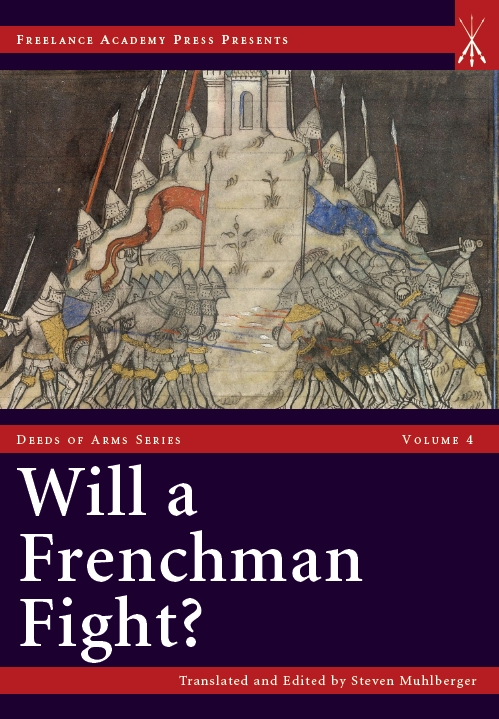 I'm grateful for this positive review but I wish the reviewer had said more about the main theme of the book, the often conflicting demands of military effectiveness and individual honor in the minds of men at arms of the time.
The Duke of Bourbon and the Poitevins left there, and they went before a place called le Faon, which was not encircled by trenches,where it would have water. And so the place was strongly assaulted, but it was not taken on that day, except only the lower courtyard, where many good men were wounded. For there was there a Franciscan who was wondrous at firing the arbelest, with which he killed four gentlemen, and he was said to be the finest arbelister in Poitou, and well provisioned [with amunition]. And on the next day, the Poitevins and Bourbonnois assailed the keep in a fierce and strong assault, and those within defended themselves, and the Franciscan let fire [again], but it was such an energetic effort that the fortress was taken, and many men killed within, save for the Franciscan-arbelester, who had removed his habit and fled to his monastery. And then the whole army asked “where is the Franciscan?”, and it was alleged that he was in the church, on his knees before the altar. And so Sir Jean de Roye hastened there, because the Franciscan had killed, by his shooting, one of his squires. And he took the Franciscan, along with his habit, and went to hang him from a tree, doing so circumspectly, so that the Duke did not know about it. And the Duke of Bourbon left le Faon.Here we see a course of action approved by the entire army but which other people might see as disgraceful. The killing of the Franciscan might harm the Duke of Bourbon's reputation so Châteaumorand is careful to say that the Duke knew nothing about the hanging of the clerical Archer. Why might others disapproved? The telling of the tale makes it clear that the Franciscan was taken out of church and hanged. It looks to be that privileges of the clergy both in the case of the Archer and the church he was found in had been violated. Other observers could see this as an atrocity or a war crime. But John the Châteaumorand, Jean de Roye and the rest of the Army were angry and felt truly justified in hunting down and hanging the Archer. Very likely they saw the Archer as stepping outside of his role as a clergyman and taking on illegitimately the role of the combatant. He was trying to have things both ways, combatant and privileged noncombatant. The may be something more to it. It's well-known that men at arms did not see archers as their equals, even if they took part in combat as part of organized armies. It could be that Châteaumorand and his friends saw the archer as a low class sharpshooter who had no right to be so effective and kill their friends.
A New book in a new series:Would you like to hear what the knights of the Hundred Years War had to say about their personal experiences of the conflict? Jean Froissart, the era's greatest fan of chivalry, devoted his life to interviewing the knights who participated in the war and to create his vast, vivid Chronicle. On the Road in the Hundred Years War shows us Froissart in his natural environment, crossing war-torn France, and talking with the warriors who knew the history of the country they passed through and the men who had fought there. On the Road (volume 1 of the new series Tales from Froissart) brings to life the military camps, the princely courts and the inns where those who followed the wars gathered and talked of their way of life. This volume is available in Kindle format and in paperback. The print version is very reasonably priced and the Kindle version is much, much cheaper. Both are illustrated (print interior is black and white, other illustrations are in color). Available in print: https://www.amazon.ca/Road-Hundred-Years-War/dp/0994755651 or http://www.amazon.com/Road-Hundred-Years-Tales-Froissart/dp/0994755651? ie=UTF8&qid=1462548915&ref_=tmm_pap_swatch_0&sr=8-1 Available in Kindle: https://www.amazon.com/Road-Hundred-Years-Tales-Froissart- ebook/dp/B01F5LNDIE?ie=UTF8&keywords=froissart%20on%20the%20road%20steve %20muhlberger&qid=1462548456&ref_=sr_1_fkmr0_1&sr=8-1-fkmr0 or https://www.amazon.ca/Road-Hundred-Years-Tales-Froissart-ebook/dp/B01F5LNDIE
On the Road in the Hundred Years War -- stories of 14th century warfare from the chivalric historian Jean Froissart.
Well, 30+30 equals 60, right?
The problem is that various accounts imply that there were 30 men on a side in addition to the commander himself. Were there 31 on a side for a total of 62?
About 100 years ago, H.R.Brush edited the most detailed account, a product of Brittany and therefore written by someone well acquainted with the battle, and he concluded that there were 30 participants on either side. In my article, my chapter in the book deeds of arms, and in my source reader on the combat, I followed Brush.
But, at about the same time that I finished my source reader (called the Combat of 30, volume 2 of my series Deeds of Arms) , Michael Jones wrote an article called "Breton soldiers from the battle of the 30 (26 March 1351) to Nicopolis (25 September 1396)," which appeared in Adrian R. Bell et al., eds., The Soldier Experience in the 14th century (Boydell Press, 2011). Jones was very interested in the careers of Bretons in the first half of the Hundred Years War, and the best examples he could find were the men at the combat of the 30. He followed them as closely as he could, and he was able to find a quite a bit about them, at least about those on the pro-French side.
And he came to the conclusion that there were 31 on a side.
I have not gone through his list systematically hecking It against Brush's (in Modern Philology).
I'd love to farm this out to Will McLean but alas he is not available.
 Early in the reign of Charles VI (1380s), the French are feeling a bit more confident about their prospects in facing the English. The Chronicle of the Good Duke shows the Duke of Burgundy trying to wind up his royal nephew:
 Then the King sent to the Duke, “You speak well my uncle but what are you saying?”Brave words, sir, brave words!
“Monsiegneur,” said the Duke, “I will tell you: It seems to me that he doesn't do anything who does not do more. These English have made war on Monsiegneur your father for a long time, and on you, and they don’t do anything but often cross over to this side, and they are but a little people. Leave off these all little enterprises, do one that will be remembered forever. You are the greatest living King, and you have more people, and it has often occurred to me that we should undertake to cross to England and to strike down the great pride of these English.
Craig Taylor's study examines the wide-ranging French debates on the martial ideals of chivalry and knighthood during the period of the Hundred Years War (1337–1453). Faced by stunning military disasters and the collapse of public order, writers and intellectuals carefully scrutinized the martial qualities expected of knights and soldiers. They questioned when knights and men-at-arms could legitimately resort to violence, the true nature of courage, the importance of mercy, and the role of books and scholarly learning in the very practical world of military men. Contributors to these discussions included some of the most famous French medieval writers, led by Jean Froissart, Geoffroi de Charny, Philippe de Mézières, Honorat Bovet, Christine de Pizan, Alain Chartier and Antoine de La Sale. This interdisciplinary study sets their discussions in context, challenging modern, romantic assumptions about chivalry and investigating the historical reality of debates about knighthood and warfare in late medieval France.And in the grand tradition of overcharging outrageously for academic books, this one even in e-book format goes for $79 US !
...it happened that Boucicaut took his turn at the watch, which was always ordered between the Army and the Saracens. Boucicaut was a chivalrous man who went to seek a skirmish where he was, through some interpreter asking whether there was any Saracen who wished to combat him on foot or horse. They replied no. Then Messire Boucicaut asked that if they wished to perform arms 10 against 10 or 20 against 20 he and his company would be ready. So the Saracens responded no, not if the Kings their Lords did not want them to. When Boucicaut saw their refusal he said to them that he would fight in a secure field, 20 Christians versus 40 of their Saracens. As long as this conference lasted it was ordained that they should not make war on each other. And scarcely were these Christian and Saracen negotiators together this astounded the Duke of Bourbon, the Lord of Couci, the count of Eu, the souldich of Estrau, and the other barons, for the whole Army ran to this assembly so that the Lord of Couci, the Count of Eu and others, who saw the Army taking leave of its senses, said to the Duke of Bourbon, “Monseigneur, the people run like beasts over there with Bouicaut and they are not able to keep guard and it seems to us that if you do not order some to retreat, things will turn out badly for us.” Then replied the Duke of Bourbon: “I can’t then send a better message, I’ll go there myself.” So he asked for a mule he always had...
So the Duke mounted his mule left his tent and went off with the people of his household. It was not long before more than 300 gentlemen were following him. The Saracens saw that the Duke of Bourbon whom they recognized by his coat of arms, came to join Messire Boucicaut with many men at arms, and began to retreat towards their tents, and Boucicaut and those with him to chase them. And Boucicaut who saw the Duke of Bourbon coming, gave himself over to pride and chased the Saracens more boldly and the Duke of Bourbon with his company went after to bring about a retreat. When Boucicaut was at the tents, the Moorish Kings and their Saracens put themselves in formation for battle outside their lodgings, and Boucicaut put himself in battle formation with his, awaiting the Duke of Bourbon and those who came with him. And the Duke of Bourbon caught up with those whom he wished to make retreat, and he very violently spoke to Boucicaut, concerning his great follies.