By coincidence I am reading this book for the second time, just as this review from the Medieval Review comes out. I highly recommend the book. Craig Taylor is always good. Taylor, Craig. Chivalry and the Ideals of Knighthood in France during the Hundred Years' War. Cambridge: Cambridge University Press, 2013. Pp. 345. £82.00(hb); £21.99(pb). ISBN: 978-1-107-04221-6. Reviewed by Thomas K. Heebøll-Holm University of Southern Denmark thee@sdu.dk The story of French chivalry and its miseries during the Hundred Years' War is an ever fascinating and puzzling one. With this book Craig Taylor breaks important ground by showing how much French knighthood in this period was shaped by and, in turn, shaped developments in the chivalrous ideology as well as by the changing military reality of the fourteenth and fifteenth centuries. While indebted to Maurice Keen's and Richard W. Kaeuper's studies of high and late medieval chivalry, Taylor refines these paragons' more general studies of medieval knighthood by concentrating on a specific time period and region, namely Valois France during the Hundred Years' War. France during this time period is especially fertile ground for such a study. Not only was it the epicenter of chivalry, but during the Hundred Years' War the French knighthood experienced a number of military catastrophes which forced French warriors and writers to critically examine and discuss the causes of these calamities and how one could remedy them. This debate is a treasure trove for historians looking to get a firmer and more nuanced picture of the muddled concept of late medieval chivalry. Indeed this concept is one of those that all think they know and consider to be simple, yet upon closer inspection find confusing, slippery and self-contradictory. It is an immensely demanding task that Taylor has undertaken. It is also one which he resolves splendidly. Taylor approaches the topic by a combined study of the practice and ideology of knighthood as it appears in various types of late medieval narratives such as chansons de geste, biographies, didactic manuals and political, legal and moral treatises. Through nine chapters (including an introduction, a chapter on the texts and their context and a very brief conclusion) Taylor takes the reader through seven core values of French chivalry during the Hundred Years' War. These were honor, prowess, loyalty, courage, mercy, wisdom and prudence. While these have been separated for pedagogical reasons, Taylor immediately acknowledges that they were not isolated values, but should be seen as part of what I am tempted to call the chivalric kaleidoscope. They were interdependent and inseparable parts of a whole. However the weighing of the relative importance of the values changed with the individual writer's personal convictions and situation as well as his/her specific historical context. In the introduction, Taylor presents and discusses the guidelines of his study. It is interesting to note that the late Middle Ages presents a new phenomenon in medieval literary production, namely that the knights themselves begin to write down their own experiences of chivalry and war. While this certainly does not remove the classic problem of to what degree medieval writing was dictated by genre conventions and socio-cultural expectations, it at least brings us closer to the military experience of the warriors, and Taylor's take on this problem is both prudent and thought provoking. These texts reflect not only practical changes in late medieval martial culture. They are also a goldmine for the historian as through them we gain access to the combatant's thoughts and recollections (flawed and biased as they may be) instead of having to rely on ecclesiastical middlemen who may have had neither interest in, or knowledge of the practical reality of knighthood. A topic which Taylor pays particular attention to is the medieval debate over chivalry and the right behavior of knights and men-at-arms. Essentially this debate came down to the difficult question of how to reconcile a proud military ethos and aggression with Christian values of humility, piety and salvation. Taylor makes the important remark that texts do not just mirror reality. They also have an influence of their own and thus enter a reciprocal relation with social reality, where texts form men and men write texts. In the following chapter "Texts and contexts," Taylor concentrates more narrowly on the historical and literary context of the narrative sources analyzed in the book. Contrary to the practical and structural reasons for the French defeats as presented by modern military historians, contemporary writers argued that the reasons for the defeats were cowardice and moral laxity due to the corrupting effects of court life (among others). Consequently, they advocated for a reform of the mores of the knighthood especially by the adoption of the values and discipline of the Romans of antiquity. This emphasis on the Romans was, as Taylor shows, in no small part due to the fact that many writers implicitly or explicitly served royal Valois interests. To these kings, the Roman models of chivalry that focused on self-sacrificing loyal service to the sovereign and the commonweal were echoed in the military reforms from Charles V onwards--and vice-versa. In chapter 2 Taylor deals with the central issue of chivalric honor. On the basis of philosophical, anthropological and historical theories of honor, Taylor produces a good and nuanced discussion which is firmly grounded in contemporary sources and contexts. In particular, the chapter contains thought provoking discussions of the relationship between masculinity and knightly honor and between honor and reputation. As Taylor shows, there was a continuous and reciprocal interplay between the chivalric values of society and those of writers of chivalric reform. He furthermore refreshingly argues that honor is not merely a societal tyranny of expectations and values. Rather, individuals knights can and do have agency. By their actions they entered a continuous (re-)negotiation of chivalric values with society. Chapter 3 deals with what Richard W. Kaeuper has termed "the fundamental quality of knighthood," namely prowess. [1] As with honor, prowess is a difficult concept to grasp, not least because it, to a large extent, was propagated by writers with no personal experience of war. Moreover its portrayal of the brutality of war was dominated by genre over reality. Indeed, at the heart of prowess lay violence--just when used in the service of a higher cause (ideally crusades, but increasingly also in service of king and country), but criminal when used by lower orders against their superiors. Unfortunately most medieval war lay in the grey area between these two, and interestingly Taylor combines this discussion of right prowess with the one on loyalty. Here it seems that contemporary Frenchmen drew inspiration from Roman military ideals where the loyalty to commonweal and crown could discourage acts of vainglorious prowess as only actions against the common enemy ought to be considered as "true" honor conferring prowess. The cousin of prowess, courage, is discussed in chapter 4. While written sources discuss these issues, they are difficult to use in historical analyses and they are very much dependent on conventions and literary stylings. Moreover they serve various practical issues such as encouraging group cohesion, leadership and discipline. In this chapter, Taylor touches upon the possibility of doing emotional history in regards to medieval warriors, but reaches the safe, if somewhat conservative conclusion, that emotions though characterized by universal triggers in their display of emotions are not human constants, but rather wholly shaped by society and culture. To this reviewer, this discussion is a bit lacking as Taylor flirts with but eventually shies away from the possibility of conducting emotional history on the basis of these sources. Though he acknowledges the promising prospects of studying the antonyms of courage, fear and cowardice, Taylor in the end resigns himself to a fleeting treatment of these two. Chapters 5 and 6 deal with mercy. In chapter 5 the topic is mercy towards other soldiers while chapter 6 concerns mercy towards civilians and non-combatants. In regards to soldiers, Taylor provides an important corrective to the romantic notion that knights spared each other out of feelings of chivalry and nobility. Rather knightly mercy towards peers was the result of the prospect of rich ransom-money. Moreover, more lowly soldiers could not expect spared since they could not pay for their liberation and in fact were reviled by the nobility. In regards to civilians, treatment was also mostly dependent on social status. While theologians and priests celebrated restraint and mercy towards civilians, the fact remained that most medieval knights treated their social inferiors with disdain. Furthermore, structural problems lay behind the more general and continuous pillaging and ravaging of soldiers on civilians. Simply put, lack of pay caused soldiers to prey on civilians. Though the Valois kings repeatedly tried to enforce discipline in the royal armies, by 1450 Charles VII's Compagnies d'ordonnances were still reputed to be mostly manned by ruffians and pillagers. Chapter 7 deals with the virtues of wisdom and prudence. In the research these virtues have traditionally been seen as the antithesis to knightly ones, yet Taylor admirably proves wrong. Chivalric culture in fact placed great emphasis on age, experience and prudence and many contemporary writers were openly critical of rashness and inexperience. Moreover, during the fourteenth and fifteenth centuries more and more French commanders collected written accounts of the experience of veteran warriors (contemporary as well as Roman) thereby suggesting a greater interest and emphasis amongst them for written advice. In regards to this, Taylor suggests that this rising interest was due to the defeats the French suffered in the Hundred Years' War. Interestingly, Taylor observes the same phenomenon in England in the 1440s when English reversals of fortune in earnest set in. This chapter is followed by a brief concluding chapter that sums up the book's major results. This is an impressive book. One of its most important contributions is its demonstration of how inspiration from the Roman Empire was by no means an isolated Italian "renaissance" phenomenon. Throughout the book, Taylor demonstrates how these ideas came to the fore in France simultaneously with Italy and how they influenced and indeed pushed chivalric ideals from a more Arthurian, "feudal" model to a "republican" Roman one. Although imperial Rome had long been one of many ideals for the European knighthood (see for instance John of Salisbury's Policraticus), then the roving bands of routiers and self-serving knights in the late middle ages caused a yearning with many writers for this Roman republican ideal of fighting for the commonweal as the highest honor for a warrior. Another feat that Taylor should be lauded for is his insistence on treating the narrative source material in its historical context. This means that Taylor studies chivalry as a dynamic genre responding to current situations instead of a fossilized monolith--as it is all too often treated in research as well as in many popular presentations. If I were to voice one criticism, it would be that, although Taylor discusses the complicated issue of routiers and their relationship with and role in chivalric ideology, his treatment of this issue is never quite to the satisfaction of this reviewer. While they on the one hand were part of the chivalric elite then at least a number of the English routier captains were indisputably of non-noble background--a fact that profoundly disturbed writers such as Jean le Bel and Geoffroi de Charny. However, this is a really minor issue. In sum, this is a piece of impressive and lucid scholarship. It is well written and presents a refreshing discussion of chivalry, war, society and literature in late medieval France. Furthermore, it is also pedagogical. This reviewer has used the book with considerable success in his teaching. Thus not only do I recommend it for its research qualities, but also for its approach to a topic that is in fact much harder to grasp for students than they usually anticipate. This book ought to be consulted by anyone interested in late medieval chivalry in ideology as well as in practice. -------- Note: 1. Richard W. Kaeuper Chivalry and Violence in Medieval Europe (Oxford: Oxford University Press, 1999), 130.
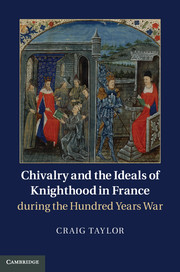
Chivalry and the Ideals of Knighthood in France...by Craig Taylor
By coincidence I am reading this book for the second time, just as this review from the Medieval Review comes out. I highly recommend the book. Craig Taylor is always good. Taylor, Craig. Chivalry and the Ideals of Knighthood in France during the Hundred Years' War. Cambridge: Cambridge University Press, 2013. Pp. 345. £82.00(hb); £21.99(pb). ISBN: 978-1-107-04221-6. Reviewed by Thomas K. Heebøll-Holm University of Southern Denmark thee@sdu.dk The story of French chivalry and its miseries during the Hundred Years' War is an ever fascinating and puzzling one. With this book Craig Taylor breaks important ground by showing how much French knighthood in this period was shaped by and, in turn, shaped developments in the chivalrous ideology as well as by the changing military reality of the fourteenth and fifteenth centuries. While indebted to Maurice Keen's and Richard W. Kaeuper's studies of high and late medieval chivalry, Taylor refines these paragons' more general studies of medieval knighthood by concentrating on a specific time period and region, namely Valois France during the Hundred Years' War. France during this time period is especially fertile ground for such a study. Not only was it the epicenter of chivalry, but during the Hundred Years' War the French knighthood experienced a number of military catastrophes which forced French warriors and writers to critically examine and discuss the causes of these calamities and how one could remedy them. This debate is a treasure trove for historians looking to get a firmer and more nuanced picture of the muddled concept of late medieval chivalry. Indeed this concept is one of those that all think they know and consider to be simple, yet upon closer inspection find confusing, slippery and self-contradictory. It is an immensely demanding task that Taylor has undertaken. It is also one which he resolves splendidly. Taylor approaches the topic by a combined study of the practice and ideology of knighthood as it appears in various types of late medieval narratives such as chansons de geste, biographies, didactic manuals and political, legal and moral treatises. Through nine chapters (including an introduction, a chapter on the texts and their context and a very brief conclusion) Taylor takes the reader through seven core values of French chivalry during the Hundred Years' War. These were honor, prowess, loyalty, courage, mercy, wisdom and prudence. While these have been separated for pedagogical reasons, Taylor immediately acknowledges that they were not isolated values, but should be seen as part of what I am tempted to call the chivalric kaleidoscope. They were interdependent and inseparable parts of a whole. However the weighing of the relative importance of the values changed with the individual writer's personal convictions and situation as well as his/her specific historical context. In the introduction, Taylor presents and discusses the guidelines of his study. It is interesting to note that the late Middle Ages presents a new phenomenon in medieval literary production, namely that the knights themselves begin to write down their own experiences of chivalry and war. While this certainly does not remove the classic problem of to what degree medieval writing was dictated by genre conventions and socio-cultural expectations, it at least brings us closer to the military experience of the warriors, and Taylor's take on this problem is both prudent and thought provoking. These texts reflect not only practical changes in late medieval martial culture. They are also a goldmine for the historian as through them we gain access to the combatant's thoughts and recollections (flawed and biased as they may be) instead of having to rely on ecclesiastical middlemen who may have had neither interest in, or knowledge of the practical reality of knighthood. A topic which Taylor pays particular attention to is the medieval debate over chivalry and the right behavior of knights and men-at-arms. Essentially this debate came down to the difficult question of how to reconcile a proud military ethos and aggression with Christian values of humility, piety and salvation. Taylor makes the important remark that texts do not just mirror reality. They also have an influence of their own and thus enter a reciprocal relation with social reality, where texts form men and men write texts. In the following chapter "Texts and contexts," Taylor concentrates more narrowly on the historical and literary context of the narrative sources analyzed in the book. Contrary to the practical and structural reasons for the French defeats as presented by modern military historians, contemporary writers argued that the reasons for the defeats were cowardice and moral laxity due to the corrupting effects of court life (among others). Consequently, they advocated for a reform of the mores of the knighthood especially by the adoption of the values and discipline of the Romans of antiquity. This emphasis on the Romans was, as Taylor shows, in no small part due to the fact that many writers implicitly or explicitly served royal Valois interests. To these kings, the Roman models of chivalry that focused on self-sacrificing loyal service to the sovereign and the commonweal were echoed in the military reforms from Charles V onwards--and vice-versa. In chapter 2 Taylor deals with the central issue of chivalric honor. On the basis of philosophical, anthropological and historical theories of honor, Taylor produces a good and nuanced discussion which is firmly grounded in contemporary sources and contexts. In particular, the chapter contains thought provoking discussions of the relationship between masculinity and knightly honor and between honor and reputation. As Taylor shows, there was a continuous and reciprocal interplay between the chivalric values of society and those of writers of chivalric reform. He furthermore refreshingly argues that honor is not merely a societal tyranny of expectations and values. Rather, individuals knights can and do have agency. By their actions they entered a continuous (re-)negotiation of chivalric values with society. Chapter 3 deals with what Richard W. Kaeuper has termed "the fundamental quality of knighthood," namely prowess. [1] As with honor, prowess is a difficult concept to grasp, not least because it, to a large extent, was propagated by writers with no personal experience of war. Moreover its portrayal of the brutality of war was dominated by genre over reality. Indeed, at the heart of prowess lay violence--just when used in the service of a higher cause (ideally crusades, but increasingly also in service of king and country), but criminal when used by lower orders against their superiors. Unfortunately most medieval war lay in the grey area between these two, and interestingly Taylor combines this discussion of right prowess with the one on loyalty. Here it seems that contemporary Frenchmen drew inspiration from Roman military ideals where the loyalty to commonweal and crown could discourage acts of vainglorious prowess as only actions against the common enemy ought to be considered as "true" honor conferring prowess. The cousin of prowess, courage, is discussed in chapter 4. While written sources discuss these issues, they are difficult to use in historical analyses and they are very much dependent on conventions and literary stylings. Moreover they serve various practical issues such as encouraging group cohesion, leadership and discipline. In this chapter, Taylor touches upon the possibility of doing emotional history in regards to medieval warriors, but reaches the safe, if somewhat conservative conclusion, that emotions though characterized by universal triggers in their display of emotions are not human constants, but rather wholly shaped by society and culture. To this reviewer, this discussion is a bit lacking as Taylor flirts with but eventually shies away from the possibility of conducting emotional history on the basis of these sources. Though he acknowledges the promising prospects of studying the antonyms of courage, fear and cowardice, Taylor in the end resigns himself to a fleeting treatment of these two. Chapters 5 and 6 deal with mercy. In chapter 5 the topic is mercy towards other soldiers while chapter 6 concerns mercy towards civilians and non-combatants. In regards to soldiers, Taylor provides an important corrective to the romantic notion that knights spared each other out of feelings of chivalry and nobility. Rather knightly mercy towards peers was the result of the prospect of rich ransom-money. Moreover, more lowly soldiers could not expect spared since they could not pay for their liberation and in fact were reviled by the nobility. In regards to civilians, treatment was also mostly dependent on social status. While theologians and priests celebrated restraint and mercy towards civilians, the fact remained that most medieval knights treated their social inferiors with disdain. Furthermore, structural problems lay behind the more general and continuous pillaging and ravaging of soldiers on civilians. Simply put, lack of pay caused soldiers to prey on civilians. Though the Valois kings repeatedly tried to enforce discipline in the royal armies, by 1450 Charles VII's Compagnies d'ordonnances were still reputed to be mostly manned by ruffians and pillagers. Chapter 7 deals with the virtues of wisdom and prudence. In the research these virtues have traditionally been seen as the antithesis to knightly ones, yet Taylor admirably proves wrong. Chivalric culture in fact placed great emphasis on age, experience and prudence and many contemporary writers were openly critical of rashness and inexperience. Moreover, during the fourteenth and fifteenth centuries more and more French commanders collected written accounts of the experience of veteran warriors (contemporary as well as Roman) thereby suggesting a greater interest and emphasis amongst them for written advice. In regards to this, Taylor suggests that this rising interest was due to the defeats the French suffered in the Hundred Years' War. Interestingly, Taylor observes the same phenomenon in England in the 1440s when English reversals of fortune in earnest set in. This chapter is followed by a brief concluding chapter that sums up the book's major results. This is an impressive book. One of its most important contributions is its demonstration of how inspiration from the Roman Empire was by no means an isolated Italian "renaissance" phenomenon. Throughout the book, Taylor demonstrates how these ideas came to the fore in France simultaneously with Italy and how they influenced and indeed pushed chivalric ideals from a more Arthurian, "feudal" model to a "republican" Roman one. Although imperial Rome had long been one of many ideals for the European knighthood (see for instance John of Salisbury's Policraticus), then the roving bands of routiers and self-serving knights in the late middle ages caused a yearning with many writers for this Roman republican ideal of fighting for the commonweal as the highest honor for a warrior. Another feat that Taylor should be lauded for is his insistence on treating the narrative source material in its historical context. This means that Taylor studies chivalry as a dynamic genre responding to current situations instead of a fossilized monolith--as it is all too often treated in research as well as in many popular presentations. If I were to voice one criticism, it would be that, although Taylor discusses the complicated issue of routiers and their relationship with and role in chivalric ideology, his treatment of this issue is never quite to the satisfaction of this reviewer. While they on the one hand were part of the chivalric elite then at least a number of the English routier captains were indisputably of non-noble background--a fact that profoundly disturbed writers such as Jean le Bel and Geoffroi de Charny. However, this is a really minor issue. In sum, this is a piece of impressive and lucid scholarship. It is well written and presents a refreshing discussion of chivalry, war, society and literature in late medieval France. Furthermore, it is also pedagogical. This reviewer has used the book with considerable success in his teaching. Thus not only do I recommend it for its research qualities, but also for its approach to a topic that is in fact much harder to grasp for students than they usually anticipate. This book ought to be consulted by anyone interested in late medieval chivalry in ideology as well as in practice. -------- Note: 1. Richard W. Kaeuper Chivalry and Violence in Medieval Europe (Oxford: Oxford University Press, 1999), 130.