Tampilkan postingan dengan label Charny. Tampilkan semua postingan

Selasa, 21 Maret 2017

Senin, 06 Maret 2017

Sabtu, 24 Desember 2016

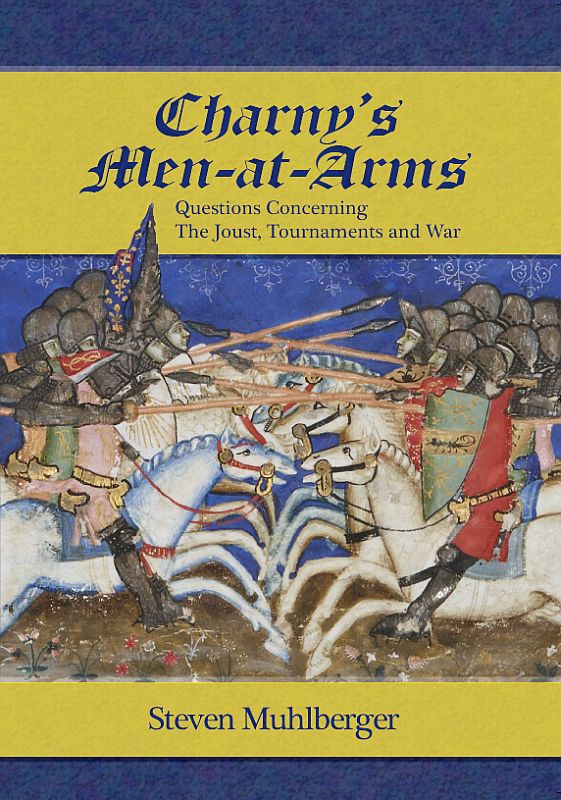
Another review of Charny's Men-at-Arms

http://deremilitari.org/2016/12/steven-muhlberger-charnys-men-at-arms-questions-concerning-the-joust-tournaments-and-war-hass/


Steven Muhlberger, Charny’s Men-at-Arms: Questions Concerning The Joust, Tournaments and War (Hass)

Steven Muhlberger

charny’s men-at-arms: questions concerning the joust, tournaments and war

(freelance, 2014) 111 pp. $25.00

Written around 1350, Geoffrey de Charny’s Questions Concerning the Joust, Tournaments and War (Les demandes pour la joute, les tournois et la guerre) consists of a series of questions – twenty relating to jousting, twenty-one to the tournament, and ninety to war – presented by the great French knight to King Jean II for the purpose of discussion among the members of the king’s new Order of the Star. As the questions found in the work remain unanswered, however, the document is often overlooked by scholars in favor of Charny’s more thorough and insightful composition; the Book of Chivalry (Livre de chevalerie). [1] Steven Muhlberger first took up the challenges presented by the Questions in 2003 with the publication of his Jousts and Tournaments: Charny and the Rules for Chivalric Sport in Fourteenth-Century France. [2] As the title suggests, the work examines only the first two sections of the text, and – but for five questions relating to jousting and the tournament – leaves the larger section on war for future comment. In this current volume Muhlberger brings his discussion of the Questions to its conclusion; but this is not merely a supplement to his earlier work. Employing his deep knowledge of medieval chivalry, the author has combined new material with a re-assessment of his previous scholarship, and the result is an enjoyable work that provides an enticing glimpse into the world of 14th Century knighthood.

Charny’s Men-at-Arms begins with Muhlberger establishing the historical context of the Questions by briefly introducing the reader to the life and career of Charny himself and the reform initiative that was the Order of the Star. He continues with the contextual discussion by showing the Questions to be part of a broader genre of writing about war; such as: Laws of Arms, Laws of War, disciplinary and administrative ordinances, etc. This latter discussion is important in helping to identify Muhlberger’s revised purpose of the Questions as being a prelude to legislation regarding the law of arms that was never enacted. (22) Chapter Three discusses the first two sections of the text – jousts and tournaments, and, as these were the core subjects of his 2003 volume, it is here that some overlap would be expected. However, Muhlberger’s re-assessment of his old discussion in light of more recent scholarship in the field – he specifically credits the works of David Crouch and Noel Fallows [3] – results in a discussion that is largely new. Older points of discussion – such as the importance of the horse – if they remain, have been edited and rearranged to fit the new narrative, with the new (questions about rank on the tourney field in light of new role of squires) and old information fitting together seamlessly.

Muhlberger’s new discussion about the questions concerning war is contained in Chapters Four through Seven. He begins with an examination of terms as a means of determining whom Charny was targeting as Men-at-Arms. Chapters Five to Seven examine the Questions themselves, and, given no answers to the queries, he uses frequency to identify what topics the Men-at-Arms thought were important. What emerges is the predominance of practical considerations; such as those involving plunder/booty or capture. Not strictly relying on frequency, however, Muhlberger also manages to identify a pattern between those above (questions which seek concrete gains or rights of warfare) and questions in which his intended audience was asked to define honorable behavior and chivalric terminology. The author’s final discussion concerns those topics (clerical sense, duels, heraldry, siege warfare) that receive little or no mention in the text. For a work like the Questions this is an important discussion as it shows its limitations, and thereby better frames the discussion and what information may be gleaned from the text itself and what may not. The volume is completed by Muhlberger’s translation of Charny. The translation is again based on the edition of Anthony Michael Taylor, but, unlike his effort from 2003, he has omitted the corresponding French text. For reasons of comparison (given the author’s new conclusion regarding the purpose of the Questions), an edition of an Ordinance of Richard II from 1385 has been included.
Overall, there is much to like about Charny’s Men-at-Arms. It is a handsomely produced and easily readable volume. The author’s translation of the original text is faultless; although there is still no information regarding the original Charny manuscripts and their dissemination. [4] Yet, it is Muhlberger’s introductory discussion that particularly stands out. Erudite, insightful, and often entertaining, he is also necessarily cautious with a text that requires deft handling. Indeed, one of his particular strengths is his recognition of the limitations of the text, and working within them to extrapolate out the considerable amount of information that he does without falling into the trap of over-speculation. In so doing he makes accessible a composition that had been overlooked and shows its merit. Moreover, this skill makes this work of particular appeal to teachers introducing students to primary texts, while at the same time contributing valuably to the scholarship of chivalry and the era of the Hundred Years War.
Jeff Hass
Franciscan University
[1] Richard W. Kaeuper and Elspeth Kennedy, The Book of Chivalry of Geoffroi de
Charny: Text, Context, and Translation. Philadelphia, 1996.
[2] Reviewed for this site by Andy King.
[3] David Crouch, Tournament. Hambledon and London, 2005.
Noel Fallows, Jousting in Medieval and Renaissance Iberia. Woodbridge, 2010
[4] Both the production values and lack of manuscript information had received mention
in King’s review.
THIS ENTRY WAS POSTED IN BOOKREVIEW. BOOKMARK THE PERMALINK.


Senin, 25 Mei 2015

A review of my book Charny's Men-at-Arms: Questions Concerning the Joust, Tournaments, and War. Wheaton, IL: Freelance Academy Press, 2014. Pp. viii, 111. $24.95. ISBN: 978-1-9374390-5-7

From The Medieval Review

Muhlberger, Steven. Charny's Men-at-Arms: Questions Concerning the Joust, Tournaments, and War. Wheaton, IL: Freelance Academy Press, 2014. Pp. viii, 111. $24.95. ISBN: 978-1-9374390-5-7.

Reviewed by Peter W. Sposato

Indiana University Kokomo

psposato@iuk.edu

Charny's Men-at-Arms: Questions Concerning the Joust, Tournaments and War is the latest in a series of important contributions made by Steven Muhlberger to the historical study of medieval chivalry. Muhlberger's previous publications have focused generally on "deeds of arms" (faits d'armes), whether in the guise of "chivalric sports," such as tournaments and jousts, or the bloody business of war. [1] In Charny's Men-at-Arms, Muhlberger continues his investigation of these major chivalric themes by focusing on a series of questions composed in the early 1350s by Geoffroi de Charny, a famous fourteenth century French knight. Charny's intended audience for his Questions were the members of the French royal chivalric Order of the Star: all strenuous, professional practitioners of chivalry. [2] Charny was himself a strenuous knight, who through his personal prowess and honorable conduct both on and off the battlefield climbed, during the course of a long and distinguished career, to the upper echelons of the chivalric hierarchy in France. As Muhlberger powerfully argues, however, Charny should be seen not only as a practitioner, but also as a "theorist of the life of chivalry," a "professor and follower of chivalry...[who] set out first and foremost to praise, to define, and to teach chivalry" (9, 14). Indeed, in addition to composing The Questions Concerning the Joust, Tournaments, and War, he also wrote the Livre de chevalerie (Book of Chivalry) and the Livre Charny (Charny's Book). [3] Thus, unlike many contemporary writers on chivalry, he not only talked the talk, he decidedly walked the walk: participating in tournaments; commanding soldiers in battle; and fighting with distinction in numerous engagements during the Hundred Years War, including at the battle of Poitiers (1356) where he was killed defending the Oriflamme (the sacred battle banner of France).

Charny's Questions are therefore crucially important to our understanding of chivalric mentality and the practical application of chivalric ideas in Late Medieval France in particular, and Europe in general. Muhlberger successfully makes the case for the importance of Charny's Questions in the very first line of his introduction, writing "The Questions Concerning the Joust, Tournaments, and War is a lost classic work of European chivalry. It is the only record we have of a dramatic occasion when crucial questions on the nature of war and the proper conduct of the warrior's life--one definition of chivalry--were posed to an audience of experts, professional men-at-arms of rank and influence" (1). Indeed, Charny's Questions deal with major issues that arose in the three main contexts in which strenuous men-at-arms (i.e. men of rank and status who lived the "life of arms") operated: jousts, tournaments, and war. (14) The Questions, one hundred and thirty four in number and divided into three categories (jousts, tournaments, and war), range from the practical ("Charny asks: Knights joust with steel lances in an emprise. One knocks the other to the ground with a stroke of his lance. Will the one who has knocked the other to the ground and out of the saddle win the horse? How will it be judged by the law of arms?" [88]) to the abstract ("Charny asks: When should a battle be called a battle and why that rather than something else?" [90]). By offering such a broad array of questions, Charny highlights both the formal and the informal rules that governed chivalric conduct, while also providing historians with a sense of the motivations, ideals, and behaviors that underpinned the chivalric lifestyle.

Equally important is the reformative nature of Charny's Questions, which Muhlberger highlights and deftly places into the larger historical context, namely the efforts of King Jean II of France to restore order in his kingdom and to turn the tide of the Hundred Years War. Muhlberger argues the ultimate purpose of Charny's Questions, given the strong reform currents found therein and the timing of their composition, was to buttress such royal initiatives and, importantly, future royal legislation "on matters of arms" (22). No doubt Charny envisioned the Questions as a means to reform and reinvigorate his fellow men-at-arms who had thus far failed to fulfill the sacred function associated with their divine ordo: to protect the French people through their prowess and bravery. Given the clear importance of this work, it is striking that Muhlberger provides in Charny's Men-at-Arms the first and only complete translation of the Questions into English. [4]

Muhlberger has done both scholars and students a great service by adeptly translating the Questions, but Charny's Men-at-Arms is much more than a simple translation: it is also an informed and insightful historical study of the Questions, of the values and attitudes that underpinned them, of the larger historical context in which they were composed, and of their intended audience. Indeed, Muhlberger's study penetrates far beneath the surface of these questions to shed considerable light on the author, the cultural milieu that shaped him, and the social circles in which he operated. Muhlberger's analysis is concise and intelligent, providing insight into Charny's Questions as they relate to a multitude of significant topics, including the nature of chivalry, the laws of war, royal ordinances on war (like King Jean II's Reglement pour le gens de guerre [issued April 30, 1351]), and theoretical treatises on war (like those of Giovanni Legnano and Honore Bouvet). Similarly insightful is Muhlberger's analysis of Charny's Questions relating to "chivalric sport" (Chapter 3: "Charny's Jousters and Tourneyers"), the practical and legal concerns about chivalric conduct in war (Chapter 5: "What Men-at-Arms Worried About"), and honor (Chapter 6: "Honor and the Lore of Chivalry"). Considering the complexity of these topics and the quagmire of scholarship associated with them, Muhlberger deserves praise for adding a great deal to the discussion. Finally, readers, especially students, will also appreciate Muhlberger's efforts to make sense of Charny's tricky terminology (Chapter 4).

There can be little doubt that Charny was a prominent practitioner and theorist of chivalry in his own time and that his writings are crucial to our modern understanding of the dominant ideology that shaped the mentality and lifestyle of the medieval warrior elite. Therefore, it is all the more remarkable that Charny's Questions, which "can be read as a reflection of the priorities and opinions of one of the most experienced and renowned warriors of his time," has been largely neglected by other scholars (23). Fortunately, such an important work on medieval chivalry has been very well served by Muhlberger's translation and study. Indeed, Charny's Men-at-Arms makes an important contribution to the historical study of medieval chivalry, chivalric sports, and warfare. Muhlberger's analysis is succinct and approachable, making it accessible to students, while still providing enough scholarly rigor and insight to earn the approbation of seasoned historians. Charny's Men-at-Arms will undoubtedly facilitate considerable discussion and future research.

------ Notes: 1. Prominent among Muhlberger's other publications on chivalry are: Jousts and Tournaments: Charny and the Rules for Chivalric Sport in Fourteenth-Century France (Union City, CA: Chivalry Bookshelf, 2002); Deeds of Arms: Formal Combats in the Late Fourteenth Century (Union City, CA: Chivalry Bookshelf, 2005); Royal Jousts at the End of the Fourteenth Century (Wheaton, IL: Freelance Academy Press, 2012); The Combat of the Thirty (Wheaton, IL: Freelance Academy Press, 2013); The Twelve of England (Wheaton, IL: Freelance Academy Press, 2013).

2. Other important studies of Charny include: Craig Taylor, Chivalry and the Ideals of Knighthood in France during the Hundred Years War (Cambridge University Press, 2013); Richard Kaeuper, Chivalry and Violence in Medieval Europe (Oxford University Press, 1999); idem, Holy Warriors: The Religious Ideology of Chivalry (University of Pennsylvania Press, 2009); idem and Elspeth Kennedy, The Book of Chivalry of Geoffroi de Charny: Text, Context, and Translation (University of Pennsylvania Press, 1996).

3. In addition to the facing page translation listed above (op. cit., n. 2), see also the slimmed down version: Kaeuper and Kennedy, A Knight's Own Book of Chivalry: Geoffroi de Charny (University of Pennsylvania, 2005).

4. The questions concerning tournaments and jousts were translated and studied in Muhlberger's Jousts and Tournaments: Charny and the Rules for Chivalric Sport in Fourteenth-Century France (op. cit., n. 1).

Rabu, 04 Maret 2015

Buy these books!

I recently got a royalty statement from my main publisher, Freelance Academy Press, and I'm sad to say that sales of been rather anemic the last six months. I know there are more people who are interested in this material than have heard about it. Also FAP does a classy job of printing and binding and illustrating these volumes. Finally, the price is right. The books are about a third the price of some of the other similar works put out by mainstream publishers. So I'm going to do my bit to get the word out, something that everybody who publishes these days is told they have to do. ,

FAP carries three recent books by me. All of them concern "deeds of arms" or chivalric sports and warfare in the late 14th century. All of them include translations of accounts from that period plus my own analysis of the material. I think I am quite a good writer so a lot of people should find my approach easy to understand and even entertaining.

First, there is "Royal Jousts". This book describes famous jousts of the 14th century as described by people who took part in them. This is the time when the kings of France and England competed not just on the battlefield but also in their sponsorship of chivalric sports. The best part of the book is the description of the jousts at St. Inglevert in the 1390s. It's famously described by Froissart, but other people wrote up the event too. I've included those other descriptions. If you are curious about what jousting meant to knights of the time, this is your book.

 Second is "the Combat of the Thirty." This is a famous incident of 1350s in which Breton – French men at arms fought English and mercenary men at arms for the fun of it. Each group controlled a strategic castle, but the war itself had bogged down. Out of boredom or other calculations, the captains of these garrisons decided to fight "30 against 30 with no one running away." Some people at the time thought it was a foolish pointless fight, while others thought it showed a true knightly spirit, unlike for instance the French cavalry who had run away from the battle of Crecy. There may have been some doubt too about whether the winning tactic was a fair one or not. Modern reenactors love to reenact this one. If you have friends who love the Hundred Years War, get them this book.

The third book is "Charny's men-at-arms." Geoffroi de Charny is the famous knight of the 1350s, among other things the first owner of the shroud of Turin. He was a trusted advisor of King John II of France and took part in John's efforts to revitalize chivalry in his kingdom. One project that Geoffroi de Charny participated in was an effort to revive knowledge of the "law of arms" that governed the relations between knights and knights (or "men at arms"). With the King's encouragement, Charny put together a list of questions about how the law of arms applied to jousting tournaments and warfare. Interestingly, he did not include or record any answers to those questions. So "Charny's questions"as they are usually called doesn't give us a codified legal document, but rather a list of things that practical warriors worried about – ransoms, who was qualified to fight in tournaments, and various questions of honour.

Let me also urge you to suggest to your local public library or academic library that they buy them books for their collections. These are not just books for scholars. Scholars will like them, but so will people of a variety of back grounds interested in some of the most colourful aspects of the Middle Ages.

Buy these books at Freelance Academy Press.

Selasa, 30 Desember 2014

Senin, 21 Juli 2014

At last, a book

Faithful readers will recognize this as the infamous book on Charny's questions that I've been slugging away at, with some interruptions from other work since the millennium was young. Really young!

If you don't know the book, it is an investigation of a list of questions put forward by a 14th century French knight Geoffroi de Charny to his fellow aristocratic warriors, presumably to educate them in their duty and privileges as warriors. Because there are no answers given, Charny's questions are an unresolvable puzzle and maybe for this reason there have been few detailed looks at the questions and their purposes. Also, no one I know has translated all the questions before now.

Like historical puzzles? Wonder about what chivalry meant to those who fought in the Hundred Years War?  Is your curiosity piqued by the phrase "who gets the horse?"

Now all this can be yours – the answers, I mean, if you are willing to stick out your neck and propose some yourself.

Here's a link to the publisher.

If you are close with the dollar, you might try poking around this blog for some of my reflections on Charny's questions over the years.

Sabtu, 05 Juli 2014

Charny's answer

People who know my scholarly work on the writings of Geoffroi de Charny, a fourteenth century knight, may associate me with "Charny's questions," a set of hypothetical problems related to "the law of arms" meant to be analyzed by knights, squires and "men at arms" so that they would be better prepared to relate with other aristocratic warriors.

Charny's questions are unanswered.

But if you want his answer to the problems of the life of arms, consider this from Charny's Book of Chivalry:
[T]hose who have the will to achieve great worth [who] because of their great desire to reach and attain that high honor … do not care what suffering they have to endure, but turn everything into great enjoyment. Indeed, it is a fine thing to perform great deeds, for those who rise to great achievement cannot rightly grow tired or sated with it; so the more they achieve, the less they feel they have achieved; this stems from the delight they take in striving constantly to reach greater heights. And great good comes from performing these deeds, for the more one does, the less one is proud of oneself, and it always seems that there is so much left to do.

Charny's answer?

Selasa, 22 April 2014

Minggu, 05 Februari 2012

Charny as arbitrator under the "droit d'armes"

Back in 1992, the renowned military historian Philippe Contamine wrote an article of Geoffroi de Charny for the festschrift (celebratory collection) dedicated to Georges Duby.  I just found this little nugget in the article (my rough translation):
At that time [Charny] was recognized as an expert in the conflicts that can arise between people in arms about ransom and loot: an act of Philippe de Valois in April 1347 sets out how Aimery de Rochechouart, chevalier , was retained, he and the men of his company having "all costs and expenses and everything which appertained to their profession" from Savary de Vivonne, Lord of Tours. However, during the taking and plundering of Poitiers by the English of the Earl of Derby in October 1345, Aimery and his people were captured. He himself was ransomed for  4000 crowns of gold, a sum to which were added expenses of 2000 crowns. He  thought he should be able to demand the 6000 crowns from Savary de Vivonne, who refused. The King with the consent of both parties, appointed arbitrators  for  the dispute concerning the "droit d’armes," namely Guillaume Flote, seigneur de Reveland Geoffroy de Charny. They discharged Savary de Vivonne any fault, however, requiring him to pay to pay 2000 crowns (the costs) to Aimery de Rochechouart.
I also found out today that if you type enough French into MS Word, it starts giving you French spellings, French quotation marks, etc.

Jumat, 27 Januari 2012

That beautiful destrier, again


I am trying to put the finishing touches on my translation of Charny's Questions, and once again I have come up against the case of the beautiful destrier -- Tourney Question 8.  I have had real experts look at this and they are baffled, and suggest that there is a transcription error.   Therefore I am putting out this call to anyone who has access to Jean Rossbach's edition (in the Free University of Brussels library, or to the main mss., which are at Paris and Brussels.  Your help in checking the text would be much appreciated.

Anyone who has sufficient confidence in their mastery of Middle French can contact me directly and I will send you the French text and my current translation, and you too can have a go at it.

Jumat, 20 Januari 2012

Four Wordles (word clouds) based on my translation of Charny's Questions

Wordles or word clouds are graphic arrangements of words indicating by the size of each word how often it appears in a text.  How much can you read into that?  Well, at the least it may alert you to something you might otherwise overlook.

In all of these "Charny" and "asks" are among the largest terms.  That is because each of the 130 or so questions begins "Charny asks."

Jousting questions:

Wordle: Charny's Questions on Jousting

Proper size:
http://www.wordle.net/show/wrdl/4699960/Charny%27s_Questions_on_Jousting

Tourney questions:


Wordle: Charny's Questions on Tournaments
Proper size:
http://www.wordle.net/show/wrdl/4699970/Charny%27s_Questions_on_Tournaments
War questions:
Wordle: Charny's Questions on War
Proper size:
http://www.wordle.net/show/wrdl/1287540/Charny%27s_Questions_on_War
All together:
Wordle: Charny's Questions
Proper size:
http://www.wordle.net/show/wrdl/4699987/Charny%27s_Questions
Have fun!

Selasa, 03 Januari 2012

Jumat, 25 November 2011

Thanks to my audience

In North Bay, Ontario, you can fill a room late Friday afternoon, late in dreary November, with faculty members, students, non-university community members and a dean or two, to listen to a paper on the fears and insecurities of 14th century men-at-arms.

Who knew?

Thanks for coming, people.

Image:  Someone else's seminar, in Hong Kong.  They had a bigger audience.

Senin, 21 November 2011

Sabtu, 28 Mei 2011

The quest for answers to Charny's Questions

I  have just posted the current draft of my  translation of Geoffroi de Charny’s Questions concerning the joust, tournaments, and war.  It is in the form of a blog entitled Charny’s Questions and it is located at http://charnyqs.blogspot.com/.

I have made the questions available in hopes that other scholars will know of parallels to individual questions or even solutions to some of the legal problems raised by Charny.   Indeed, I have found or been sent a few already, and will be putting them in the comment section of the appropriate question.  If you have something relevant, please do likewise.

I must say that I am only interested in material that originates in primary sources or in a detailed discussion in secondary treatments (few and far between!).  I learned a long time ago that it is quite easy to come up with a plausible answer to most of these questions, indeed more than one.  As Charny said repeatedly, “there are many good reasons offered on either side.”  It’s a fun game to spin your own answers, especially around a campfire at a medieval re-creation, drink in hand, but that’s not  what the blog is for.

Anyone is welcome to read the translation -- which, I warn you, is not quite done and has a few irresolvable problems -- but it is copyrighted.  Please do not publish; if you are a scholar you might even hesitate to quote what is still a working document.

I should end this by thanking the various people who have helped with the most intractable problems of translation.  I am very grateful, and you will all be thanked by name when I publish the final version. 

Kamis, 19 Mei 2011

That beautiful destrier


In Charny's Questions on Tournaments, there is a case proposed to Charny's audience about a knight who brings a beautiful destrier to a tournament and decides not to ride it. An unarmed man gets on the destrier and rides out past the lists and all over the field, until some other tourneyers drag him to the goal post, knock him off, and take the destrier as a prize. The knight who brought the destrier to the tourney objects. Who is right?

At least, that's how I (and some others) think the question should be interpreted. Grammatically the question is such a puzzle that it stops learned philologists and scholars of medieval French in their tracks, and leads them to propose desperate measures, for instance, that there are words missing, either from the edition or from the original text in the manuscripts. I can well believe they are right about this, but it leaves me in an awkward position to explain how I arrived at my published translation, when I do publish one. At least I will know that had I spent my life studying Old and Middle French, I'd be in much the same situation.

I am deeply grateful to all the people who wrinkled their skulls over this problem to help me out. Generosity still reigns in medieval studies.

Image: Not exactly the destrier visualized by Charny.

Rabu, 04 Mei 2011

Rabu, 20 April 2011

Guy Halsall on the Staffordshire Hoard

My memory is not what it once was, but I don't recall commenting on this presentation on the Staffordshire Hoard. Guy Halsall, the speaker on this occasion, is a careful historian of late antiquity and the early Middle Ages, and has written a brilliant book on early medieval warfare, Warfare and Society in the Barbarian West 450-900.  This talk gives you an idea how well he handles the sparse and difficult evidence of the early medieval period.  I recommend you read the whole thing.
The Hoard also speaks to the nature of warfare itself. In Warfare and Society I argued, against a common view which claims that sieges were the main means of deciding the outcome of warfare, that the period 450-900 was one when pitched battles were unusually common. I drew attention not just to the frequency with which battles are mentioned in narrative sources but also to the need to see warfare in a broader, socio-economic context. There were factors concerning social structure and the élite’s dependence upon the army and military affairs for its legitimacy that pushed towards more frequent battlefield confrontation.  Moreover, highly-developed fortification is notably absent between the Roman Empire’s fragmentation and the ninth century; siege-warfare was not the elaborate science it would be later. This is not surprising. Settlements, other than monasteries perhaps, were not the foci for wealth that they would become. If loot and booty oiled the cogs of early medieval politics, which they did, though not to the extent that is often surmised, it was not going to be yielded through the seizure of sixth- to eighth-century towns.

The best way to make a significant profit from warfare was to defeat the enemy army in battle, because early medieval armies took their wealth with them. More and more the lesson is underlined that, particularly in the immediately post-imperial centuries, people wore their wealth, and that was nowhere truer than with warriors, except that they also rode theirs.  The price of a warhorse remained fairly (if you’ll excuse the pun) stable at about 10 solidi across western Europe between 450 and 900. It’s difficult to know what that really meant, the solidus usually being a somewhat abstract unit of account; suffice it to say that people swapped reasonably sized parcels of land for horses. These were then given lavishly decorated harnesses, bits, bridles and saddles – some of this seems to be represented in the Hoard. This, it’s worth pointing out, was a hugely risky investment; horses die distressingly easily on campaign. Looting the average Anglo-Saxon village – as we currently understand it – was not going to recoup such a loss.

An early medieval warrior’s own accoutrements didn’t cost a year’s income from a whole village, as sometimes claimed, but they certainly didn’t come cheap. They were adorned and decorated as much as possible. The sometimes-seen notion that things like the Sutton Hoo helmet represent ‘parade armour’ is misconceived. The early medieval warrior was a frightening and imposing, a glittering and plumed figure. I don’t doubt that in their own way these were every bit the dangerous strutting dandies that were their descendants in the Hussar regiments of a millennium later. The Staffordshire Hoard’s items emphasise this; the almost casual gilding and ornamentation of just about every object or surface that could be so decorated. The Hoard fascinates, it intrigues, but it does not surprise me.

What is maybe more important, following my earlier numbers game, is just how much of the surplus from the agriculture of earlier Anglo-Saxon England was being – excuse the pun – ploughed into the dandification of warriors. When you think of that, the lack of impressive settlements, say, becomes easier to understand. It also confirms the wealth of Mercia. We ought not to be surprised about where the biggest find of Anglo-Saxon gold was located.

Battles were a huge risk – early medieval people knew that – but if you won the rewards were enormous. Taking an enemy army’s horses, let alone its weaponry and armour, would represent a major windfall.

Those who know my work on Charny's Questions may get a laugh from this early appearance of "who gets the horse?"

Image:  Helmet cheek-piece from the Hoard.

Jumat, 03 Desember 2010

Charny on retreating and surrendering -- my attempt to understand him

An excerpt from work in progress:

Scenarios involving retreating or surrendering or both appear in a conservative estimate in eleven of Charny's questions on war. It is clear from several of them that anything resembling running away might be interpreted as blameworthy. Question W30 says :
There is a battle …in which many men-at-arms of the defeated party depart and go away. Some consider that these have gone on their honor without being defeated; and many others consider that those who have gone are defeated. How can this be?
Judgments vary, but elsewhere we see that if the judgment was adverse, if one was thought to have been "fleeing" to one's "dishonor," it was so serious that some might think it would wipe out a lifetime of renown (W39). What distinguished dishonorable flight from the "safe and honorable withdrawal" which Charny thought all good men-at-arms needed to learn to execute? Of course we have no correct answer to this, just indications about how serious the dilemma was. For instance, in W31 we have a story that shows what problems arise when good military practice and the perception that one is fleeing conflict:
A captain of men-at-arms rides out in the field and orders some of his scouts to see the situation of his enemies who are in the field; and there are a sufficient number of these scouts. And at the approach of their enemies one party of their enemies pursues them faster than they can go; and the scouts retreat from their enemies and are able to retreat without loss. So there are some of the scouts who turn back and meet their enemies, and perform arms like good people should; and others retreat to their captain and make their report. Which of these are to be more valued and praised: those who went back to their lord or those who are captured?
The scouts who turn back and fight are doing something good and praiseworthy; yet Charny thought that the scouts who returned were also doing something valuable, and were obedient to their captain to boot. Perhaps Charny anticipated a reflexive endorsement of warriors who "perform arms like good people should." This is consistent with scenarios discussed in W7 and W8, where what might seem sensible course of action is contrasted with conventional belligerent courage. In the first we see a captain, the principal leader of one side in a hypothetical war, who
 is defeated but remains on the field so long that he sees and understands that he is unable to recover his fortunes or the day; and the battle has been very well fought. Which is the better thing for him to do: remain and take his chances, or leave so that he can recoup? And if he leaves, should he thereby lose his honor?

We may think that it hardly makes sense that the captain should sacrifice his rights and his person after one serious defeat; and we've seen that Charny did not reject the possibility of honorable retreat. Then we remember that King John refused to leave the field at Poitiers in 1356, even though he understood that the day was lost. This gives the scenario in question W7 a real piquancy. Question W7 also prepares us for the dilemma of the bodyguards in the next question who seriously contemplate abandoning their lord to return to fight in a lost battle. There are good reasons for them to remain with the captain, yet they hesitate:
Which is the better thing to do: lead their master to safety, and in that case, either go with him, or send him outside of the melee alone, and tell him to save himself if he is able? There is a great risk that he will not be able to save himself; and by returning into the battle they take the risk of death or capture. Since they have agreed to be men in his retinue, will they be blamed if they go with him? Which is better, to go or to stay?
Neither avoiding the presumed shame of abandoning their employer, their "master," nor the danger of returning to a hopeless situation are unquestionably preferable to the criticism they might attract for leaving the field. Even if we guess that Charny might have a clear preference himself, he expected debate. This is confirmed by other scenarios, which show that there was an entire terminology of warfare, which was meant among other things to clarify what was honorable behavior. One of the questions I would most like answered, were that possible, is W37:
Since I have heard it said that one is able to leave and retreat (retraire) from a battle from the defeated side (la part desconfite), if he has acted in seven ways without being killed or taken, without being reproached. How can this be and what are the seven ways?
It would certainly be very illuminating to have Charny's list of seven mitigating circumstances, and his comments on them, given that he was twice captured and must have twice surrendered himself, even though he did not consider this something that could be done lightly (W79). Unless Charny is disingenuously preparing to present a list of his own as something he heard from others, the list of seven implies serious discussion, perhaps long debate, that unfortunately never found the pen to write it down.