Tampilkan postingan dengan label academia. Tampilkan semua postingan

Minggu, 09 Oktober 2016

Purge those evil foreigners

From the Guardian:
Leading foreign academics from the LSE acting as expert advisers to the UK government were told they would not be asked to contribute to government work and analysis on Brexit because they are not British nationals.
The news was met with outrage by many academics, while legal experts questioned whether it could be legal under anti-discrimination laws and senior politicians criticised it as bewildering.
“It is utterly baffling that the government is turning down expert, independent advice on Brexit simply because someone is from another country,” said Nick Clegg, the Liberal Democrats’ EU spokesman.
“This is yet more evidence of the Conservatives’ alarming embrace of petty chauvinism over rational policymaking.”
Sara Hagemann, an assistant professor at the London School of Economics who specialises in EU policymaking processes, EU treaty matters, the role of national parliaments and the consequences of EU enlargements, said she had been told her services would not be required.
It's the end of the British Empire, at the hands of its own people. Late Roman historians, think of this.
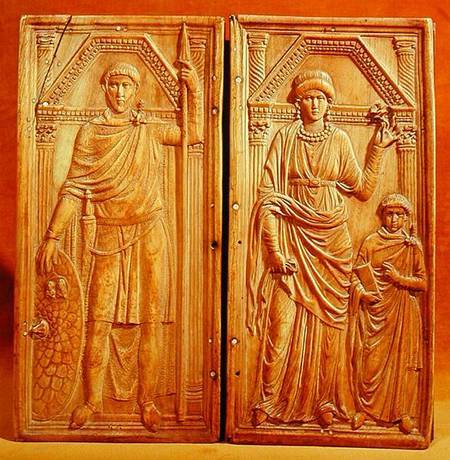
Image: Stilicho, an obvious evil foreigner.

Senin, 18 Mei 2015

Griping about the word medieval

This past week I was in Kalamazoo Michigan for the International Congress for Medieval Studies. It was the 50th such Congress at Western Michigan University, and a certain number of sessions were devoted to looking back over the past half-century or so.

Sure enough, some of those sessions (which I should point out were very good and interesting) included a lot of griping and grouching about the misuse and ambiguity of the word medieval. You would think that a bunch of scholars who by their very nature of their discipline are experts in the evolution of the meaning of words would by now have gotten over the fact that though it doesn’t make a lot of sense to call “the Middle Ages” by that term, and that coming up with a really good, chronological definition of those ages is impossible, we are stuck with the words medieval and Middle Ages anyway. But no, there is a lingering feeling that it should be possible to nail down these terms – Middle Ages, medieval – once and for all. Or ditch them. If all the experts agreed, everybody else would have to fall into line – right?

You know that’s not going to happen.

Scholars of the Middle Ages, like experts in any other field, feel they should be in control of the terminology that defines their work and gives them legitimacy. But the truth is that any important subject is contested between a whole bunch of different individuals and groups who have an interest in that field. A single word – medieval – is shattered into a variety of definitions, many of which are out of date – at least in the eyes of people working on the cutting edge of, say, “medieval studies.” Old assumptions and terms and generalizations which current practitioners have rejected hang on in popular and nonspecialist discussions.

This can be intensely irritating for people who know that certain phrases and analyses lost their cogency back in 1927 and want to talk about what their friends are doing in the field now. Nevertheless people whose business is words should really accept the fact that words like “medieval” have a number of popular meanings, and when one of them shows up in current discussion (when, for instance, a Game of Thrones shows up and is widely labelled as medieval, even though the world of Game of Thrones is not our earth at all), the fact can be dealt with a good-humored way. It certainly would reflect credit on any field where a good-humored approach was the norm.

David Parry made the most sensible remark of the entire week when he pointed out that an imprecise word like medieval has a lot of cultural value for people who make their living interpreting that era. Indeed there is a financial payoff being associated with it. As he said, “the word makes students registering for courses press the button on the screen that says ‘enroll.’ The phrase ‘early modern’ doesn’t have that effect. ”

Selasa, 17 Maret 2015

Scholarly editions and databases online


In the good old days of the early Internet, the appearance of a new site or resource often attracted a lot of attention. Now there are so many good resources that it’s quite easy for them to slip by without people who might really be interested finding out about them.


Here are three resources related to medieval military history and chivalry, one of my own particular interests. I am not surprised if you’ve missed them.

What looks like a brand-new one just caught my attention. It is a site devoted to the Spanish epic, the Song of the Cid (Cantar de mio Cid) Its purpose is to make the text more accessible in its original language.  Thus its primary users will be students of medieval Castilian who want to compare the readings of the chief manuscript with a “normalized” text, to a spoken version, to an English translation. There is a lot of useful information packed into the site, and it is really pretty to look at, too. One gripe: it is not so easy to find the English translation. There is a button that takes you straight to it, but that button is not labelled. I rather think that was people who come to the site will be using the English version, even if they are not the core audience for whom the site was built.

A similar site has been around for a while. It is the Online Froissart, which like the Cid site presents textual material in a variety of ways, with once again serious scholars being the core audience. The value of the site is underlined by the fact that the the best print edition Froissart’s over a century old and still unfinished. Looking at book prices for much less specialized and complicated scholarly works, one wonders whether the print edition will be finished and if anyone will be able to afford it on that happy day. The editors of the site have broken down one set of barriers to this key later medieval work.

And how about Armour in Art?  It describes itself thus:  “ArmourInArt.com is a searchable database of medieval art featuring armour. Items in the database range in date from 1100 to 1450 and are located throughout Europe. Content is varied - frescos, altars, stained glass, reliefs, etc - anything that is not an effigy/brass or manuscript is included.”

Why those latter two exclusions? Because, Mr. Bones, there related sites to cover that of the material. See the links just above.

Even yet, the Internet offers us some good serious content along with the kitty cats and the child stars who have aged so badly.


Rabu, 30 Januari 2013

Online intellectual content – the real thing!

Two interesting posts from long time correspondents (what do you call a person whose blog you read on a regular basis?).

Over at Hammered Out Bits, Darrell Markewitz, the Norse reenactor and craftsman, brings his own perspective to the question of interpreting small objects. This artifact sparked a discussion about what it actually represents or how it can actually be used to establish details of Norse costuming.


Says Darrell:
...no matter how much you work with artifacts, you never really understand then until you see them in life, actually before you. Reading the measurements does not really impact you. Almost everything is either way SMALLER, or way LARGER in actual truth, than what you imagine it is.
That's the core of his post, but it's actually worth looking at it to see why Darrell thinks this. Well illustrated!

Then there is Professor Grumpy over at Historian on the Edge. He is writing a new book about how historians have not only lost control of history, but are in danger of being excluded from it. Sounds cranky? More like appalling, actually. In the sense that he is describing an appalling situation.

This reminds me of a time maybe twenty years ago when a well-known Canadian scholar, an historian actually, was arguing that we should reorganize Canadian academia on the model of "real countries." Reading this summary of how a real country (UK) does things, I am just glad that we have avoided reality so far.

Anyway, I highly recommend Prof. Grumpy's first chapter, and I congratulate him on maintaining his calm in the face of a situation that he must find intolerable.


Selasa, 15 Mei 2012

From Kalamazoo -- Miniature Manifestos

A new feature of the Kalamazoo conference this year -- the International Congress on Medieval Studies -- were some very short presentations by people talking about issues that really mattered to them.

Here's a piece from Historian on the Edge that spoke to me:
Item: History is not ‘relevant’
History does not tell us ‘how we got here’
History’s value lies in:
i. not believing what you’re told;
ii. understanding that the world didn’t – and doesn’t – have to be like this: there are other ways of doing things
                                       
iii. Ethical and political stances are implicit in both; to which we must be committed
History has no monopoly on these; what sets it apart from other arts, humanities and social sciences might uncontroversially be said to be its focus upon concrete situations and completed actions
And yet it is there that lies the aporia we must explore

Sabtu, 14 Januari 2012

Intellectual goodies on the Internet -- two sets of economics posts


Will McLean has a wide and serious interest in late medieval society, especially that of 14th and 15th century England.  Currently he is interested in how English noble households worked, and is investigating them through their preserved account books.  A number of people I know, and perhaps more readers whom I don't know, may find his explorations worth reading.  This looks like a good place to start; from there you might follow the "Economics" tag, backward and forward.

The very validity of the academic tradition(s) of economic thought is being debated, by economists most of all.  If at this point you are curious about what university students are actually being taught in introductory economics classes, then you might want to wander over to Brad DeLong's blog and follow the "Econ 1" postings starting, say, here.  Brad DeLong (who teaches at Berkeley) is a prominent controversialist and critic of much of what has happened in the United States in the last 10 years, so he is not a  neutral voice.  He has a lot to say on a lot of subjects, and if you follow him you will be exposed to a lot of material, including the arguments of people he disagrees with.  Some of this will be economic arguments that I find rather opaque, but others will be of wider relevance.

Image:  loafing -- and working -- around the old manse.

Kamis, 19 Mei 2011

That beautiful destrier


In Charny's Questions on Tournaments, there is a case proposed to Charny's audience about a knight who brings a beautiful destrier to a tournament and decides not to ride it. An unarmed man gets on the destrier and rides out past the lists and all over the field, until some other tourneyers drag him to the goal post, knock him off, and take the destrier as a prize. The knight who brought the destrier to the tourney objects. Who is right?

At least, that's how I (and some others) think the question should be interpreted. Grammatically the question is such a puzzle that it stops learned philologists and scholars of medieval French in their tracks, and leads them to propose desperate measures, for instance, that there are words missing, either from the edition or from the original text in the manuscripts. I can well believe they are right about this, but it leaves me in an awkward position to explain how I arrived at my published translation, when I do publish one. At least I will know that had I spent my life studying Old and Middle French, I'd be in much the same situation.

I am deeply grateful to all the people who wrinkled their skulls over this problem to help me out. Generosity still reigns in medieval studies.

Image: Not exactly the destrier visualized by Charny.

Selasa, 19 April 2011

President Lester Pearson


A visitor from another timeline wandered into the Islamic Civilization final exam to tell us that in his/her world, Pearson was the US President during the Suez Crisis.

These cross-time travelers are surprisingly common this time of year. I well remember when one came here to tell us how Elizabeth I said "England is worth a Mass."

I love this job.

Minggu, 20 Maret 2011

Jumat, 11 Maret 2011

Benjamin Isakhan interview at the Journal of Democratic Theory

The Journal of Democratic Theory is a new web-based journal which is financing free distribution by charging authors a fee.  It will be interesting to see how scholars react -- though the charging of subsidies to the authors of books by academic presses is fairly common.

The first issue includes a quite interesting interview with the co-editor of The Secret History of Democracy, Benjamin Isakhan, both as a PDF and as a podcast.  I appreciated the podcast option -- nice to hear Benjamin's voice after only seeing his words.

Selasa, 04 Januari 2011

Students: you can do this too

 From the Chronicle of Higher Education, The Writing Group of Two.

An excerpt:
I've written in this space before about the usefulness of a "writing date." You buy a kind of accountability when you're with someone and you're both supposed to be working....

Last summer I got an astonishing amount of writing done, as did Nancy and Jeff; we all suffered together, over endless cups of coffee and an occasional scone.

But Nancy and I did something else, too. When one of us got stuck, we asked the other for help. And by stuck, I don't mean when you have to stop looking at the page for a while and go out for a run, bake a cake, or do whatever you do when your brain needs to be reset to start working again. I mean stuck as in paralyzed. You know what you need to do, but you just can't get there.

Maybe that doesn't happen to everyone. But it happens to me. And it happens to Nancy. It's easier for me when it happens to Nancy. And that's when we move from having a regular writing date to being members of the Writing Group of Two.

Here's how it works. Nancy will say something like, "I have to put this book proposal together." And then she will stare into space for three hours. Or start working on a syllabus for some course she might teach someday. Or search for an apartment to rent in Paris.
That's when I say, "OK, let's get to work." I make her think out loud and interrupt her with a stream of questions. I ask her what the argument is, and make her articulate the question she is trying to answer. I ask her why she is the right person to write the book. I tell her she has to come up with a table of contents. Nancy is a slow typist, so usually I grab her laptop and curse that rainbow-striped Apple when I can't find the right keys and make stupid mistakes. But I type as she talks.

Everything is already in her head. It's not that she's stuck on the thinking part. It's that she finds it difficult to get her thoughts onto the page. So, like a translator, or a secretary, I listen to what she's saying and I record. I don't worry much about getting things right—that's her job. What I do is help her produce that first impossible draft.

Then it's my turn. My problem is different. I can write a first draft. But often, while I suspect it's crap, I can't figure out where it's gone wrong. The language is generally fine. Sometimes, in fact, it's too good; fluid prose can hide hideous flaws of thought—at least from the author. If you get a draft that you like, you tend to memorize it; the sentences start to seem inevitable and unchangeable. I know that once it's out there in the world, there will be people quick to point out my inadequacies, my glibness, my habit of skimming along the shiny surface.

So Nancy reads my embarrassing first draft and says, usually, "I think it's more complicated." Then we discuss. She forces me to refine my thinking...

Selasa, 28 Desember 2010

Actually cutting and pasting

Grad student Tanya Roth, no stranger to the tools of the computer age, sometimes takes out the scissors and starts hacking away:

My grad school colleagues know me as someone who uses a number of digital processes for the dissertation project. ...

Maybe that’s why my advisor seemed surprised when I told her about my other hacking process…the literal cut-and-paste process I use when I’m editing chapters. This is the part where I hack the printed pages into pieces... I fell into this practice as a college freshman when I took my school’s comp 101 class. Back then, it was just a 10-page paper, but it worked. I cut the draft into paragraphs, numbered each, and wrote notes on the sides of each paragraph – sometimes editing sentences, but other times just noting what the theme of the paragraph was so I could rearrange content more effectively.

I did the same for my undergrad thesis, and the whole process has reemerged periodically during the dissertation stages. For all my digital processes, I can’t deny that this cutting and pasting works for me: it gives me the ability to visualize the whole piece a little better because I can see more than just one or two pages on the screen. I can try out what it will look like/sound like to rearrange paragraphs.

There's more, in this post and in others.

I like the idea of seeing the whole chapter laid out:


I don't know if it would work for me, but it might be worth a try.

Selasa, 21 Desember 2010

History -- and everything academic -- is useless

So says Charlie Brooker in the Guardian, talking about British tuition increases. He's staking out the "tough love" position. An excerpt:

Take history. There's already far too much of it. In fact, mankind is generating a "past mountain", which grows 24 hours in size every single day. No one can be expected to keep all of that in their head. There simply isn't room. Even award-winning historians will be lost for words if you unexpectedly leap out in front of them and demand they list everything that happened on, say, 6 July 1919, before the special quiz music ends, especially if they thought they were alone in the house.

So instead of studying the whole of human history, why not focus on a concentrated period, such as the most exciting five minutes of the second world war? That way you just get the fun bits with the machine guns and everything, and there's none of that boring exploration of the "consequences" or the "causes" or "how we can stop it happening again"....

Rather than providing frivolous courses in artsy-fartsy-thinky-winky subjects with no obvious revenue stream, our educational institutions could save a lot of time and unnecessary expense by only providing courses that train students for jobs we're definitely going to need in the brilliant future we're steadily carving for ourselves. What's the point in learning botany? We all know there won't be plantlife. Apart from maybe the odd triffid, or whatever sort of moss can withstand a dirty bomb. So why bother learning about it? There's no money to be made.
Instead, let's focus on giving young people the skills society will be crying out for in the years or months to come. Practical vocations such as water-cannon operator, wasteland scavenger, penguin coffin logger, Thunderdome umpire, dissident strangler, henchperson and pie ingredient.
Come to think of it, even those courses are going to be costly, and the eventual wages so insultingly low it'll take them three lifetimes to repay the loans.

Thanks to Guy Halsall for the link.

Rabu, 22 September 2010

Opuscula -- an interesting experiment in scholarly publishing

My colleague Mark Crane have offices across the hall from each other and we sometimes talk face to face and voice to voice (!) .  Sometimes we talk about the present and future of scholarly publishing.  So today Mark crossed the hall and told me about the following project:


Opuscula: Short Texts of the Middle Ages and Renaissance is a peer-reviewed, on-line journal/text series published by Classical, Medieval and Renaissance Studies at the University of Saskatchewan, specializing in short texts of the Middle Ages and Renaissance. We seek single-witness editions of a broad range of pre-modern texts including but not limited to literary and philosophical works, letters, charters, court documents, and notebooks.

The goal of the journal is to establish open access to a substantial body of small but complete texts in scholarly editions to researchers and educators. Our first issue will be published in 2011.

I look forward to it!

Jumat, 03 September 2010

Two views of grad school

Two recent posts talk about the graduate school experience.

Tanya Roth, a military historian, talks about non-academic activities that have kept her fit and sharp:

One of the accomplishments of the past two years that I’m most proud of – aside from my dissertation progress – is my gym routine. During the first two years of grad school, the idea of taking time to hit the gym was just stressful. I had no idea how to fit it in on top of the reading and the writing and the general survival of graduate school.

In year three, I got a little better, but it was really the end of year three – late spring 2008 – when I got myself into an actual routine. Now I hit the gym for 45 minutes to an hour every weekday morning before I start to work, and that’s a commitment that I like.
 I like variety, so I try to shake things up as I’m able....
 In October, I think I’ll finally give running a shot and check out Couch to 5K to see if I’m up for the challenge.
I’m proud of this routine because it’s not always easy to get myself to the gym. There are days when I’d rather be frittering around on email or something else, or even sleeping a little later. But in the end, I think the gym routine is one of the best “for-me” things I could have added to my schedule: not only am I keeping my body in better shape, but I’m also giving myself a stress outlet.

You know, it may actually be part of the reason why I’ve been able to get through this dissertation thing so far.
I would also like to point out that stress doesn't end with finishing grad school, and plenty of people are stressed out as undergrads.  The sedentary aspects of modern life are debilitating and even deadly; you've got to fight back.   And just because you've stayed fit for a good long time doesn't mean you can take five years off, sitting in front of screens.

Speaking of fighting back, if J.J. Cohen's remarks on George Washington University's English program are accurate, it's kind of too bad that Tanya isn't there.  She might be a star in this situation:


Last May in Kalamazoo I had a pleasant dinner with a large group of faculty and graduate students at restaurant called Food Dance. A great deal of wine may have been involved. At one point I told someone who had been accepted into GW's graduate program and who was about to relocate to DC that we have a tradition of locking each arriving student in a steel cage with a faculty member. Just as in Thunderdome, only one combatant emerges from the Cage of Scholarship conscious. I believe I described the cage fight as one of our more beloved GW English traditions, something that everyone eagerly looks forward to as a rite of passage.

Why I make this shit up I have no idea. I blame the great deal of wine.

Imagine my alarm to have found the pictured gift waiting on my desk this morning. The note card states, with quiet menace, "See you in the cage, Jeffrey." I know its sender practices krav maga. Tauntingly, the cotton hand wraps she gave me are labeled NOVICE. I wonder if she will settle for being taken out to lunch instead? Please?


Rabu, 25 Agustus 2010

Nipissing history students find the fun in academia


Some readers may disapprove, but seeing as this grew out of a seminar situation, this tickled me:

Yesterday, Matt and I went to Sudbury (Laurentian University) for a conference called "Social Science on the Final Frontier." Essentially, the conference was about the intersection of the social sciences and the science fiction genre. We presented about the conceptualization of the state of nature in the TV series LOST.

Here's our abstract if you were actually interested in what we were presenting about:

Nasty, Brutish and LOST: the State of Nature in the hit TV series LOST
By: Holly Ann Garnett and Matthew Morris

The state of nature has generally been described as life outside of society, the state, or government. Indeed, many political philosophers have envisaged the human being prior to, or exterior to, these social constructs in order to ascertain the true nature of humanity. Although a primarily hypothetical situation, the closest observations of the state of nature today could be in post-disaster areas, a hijacking situation or perhaps even the archetypal deserted island scenario, like in ABC’s hit science fiction saga of LOST.

Our discussion paper ponders the question: can the situations of ABC’s hit science fiction saga truly be considered the philosophical state of nature? We explore this question through an examination the theoretical underpinnings of this political concept through the writings of Thomas Hobbes, John Locke and Jean-Jacques Rousseau.We find that many of the characteristics of the state of nature that Hobbes, Locke, and Rousseau describe exist in the characters and scenarios of LOST, even if these diverse thinkers describes quite varied situations.


Now, if you were wondering why the heck we did this, it's really borne out of our honours seminar class, in which we ended up making references (and sometimes just talking about) the TV series LOST since we, and our professor, are such big fans of the show. So over the past few months (since April at least) Matt and I have been researching and reading about LOST and political philosophy (yes, academics is THAT fun!)
More fun, perhaps, than reading Thomas More's creepy Utopia (at least, that's how I remember Utopia). More useful? Argue your opinion!

Image: The brooding, mysterious master of a far-away island.

Jumat, 20 Agustus 2010

Kamis, 19 Agustus 2010

Ploys

Roger Pearse on the ploys scholars use to keep interesting texts to themselves:

Another ploy has been to have only German scholars work on it, and get them to do it a century ago in obscure publications, usually without translation. After all, if you provide a translation, who knows who might start looking at this stuff? It doesn’t bear thinking about.

Been there, several times, and from more than one direction.

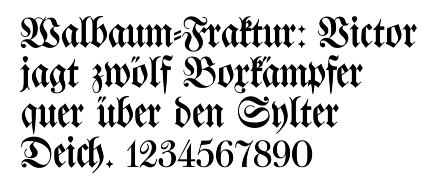
Image: just a little Fraktur, not obscure at all.


Jumat, 30 Juli 2010

Minor triumph

Today I heard from the editors of a book I am appearing in that the deadline for first drafts is just two months away.

I sent my first draft in last week.

Boy, that feels good!

Kamis, 15 Juli 2010

Writing: students, listen to the voice of experience

No, I don't mean me. Students never get (or respond to) good advice from their teachers!

But they might listen to a more experienced student (one writing a dissertation, perhaps) who has seen it all and is willing to tell uncomfortable truths about her writing life. Meet Tanya L. Roth:

The truth is that I am a perfectionist with my work. Or, as I like to think of it – I’m a recovering perfectionist, as this is something I’ve been working to overcome for the last five years. Perfectionism, as it turns out, gets in the way of things more than it actually helps. (As Lamott says, “Perfectionism is the voice of the oppressor…and it is the main obstacle between you and a shitty first draft.” Also, “perfectionism will ruin your writing, blocking inventiveness and playfulness and life force.” (Lamott, 28).)

In my experience, five years of graduate school teaches you a lot about your writing habits, your strengths, and your weaknesses. I’ve learned that revisions are my bread and butter, and that facing the blank page is one of my greatest challenges (see: perfectionist tendencies). My solution? Conquer the Blank Page.

I like to think I’ve gotten very good at drafting. I can eliminate the blank page in fairly short order and transfer something from my brain to the screen. That something tends to be the worst writing you have ever seen, but as it turns out, it helps me get started. In a couple of hours, I can pour out about ten to fifteen double-spaced pages of the very early thoughts on a chapter topic. I do this, of course, by simply writing.

There’s no rhyme or reason to it. It’s not quite freewriting (I pay attention to grammar and spelling and all that). In a sense, it’s stream of consciousness, but some of it will appear more Faulkneresque while other parts sound like I’m actually trying to write a real academic piece. I don’t delete anything. I do tend to write “this is crap” at least once or twice every two pages, and the general tone tends to be “here’s what I’m thinking I need to do in this chapter…” – as if I’m talking to my best friend.

Before I know it, I have something. Something I can create an outline from and begin to make into a real chapter. Once I have a rough outline – which will change, and become more detailed as I continue to write – I divide the chapter into sections. Sections, you see, are far more mentally (and physically) manageable to work with than the prospect of an entire chapter.

Lynn Hunt wrote in a recent issue of AHA’s Perspectives:

Everyone who has written at any substantial length, whether prose or poetry, knows that the process of writing itself leads to previously unthought thoughts. Or to be more precise, writing crystallizes previously half-formulated or unformulated thoughts, gives them form, and extends chains of thoughts in new directions.

This is why the shitty first draft – Lamott’s term, not mine – is so important. If you haven’t written anything yet, how can you know what you’re thinking?

More interesting thoughts here.

Update from Lynn Hunt's article:

The best advice about writing that I ever got was many years ago from the poet and prose writer Donald Hall. His book Writing Well was then in an early, if not a first, edition (it is now in its ninth), but he also generously read the pages of those of us who were junior fellows in the Michigan Society of Fellows. He was a senior fellow, and I knew that my dissertation needed serious work. From him I learned that writing requires an unending effort at something resembling authenticity. Most mistakes come from not being yourself, not saying what you think, or being afraid to figure out what you really think.
Wonderful! (I'll tell you about Sir Percival someday...)

Image: borrowed from these people.