Tampilkan postingan dengan label European Union. Tampilkan semua postingan

Senin, 07 November 2016

Things change

A prominent English orchestra conductor said this on the radio yesterday, about refugee policy:

"It is nice to live in a country where we can do the right thing and not just the politically expedient thing." The country he was speaking about was, of course, Germany. The conductor was Sir Simon Rattle, who leads the Berlin Philharmonic Orchestra.

Minggu, 09 Oktober 2016

Purge those evil foreigners

From the Guardian:
Leading foreign academics from the LSE acting as expert advisers to the UK government were told they would not be asked to contribute to government work and analysis on Brexit because they are not British nationals.
The news was met with outrage by many academics, while legal experts questioned whether it could be legal under anti-discrimination laws and senior politicians criticised it as bewildering.
“It is utterly baffling that the government is turning down expert, independent advice on Brexit simply because someone is from another country,” said Nick Clegg, the Liberal Democrats’ EU spokesman.
“This is yet more evidence of the Conservatives’ alarming embrace of petty chauvinism over rational policymaking.”
Sara Hagemann, an assistant professor at the London School of Economics who specialises in EU policymaking processes, EU treaty matters, the role of national parliaments and the consequences of EU enlargements, said she had been told her services would not be required.
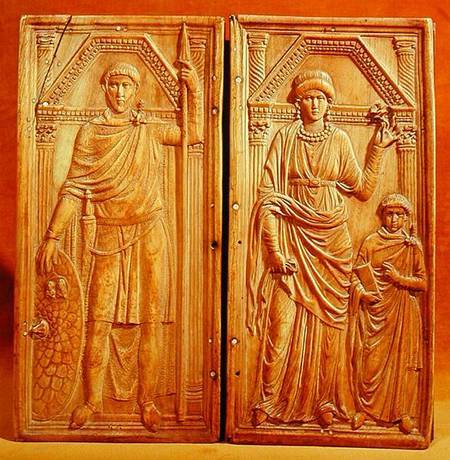
It's the end of the British Empire, at the hands of its own people. Late Roman historians, think of this.
Image: Stilicho, an obvious evil foreigner.

Minggu, 05 Juli 2015

Fintan O'Toole and the imaginative foundations of political structures

From the Guardian:
Has Europe lost its hold on our collective imagination?

Fintan O'Toole

When I was a teenager in Dublin in the early 1970s, the phrase “We’re into Europe!” gained a peculiar currency. It was half-jokey but not really sardonic. You used it for good things that promised even better things – when a girl you fancied smiled at you or your team scored the first goal.

We were into Europe [the EEC].

...

But what did “Europe” mean in this sense? It was not a physical place. Ireland had, after all, always been part of Europe. And the EEC was not, in any case, Europe – it was a small fraction of the continent. But it wasn’t a mere set of trading and institutional arrangements either. It was a story, an imaginative fiction of the kind that Yuval Noah Harari evokes in his book Sapiens: A Brief History of Humankind. He makes the point that the capacity to believe in fictional constructs is a defining element of what makes us human, because without it we cannot co-operate with people we do not know: “At the heart of our mass co-operation networks, you will always find fictional stories that exist only in people’s collective imagination... There are no gods, no nations, no money and no human rights, except in our collective imagination.”

One of these enabling fictions is “Europe”. It is a story that most of the central and western nations of the continent agreed to tell themselves and each other in order to deal with the legacies of the second world war and the cold war. And like all stories, it sustained itself, if not exactly with belief, then at least with a willing suspension of disbelief. The question now is whether it still exists at all, whether “Europe” has lost its hold on our collective imagination. All the evidence suggests that it has.

In a remarkable outburst reported last week by the Observer, the Italian prime minister, Matteo Renzi, denounced the failure of his fellow EU leaders to agree on more than a voluntary plan to deal with the thousands of refugees and migrants landing on his country’s shores: “If this is your idea of Europe, keep it for yourself… you do not deserve to call yourself Europe. Either we have solidarity or we waste our time!”

In recent weeks, too, the appeals by leaders of Syriza in Greece to “our shared European values” have come to seem not just desperate but naive. It is as if the Greeks were appealing to medieval codes of chivalry or expecting Premier League footballers to respect 19th-century Corinthian values. “Europe” and “European values” seem, even as rhetorical gestures, entirely hollow. They are evoked now only to underline their absence.

One by one, the elements of the Europe story have fallen away. Democracy? ... The free movement of people? ... Thresholds of decency? Formulaic expressions of sympathy aside, there is little sense that the European Union as a whole finds it intolerable that hundreds of thousands of Greeks are living without electricity or that millions have no access to public health care.

The “ever closer union” envisaged by the EU’s founders has been replaced in effect by a deeply incoherent mixture of one-size-fits-all thinking and double standards. On the one hand, there is the absolute insistence that there can be no challenge to the technocratic formula for solving the eurozone crisis: austerity plus massive bank bailouts plus privatisation and the dismantling of social and labour protections.

On the other, there is a sharp moral and political divide between the creditor states and the debtor states, with a supposedly virtuous, prudent and righteous core beset by a feckless, reckless periphery. Or, if viewed from that periphery, between victimised citizens and a European political elite bent on punishing them for sins they did not commit on their own.

There is no “collective imagination” of the crisis – in one Europe, it is respectable, hard-working people being exploited by chaotic layabouts from the hot south; in the other, it is hard-pressed and equally hard-working people being sucked dry to feed foreign banks. The stories Europeans are telling themselves about what’s going on around them are not just different but mutually exclusive and mutually antagonistic.

... the generation of leaders with memories of the Second World War – the likes of Helmut Kohl and Helmut Schmidt, François Mitterand and Jacques Delors – passed on. With them has gone the urgency of imagining a European story, not as an abstract fable, but as a necessary alternative to the other European stories of Hitler and Stalin.

... In the technocratic mindset that has filled the vacuum where “Europe” used to be, the old story is just a sentimental romance. But there’s always a story – the old fable of democracy, solidarity and decency hasn’t been replaced by simple dull reality. What has taken its place is a narrative that poses as hard-headed realism but that is actually much more fantastical than the one that was constructed by the postwar generation. It has a wildly improbable plot in which years of austerity magically produce economic growth; mountains of public debt are paid off by shrinking economies; unaccountable experts know more about other countries than their own elected governments; and everyone lives happily ever after. The good are rewarded. The bad are punished but they repent in the end and return to the fold. There’s certainly a lot of imagination in this story. But its ability to sustain a collective enterprise among 28 stubbornly individual nations is negligible.

It is not entirely true, of course, that no one at all believes the old story of Europe. The last true believers are on rickety boats in the Mediterranean, trying to make their way to an imagined continent of compassion, solidarity and security. If they ever get to shore, they will find at best a grudging welcome. But those who purport to share their belief in what Europe means badly need some of their desperate optimism.

Sabtu, 11 Februari 2012

On the euro crisis

I have just been reading the comments following an article by Eric Reguly in the Globe and Mail's Report on Business.  Reguly makes the point that anger against foreign demands for Greek austerity is rising, and a lot of it is aimed at the Germans, who are providing much of the funding for Greece's financial lifeline as lenders of last resort.

The more than 400 comments show very little sympathy for the resentment of the Greeks. Very, very little.  The Greeks are characterized as lazy, crooked, and beggars who can't be choosers.

Several commentators cite the old joke I first saw in the comic strip the Wizard of Id:  The joke was that the  "Golden Rule," was "he who has the gold makes the rules." This is used as a point in favor of the "German" position.  But in fact these Greek debts are not gold, nor do the Germans and others have gold to give to Greece.  The money involved in this crisis includes a lot of funny money created by a few politicians and bankers who committed their populations or customers to guarantee the profitability of basically unsound loans.  The question is really who will pay for this imprudence and sharp practice.   In the conflict between lenders of last resort and Greeks resisting debt slavery, the Greeks have almost as much ability to write the rules as the lenders of last resort who are trying to save the banking system from the consequences of its foolish behavior.  Who is the bigger crook, who should suffer, and who can be blamed, can be treated as purely moral questions, but that attitude will not save Greece, the euro, or the banks.

Image:  a gold ecu in more hopeful days for the pan-European currency.