Tampilkan postingan dengan label Germany. Tampilkan semua postingan

Senin, 07 November 2016

Things change

A prominent English orchestra conductor said this on the radio yesterday, about refugee policy:

"It is nice to live in a country where we can do the right thing and not just the politically expedient thing." The country he was speaking about was, of course, Germany. The conductor was Sir Simon Rattle, who leads the Berlin Philharmonic Orchestra.

Minggu, 22 Februari 2015

More (and more chilling) German folk tales

This Salon article talks about "darker-than-Grimm stories" recently discovered in a German archive and now published in English translation.  That cutesy description rang alarm bells for me, but to my surprise the interview with the translator, Maria Tatar, is really substantial. Congrats to the interviewer, Laura Miller, for doing such a good  job.

Some excerpts:

[MILLER] I was struck by several themes that came up repeatedly in these tales. There are a few stories where parents turn against their son because he’s too strong. It doesn’t seem that different from the more familiar stories where the stepmother takes against the daughter who’s prettier than her. We’re always hearing about the wicked stepmother and how she hates Snow White for being the fairest of all. That is a real generational rivalry, but the same rivalry happens between fathers and sons, except it’s about virility or strength instead of beauty. I was fascinated to see that there is a male equivalent of the beauty rivalry.

[TATAR] It’s remarkable, in one particular story, how the parents team up against the son. You would think they would make his strength work for them. Instead, they try to do him in! That’s another great difference between Schönwerth and the Grimms. For the Grimms, it is always the evil stepmother. The fathers tend to be exonerated. Sometimes they just go along with the stepmother, and they’re not described as complicit in any way, just overpowered by this demonic wife. Whereas in Schönwerth, there’s the story of Prince Goldilocks, where the father sends the boy into the wilderness and wants to kill him. That is unheard of in the Grimms’ tales.

  [MILLER] You point out that we have this one-sided view of the way gender works in fairy tales partly because of how the Grimms edited their collection, but don’t you also feel that partly it’s because over time, as the oral storytellers became overwhelmingly female, they also might have focused on female characters more? 

 [TATAR] I’m not so sure. The Grimms picked and chose their stories, and I think that they just had some sort of deep reverence for fathers. Fathers could do no wrong for them. For example, take the story of Cinderella, where the villain is the evil stepmother. But there’s another version of Cinderella that circulated in the 19th century that is called “Donkeyskin” or “Thousandfurs,” and in that one it’s a father who loves his daughter too much. When his wife dies, he wants to replace her with his daughter. So you have a father who is totally out of control. Then he disappears in the course of the 19th century. I guess you’re right, I shouldn’t put it all on the Grimms. It could be part of a general trend toward focusing on evil women. 


[MILLER] Reading this collection made me realize the degree to which intergenerational conflict in fairy tales is not just about the female characters but is a really pervasive theme. It’s about the child’s awareness that as much as their parents might love them, parents also know that their children will supplant them. Children can be threatening in this weird way, as well as being very much desired at times. The parents will fade as the children come into strength, and so the children also represent the parents’ own deaths. So there’s this ambivalence to the relationship. I didn’t really see that before because it had always been presented in such a gendered way in the more familiar fairy tales, presented as a conflict between women about desirability as opposed to something even more universal than that. 

 [TATAR] Fairy tales are about the hyper-dysfunctional family. Think of “Jack the Giant-Killer”: The giant is a proxy for the father. There’s always something terrible going on, these domestic dramas that are larger than life and twice as unnatural. 

[MILLER] What do you in particular find so compelling about this form?

[TATAR] What I really love about fairy tales is that they get us talking about matters that are just so vital to us. I think about the story of Little Red Riding Hood and how originally it was about the predator-prey relationship, and then it becomes a story about innocence and seduction for us. We use that story again and again to work out these very tough issues that we have to face. My hope is that this volume will get people talking about not just the stories and the plot but the underlying issues. >

Selasa, 03 Februari 2015

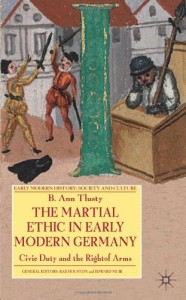
The Martial Ethic in Early Modern Germany, by B. Ann Tlusty

Ken Mondschein's review will tell you whether you can live without this book:
B. Ann Tlusty’s The Martial Ethic in Early Modern Germany is one of those books that simultaneously delights and frustrates the reviewer: Delight, for the immense wealth of valuable material it contains, coupled with admiration for the author; frustration, because of the sure knowledge that one is unlikely to ever write a work as good. Then again, few scholars do: Tlusty bases her argument on an intimate knowledge of city archives, especially those of Augsburg and with an emphasis on judicial records, but incorporates a wide number of other sources, both archival and published. These are masterfully synthesized into a nuanced and far-reaching argument that addresses core questions in the historiography of early modern Europe. Martial Ethic, in other words, a definitive work of history, one that deserves to stand beside works on the history of violence and arms in Europe such as those of Ute Frevert and Kevin McAleer for modern Germany and François Billacois, Peter Blastenbrei, Trevor Dean, Robert Nye, and Pieter Spirenberg for the rest of Europe (1) and which ought to be on comprehensive exam reading lists and incorporated into survey courses on later medieval and early modern Europe. It has already achieved well-merited renown amongst the Historical European Martial Arts crowd, but seen from the perspective of Martial Ethic, the Fechtbücher (records of fencing teaching) seem like footnotes to the greater trends and ideas brought out by Tlusty.

However, like all great history, Martial Ethic is not an apolitical work. By this I do not mean that Tlusty’s objectives or arguments are in any way directed towards making a modern political argument, but rather that they resonate with an important contemporary concern—namely the American debate over firearms. This is unavoidable for two reasons: the fact that (as Tlusty points out) American gun culture owes some of its genetic material to Germany, and the fact that the historian’s ever-present obligation to make the past relevant to the present naturally guides us towards subjects of broader interest. While Tlusty’s main aim is to make a contribution to the literature of violence and the growth of the state in premodern Europe, she is certainly cognizant of contemporary resonance. In the same way, it is the reviewer’s obligation to tease out the broader implications of the work under consideration. Therefore, I will first discuss the structure and arguments of Tlusty’s book and what they mean for the historical discipline, and then editorialize on their relevance to modern society.

And there is lots more...

Rabu, 23 Oktober 2013

Some of the best stuff on the internet


 But it's fairly clear that hate that made the Shoah was neither an invention nor the magic of false-consciousness, but a reflection of the people themselves:


In the same poll of November 1946, one German in three agreed with the proposition that ‘Jews should not have the same rights as those belonging to the Aryan race’. This is not especially surprising, given that respondents had just emerged from twelve years under an authoritarian government committed to this view. What does surprise is a poll taken six years later in which a slightly higher. percentage of West Germans—37 percent—affirmed that it was better for Germany to have no Jews on its territory. But then in that same year (1952) 25 percent of West Germans admitted to having a ‘good opinion’ of Hitler.


Attendant to all of this was something that any student of white supremacy in America will recognize--a strong propensity toward national amnesia:


 In Italy the daily newspaper of the new Christian Democrat Party put out a similar call to oblivion on the day of Hitler’s death: ‘We have the strength to forget!’, it proclaimed. ‘Forget as soon as possible!’ In the East the Communists’ strongest suit was their promise to make a revolutionary new beginning in countries where everyone had something to forget...


It's worth taking a moment to think about this "strength to forget" notion. National forgetting is always a selective endeavor. Italy had no more intention of dismissing its Roman heritage as "the past," then Americans have of dismissing George Washington as "the past." "The past" is whatever contributes to a societies moral debts. "Heritage" is everything else. 


Judt is making a very disturbing argument--that postwar Europe was built on  a willingness to only push deNazification but so far. There is here something not wholly dissimilar to our own reunion accomplished on an agreement to "forget" what the War was over. So far does the myth advance that Judt finds president Eisenhower lauding the Wermacht--"The German soldier fought bravely and honorably for his homeland."
We are confronted with a series of awful questions: What are the actual limits of human justice? How much of human justice, ultimately, rests on the accumulation of guns? What is one to do when the people, themselves--not sinister hidden forces are the engines of persecution? Of useful killing? Of genocide? ...


Man.  Such hate. What can we do against such reckless hate. Don't study history to boost your self-esteem. Study history to lose your religion. Or maybe in the end, to gain it. I am not religious at all. But seeing the limits of all of us, you start to understand why people might appeal to some higher, more certain, more fierce, invention.

Rabu, 11 April 2012

Minggu, 06 Maret 2011

The real (?) Ulrich von Liechtenstein

Dr. Beachcombing propounds:
Ulrich von Liechtenstein (obit 1278) was a standard thirteenth-century knight. He had castles (three of them). He fought – above all, in Eastern Germany. And he also dressed up as a woman and rode from Maestre (Venice) up to Vienna.

Yes, yes, Beachcombing stopped too when he first read this many years ago. But now he no longer even notices. This is what comes of spending half your life in the Middle Ages…

The root of Ulrich’s unlikely transvestism was courtly love. In his poetical ‘autobiography’ – a word Beachcombing will return to – Ulrich describes how he decided to undertake his quest as an act of homage to one lady, but also, by extension to all women. Indeed, his autobiographical work – ich comes up frequently – is entitled Frauendienst (Lady Service).

As Ulrich rode through the hinterland of hellish medieval Europe – spending half your life in the Middle Ages also makes Beachcombing all too honest about what kind of world theirs was – he challenged the knights he met to jousts and gave gifts to ladies.
By the end of his little jaunt Queen Venus (i.e. Ulrich in drag) had broken 307 spears, donated 271 rings and unhorsed four knights. Included among his honoured opponents was a knight dressed as a monk that Beachcombing will let go without any comments. But also interestingly another knight dressed as a woman. How Beachcombing would have liked to have seen that joust. [There's more...]
Me, too.


Image:  Yes, that's him, according to the Manesse Codex.

Senin, 03 Januari 2011

Rabu, 17 November 2010

Brad DeLong reprints one of his better short posts...

...and asks us to count our blessings:
November 12, 2004:
Brad DeLong's Semi-Daily Journal: A Weblog: Let Us Give Thanks (Wacht am Rhein Department): Daniel Drezner writes:
danieldrezner.com :: Daniel W. Drezner :: The dogs that don't bark in international relations: Newspapers, media outlets -- and, because we feed off them, blogs -- tend to focus on the violent hot spots in international affairs. This is entirely appropriate -- but occasionally, it's worth stepping back and remembering that there are parts of the globe where everyone has expected and predicted things to go "BOOM!" -- and yet, in fact, conditions have improved.
Yes. Let us give thanks that the most brutal and blood-soaked border in the world is quiet--a border inhabited on both sides by those bloodthirsty peoples who have been numbers one and two in terms of the most effective killers of foreigners for centuries.
Who am I talking about? The Germans and the French, of course
It is now 59 years and 9 months 65 years and 9 months since an army crossed the Rhine River bearing fire and sword. This is the longest period of peace on the Rhine since the second century B.C.E., before the Cimbri and the Teutones appeared to challenge the armies of the consul Gaius Marius in the Rhone Valley.

 I have to wonder, though, if that "longest period of peace" observation would really hold up.

Image:  anyone got some anti-French propaganda?

Senin, 18 Oktober 2010

Minggu, 11 Juli 2010

Walther Rathenau on Soviet Communism, early 1920s

From Wikipedia on Rathenau, Foreign Minister of the early Weimar Republic:

In fact, despite his desire for economic and political co-operation between Germany and the Soviet Union, Rathenau remained skeptical of the methods of the Soviets. In his Kritik der dreifachen Revolution (Critique of the triple revolution) he noted that:

We cannot use Russia's methods, as they only and at best prove that the economy of an agrarian nation can be leveled to the ground; Russia's thoughts are not our thoughts. They are, as it is in the spirit of the Russian city intelligentsia, unphilosophical, and highly dialectic; they are passionate logic based on unverified suppositions. They assume that a single good, the destruction of the capitalist class, weighs more than all other goods, and that poverty, dictatorship, terror and the fall of civilization must be accepted to secure this one good.

If ten million people must die to free ten million people from the bourgeoisie, then this is a harsh but necessary consequence. The Russian idea is compulsory happiness, in the same sense and with the same logic as the compulsory introduction of Christianity and the Inquisition.

Senin, 04 Januari 2010

Simplicius Simplicissimus: a forgotten classic


I have taught my year-long course on early modern European history 1400-1800 maybe 10 different times. From the beginning I was aware that there was a classic novel of the 30 years war called Simplicius Simplicissimus, written in German not long after the events it describes. The book is considered a valuable resource for people studying the war and the experience of soldiers in it. I never had time to get hold of it myself, since it wasn't in any of the University libraries that I frequented.

I have temporarily relocated for my sabbatical and now have been able to put my hands on the book. And you know, it is really good. It is a typical 17th-century satire where the hero is a fool, which is to say that he has a clear-eyed view of what other people do and why they do it, and the same for himself, for whom he makes no excuses. Simplicius starts out as a poor orphan, and travels through society rising and falling in wealth and status, mostly depending on his luck at any given time.

A book like this has a real chance of being absolutely deadly to modern tastes. But somehow it isn't, at least not in this translation by George Shulz-Behrend from 1965. The prose is clean and light with no fake archaic flavor. In fact, it has a real contemporary feeling, meaning fresh and contemporary by the standards of the middle 60s. Not so long ago even if you weren't born then. Despite the fact that it exposes the sins and foibles of all sorts of people, it isn't brutal as it so easily could be.

The main fault of the book is that the author, Johann Jakob Christoffel von Grimmelshausen, throws in more digressions that I care for with the result that the book is about 20% too long and sort of runs out of steam rather than ending properly.

Image: the cover page of the 1669 edition.

Sabtu, 07 November 2009

One of the best things to happen in human history

We are coming up to the 20th anniversary of the fall of the Berlin wall, part of the greater fall of communism and the Iron Curtain in Europe. This is one of the best things that ever happened in human history. It could all have gone very wrong.

All over the web there is commentary and reminiscences, and I urge you to have a look. The Toronto Globe and Mail is not a bad place to go. Their coverage was excellent 20 years ago, and I have just finished reading an amazing article by Doug Saunders and video by the same, both discussing what happened in East Germany.

The video is here.
(Click video tab if necessary.)

The article, "Half a life ago, Katrin blew the Wall down," is here. (Click article tab if necessary.)

Some excerpts (note the lack of mythologizing about Gorbachev or Reagan):
Through the bare tile walls of her solitary-confinement cell in Leipzig, Katrin Hattenhauer could feel a rumbling. As she lay on her bare, plank bed, her petite frame shook with a vibration from the main street outside, the sound of something large and heavy and determined.

She knew, from the air of distress among her Stasi guards, that something was going on. But it was damningly hard to make the distinction: Was this the thundering surge of huge numbers of people rising against the state, or of tanks and columns of soldiers restoring order?

It was Monday, Oct. 9, 1989. In a month, it would be her 21st birthday. It seemed unlikely she would live that long. Cancer had nearly killed her five years before, and now the Stasi, the East German secret police, had told her that they wanted her dead, soon.

She had been locked in isolation for five weeks, after being picked out of a crowd of hundreds and arrested for insurrection as she carried a large, cloth banner: “For an open country with free people.”

...

Unbeknownst to Katrin Hattenhauer, East Germany had erupted that Monday, in her name. The banner she had carried, and the air of martyrdom created by the arrest of her group of unknown students, had galvanized the nation.

During her confinement, the tiny, silent peace protests they had been holding on Mondays in the square of Leipzig's St. Nicholas Church had metamorphosed into a full-scale revolt with thousands of people, then into a mass insurrection with tens of thousands, then into a national revolution, bringing a million people onto the streets, that would precipitate the end of the Berlin Wall exactly a month later, on the night of Nov. 9.

When Berlin celebrates the 20th anniversary of the Wall's breach on Monday, it will mark a symbolically important event that was neither the beginning nor the end of anything. Communism would stagger on for a month after Nov. 9, and elections and German reunification wouldn't take place until well into 1990.

Nor was the Wall's fall the event that triggered the end of East German communism. That pivotal event, the day that ripped past from future, had taken place exactly a month earlier, in Leipzig, where pressure had been building quietly, for weeks and years, in a church courtyard.

Its eruption was what Katrin Hattenhauer had felt shaking her prison-cell bed. It was the eruption she and her friends had launched.

The rumbling she felt on Oct. 9 had been the force of 70,000 people marching past and occupying the city's downtown district. Tanks, dogs and train-loads of shells had been shipped into the city that morning, and stood waiting at the train station, along with thousands of troops.

The soldiers were under direct orders from Erich Honecker, the leader of the German Democratic Republic, to prevent the occurrence of mass protests “from the start,” and, if provoked in any way, to respond “offensively.” Only four months earlier, tanks had cleared Beijing's Tiananmen Square of democracy protesters, killing hundreds. Mr. Honecker was not against a Chinese option. Slaughter seemed the logical outcome.

But the soldiers did not fire. They didn't even block anyone's path. Mr. Honecker was shocked, and only a few days later the magnitude of the Oct. 9 protest (and the even-larger ones encouraged by its lack of violence) would force him to resign.

Their decision not to shoot – apparently made without much discussion – owed much to the collapse of East German confidence. Russian premier Mikhail Gorbachev had made it clear a year before that he wouldn't use Soviet troops to enforce communism in satellite states. Poland and Hungary had ceased to be communist earlier that year in peaceful, negotiated handovers, so they wouldn't provide troops.

But even more important was the tradition of calm, tranquil protest that began in Leipzig as “prayers for peace” with a few dozen people holding candles, expanded into the Monday demonstrations and then inspired the quiet queues of people who chanted open the Wall on Nov. 9.

On that Monday, the soldiers searched for provocations that might justify a violent response, but found none. “We were told we would be facing counterrevolutionaries,” one soldier explained later, “and we realized it was just people like us.”

...

The “peace prayer” protests (only a small fraction of the participants had religious beliefs) and environmental statements had not been intended to challenge the existence of the state. Nobody dared imagine that. But the mood in East Germany changed in 1989: Between the increasingly dramatic liberalizations occurring in the USSR under Mr. Gorbachev, the sense of economic collapse within the GDR and the quiet revolutions in Poland and Hungary, there was a desire for change.

And one of the only vehicles for change was the small circle of protesters in Leipzig.

“No one was dreaming that the Wall would fall,” Ms. Hattenhauer said. “That was unimaginable – 1989 was a year of escalation, where we had the feeling the state was getting more dangerous. People were being arrested faster and disappearing faster. Nobody had sensed that the system was kaput economically.”

By July, after news of Poland and Hungary ending communism had reached the public, the Monday protests were attracting hundreds of people. The Stasi and police would sometimes arrest and beat protesters – they had started to worry.

But the protesters became organized. There was a circle of half-a-dozen young students who became very adept at sidestepping the Stasi. Mr. Müller devised ways to stay in touch with other protest groups forming in different cities. And he developed a way to get videotapes of protests, and subtle messages of coming ones, smuggled out to the West, where they would be broadcast on TV stations that could be received in towns close to the border such as Berlin and Leipzig.

...

Three weeks after her release from prison, on Nov. 9, Katrin Hattenhauer took the train to Berlin. This was illegal, as she was still under arrest for insurrection and was not allowed to travel.

But she wanted to celebrate her 21st birthday, on Nov. 10, so she defied the Stasi and went to meet her friends at a bar on Bornholmer Strasse, near a fortified checkpoint. Later in the evening, guests started leaving because they had heard a rumour that the Wall had opened.

Nobody believed it until the bar owner himself shut down the place, ushered everyone out and made his way down the street to the crossing.

What had happened at the Wall that night, like what had happened in Leipzig in September and October, was by no means inevitable and relied entirely on the quiet accumulation of large numbers of people.

An official had announced, earlier that day, that more-liberal travel policies would soon be in effect. Without clear instructions, he mistakenly announced that they were in effect immediately. Within an hour, East Germans were rushing to the border crossings to find out if they could get visas to the West.

The bureaucratic confusion and the sheer number of people pressing at the gates, especially those at Berlin's Bernholmer Strasse checkpoint, eventually provoked the guards simply to throw up their hands, open the gates and walk away.

Shortly after that, the heroes of 1989 simply melted into the crowd. Unlike in Poland and Czechoslovakia, people such as Ms. Hattenhauer and Mr. Müller were not transformed into heads of state and cabinet ministers: There was a pre-existing German government waiting to absorb the reunified East.

Mr. Müller stayed east and had the family he had put off during the underground years, staying an environmental activist. Ms. Hattenhauer moved west and became an artist. Most of their colleagues followed similar paths: Now in their early 40s, they reminisce about the moment, half a lifetime ago, that they changed history.

“It was completely absurd: We didn't really believe it until we saw it,” Ms. Hattenhauer said while making me coffee in her flat in one of the quiet bedroom communities that make up much of the former West Berlin, now that the city's core has shifted sharply east.

“It was almost cute to see how the East Germans just went to see if it could possibly be true, and just by being there in such numbers they made it come true.

“For me, it was a sign of what could have happened had we gone to the Wall years earlier, instead of doing a typical German revolution where we all went to work during the day and then we went to the St. Nicholas Church afterwards and protested.”

She laughed at this, and reflected for a moment. “Maybe something would have happened much earlier if we'd done that, but we went about it in a very organized, very peaceful, German way, so it took a lot longer.”

It's all in the timing. And you need luck. Ask anyone who was at Tiananmen Square. Charles Kurzman's book on the Islamic revolution in Iran makes a similar point about timing, numbers, and luck.