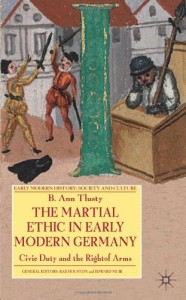
 Ken Mondschein's review will tell you whether you can live without this book:
 B. Ann Tlusty’s The Martial Ethic in Early Modern Germany is one of those books that simultaneously delights and frustrates the reviewer: Delight, for the immense wealth of valuable material it contains, coupled with admiration for the author; frustration, because of the sure knowledge that one is unlikely to ever write a work as good. Then again, few scholars do: Tlusty bases her argument on an intimate knowledge of city archives, especially those of Augsburg and with an emphasis on judicial records, but incorporates a wide number of other sources, both archival and published. These are masterfully synthesized into a nuanced and far-reaching argument that addresses core questions in the historiography of early modern Europe. Martial Ethic, in other words, a definitive work of history, one that deserves to stand beside works on the history of violence and arms in Europe such as those of Ute Frevert and Kevin McAleer for modern Germany and François Billacois, Peter Blastenbrei, Trevor Dean, Robert Nye, and Pieter Spirenberg for the rest of Europe (1) and which ought to be on comprehensive exam reading lists and incorporated into survey courses on later medieval and early modern Europe. It has already achieved well-merited renown amongst the Historical European Martial Arts crowd, but seen from the perspective of Martial Ethic, the Fechtbücher (records of fencing teaching) seem like footnotes to the greater trends and ideas brought out by Tlusty.And there is lots more...However, like all great history, Martial Ethic is not an apolitical work. By this I do not mean that Tlusty’s objectives or arguments are in any way directed towards making a modern political argument, but rather that they resonate with an important contemporary concern—namely the American debate over firearms. This is unavoidable for two reasons: the fact that (as Tlusty points out) American gun culture owes some of its genetic material to Germany, and the fact that the historian’s ever-present obligation to make the past relevant to the present naturally guides us towards subjects of broader interest. While Tlusty’s main aim is to make a contribution to the literature of violence and the growth of the state in premodern Europe, she is certainly cognizant of contemporary resonance. In the same way, it is the reviewer’s obligation to tease out the broader implications of the work under consideration. Therefore, I will first discuss the structure and arguments of Tlusty’s book and what they mean for the historical discipline, and then editorialize on their relevance to modern society.
