Tampilkan postingan dengan label church history. Tampilkan semua postingan

Jumat, 23 Mei 2014

The age of the monks


This fall I will be teaching, for the first time in a very long time, part of our second-year survey of the Middle Ages. I will be teaching the first half of the course, up to about 1100.

I feel very capable when it comes to the period up to about 600, and after 1100 would not be difficult for me either. But I have to say that I am looking at the period in between is a certain amount of trepidation.

My guide for the Carolingian period and the period just before and after is going to be my textbook, Rosenwein's Short History of the Middle Ages. Dr. Rosenwein's first fame was as a student of the prominent Burgundian monastery at Cluny, so of course she emphasizes the monastic aspect of the early Middle Ages. The thing is, both the textbook and her other works convince me that I have to come to grips with this age of monks and somehow get across to my students that the real politics of the era are the ecclesiastical and especially the monastic ones. Her brief but well-written discussion of the iconoclastic movement and how it affected the entire Western world – well, it was convincing. That experience has also made me think that minimizing my discussion of and the investiture controversy would not  necessarily be very honest.

I can hear my colleagues who specialize in the Carolingian and post-Carolingian period laughing at my "predicament." Making this era comprehensible is their meat and drink and I have to say I don't envy them.

I am fortunate to have as my partner in this enterprise someone who knows much more about the monks that I do and she can logically take the investiture controversy at the beginning of the second term.

Image:  An Armenian monastery.
Selasa, 12 Maret 2013

The Papal Election

Somehow the Atlantic got the idea of getting a historian to write up a piece.  They picked a good one, David Perry. I especially liked this:

1) Voting is medieval.
Voting is a quintessentially medieval activity. Sure, popular representations of the Middle Ages focus on kings and knights, princesses and peasants, but medieval people, especially in cities, loved to vote. They organized themselves into groups - guilds, religious fraternities, charitable organization, drinking societies - and wrote complicated bylaws governing elections. Many cities embraced various kinds of representative government during the High Middle Ages. Even the army outside the walls of Constantinople in 1204 took time to develop a voting system to elect the next emperor.
It's easy to characterize the Conclave of Cardinals as an authoritarian relic of the past. It's not. It's the same kind of democratic tradition that permeates modern American and European life, from board rooms to union halls to church groups to town councils.

Kamis, 07 Juli 2011

Goodricke and Constantine without honor in their own city

Today I went on a free guided tour of York, provided by one of the many volunteers who have been providing this service since 1950 (!). Well worth the time and I'm grateful to the organization and our guide.

However, I must say that he had me biting my tounge more than once with his version of York history (and of his weakness for terrible folk etymologies no more will be said). My faith in his knowledge of his home town's history -- and he called himself a local historian -- was given a shock when he called Athelstan a Viking king. I mean, is there a more (Old) English name? If, dear reader, you were a volunteer guide at York, I believe you would not make this mistake.

Nor, I hope, would you try to be relevant by saying that Henry VIII used the loot from the Dissolution of the Monasteries "to found the Oxbridge Consortium." Would you?

It's odd what people include, and don't. Maybe there was no archaeological or architectural hook to bring in the Pilgrimage of Grace, but I bet I could find one. (Just sitting here I now have one.) But how can you say that the late Roman HQ was found under the Minster in the late 1960s, and not mention that Constantine was elevated to the emperorship in York? This has got to be one of the most important things, on a world-historical scale, to ever happen in the city. But it went unmentioned.

And about the same time Constantine was being ignored, we were standing in front of the Treasurer's House in the old ecclesiastical enclave, also ignoring a sign that said John Goodricke worked there in the 1780s on Cepheid variables, the discovery of which eventually provided an astronomical yardstick to estimate the size of the universe. Talk about world-historical.

I should study up and volunteer myself...

Challenge: look up Henrietta Swan Leavitt, who should have got a Nobel Prize. No York connection.

Rabu, 06 Juli 2011

The churches of York


The last time I was in York it was 1972. The town, with its medieval walls and street layout, overpowered me. I was particularly impressed by the cathedral, York Minster, the biggest piece of medieval architecture I had seen yet. But as a budding medieval historian I was seriously taken with the number of other medieval churches there were in the immediate vicinity. It spoke to me of the tangible presence of the church in the city which was the capital of the north. I mused on the revolt against that presence during the Reformation (in an unsophisticated way).

This time what strikes my eye is how the people of York kept doing it -- building churches in medieval style in the vicinity of the Minster and those other real medieval churches. There are an awful lot of churches from, say, the last two centuries crowding into the Minster neighborhood, demanding attention.

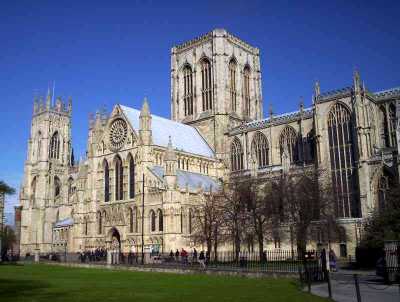
Image: the Minster, from which a "clerk in holy orders" told me you can see a distant brewery tower. Ask me in person.

Kamis, 25 Maret 2010

Benefactors of humanity


More than once in the past I have said that Roger Pearse is a benefactor of humanity. It still seems to be true. Why is he our benefactor? He has taken it upon himself translate or commission translations of a great many early Christian works which have until now been available only to people who could read the original languages. Some people think that's fine -- if you don't know ancient Greek you would not understand these sources anyway -- but that's not my attitude, nor is it Roger's. As someone who has studied late antiquity and read a lot of obscure Christian literature from that era, I am in awe of Roger's generosity. The translations that he posts and otherwise gives away are not a complete substitute for the originals, but they make available part of the cultural and religious legacy of early Christianity to many new people.

I was inspired to say something about Roger by a blog post he published today, just one of the interesting posts of his that I've read since I discovered he had a blog. the Post announces a new translation of Hippolytus's Chronicon, one of the very first world chronicles written by Christian, in this case a third century Roman clergyman who eventually was martyred. (He is sometimes considered the first antipope.) In an earlier incarnation I had to know something about Hippolytus; it would have been nice to have this translation then.

But one of the interesting things about this new translation is that it is not, as far as I can tell, one of Roger's projects! There is another benefactor of humanity out there and this person is named T. C. Schmidt. Thank you very much, T.C.!

Image: Hippolytus being martyred, dragged behind a horse, from the Wikipedia entry on him.

Rabu, 03 Maret 2010

Matthew Paris really did not like the papal court

The great English chronicler and illustrator Matthew Paris is famous for his dislike of foreigners. Among the worst of foreigners were the Romans, the term he used primarily to mean members of the papal court, who used their positions to enrich themselves. In the 1250s, King Henry III of England and the Pope made an agreement which obliged Henry to conquer the kingdom of Sicily at his own expense; which would eliminate the Pope's most dangerous enemies. No one in England thought this was a good idea, except perhaps the King and the son that he was going to put on the Sicilian throne. Matthew Paris's reaction is a great example of his scathing anti-foreigner rhetoric.

In consequence of this [agreement], the Pope's messengers vied with one another, as it were, in coming to England to the king, for the purpose of carrying off his rich presents; for they smelled the sweet savor of his money from afar.

A few pages later, Paris illustrates "Roman" greed:
Master Berard de Nympha, native of the suburbs of Rome, died suddenly about the same time. He was a crafty and wealthy man, had been a clerk of Richard Earl of Cornwall, and had extorted money from the Crusaders on various specious pretexts. Amongst his goods was found in a coffer choose one of blank sheets sealed with the bull [the most important papal seal], which might be filled up at pleasure and applied to any misuse, such as fraudulently extorting money from the poor as if by authority of the Pope.

At first, Matthew's Chronicle struck me as pretty tedious, but it got better as it went along. There's a rhythm to these things, and it eventually caught me. Paris could write almost as well as he could draw.

Selasa, 02 Maret 2010