Tampilkan postingan dengan label Detroit. Tampilkan semua postingan

Jumat, 16 September 2011

Not to be missed: conjuring up Rome in AD 600


Dr. Beachcombing imagines the near-ghost town it must have been:

Let’s take the lowest sensible estimate for classical Rome – half a million – and the highest for Rome c. 600, about 50,000. That means that the population has not only been decimated, but that it had been decimated nine times over. And what is more these heirs of Rome (as fashionable ‘late antique’ historians call them) were resident in an echo box; a city that they no longer had the technology to repair, let alone recreate, where nine out of every ten residences were empty, where three and four story buildings gradually keeled over into the streets and where the Parthenon and the Coliseum looked down mockingly on the little people below, not so much dwarfs on giants’ shoulders, as blue-bottles buzzing around a cow’s backside.

Then, remember, perhaps the actual population of Imperial Rome was more like a million and the population of Rome c. 600 was more like  ten thousand, a hundredth of what it had been. The psychopathic Anglo-Saxon guard, the tourist from Scythia and the Pope and his tiny administration could shout as loud as they wanted and no one would have heard them in their ghost town. No one was listening, not even the red baked tiles made in a happier age.
I have recently lived across the river from Detroit...so this is evocative.  Detroit is not, however, quite so echoic.

Parthenon presumably should be Pantheon (above).

More on ancient population estimates in a later post.

Jumat, 29 Januari 2010

Visit to Wayne State University, Detroit

I should mention, in connection with my praise for the Detroit Institute of Art, that it is right next door to Wayne State University, which I visited yesterday for the very first time. The weather was arctic and there was a wind tunnel effect around the buildings to make it worse, but I was impressed anyway by the grounds and the rather attractive buildings. The research library is a good one and I may be back; it is certainly worth checking out via the online catalog. Surprisingly, if you forget about the tunnel under the river, it's not that much farther from me than the University of Windsor's campus.

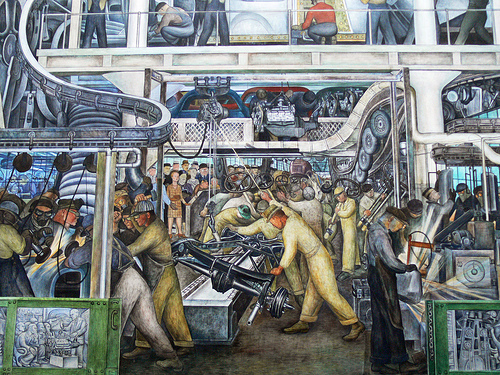
Detroit Industry, a mural by Diego Rivera

Back when I was teaching introductory world history, I became aware that Diego Rivera -- the early 20th century artist and social critic, the man whose huge murals of the Spanish conquest of Mexico probably formed everybody's image of those events and especially what the Aztec looked like (at second or third hand if not directly)-- had some of his work in the Detroit Institute of Art. Somehow I got the idea that it might have been some version of his Mexican historical work.

Well, today I was at the DIA and found out how wrong I was. Diego Rivera was in Detroit in 1932-3, and while he was there he was commissioned by the Ford heir, Edsel Ford, to do original work right on the walls of an interior court built specially for that purpose. It is a depiction Detroit Industry, showing its power, its dynamism, its potential for evil as well as good. What's haunting about the murals are the occasional appearances of warplanes, men in gas masks, and the production of poison gas bombs.

This is an amazing piece of art, and I bet next to no one knows about it anymore. There are lots of pictures on the web, including some posted by the Institute itself, but there's no substitute for seeing this kind of large-scale art in person. I gasped when I first saw it.

At the top of this post, is one small section of the mural which I think comes across fairly well at the scale at which you're going to see it. It shows workers in the foreground being observed by both men and women in dressier clothes. The observers have rather sour expressions on their faces. My theory is that the noise is probably overpowering. Or are they repulsed for some other reason?

I am rather surprised that the generally conservative Ford family patronized Diego Rivera. They must have thought he was the next thing to a communist. I mean, have a look at this (On a communist site yet.) Even the Detroit Industry murals show no sympathy for the captains of industry.

By the way, I should point out that the Detroit Institute of Art has mountains of good stuff in a very impressive building, right downtown in what might be called the museum district of Detroit.