Jumat, 07 Januari 2011

William Morris' Order of Chivalry

An on-line edition of William Morris' 1893 Order of Chivalry can be found here.

We have an outfit called Sovereign Press Canada, down the road from me in Barrie, Ontario to thank for this reproduction.

It contains Caxton's translation of Ramon Lull's Book of the Order of Chivalry, the Old French L'Ordene de Chevalerie, and Morris' translation of the Ordene, The Ordination of Knighthood.

It also includes some famous examples of Morris' woodcuts, most notably the one above.

The debate over Islamic law in Pakistan

Juan Cole hosts an excellent discussion by Aadil Wainwright about the issues at stake in the blasphemy issue, which led to the recent assassination of an important provincial governor.  An excerpt:

The assassination of Punjab Governor Salman Taseer has laid bare a crucial debate within the Pakistani public over the nature of Islam and the place of Islamic law in national affairs. That it is a debate among Muslims with more than one side is a point that sometimes gets lost in Western discussions of Pakistan.

An investigation into the assassination of Punjab governor Salman Taseer, killed Wednesday 4th January, has been opened. According to Stratfor, it will try to identify why Malik Qadri, the assassin, was able to fire two magazines full of bullets before being apprehended, as well as how Qadri (who was already considered suspicious because of his religious views) was allowed to become part of the personal security detail of a politician whose secular positions had aroused much ire.

Despite confusion over the extent of organisation and the number of individuals involved, the motive of the assassin himself appears clear. Qadri told photographers as he was led away that he was proud to have killed a ‘blasphemer’. It was through actively defending Aasia Bibi, a Christian woman sentenced to death under the blasphemy law in November 2010, that Taseer had became infamous.
...
Like many others, Taseer had insisted Aasia Bibi was innocent. The claim was brought against Bibi six days after a spat with two Muslim women of her village refused to drink water from a glass she had touched because they said it had been defiled due to her Christian faith. Six days after the argument, her accusers said she had insulted the Prophet Muhammed (peace be upon him), Bibi said they were merely trying to settle an old score.
Taseer became a campaigner for Bibi and for reform of the blasphemy law, attracting approbation. Despite threats, he continued to be vocal on the issues he cared about, pointing to the way the blasphemy law is abused as a political tool against minorities and the vulnerable. In a recent interview he said, “This is a man-made law, not a God-made one.”
Looking in to the historical origins of the blasphemy law is beyond the scope of this article, here we merely seek to identify the parameters of the debate.
It will be useful to quote two different authorities interviewed recently about the blasphemy law. Dr. Khalid Zaheer of the University of Central Punjab is against the death penalty for blasphemy and says: “One must concede that there are a few instances that have been mentioned in Hadith literature where the death punishment was apparently inflicted upon people who were involved in the act of blasphemy. However, if you look at these instances and then study the Quranic text, it seems there is a conflict or contradiction.”
By comparison, the leader of the well-established conservative movement Jamaat e Islaami in Karachi, Miraij ul Huda Siddiqui, said of the blasphemy law, “It has been derived from the Quran and Hadith and there is unanimous consensus on this by scholars of varying sects and they also agree with the death penalty.”
Effectively Dr. Zaheer is saying that, though there may be examples of it being implemented in the Hadith, we do not need to consider these because they disagree with what can be described as the humanistic spirit of the Qur’an. Mr. Siddiqui’s argument, on the other hand, is based purely on the legal texts of the Islamic tradition and does not explicitly mention a role for human reason.

Though these are merely quotes from newspaper interviews and the interviewees don’t go into detail, these words illustrate some of the fundamental issues at play here.


Lots more substantial analysis where that came from.

Rabu, 05 Januari 2011

The hysterics bash Batman's Parisian partner


A friend sent a link to this story about hostile reviews of the new comic character, the Batman de Paris, Nightrunner. It seems that Nightrunner is a Muslim kid of Algerian background, and some people find this inherently wrong. Andy Khouri at comicsalliance.com takes this attitude on.
Green's hideous remarks convey incredulity as to the crime fighting qualifications of Muslims, but Huston doubles down on the disgust and writes that a Muslim hero is patently ludicrous because Muslims are apparently congenitally terrorists.

...in this age of international Muslim terrorism assaulting the whole world, Batman's readers will be confused by what is really going on in the world. Through it all DC makes a Muslim in France a hero when French Muslims are at the center of some of the worst violence in the country's recent memory.

The true cause of the riots and violence between Frenchmen of European stock and that of immigrant Muslim stock is glossed over as if it doesn't even exist. DC Comics makes the whole problem as simplistic as mere racism as if that is all there is to it ignoring the fact that Islam is the single most important factor in the strife.

Huston refers to the civil unrest France saw in late 2005, when a state of emergency was declared after Muslim youths began rioting in Paris and other cities, burning thousands of cars and several buildings. Huston, Green and other bigots in the conservative media read the tragic situation as an expression of nefarious Islamic purpose, but most commentators and reporters who followed the event described a matter having more to do with social inequality than religion. As is the case in America, where there have also been riots, the economic and social underclass of France is populated largely by minorities and immigrants, and many of those immigrants are Muslims.

Contrary to Huston's claims that DC whitewashed (heh) the sociopolitical realities of France, the story of Nightrunner -- which we strongly suspect Huston didn't actually read [my emphasis -- SM] -- begins in the Clichy-sous-Bois area of Paris, accurately depicted by writer Kyle Higgins and artist Trevor McCarthy as a hotbed of immigrant frustration. The young Bilal Asselah tells us he can't remember a time when people weren't rioting and setting fires, but his pious Muslim mother has obviously kept the boy on the straight and narrow path. Unfortunately, 16-year-old Bilal and his best friend accidentally run afoul of some police officers who confuse the young men for rioters, and Bilal ends up in the hospital. His mother manages to talk Bilal down from the ledge of revenge, but his friend is not satisfied and is killed by French cops after burning down a police station. It's this event that opens Bilal's eyes to the terrible cycle of violence his mother had tried to protect him from, and he weeps.

As he grows older, Bilal's instincts are to take some kind of action, but he can't think of what to do that won't cause more violence in his community. Instead, he teaches himself parkour, which beyond calming him down also gives the neighborhood something to talk about besides riots. But when a series of high profile murders appears ready to claim an inspirational Muslim musician and ignite the ghetto once again, Bilal puts on a mask and sets out to stop the unthinkable from happening.

What Huston calls "PCism run amok," we in the business call an awesome superhero origin story about adversity and character. What's more, it is not at all incongruous with reality, as Huston claims. Like a lot of young men in France, Bilal Asselah was one pissed off Muslim. His best friend burned down a building! He's witnessed firsthand what the cycle of prejudice and violence can do to his city, but rather than give in to hate and fear, he's literally rising above it -- just as Batman swore to make his city safer for innocent people and just as Spider-Man swore to use his abilities for good.

Khouri's guess that Huston didn't actually read the comic corresponds with my sense of reality.

Image: "It's my turn." Read the comicsalliance.com article for how this scene fits into the Nightrunner origin story.

Selasa, 04 Januari 2011

Students: you can do this too

 From the Chronicle of Higher Education, The Writing Group of Two.

An excerpt:
I've written in this space before about the usefulness of a "writing date." You buy a kind of accountability when you're with someone and you're both supposed to be working....

Last summer I got an astonishing amount of writing done, as did Nancy and Jeff; we all suffered together, over endless cups of coffee and an occasional scone.

But Nancy and I did something else, too. When one of us got stuck, we asked the other for help. And by stuck, I don't mean when you have to stop looking at the page for a while and go out for a run, bake a cake, or do whatever you do when your brain needs to be reset to start working again. I mean stuck as in paralyzed. You know what you need to do, but you just can't get there.

Maybe that doesn't happen to everyone. But it happens to me. And it happens to Nancy. It's easier for me when it happens to Nancy. And that's when we move from having a regular writing date to being members of the Writing Group of Two.

Here's how it works. Nancy will say something like, "I have to put this book proposal together." And then she will stare into space for three hours. Or start working on a syllabus for some course she might teach someday. Or search for an apartment to rent in Paris.
That's when I say, "OK, let's get to work." I make her think out loud and interrupt her with a stream of questions. I ask her what the argument is, and make her articulate the question she is trying to answer. I ask her why she is the right person to write the book. I tell her she has to come up with a table of contents. Nancy is a slow typist, so usually I grab her laptop and curse that rainbow-striped Apple when I can't find the right keys and make stupid mistakes. But I type as she talks.

Everything is already in her head. It's not that she's stuck on the thinking part. It's that she finds it difficult to get her thoughts onto the page. So, like a translator, or a secretary, I listen to what she's saying and I record. I don't worry much about getting things right—that's her job. What I do is help her produce that first impossible draft.

Then it's my turn. My problem is different. I can write a first draft. But often, while I suspect it's crap, I can't figure out where it's gone wrong. The language is generally fine. Sometimes, in fact, it's too good; fluid prose can hide hideous flaws of thought—at least from the author. If you get a draft that you like, you tend to memorize it; the sentences start to seem inevitable and unchangeable. I know that once it's out there in the world, there will be people quick to point out my inadequacies, my glibness, my habit of skimming along the shiny surface.

So Nancy reads my embarrassing first draft and says, usually, "I think it's more complicated." Then we discuss. She forces me to refine my thinking...

Senin, 03 Januari 2011

Minggu, 02 Januari 2011

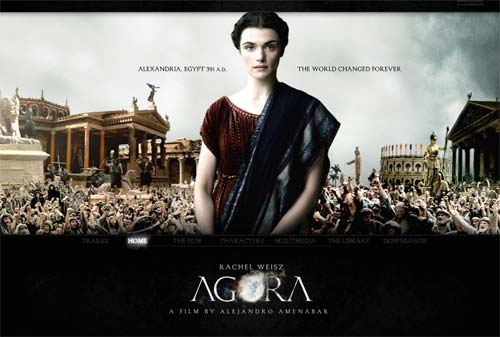
Agora (2009)


This is a seriously good movie.

I haven't heard much unmixed praise for this film, not a lot of commentary at all, and I think it deserves better. So here are my observations.

You should know that the story concerns the 4th century Alexandrian philosopher Hypatia. As a woman philosopher she was an oddity, as an educated pagan she lived in an increasingly hostile environment. Alexandria was a major center for both Christians and pagans, and the two groups were competing for control of the city. The Christians were winning -- they had the support of Theodosius, the eastern emperor who eventually banned pagan observances. The conflict in Alexandria was quite violent at times. This is one of the times that the Library of Alexandria, a pagan institution, is supposed to have been destroyed. More certain is that Hypatia attracted the hostility of the Christian party, and was killed by a mob. It's a depressing story, and one that could easily be butchered.

There are three important aspects to the movie. One is its degree of success in evoking late fourth-century Alexandria. I give Agora very high marks indeed on this. Visually, the evocation of the city, with its mixture of Greek and Egyptian elements, is stunning and flawless. The dialogue likewise does nothing to throw the viewer back into the 21st century, while avoiding pseudo-historical cuteness. That is a harder trick than the mere statement might indicate.

Second is the depiction of the religious conflict between Christians on one hand and Jews and pagans on the other. This is certainly what has made distributors very reluctant to show Agora in most of North America, because the Christians don't come out of it looking good. I, however, have read a lot of late ancient ecclesiastical history, some fair amount of it on the turbulent Alexandrian developments of the era, and I found this account believable. Rioting monks were a staple of Alexandrian religious life, even in purely intra-Christian disputes.

Third is the scientific story. The film proposes that Hypatia came to reject the Ptolemaic view of an earth-centered universe, with the complex series of epicycles to make planetary movements correspond to the predictions of Ptolemy's theory. Instead, says the movie, she became convinced that a more elegant solution was possible, a heliocentric one. Because predictions based on circular orbits won't work, she, like Kepler, comes up with the notion that planets moved on elliptical orbits.

I don't think that there is any evidence that Hypatia did any of this, but that doesn't bother me. But I was sure before I saw Agora that the filmmakers would do a terrible job of this part of the film.

They didn't. Indeed, that part of the plot works very well indeed. Hats off to them. And particularly to the bright guy or gal who suggested intercutting images of the Earth from space in a few appropriate places.

This is a serious, good movie.

Sabtu, 01 Januari 2011