Just click here!
Tampilkan postingan dengan label favorites 2010. Tampilkan semua postingan
Sabtu, 01 Januari 2011
Kamis, 30 Desember 2010
Mongol: The Rise of Genghis Khan (2007)
Every culture has its historical moments that matter a great deal to its members. The moments can be mythological: in the English-speaking world, millions care about the legend of Robin Hood and whether it reflects a historical reality. It is hard to go broke making a movie about Robin Hood.
If the fall of the Tangut kingdom is your emotionally resonant moment in history, this is the movie for you. A combination of Russians, Mongolians, Kazhaks, and Germans have invested a lot of money and talent on the intuition that there are millions of moviegoers just like you.
Just in case you have never heard of the Tangut kingdom, this destruction, if you believe the movie, was the turning point in the early life of Genghis Khan. Its destruction begins and ends the movie; in between there is a rather curious account of the early years of the great conqueror, when he is repeatedly betrayed, defeated, robbed of all his meager wealth, and enslaved. The only positive elements in the story are his relationship with his wife, and his relationship with a blood brother who is not always on his side. Oh, he is also faithful to the Mongol code, which other people give lip service to but ditch whenever it is convenient. Thus Temugin's (Genghis' ) rough early years. He plays by the rules, everybody else cheats. But don't worry, he will undoubtedly return in a later movie (if financing is available) to teach the Mongols law. In the meantime, he looks soulful, and does not send away his wife, whom he chose when he was nine, even though there is a reasonable doubt about the paternity of her son. (She was kidnapped by his enemies and who knows what happened then.)
A whole bunch of cultural buttons are being pushed here, but if you're not a Central Asian it's not exactly clear what they are.
This may come across as a negative review, but actually it is a well made movie. It's just not Robin Hood. For the non-Central Asians among us, the most remarkable feature of the film may be the vast landscapes which fill the screen for the entire two hours.
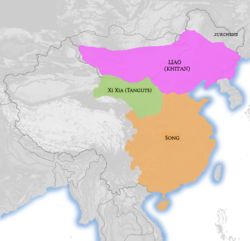
Images: top, Temugin, played by the big Japanese star Tadanobu Asano; bottom, the Tangut kingdom (Western Xia), shown in green.
If the fall of the Tangut kingdom is your emotionally resonant moment in history, this is the movie for you. A combination of Russians, Mongolians, Kazhaks, and Germans have invested a lot of money and talent on the intuition that there are millions of moviegoers just like you.
Just in case you have never heard of the Tangut kingdom, this destruction, if you believe the movie, was the turning point in the early life of Genghis Khan. Its destruction begins and ends the movie; in between there is a rather curious account of the early years of the great conqueror, when he is repeatedly betrayed, defeated, robbed of all his meager wealth, and enslaved. The only positive elements in the story are his relationship with his wife, and his relationship with a blood brother who is not always on his side. Oh, he is also faithful to the Mongol code, which other people give lip service to but ditch whenever it is convenient. Thus Temugin's (Genghis' ) rough early years. He plays by the rules, everybody else cheats. But don't worry, he will undoubtedly return in a later movie (if financing is available) to teach the Mongols law. In the meantime, he looks soulful, and does not send away his wife, whom he chose when he was nine, even though there is a reasonable doubt about the paternity of her son. (She was kidnapped by his enemies and who knows what happened then.)
A whole bunch of cultural buttons are being pushed here, but if you're not a Central Asian it's not exactly clear what they are.
This may come across as a negative review, but actually it is a well made movie. It's just not Robin Hood. For the non-Central Asians among us, the most remarkable feature of the film may be the vast landscapes which fill the screen for the entire two hours.
Images: top, Temugin, played by the big Japanese star Tadanobu Asano; bottom, the Tangut kingdom (Western Xia), shown in green.
Jumat, 24 Desember 2010
This blog's top 5 posts, according to Blogger stats
The legend of Saladin
Not quite Christmas, but wolves anyway
More from Kyrgyzstan
Memories of Catal Huyuk
Blue sunset?
They are all there not for my deathless prose, but for the pictures, none of which originate with me. (The wolves, alas, are no longer accessible, except by searching for the image via Google.)
Jumat, 03 Desember 2010
Charny on retreating and surrendering -- my attempt to understand him
An excerpt from work in progress:
Scenarios involving retreating or surrendering or both appear in a conservative estimate in eleven of Charny's questions on war. It is clear from several of them that anything resembling running away might be interpreted as blameworthy. Question W30 says :There is a battle …in which many men-at-arms of the defeated party depart and go away. Some consider that these have gone on their honor without being defeated; and many others consider that those who have gone are defeated. How can this be?Judgments vary, but elsewhere we see that if the judgment was adverse, if one was thought to have been "fleeing" to one's "dishonor," it was so serious that some might think it would wipe out a lifetime of renown (W39). What distinguished dishonorable flight from the "safe and honorable withdrawal" which Charny thought all good men-at-arms needed to learn to execute? Of course we have no correct answer to this, just indications about how serious the dilemma was. For instance, in W31 we have a story that shows what problems arise when good military practice and the perception that one is fleeing conflict:A captain of men-at-arms rides out in the field and orders some of his scouts to see the situation of his enemies who are in the field; and there are a sufficient number of these scouts. And at the approach of their enemies one party of their enemies pursues them faster than they can go; and the scouts retreat from their enemies and are able to retreat without loss. So there are some of the scouts who turn back and meet their enemies, and perform arms like good people should; and others retreat to their captain and make their report. Which of these are to be more valued and praised: those who went back to their lord or those who are captured?The scouts who turn back and fight are doing something good and praiseworthy; yet Charny thought that the scouts who returned were also doing something valuable, and were obedient to their captain to boot. Perhaps Charny anticipated a reflexive endorsement of warriors who "perform arms like good people should." This is consistent with scenarios discussed in W7 and W8, where what might seem sensible course of action is contrasted with conventional belligerent courage. In the first we see a captain, the principal leader of one side in a hypothetical war, who
is defeated but remains on the field so long that he sees and understands that he is unable to recover his fortunes or the day; and the battle has been very well fought. Which is the better thing for him to do: remain and take his chances, or leave so that he can recoup? And if he leaves, should he thereby lose his honor?
We may think that it hardly makes sense that the captain should sacrifice his rights and his person after one serious defeat; and we've seen that Charny did not reject the possibility of honorable retreat. Then we remember that King John refused to leave the field at Poitiers in 1356, even though he understood that the day was lost. This gives the scenario in question W7 a real piquancy. Question W7 also prepares us for the dilemma of the bodyguards in the next question who seriously contemplate abandoning their lord to return to fight in a lost battle. There are good reasons for them to remain with the captain, yet they hesitate:Which is the better thing to do: lead their master to safety, and in that case, either go with him, or send him outside of the melee alone, and tell him to save himself if he is able? There is a great risk that he will not be able to save himself; and by returning into the battle they take the risk of death or capture. Since they have agreed to be men in his retinue, will they be blamed if they go with him? Which is better, to go or to stay?Neither avoiding the presumed shame of abandoning their employer, their "master," nor the danger of returning to a hopeless situation are unquestionably preferable to the criticism they might attract for leaving the field. Even if we guess that Charny might have a clear preference himself, he expected debate. This is confirmed by other scenarios, which show that there was an entire terminology of warfare, which was meant among other things to clarify what was honorable behavior. One of the questions I would most like answered, were that possible, is W37:Since I have heard it said that one is able to leave and retreat (retraire) from a battle from the defeated side (la part desconfite), if he has acted in seven ways without being killed or taken, without being reproached. How can this be and what are the seven ways?It would certainly be very illuminating to have Charny's list of seven mitigating circumstances, and his comments on them, given that he was twice captured and must have twice surrendered himself, even though he did not consider this something that could be done lightly (W79). Unless Charny is disingenuously preparing to present a list of his own as something he heard from others, the list of seven implies serious discussion, perhaps long debate, that unfortunately never found the pen to write it down.
Sabtu, 06 November 2010
I feel this way about the Early Modern sometimes
Dr. Beachcombing:
You will want to read this post. It's got chocolate.
Image: Guy Fawkes, a 17th century sort of guy. Er, fellow.
Beachcombing’s first thought on reading this was just how glad he is to not have lived in the seventeenth century. The Middle Ages did bigotry with style, whereas modernity manages tolerance tolerably well. The early moderns though fall between two stools – even the likeable Gage [the English Dominican, Thomas Gage (obit 1656) who traveled to the New World in the first quarter of the seventeenth century] converted to Catholicism and back again to Anglicanism and then worked with that monster Oliver Cromwell towards the end of his life.
You will want to read this post. It's got chocolate.
Image: Guy Fawkes, a 17th century sort of guy. Er, fellow.
Minggu, 24 Oktober 2010
More beautiful iron work from a re-enactor
Historical re-enactors and re-creationists don't have the highest reputation either with the general public or among scholars. since I have spent more than my fair share of time running around in armor, I have a different opinion. Part of it goes back to the attitude that "historians don't own history" ( or at least not all of it :-)) but also because I know a number of people who have come out of the reenactment and become masters of some historical-based skill. Their accomplishments deserve the highest praise.
One such person is Darrell Markewitz, whom I've known for almost 40 years now. In that time has grown from a young eccentric to a mature eccentric who knows things other people don't know and can do things that other people can't do. He loves researching historical techniques and has done valuable work in connection with Viking culture in North America, but he is also a contemporary person who makes iron – based art for modern clients. Here, too, he might be seen as a reenactor – reenacting some of the graphic innovations of the 1970s. Whatever you call it, I say it is good, and better than good. The picture above is an example of a commission piece for a patron/client. Go here to have a closer look and, if you've got the cash and share Darrell's belief in the beauty of iron, give him a call.
Langganan:
Postingan (Atom)
Recent
Weekly
-
This announcement speaks for itself: Dear Colleagues, After two decades teaching medieval art history and doing photography for my own use,...
-
From the Guardian: Leading foreign academics from the LSE acting as expert advisers to the UK government were told they would not be asked ...
-
A new translation of this fascinating treatise on horsemanship by a fifteenth-century king. This interview with Jeffrey Forgeng comes from...
-
Byron York talks to dedicated, long-time Romney supporters right after the concession speech: A few hours earlier, across the street at the...
-
...if you are very, very rich. (Most mss. of this age and quality are in national or university libraries and are not for sale at any price...
-
Two experts in the Middle East have been more useful to me than most of the more prominent ones. They are Juan Cole and Joshua Landis. If yo...
-
I have always loved maps and history. Growing up in the USA in the early 60s, the Southeast Asian war gave me the opportunity to learn geog...
-
I just discovered this book, which came out a couple of years ago, thanks to Brad DeLong, who provided a link to a pre-print to chapter 9, ...
-
...full of archaeological goodies. Thanks, David Meadows! One of the nice things about this e-mail news compilation is that it supplies me ...
-
I have been reading the magazine Foreign Policy recently, and despite the fact that is understandably American-centric, it does tend to take...