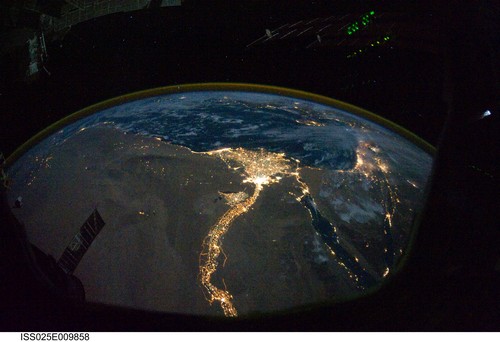
Thanks to NASA, Juan Cole and Amity Law for bringing this to my attention. Click on the pic for a better view.

...I tend to get most on my high horse when I feel that some stupid or wicked notion is being smuggled into our subconscious by a turn of phrase or an implied definition.
This is exactly the case with the currently accepted use of the word identity. You see this word used all the time, and phrases like “identity politics” are assumed to have an easily recognizable meaning. I’ve just been reading a spate of archaeological papers which routinely refer to “identity” interchangeably with ethnicity. These papers, from a variety of academics, constantly repeat phrases like “negotiating their identity” — inane jargon which the field has borrowed from sociology, and which is now firmly entrenched. Archaeology is impoverished by this kind of rubbish, and drifts away from scientific rigour.
When someone casually refers to religious affiliation, or to ethnicity, or nationality, or gender, as being their “identity,” there is an implicit assumption that membership in large, formally defined or organized groups of people is the essential characteristic of an “identity.”
Now, I find this a profoundly wrong, and extremely offensive assumption. Your identity, as far as I’m concerned, and as I’ve believed throughout my life, is that which makes you uniquely yourself. My “identity” is composed of those things which refer to me and only me, experiences that occured to me alone, passions and ambitions that are mine, private symbols that only I understand, inner experiences that belong only to me. These unique, individual characteristics form, all together, my Identity. No characteristic that I share with some arbitrary group of other human beings, or that is demanded of me by some collective mush, or imposed on me by some proclaimed Authority, can constitute my identity. Certainly no group that I am merely associated with by accident of birth can ever be my identity. I find the idea that anyone would consider their identity to be, say, Norwegianess, or their skin colour, a profoundly disgusting notion. It is to abandon individuality entirely, to crush and erase identity, not to describe it.
This is a particularly creepy kind of creeping collectivism. The meaning of the word identity has been distorted, perverted, inverted. I don’t believe such things are random accidents. There are always powerful forces that seek to obliterate respect for, and recognition of, the individual human being. If you can pursuade people that their “identity” is nothing more than their membership in a collective blob, that there is nothing specifically notable or significant about themselves, then half the work of enslavement has been accomplished.Amartya Sen has made a similar point in a recent book Identity and Violence, but his point was that reducing people to a single group identity led not just to enslavement, but genocide.

It focuses on three jousting manuals, written by practising champions at the time: Ponç de Menaguerra's Lo Cavaller (`The Knight', 1493); Juan Quijada de Reayo's Doctrina del arte de la cavalleria (`Doctrine of the Art of Chivalry', 1548); and Luis Zapata's Del Justador (`On the Jouster', c.1589-93). As well as editions, with the first English translation, of these important texts, it includes introductions and an analytical study; there are also chapters on the arms and armour of the joust. Nearly 200 colour and black-and-white illustrations, many never previously published, illuminate the sometimes complex technical terminology of these authors, and provide further evidence of how weapons and armour were actually used.There's just one problem, a temporary one I hope: the book, published this month, seems to be out of stock already! (You can back order.) Somebody thought the book would sell, but not this fast.

11. Hurricane Katrina. It takes a truly spectacular domestic-policy blunder to register as a foreign-policy screw-up, too. Yet Bush's bungled response to Hurricane Katrina was exactly that. Observers around the world saw this debacle as both a demonstration of waning U.S. competence and a revealing indicator of continued racial inequality, if not outright injustice. (You know you've screwed up when you get offers of relief aid from Venezuela's Hugo Chávez.) Because America's "soft power" depends on other states believing that we know what we are doing and that we stand for laudable ideals, the disaster in New Orleans was yet another self-inflicted blow to America's global image. If the United States cannot take good care of its own citizens, why should anyone think we can "nation-build" in some distant foreign land?
14. The Crash Heard 'Round the World. By lowering taxes while waging costly wars, Bush produced near-record fiscal deficits and a mountain of foreign debt. At the same time, Federal Reserve Chairman Alan Greenspan's easy money policy encouraged a vast real estate bubble that eventually collapsed in 2008. Bush's economic team also paid little attention to regulating Wall Street, thereby facilitating the reckless behavior that produced a major financial collapse in 2008. The resulting meltdown cost Americans trillions of dollars and millions of jobs, and the aftermath will affect U.S. economic prospects for many years to come.
Although Bush does not deserve all the blame for causing the greatest recession since the 1930s, he was in charge when it happened and his actions contributed significantly to the debacle. And because international influence ultimately rests upon a state's economic strength, the damage wrought by this economic crisis may be Bush's most enduring foreign-policy legacy.
The Secret History of Democracy explores the intriguing thesis that there is a lot more democracy in human history than historians generally admit, and presents some surprising evidence for this case. The idea that democracy could have a 'secret' history might at first seem strange. Indeed, the history of democracy has become so standardized, is so familiar and appears so complete that it is hard to believe it could hold any secrets. The central argument of this book is that there is much more to the history of democracy than this foreshortened genealogy admits. There is a whole 'secret' history, too big, complex and insufficiently 'Western' in character to be included in the standard narrative. Against the assertion that new democracies have no democratic heritage, the contributors to this volume establish that democracy was developing in the Middle East, India and China before classical Athens, clung on during the 'Dark Ages' in Islam, Iceland and Venice, was often part of tribal life in Africa, North America and Australia and is developing today in unexpected ways through grassroots activism. This book is a timely collection of essays that make a substantial contribution to the emerging debate about the history of democracy and set the tone for future discussion and research.
| Slavoj Zizek, philosopher, on Al-Jazeera English. This man knows a thing or two. |

