Rabu, 17 November 2010

Brad DeLong reprints one of his better short posts...

...and asks us to count our blessings:
November 12, 2004:
Brad DeLong's Semi-Daily Journal: A Weblog: Let Us Give Thanks (Wacht am Rhein Department): Daniel Drezner writes:
danieldrezner.com :: Daniel W. Drezner :: The dogs that don't bark in international relations: Newspapers, media outlets -- and, because we feed off them, blogs -- tend to focus on the violent hot spots in international affairs. This is entirely appropriate -- but occasionally, it's worth stepping back and remembering that there are parts of the globe where everyone has expected and predicted things to go "BOOM!" -- and yet, in fact, conditions have improved.
Yes. Let us give thanks that the most brutal and blood-soaked border in the world is quiet--a border inhabited on both sides by those bloodthirsty peoples who have been numbers one and two in terms of the most effective killers of foreigners for centuries.
Who am I talking about? The Germans and the French, of course
It is now 59 years and 9 months 65 years and 9 months since an army crossed the Rhine River bearing fire and sword. This is the longest period of peace on the Rhine since the second century B.C.E., before the Cimbri and the Teutones appeared to challenge the armies of the consul Gaius Marius in the Rhone Valley.
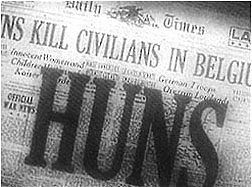
 I have to wonder, though, if that "longest period of peace" observation would really hold up.

Image:  anyone got some anti-French propaganda?

Minggu, 14 November 2010

Sabtu, 13 November 2010

The Sack of Rome, AD 410: what do historians and archaeologists think now?

Some of them got together in Rome earlier this month to talk about the subject.  I wasn't there, but Guy Halsall was, and he reports at length. 

Some excerpts I liked:

After these preliminaries, Arnaldo Marcone gave a lengthy run-down of the symbolic importance of Rome in imperial sources from the Battle of Adrianople onwards and then, more interestingly, Carlos Machado spoke on 'The Roman Aristocracy Before and after the Sack'.  What Machado showed quite graphically was a dramatic shrinking of horizons in the interests and indeed the geographical make-up of the Roman senatorial aristocracy after 410.  He also, very interestingly, pointed up the factional divides within the senate and highlighted their absolutely central involvement in the events of 408-410, making clear the complicity of some of the most powerful noble families in events such as the raising up of the usurper Attalus.  What I thought was interesting, from a personal point of view, was just how little connection there was between the Roman aristocracy (in its composition and in the areas it served in) and Gaul (especially) and Spain.  Links with North Africa were extensive, perhaps unsurprisingly, but so too were links with the East.

After coffee it was the turn of the revisionist 'terrible twins', which is to say Michael Kulikowski and me.  I spoke on the subject of 'Goths and Romans'.  I'll post the whole text anon.  For now, suffice it to say that most of it was a distillation of the relevant bits of Barbarian Migrations and the Roman West but with some revisions and developments.  These can be summarised thus:
1: The Gothicness of Alaric's forces may have stemmed largely from continued widespread recruitment north of the Danube, rather than from Goths settled in the Empire after 376
2: The nature of the foederati was new but not unprecedented but in the precise circumstances of the period 395-410 (the heated - and sometimes bloody - debate on the presence of barbarian troops inside the Empire) meant a closer bond between commander and soldiers
3: The title rex has a more specific resonance and particular appropriateness to a commander of foederati in rebellion
4: Kingdoms, far from being an objective, are the default option if nothing better can be obtained.  'Kingdoms are for losers'
5: Honorius' role is much more decisive than people give it credit for being

Michael's paper likewise drew on his body of work to critique the notions of barbarian migration, especially in its recent manifestations, and to show (in similar but far from identical ways to my paper) how the specific circumstances of the period led to a tense and dangerous focus on the commanders of armies of barbarian recruits and their relationships with the court.  Michael built on this a discussion of the traditional Roman means of defending Italy and how these were quite irrelevant to the situation in 408-10.  He then used post-colonial theory to reconstruct Alaric's career in terms of a subaltern mimicking of the dominant culture but one where sudden changes in the situation and the lack of precedent for his position meant that in some points of crisis, unable to obtain what he wanted from the inside, he had to fall back on 'playing the part' assigned to him within the ideological order - that of rampaging barbarian - and to attacking the system from the outside, with dramatic results.  I hope this is not too crude a synopsis.  It was very interesting and I agreed with most of it, even if I had some problems with some elements (I think that Michael would probably say the same about my paper).
 ...
The conference's last session was I think set up to be something of a play-off between Peter Heather and Walter Pohl, representing the schools of 'Fall of Rome' and of 'Transformation of the Roman World' respectively.  I didn't hear most of Peter Heather's presentation but from what I did hear and from what emerged in questions, it was exactly the same line that he has been arguing since 1991, without modification or any real reflexion.  The Roman Empire was brought down by the exogenous pressure of barbarian incursions produced by the Huns (an idea first expressed by St Ambrose of Milan in the 380s, incidentally).  From what heard it was clear that Heather hasn't had anything new to say on the subject of Goths and Romans for twenty years.  In questions he declared that the world was irreparably changed by 420; if he meant that and it wasn't a slip of the tongue, then I think that that is just empirically wrong.  In 420 I would say that the West was on the verge of complete restoration under Constantius III and that had the emperor not dropped dead of pleurisy then next year things would probably have been very different indeed (see, Barbarian Migrations and the Roman West, p.).  What brought down the Roman Empire?  Pleurisy.  ... As I always, not entirely jokingly, tell my first-years. 

Walter refused to play the part scripted for him and instead presented a useful summing up, and a view that pointed out how Heather and Ward-Perkins had essentially misconstrued the position of those who don't believe that barbarians conquered the Roman Empire, by claiming that they don't believe there was any violence. ('Transformation' is not the same as 'continuity', said Andrea Giardina in discussion afterwards.)  The process - and the debate - was more subtle and more complex than that.  That apart he did a very fine job of conciliation, and so the whole event drew to a close.
Plenty more, not easily re-summarized, where that came from!
 

Harassmap.org -- using web-based publicity in Cairo to fight the harassment of women

From PRI:

Cairo is a bustling city. Its streets are almost always full. But walking around for women here can be unpleasant.
EMAN MORSI: You get people just saying things like hey sweetie, hey honey… Or just insults.
Eman Morsi is an Egyptian woman in her twenties.
EMAN MORSI: Another type of street harassment is when they just brush across. And that kinds of tends to be a bit intimidating. There’s also when they grope you and stuff. I think pretty much many women went through that but we don’t really talk about that.
That’s why a crowd of young Egyptians gathered last week at a cultural center in Cairo. We all know that sexual harassment is a wide-spread phenomenon, online activist Sara El-Demerdash told the audience.
The kids – many with laptops on their knees – were being introduced to a new website that hopes to help change that.
The site allows women to send emails or SMS messages reporting harassment. The information is used to create an online map of harassment in Cairo: HarassMap. Rebecca Chiao is with the HarassMap team.
Rebecca Chiao: “The goal of our effort actually is not just to create a map. The goal is to change the social acceptability of harassment. So, the map is the first step.”
Chiao is an American who’s lived in Egypt for many years, working on women’s rights. She and three Egyptian colleagues created HarassMap. The online map will help identify harassment hotspots, says Chiao.
Rebecca Chiao: “And after identifying them, we’ll go to the communities in groups of volunteers and speak to people with roots in community, you know, shop owners, and use the map to show them: this is what’s happening in your neighborhood.”
...
Nihad Al Qumsan heads the Egyptian Center for Women’s Rights. A 2008 survey the center carried out showed that about 80 percent of women in Egypt have faced some form of harassment.
NIHAD AL QUMSAN: “When they’re speaking generally, men will say that harassment is the result of women wearing provocative clothes. But when they filled out our survey they admitted they also harass women who are veiled. The men try to find an excuse for their behaviour, but most women in Egypt are veiled. And anyway a woman is free to wear what she wants.”
See Harassmap.org (English version).

Jumat, 12 November 2010

One scholar's view on love, beauty and courtliness in the Middle Ages

From James A. Schultz's 2006 book, Courtly Love, the Love of Courtliness, and the History of Sexuality, page 80-1:

In what follows, I will show that nobility is an attribute of bodies, that it is visible, and that visible nobility provokes love.…

The heroes and heroines Middle High German romance can hide their individual identity, but it is impossible for them to hide their noble identity. Their bodies give them away...

When Oringles comes across Enite,... [he] has no idea who she is. This much, however, he can tell "she is in truth a noble woman: that is proved by her most beautiful body."...

Just as the beauty of bodies incites love, so does the nobility of bodies, of which their beauty is an unmistakable index. Meinloh is devoted to a woman he has not even spoken with because "my eyes saw the absolute truth: she is noble and beautiful."
Page 91:
Courtly lovers do not respond to a sexy body or to an engaging personality or to a mere display of wealth. They fall in love with an ideal of courtly nobility. This ideal presents itself as a single image that combines a noble body, courtly virtue, splendid clothing, and the visible mastery of courtly skills. When someone susceptible to these qualities sees them realized in the highest form, that person is taken aback, is captivated, and falls in love.
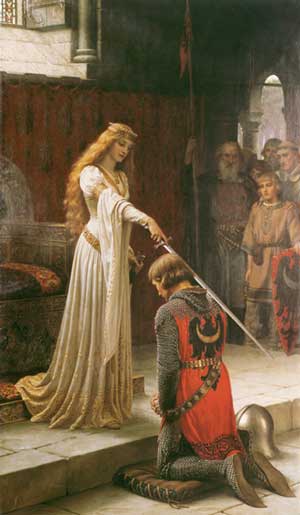
 Image:   The Accolade, by EdmundBlair Leighton.