Tampilkan postingan dengan label heraldry. Tampilkan semua postingan

Sabtu, 29 Maret 2014

A thought on modern heraldry


This week there was an article in the National Post about how Canada's heraldic authority was producing some of the best and most imaginative modern heraldry around. The focus was on the supporters, the animals (usually) who support the shield with the arms proper on them.

It was all positive in the article but I could not help but think that different message might be appropriate, too. The article might say that Canada's top heraldic artists are so good that they can take any bizarre thought you have for a supporter and make it look not only decent but really excellent.

And if the heraldic artists said that about themselves I would be the first to agree with them. This is amazing work.

My taste in heraldry is focused on the shields, however. I'm interested in early heraldry and things like supporters have always seemed to me to be later clutter. But even there, Canada's heralds shine. Just look at the coat of arms above, the one for the Québec City ballet company. I gasped when I saw it first. Brilliant and pure.

Jumat, 08 Maret 2013

Heraldic insignia and late medieval warfare


Will McLean has a good entry on the use of various heraldic signs in time of war.   Here's the most interesting bit:


When did men-at-arms wear coat armor, and when did they wear something else? It's a complicated question.  [The ]  closely related Agincourt accounts of Jean Le Fèvre and Jean de Waurin shed light on who wore coat armor and when.
To tell the truth, the king of England had wanted to lodge in another village which had been taken by his herbergers, but he, who always observed proper and honourable practices, did what you will now hear. It is true that whenever he wanted to send scouts before towns or castles or any matter, he had the lords or gentlemen take off their coats of arms when they went off and put back on again when they returned. It it so happened  that on the day that the king left Bonnières to go up close to Blangy, there was a village which had been commandeered by his harbingers, but he had not been told of it. Not knowing in which village he was supposed to lodge, he went on by a bow shot and rode past it. Then he was told he had  passed it. Then he stopped and said 'As I have passed, god forbid that I should return as I have got my coat of arms on'. And he moved on and lodged where his vanguard was lodging, and moved the vanguard further forward.

...But to return to the king of England, before he crossed the river at Blangy en Ternoise, because the crossing was narrow he had six bold men of his vanguard take off their coats of arms and cross over in order to find out whether the passage was guarded. They found that there was no one seeing to its defence, so they crossed quickly.

From these accounts it appears that coat armor was particularly associated with pitched battles, and that anything that could be considered retreat could be considered dishonorable once it was put on. For that reason Henry did not want it worn when scouting, because the men would necessarily have to return to the main body, and this could be described as retreat. Also, coat armor was worn not only by commanders, but by at least some of the ordinary gentlemen.


Later, Le Fèvre and de Waurin tell how Anthony, duke of Brabant, rode in such haste to the battlefield that he left the main body of his men behind.

As he would not wait for him, because of the haste with which he had come he took one of the banners from his trumpeters, made a hole in the middle of it, and used it as his coat armour.

So, the duke did not have coat armor with him on the march, but thought it so important to wear it in battle that he made improvised coat armor from a banner.



Kamis, 11 Februari 2010

Scrope v. Grosvenor

The English lawsuit, Scrope v. Grosvenor has a prominent place in the history of heraldry, since a record of the case before the court of chivalry has been preserved. I am going to be lazy and reproduce part of the Wikipedia entry, mainly because I couldn't do better myself:

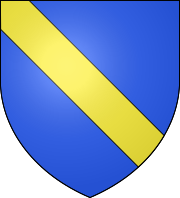
In 1385, King Richard II of England invaded Scotland with his army. During this invasion, two of the king’s knights realized that they were using the same coat of arms. Richard Scrope, 1st Baron Scrope of Bolton from Bolton in Yorkshire and Sir Robert Grosvenor from Cheshire were both bearing arms blazoned Azure a Bend Or. When Scrope brought an action, Grosvenor maintained that his ancestor had come to England with William the Conqueror bearing these arms and that the family had borne them since. The case was brought before a military court and presided over by the constable of England. Several hundred witnesses were heard and these included John of Gaunt, King of Castile and Duke of Lancaster and Geoffrey Chaucer and a then-little known Welshman called Owain Glyndŵr. It was not until 1389 that the case was finally decided in Scrope’s favor. Grosvenor was allowed to continue bearing the arms within a bordure argent for difference. Neither party was happy with the decision, so when King Richard II gave his personal verdict on 27 May 1390 he confirmed that Grosvenor could not bear the differenced arms. His opinion was that these two shields were too similar for unrelated families in the same country to bear.


Unfortunately, it is not easy to get beyond modern summaries of this sort. The last time a record of the case was printed was 1832, and the book seems to be very rare; the University of Toronto's copy is on microfilm, with all the inconvenience and lack of readability that that implies. Today, however, it occurred to me that it might be on Google Books, a resource that is extremely useful for out of copyright materials.

At the moment, only half of the two volume work is available on preview. Maybe volume 1 (probably Stanford University's copy) was too beat up to be scanned? Volume 1, I am sad to say, has the actual transcript of the trial -- which I recall was in Latin -- but volume 2 which is a history of a family of Scrope contains a lot of information, and includes short biographies of the witnesses at the trial (who attested to where they had seen the arms borne by the two principals). Somebody out there might be very interested in this material.