Tampilkan postingan dengan label food. Tampilkan semua postingan

Minggu, 09 Oktober 2016

Review of Woolgar, C. M. The Culture of Food in England 1200-1500


Reviewed by Paul Freedman
Yale University paul.freedman@yale.edu
No longer a neglected field, the study of medieval food has flourished recently. At one time it was the dearth of food, outright famines or food-supply problems that occupied the attention of historians, but taste preferences, the food styles of the Middle Ages and the development of cookbooks are now being investigated as part of an expansion of interest in material culture and in food history generally. Scholars such as Massimo Montanari, Bruno Laurioux and Trude Ehlers have enriched our knowledge of the international and regional fashions and practices in medieval cuisine while the basic standards of living have been explored by Pere Benito for Catalonia or Christopher Dyer for England. A virtue of this new and wide-ranging book by C. M. Woolgar is its treatment of both the effort and business of obtaining food and the manner of cooking and serving it. Food shortages and the difficulties of weather, war and low crop yields are considered, but so are banquets and less extravagant manifestations of festive aesthetics and appreciation. Medical literature and advice is included as are the flexible interpretations of monastic dietary regimens, but the emphasis here is on the gustatory experience of ordinary people, ordinary people with enough prosperity to have some choice in what they consumed, to be sure, but not necessarily nobles.
Woolgar does not rely exclusively on court cookbooks, accounts of great feasts or other evocations of princely entertainments. Those celebrated events, however, influenced the tastes of the other classes, down to the merely modestly well-off. Woolgar emphasizes that while certain effects such sculpted entremets such as edible castles or giant pies, or peacocks cooked and sewn back into their skin and feathers were beyond the reach of all but a tiny elite, aristocratic tastes for highly-spiced food and wine or consumption of game or lampreys were adopted by their social inferiors. Cloves and nutmeg might be prohibitively expensive, but cinnamon was widely used and pepper became so common by the mid-fifteenth century as to be associated pejoratively with the higher peasantry.
Limited to England, the book does not provide a wide-angle view of medieval cuisine as a whole, nor does it concern itself much with regional differences. It is, however, a thorough and fascinating study in depth, imaginatively using sources especially archaeology, household accounts and coroners' records. In an earlier book, The Great Household, Woolgar looked at the aristocratic way of life, including dining, on the basis of the physical remnants of grand houses and castles as well as the records of purchases for these households. Here particular use is made of the records left by officers in charge of supplying the kitchens of ecclesiastical as well as noble houses, showing the organization of large-scale buying a few times a year, more frequent opportunities afforded by regional fairs (especially for luxuries such as dried fruit or spices), and the everyday supplements from markets and urban retailers. Such purchases were in addition to basic commodities such as wheat, malt or meat supplied by dependent tenants or storage centers set up to supply itinerant courts.
New here is the use of evidence of unnatural death to reconstruct what snacks people were munching on or what food-seeking activities they were engaged in just before they accidentally drowned, fell or were burned or scalded to death. The coroners' inquiries provide snapshots of daily life, serene but retrospectively grisly prologues to tragedy. Children and the elderly fell into wells and ditches intending to get a drink of water (43), the consumption of water being more common than historians usually believe. Hot water was also hazardous and we can see brewing and boiling of vegetables in large cauldrons going on through the accounts of unfortunate mishaps (35-36). The results of drunkenness, hunting accidents and falling out of orchard trees are common food-related incidents immortalized by coroners' rolls.
Food has always served as a marker of social distinction, not just dividing those who have more than enough to eat from those who are hungry, but also within the category of the affluent, those who occupy various stages of privilege. Divisions within the comfortable classes were codified less by formal sumptuary laws than by arrangements for banquets whose various tables featured different numbers and types of dishes depending on the social quality of those invited. The exhaustive details of carving and ceremonial are presented here as evidence for a food culture that was regulated, formal but at the same time convivial. In common with the Victorian banquet. the medieval feast featured an intimidating display of precious metal, elaborate décor, fancy dress and remarkable and copious food—but it was organized in an entirely different fashion. Tables were movable and rooms were used for various purposes other than simply dining. Musical and theatrical entertainment was more important than in the nineteenth century. Woolgar is particularly innovative in describing the culinary festivities of regional guilds, particularly in Stratford-on-Avon, whose feasts were ample, immense even, but not as refined or exotic in terms of the actual food served as at those arranged for the aristocracy.
Woolgar mentions aspects of dining that the reader will very likely have wondered about without ever knowing quite the answer: how much meat was consumed in monasteries and with what justification for straying from the Benedictine Rule's austerity; where dining took place (meat-eating was often kept separate in monastic communities), how much in the way of vegetables, fruit, cheese (all considered beneath the notice of court cooks and chroniclers) were consumed by the affluent and in what forms, when spices first became de rigueur (after the 1270s), or the introduction of beer with hops as opposed to the domination of ale.
Woolgar shows diners having a good time together. Food was an important form of social distinction and entertainment. Medieval ceremoniousness in comparison with modern habits is part of an overall regime of commensality. Although not in every respect enviable, the medieval centuries constitute a world in which all chickens were free range, people knew where their food came from, and the company at the table was exempt from some of the distractions that today interfere with our pleasure in dining.
Sabtu, 09 April 2016

The state of affairs, April 2016

My various projects, including this blog, are progressing only slowly. I am undergoing medical treatment at the Hamilton General Hospital in Hamilton, Ontario. It's nothing to be alarmed about, but being away from home does make it difficult to work on my translations.

A couple of years ago another health problem gave me the opportunity to see London, Ontario, a place known to me only as the location of bad winter weather. Now I am seeing more of the city of Hamilton than I have seen before. It has the reputation of being a dirty industrial city, but as is the case in many another place in the Great Lakes region, a lot of the old factories have closed. Nonetheless, it doesn't seem that Hamilton's economy is suffering all that much. (Ditto for Canada as a whole, surprisingly. Unemployment is dropping significantly EVEN IN ALBERTA!)

One of the wonders of Hamilton is a bar/restaurant on James St. called Mezcal Tacos Tequila, which features a large number of tequilas and an amazing style of what might be called Mexican fusion. It is some of the best restaurant food I have ever eaten. And it is relatively cheap. If you live close to Hamilton, run don't walk to Mezcal.

I am also passing the time by listening, through You Tube, to my classic music, music on either side of 1970. In particular I am playing the Jefferson Airplane's

amazing early-morning set at Woodstock.

It has long been fashionable to make fun of Woodstock but it was the site of an amazing effloresence of music. Perhaps equally astonishing is the high quality of audio and video recording that was accomplished in what was a weather disaster. Here's to the sound engineers, cinematographers and all the other hardworking people who preserved this wonderful music.

Selasa, 24 November 2015

A Feast for the Eyes: Art, Performance and the Late Medieval Banquet, by Christina Normore

From the Medieval Review (online book review source): Normore, Christina. A Feast for the Eyes: Art, Performance and the Late Medieval Banquet. Chicago: University of Chicago Press, 2015. Pp. viii, 261. $55.00. ISBN: 978-0-226-24220-0.
Reviewed by Claire Sponsler
University of Iowa
claire-sponsler@uiowa.edu
In February of 1454 in the city of Lille, Philip the Good, duke of Burgundy, sponsored a banquet whose purpose was to promote a crusade against the Turks who in the previous year had captured Constantinople. Although the propaganda effort failed (the crusade was never undertaken), the banquet itself made quite an impression, as well it might, given that it featured among other entertainments an actor dressed in white satin to represent the Church of Constantinople, entering the hall on an elephant led by a giant Saracen; twenty-four musicians who played their instruments inside a gargantuan pie; and marvelous automata that included a tiger battling a serpent in a desert landscape and a boy riding a golden-horned stag, the two singing a duet as they circled the tables set up for the banqueters. The Feast of the Pheasant, as this astonishing event came to be called, made it into the historical record in unusually detailed form, most notably in the Memoirs of Olivier de la Marche and the Chroniques of Mathieu d'Escouchy, and while it is not the only banquet discussed by Christina Normore, it serves as a running example of the complexities of feasting in late medieval culture--her topic in this multilayered and ambitious book.
It might initially seem odd that an art historian would choose banquets as an object of study, but that, as Normore stresses, is exactly the point, both for art history and for the cultural history of medieval Europe. By focusing her eye on feasts, Normore demonstrates what the history of art stands to gain by broadening its scope beyond the traditional high arts of painting, sculpture, and architecture in order to take in a form that is usually relegated to the so-called, and lesser, decorative arts. What the cultural history of medieval Europe reaps, even more importantly, is a less anachronistic (because less constrained by modern categories of aesthetic activity and notions of individual talent) and hence more accurate view of the insistently mixed-media and collaborative arts of late medieval and early modern Europe, such as feasting, that drew together politics, ethics, religion, and other spheres of social life under the guise of entertainment.
Because Normore is an art historian, it is no surprise that she approaches her subject matter chiefly through the visual and provides detailed close readings of the objects and representations found in lavish feasts, while also turning to other pictorial sources such as manuscript illuminations to underscore her claims. The generous use of illustrations in the book lets the reader track Normore's analysis and offers a tantalizing glimpse of late medieval banqueting in action.
But this book moves well beyond the analysis of discrete visual objects. Normore signals her ambitions by setting feasting within the larger context of festivity more generally, a move that allows her to examine the wide array of activities that took place at banquets, activities that combined the culinary, visual, and performing arts into one complex whole. More specifically, her aim is to demonstrate that feasting "helped form a culture deeply invested in discernment" (3), and thus aided in the creation of a court culture grounded in the exercise of aesthetic judgments.
After an introductory chapter aptly titled "Setting the Table," which does the work of laying out the general argument and considering the interpretive issues surrounding a study of feasting, Normore begins in the first chapter, "Between the Dishes," by asking what, exactly, an entremet was, charting the term's ambiguity when used by fourteenth- and fifteenth-century Francophone authors, for whom the word's semantic range included performances, material objects, and foodstuffs. Normore argues that entremets "complicate the separation between media" and, because their production required the collaboration of many different craftspeople, they complicate the separation between "makers" as well (42). Here as elsewhere, Normore is keenly alert to the difficulties of terminology and definition, to the limits of an approach based on a modern taxonomy of artistic forms, and to the need to read with rather than through the material evidence that survives to tell us about these important cultural occasions.
Echoing her claim that the feast was more than just visual display, she pays attention to the sounds and smells of banqueting, as well as to the impact on those who participated. The next four chapters take up various aspects of the way feasts shaped late medieval elite society, by looking at the relationship between banquets and those who participated in or observed them (chapter two, "Spectator-Spectacle"), the success with which feasts intervened in the political sphere (chapter three, "Efficacy and Hypocrisy"), and the meaning of lavish banquets within the ethically-charged notion of magnificence (chapter four, "Dining Well"). The last of those chapters rejects the tendency of modern scholars to equate magnificence with overabundance and instead considers how feasts could function as places "where virtue could be practiced and learned" or as locations where dining could make visible "key concepts of systematic ethics" within a courtly milieu (104). Chapter five, "Stranger at the Table," turns from politics and ethics to an inquiry into feasting's aesthetic ends, particularly in its use of strange and wondrous displays that provided courtly society with "marvels to think with," as Normore cleverly puts it (138).
Readers hoping for an up-close look at one feast will be grateful for the final chapter, "Wedding Reception." Focusing on a specific example, the first night of banqueting that celebrated the marriage of Charles the Bold and Margaret of York in 1468, this chapter aims to strike a balance between anthropologically-oriented studies of feasting as a general social practice and historically-grounded analyses of individual banquets. Normore argues that while it is only within the broad context of late medieval marriage and gift exchange that the complex symbolic and sensory nature of the 1468 banquet can be understood, nonetheless "the specific iconographic and sensual program" (165) of this particular event had distinctive meaning for the marriage at hand: the feasting may have gestured toward all marriages, but it spoke directly to Charles and Margaret's. The conclusion to this chapter serves as a kind of last word for the book as a whole: "the creators of the feast, from the planners to the final participants, worked not only with a particular iconographic program but also within a shared understanding of the proper behavior, values, and aesthetic modes of wedding banquets in particular and feasting in general" (191). In a sentence that drives the book's point home, Normore insists that only when the individual and the general are brought together "can we truly begin to appreciate how and why banqueting captured the imaginations and influenced the actions of late medieval men and women" (193).
By pointing to the complex cultural and artistic interactions of the banquets devised for the Burgundian court, A Feast for the Eyes makes a welcome and sophisticated addition to an emerging body of work on the persistent mixing of media that characterized the public culture of late medieval Europe. Returning representational forms and recreational activities that have now been slotted into separate disciplinary niches--art, music, literature, theater, politics, religion, food--to their thoroughly entwined states in late medieval culture, Normore joins a new wave of cutting-edge work in medieval studies. As resolutely as its subject, A Feast for the Eyes escapes scholarly categories and invites the appreciation of a wide range of readers.


Kamis, 24 Oktober 2013

Culinary despair in the USA

Squarely Rooted disses Cincinnati Chili over at Brad DeLong's blog:

For the mercifully unacquainted, "Cincinnati chili," the worst regional foodstuff in America or anywhere else, is a horrifying diarrhea sludge (most commonly encountered in the guise of the "Skyline" brand) that Ohioans slop across plain spaghetti noodles and hot dogs as a way to make the rest of us feel grateful that our own shit-eating is (mostly) figurative. The only thing "chili" about it is the shiver that goes down your spine when you watch Ohio sports fans shoveling it into their maws on television and are forced to reckon with the cold reality that, for as desperately as you might cling to faltering notions of community and universality, ultimately your fellow human beings are as foreign and unknowable to you as the surface of Pluto, and you are alone and always have been and will die alone, a world unto yourself unmarked and unmapped and totally, hopelessly isolated.

There's more!

(I have no personal experience of Cincinnati Chili, but I love a good rant.)

Rabu, 13 Maret 2013

What the Irish ate before potatoes

Bon Appetit magazine says milk, butter and curds in dizzying variety:


There was drinking milk, and buttermilk, and fresh curds, and old curds, and something called "real curds," and whey mixed with water to make a refreshing sour drink. In 1690, one British visitor to Ireland noted that the natives ate and drank milk "above twenty several sorts of ways and what is strangest for the most part love it best when sourest." He was referring to bainne clabair, which translates as "thick milk," and was probably somewhere between just straight-up old milk and sour cream. And in the 12th century, a satirical monk (this is Ireland, after all), wrote a fake "vision" in which he traveled to the paradise of the Land of Food, where he saw a delicious drink made up of "very thick milk, of milk not too thick, of milk of long thickness, of milk of medium thickness, of yellow bubbling milk, the swallowing of which needs chewing." And many British tacticians, sending home notes on how best to suppress local rebellions, noted that the majority of the population lived all summer on their cows' milk, so the best way to starve out the enemy would just be to kill all the cows.


And the introduction of the potato was part of the impoverishment of the Irish people.


There was drinking milk, and buttermilk, and fresh curds, and old curds, and something called "real curds," and whey mixed with water to make a refreshing sour drink. In 1690, one British visitor to Ireland noted that the natives ate and drank milk "above twenty several sorts of ways and what is strangest for the most part love it best when sourest." He was referring to bainne clabair, which translates as "thick milk," and was probably somewhere between just straight-up old milk and sour cream. And in the 12th century, a satirical monk (this is Ireland, after all), wrote a fake "vision" in which he traveled to the paradise of the Land of Food, where he saw a delicious drink made up of "very thick milk, of milk not too thick, of milk of long thickness, of milk of medium thickness, of yellow bubbling milk, the swallowing of which needs chewing." And many British tacticians, sending home notes on how best to suppress local rebellions, noted that the majority of the population lived all summer on their cows' milk, so the best way to starve out the enemy would just be to kill all the cows.


Senin, 21 Mei 2012

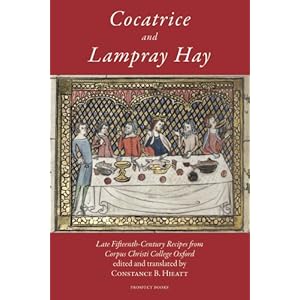
A review of Constance Heiatt's most recent book on medieval cookery: Cocatrice and Lampray Hay


Reproduced from the excellent review source, The Medieval Review 
Hieatt, Constance B. ed. and trans. Cocatrice and Lampray Hay: LateFifteenth-Century Recipes from Corpus Christi College Oxford.
Totnes: Prospect Books, 2012. Pp. 176. GBP30.00/$60.00. ISBN: 978-1-903018-84-2.
 Reviewed by Melitta Weiss Adamson     The University of Western Ontario     melitta@uwo.ca

For nearly four decades the study of food in medieval England has beeninextricably linked with the name Constance B. Hieatt.  Her 1976 bookPleyn Delit: Medieval Cookery for Modern Cooks, which she co-authored with the late Sharon Butler, became a best-seller.  Apaperback edition in 1979 was followed by a completely revised secondedition in 1996 with Brenda Hosington as her collaborator.  In 1985,Hieatt and Butler published Curye on Inglysch, and in 1988appeared Hieatt's edition of An Ordinance of Pottage.  TheLibellus de Arte Coquinaria, published in 2001, was the resultof her collaboration with the late Rudolf Grewe.  To the books fromthis period must be added many shorter pieces which appeared inSpeculum, Medium Aevum, and elsewhere.  In addition tomaking more of the medieval manuscripts available in scholarlyeditions and translations, and offering modern adaptations for many ofthe recipes, Hieatt soon recognized the need for a comprehensive listof extant culinary manuscripts from medieval Europe and collaboratedwith Carole Lambert, Bruno Laurioux and Alix Prentki on the 1992Répertoire des manuscrits médiévaux contenant des recettesculinaires, which is included in the book Du manuscrit à la
table
edited by Carole Lambert.  The Répertoire remains to
this day one of the most important reference works for medievalEuropean cookbook manuscripts.  With a good number of the extantculinary manuscripts from England accessible in print by the beginningof the new millennium, Hieatt set out to collate the various versionsof individual recipes and in collaboration with the late Terry Nutterand Johnna H. Holloway published the Concordance of EnglishRecipes: Thirteenth Through Fifteenth Centuries in 2006, which she
followed two years later with her book A Gathering of MedievalEnglish Recipes containing editions of various shorter culinary
manuscripts and a supplement to the 2006 Concordance.
With Cocatrice and Lampray Hay Constance Hieatt returns to amanuscript she and the late Sharon Butler had first begun totranscribe around 1980, but put aside on account of its manydifficulties (22).  Corpus Christi College Oxford MS F 291 is amanuscript from the end of the fifteenth century, written in MiddleEnglish and possibly originating from Norfolk (10).  Its recipes,unlike most in the earlier cookbook manuscripts from England and thecontinent, are very detailed and provide quantities for manyingredients.  The dishes usually serve between sixteen and eightydiners (20).  The recipe titles in the table of contents on fols. 1v-2v correspond largely but not completely with the recipes that followon fols. 3r-68r.  The main differences are due to some recipe titlesomitted in the table of contents, and two sheets now missing from thecodex.  All in all, Hieatt calculates that the cookbook likely oncecomprised 101 recipes of which 99 are extant today, most of themwritten in one hand (10-11, 19).  For each recipe, the editor providesthe transcription of the original text, a modern English translation,and a commentary which in most cases also contains notes for moderncooks who would like to interpret the dishes.  Since she does notoffer modern adaptations of the recipes complete with exact quantitiesand cooking instructions, the notes are geared more towards theexperienced cook than the novice.  Although many recipes havecounterparts in other manuscripts, the Corpus Christi College cookbookis not directly related to any of those recipe-collections, as Hieattpoints out (11).  What becomes clear from reading her comments to therecipes is that vocabulary, some of which not found anywhere else,confused instructions, and scribal errors pose the biggest problems toour understanding of the manuscript today.  We are fortunate thatConstance Hieatt decided to publish the recipe collection late in hercareer when she had the extant cookbook tradition of medieval Englandat her fingertips and was able to solve more of the problems than anyof her peers or she herself at an earlier time would have been ableto.  The book concludes with a supplement to the Concordance of2006 which combines the new material from the Corpus Christi Collegemanuscript with that contained in the 2008 supplement of AGathering of Medieval English Recipes (145-172).  Future users
will therefore only need to consult one supplement to theConcordance rather than two.  As in the 2006Concordance, Hieatt also provides a helpful "Glossary of RecipeTitles Used as Lemmas and Cross-Index of Variant Titles" at the end(173-176).
The cuisine reflected in the ingredients and recipes of the CorpusChristi College manuscript is that of a wealthy household.  Pepper,cinnamon, saffron and salt are the standard seasonings; honey in morethan half of the recipes, together with the ubiquitous figs and datespoint to a preference for sweetness.  Other prominent ingredients arealmond milk and grated bread used as a thickener.  The cookbook startson a flamboyant note with a recipe for "cocatrice," or basilisk, afabulous creature half piglet and half chicken (Recipe 1), and endswith a recipe for apple sauce (Recipe 99).  Hieatt describes the orderof the recipes in the collection as "quite eccentric" and detects "nodiscernable overall rationale" (11).  And yet, the collection doesfall into various sections which may point to different medievalsources from which it was compiled and/or various attempts to sort therecipes.  Many of the first thirteen recipes would have been suitablefor a banquet as a sotelty or surprise dish such as the aforementioned"cocatrice" or the skillfuly stuffed chicken (Recipe 4) or stuffedmackerel (Recipe 5).  Following the group of pastries under thesubheading "Baken Mete" (Recipes 14-19), we find two recipes forkeeping foodstuffs for extended periods of time, namely pea pods(Recipe 20), and venison (Recipe 21).  The recipe for "Lampray Hay"opens a long list of fast-day recipes (Recipes 22-55) featuring a vastarray of fish and seafood interspersed with some fruit and vegetabledishes, and a group of four pastry dishes (Recipes 48-51) under thesubheading "Baken Mete for Lentyn."  That "Lampray Hay" containsneither lampray nor hay causes Hieatt to surmise that we may bedealing with a "deliberate joke" (58).  The seventeen recipesfollowing the Lenten dishes are for meat dishes and various pottages(Recipes 56-72).  While most of these are standard recipes also foundin other collections, the five subsequent dishes and dish names notfound anywhere else leave even an expert such as Constance Hieattmystified (Recipe 73-77).  Quite the opposite is the case with thenext set of eight recipes starting with the popular "Morterews"(Recipe 78), "Mawmone" (Recipe 79) and "Blawmanger" (Recipe 80) andending with the simplest of cabbage recipes (Recipe 85).  The editoris unable to place the next recipe with the rather distasteful name"Capoun in Urinele" (Recipe 85) in the medieval English cookbooktradition but vaguely remembers having seen such a recipe before.  Infact, chicken cooked in a glass is a standard recipe in Italiancookbooks of the Liber de coquina tradition where it issometimes referred to as "de gallina implenda" or "gallina cocta incarafia."  The subsequent recipe for "Two Cunnyngs of One" (Recipe 87)in the Corpus Christi College collection also points to an Italianconnection.  The idea of skinning an animal, albeit not a rabbit but adove, roasting the carcass, stuffing the skin with other meat andserving both side by side, is found in the fifteenth-century CuocoNapolitano as Recipe 67, and interestingly followed there by a
recipe for chicken in a carafe (Recipe 68 in the 2000 edition andtranslation by Terence Scully).  In her comments to Recipe 87, Hieattmakes reference to a recipe for two capons from one that is containedin another manuscript from England but does not mention the Neapolitanparallel.  The final set of twelve recipes in the Corpus ChristiCollege cookbook brings an assortment of dishes ranging from pottages,fish and seafood dishes, to gruel, a pudding, pie, tart, and applesauce, all of which may well have been later additions (Recipes 88-99).
Cocatrice and Lampray Hay is Constance Hieatt's latest book onmedieval food but it will not be her last.  Prior to her passing inDecember 2011, she worked on the draft of another book entitled TheCulinary Recipes of Medieval England, which will be published
posthumously.  With her editions, translations, adaptations,concordances, and in-depth studies of medieval and early moderncookery, this prolific scholar has given us tremendous tools withwhich to study early European culinary history.  Now it is up to thenext generation to continue the work and bring the picture that hasemerged thanks to her tireless efforts into an ever sharper focus.Constance Hieatt will be missed by many.