Tampilkan postingan dengan label Guy Halsall. Tampilkan semua postingan

Minggu, 10 April 2016

"Two Worlds Become One: A 'Counter-Intuitive' View of the Roman Empire and 'Germanic' Migration" by Guy Halsall

This is an interesting re-interpretation of the "migration" period, part of a debate that has contemporary resonances and which has been going on for decades now.

Here is the abstract:

Abstract

The Roman Empire and barbaricum were inextricably linked throughout the Roman Iron Age. By late antiquity, Germanic-speaking trans-Rhenan areas were inundated with imperial influence. Migration was two-way and in various forms, all of which, including large-scale ‘folk movement’, were normal: part and parcel of the imperial frontier’s dynamics. The counter-intuitive conclusion is drawn from this that the relationship between the existence of a formal frontier and significant migration is quite the opposite of the one we have grown used to imagining. The collapse of the frontier took with it the mechanisms for migration. Therefore I have to modify my 2007 epigram that ‘the end of the Roman Empire produced the Barbarian Invasions and not vice versa’. The end of the Roman Empire put an end to the barbarian migrations. This conclusion helps us contribute more responsibly to modern debate on migration. It also contributes to a discussion of the formation of Germany. The end of migration changed the political dynamics of the regions between Rhine and Baltic. The latter became more inward-facing and from these, eventually, emerged ‘Germany.’

Here is the complete text

Minggu, 31 Mei 2015

Guy Halsall: think with history, act in the present.

Guy Halsall sings, "You better free your mind instead!"

The point is this: HfB [Historians for Britain] and its opponents share exactly the same, entirely conventional approach to the ‘relevance’ of history to current political debate; in other words, to ‘why history matters’. That relevance, as is clear from any close reading of almost all of the contributions to the exchange, consists entirely in the deployment of historical ‘fact’. I find this, to be blunt, more than a tad wearisome. [The involvement of historians in the referendum on Scottish separatism took exactly the same tedious form.] What seems largely to be at stake is who can assemble the biggest pile of facts. This is not going to make much of a difference, let alone decisively carry the day, either way. By way of demonstration, and if you can bear it, just read ‘below the line’ on the on-line version of the ‘Fog in the Channel…’ piece. To quote the (in my estimation) criminally underrated Andrew Roachford, ‘I don’t want to argue over who is wrong and who is right’.

Let me row back from the extreme position that might be inherent in that statement. First, it is very important to deploy historical fact to counter misleading public presentations of what ‘history shows us’. This was another reason I signed up to the ‘Fog in the Channel…’ letter. There were some seriously dubious elements in Abulafia’s piece ... However, as I have said too many times to count, history (as opposed to chronicling or antiquarianism) is the process of thinking, interpretation, explanation and critique, carried out on the basis of those facts, it does not stop at the latter's simple accumulation (most historical 'facts' are, to me, not especially interesting in and of themselves: this happened; that did not happen – factual accuracy is a duty not a virtue).

More seriously, both sides essentially see the course of history (as established by these facts) as providing a set of tramlines governing the proper path we should take in future. This removes any kind of emancipatory potential from the study of history. Put another way, and to restate the counter-factual posited earlier, suppose you agreed with Abulafia (and after all he’s not wrong about everything) that Britain’s history was, fundamentally, profoundly different from that of mainland Europe and had run a quite separate course (there is a case that could be put to support that contention that would have to be taken seriously, even if it is not the one put forward by HfB). But suppose that, unlike him, you thought that this had been a terrible thing and thought that Britain needed to incorporate itself more fully in Europe. Or suppose that you thought that the authors of ‘Fog in the Channel…’ were fundamentally right that Britain’s history was entirely entwined with that of the mainland but that you thought that this was wholly regrettable. In still other words, suppose that – like me – you thought that the course of the past had no force and provided no secure or reliable guide at all to what ought to be done in future.

So, what would one be able to contribute to a debate on these (or other) issues if one held a (superficially) seemingly nihilistic view, like mine, of history as random, chaotic, ironic, and unpredictable, and of the past as having no ability in and of itself to compel anyone to do anything? What, so to speak, would be the point of history? Why would it matter?

In his excellent blog-post – in my view, the best intervention in this discussion by some way (impressive not least for its concision) – Martial Staub draws attention to the discontinuities of history that subvert any attempt at a unified narrative or quest for origins. This seems to me to point us at a much more valuable and sophisticated means by which the study of history (rather than ‘History’ itself, that somehow mystic object, or objective force) can make a political contribution. Every dot that is later joined up to make a historical narrative represents a point of decision, of potential or, if you prefer, of freedom, where something quite different could have happened. To understand any of these decisions, as again I have said many times before, it is necessary to look at what people were trying to do, at what the options open to them were, or those they thought were open to them, what they knew – in short at all the things that didn’t happen, which frequently include the intended outcomes. You cannot simply explain them as steps on a pre-ordained path towards a later result, or as the natural outcomes of the preceding events. Any present moment of political decision represents the same thing: a point of choice, of decision, which requires serious thought. It should not be closed down by the idea that some 'burden of history' or other compels us to go one way rather than another. Those decision points that I just called the dots joined up to make a story were, at their time, points of freedom when any number of things were possible. The unpicking of narrative constructions makes this very clear and that – in my view – is the point that emerges from historical study.

This lesson, for want of a better word (I mistrust ‘lessons from history’), points at a string of possible subversions. Staub points out the subversion of the ‘national’ story but at the same time it subverts any similar ‘European’ master narrative. Britain can be said to have had a history different from that of other European countries – true enough - but to no greater extent than any other region of Europe has a history different from the others. It may be true that at some points British history seemed to run on a course that bucked European trends, but exactly the same can be said of, for example, Italian or Spanish history at various points. What is Europe anyway? Is it any more natural a unit of analysis than any other? In the Roman period, the idea of thinking of the north of Africa as somehow a different area from the northern shore of the Mediterranean would be very odd. Indeed the Mediterranean basin can be seen as a unified area of historical analysis (who, after all, knows that better than David Abulafia?), rather than as different continents divided by a sea – perhaps one with different histories from northern Europe or the North Sea cultural zone (which obviously includes Britain). All of these points also contribute to a historical critique and dismantling of the idea of the nation (any nation) itself, not simply the national story (see also here). All historical narratives are constructs so (unless one is based upon the misuse or fabrication of evidence, or not staying true to the basic 'facts' of what did or did not happen) one cannot be claimed to be more accurate than another. No one can win an argument on that basis. The best that can happen (and it is important) is the demonstration that there is more than one story to be told.

Above all, what I find to be one of the most important contributions that historical study can make, in terms of social/political engagement, is the subversion of all reifications, of all attempts to render contingent categorisations as natural. And of course it similarly subverts claims to represent contingent oppositions as eternal or natural.

All these subversions arise from what I have repeatedly argued on this blog are historical study’s most important benefits: the critique of what one is presented with, as evidence, and the simultaneous requirement to see similarity – shared human experience – in difference and diversity, or to listen to and understand that evidence).

So I would contend that the view of history sketched above is very much not a disabling, nihilistic one but quite the opposite. The careful, sympathetic yet critical investigation of the traces of the past, the deconstruction of narrative, nation and so on, can and should free us from the burdens that people want to impose on us in the name of history. The appreciation of the once possible but now impossible potentials at the decision-points of the past can and should allow us to think twice about what people tell us are now impossibilities and open our minds to the potentials and possibilities of the present.

If you want a catchphrase, try this: think with history, act in the present.

Minggu, 27 Oktober 2013

Worlds of Arthur, by Guy Halsall


I know Guy Halsall and correspond with him fairly frequently. I think he's a very good historian. So when he wrote a book with a riproaring commercial title like "Worlds of Arthur" it was only a matter of time before I got around to having a look.

Frankly, I don't know how commercial this book is, or how much impact it will have on even the more serious readers among the general public, namely the people who actually shell out their own money to read books on serious subjects like post-Roman Britain and King Arthur. Certainly Halsall tries very hard to reach those people, and does a much better job than most academics do on similar projects. But the book is a thorough debunking of certain ideas about Arthur and his place in history, and is already provoking a mixed reaction.

Halsall believes that trying to find the real Arthur behind the legends is entirely futile, and he classifies most efforts to do so as pseudo-history.  It is possible that somebody named Arthur led British forces against Saxon invaders, but the simple truth is that we know nothing about any such person and can't  reconstruct his life and career. The few written sources we have for this two-century period (410-597) does not allow us to do it and unless some miraculous discovery turns up new information (and none has appeared for many centuries) we will never find Arthur. A lot of professional historians agree with this, but I doubt that anyone has made such an uncompromising presentation of this fact – the unknowability of Arthur – as Halsall does here. 


Halsall is equally interested in revising a framework that scholars of the past have imposed on our understanding of post-Roman Britain. To simplify, Halsall does not think that British history of the fifth and sixth centuries is best understood as a fight between "the Britons" and "the Saxons," a long contest which resulted in the expulsion of Britons from most of what is now England. In line with developments in other parts of Western Europe, English ethnic identity came to dominate because older identities, specifically the Roman identity, were no longer relevant to a Britain where the Roman economy and society had collapsed.

Halsall both discusses changes in our interpretation of British archaeology over the last 40 years, and offers his own reinterpretation, which he frankly labels as speculative. It's an interesting interpretation and one I find fairly persuasive, though in this period we will never have certainty.

One of the best things about this book is that Halsall discusses how people use and misuse evidence for difficult historical problems in great detail. This may put people off, but it is one of the most transparent discussions of what historians do in interpreting the often difficult to understand early Middle Ages that I've ever seen. It is not likely to be everybody's cup of tea. But have a look at this discussion of DNA evidence and how it can deceive, especially people who want to be deceived.
Even with these data, an even more serious problem concerns the move from DNA to conclusions about ethnic or political identity. Ethnic identity is multi-layered. It is deployed (or not) in particular situation as the occasion demands, and can be changed. DNA cannot give you a sense of all the layers of that person's ethnicity, or of which she thought the most important, or even if she generally used a completely different one, or when and where such identities are stressed or concealed. A male Saxon immigrant into the Empire in, say, the fourth century, would – one assumes – have DNA revealing the area where he grew up, but he would probably increasingly see himself, and act, as a Roman. Saxon origins would have little part in his social, cultural, or political life, and even less for his children, if they stay in the Empire. If he returned home with the cachet of his Imperial service, it might have been his Roman identity that gave him local status. He might even have called himself a Roman. However, if a distant male relative moved to Britain 150 years later, his DNA might be very similar but, in complete distinction, he might make a very big deal of the Saxon origins. They would, or could, propel him to the upper echelons of society. DNA tells us nothing about any of this. What is pernicious about this use of genetic data is its essentialism. It views a person's identity as one-dimensional, unchanging, and as entirely derived from that person's biological and geographical origins. In short, it reduces identity to something similar to 19th century nationalist ideas of race. Everyone sane knows that people moved from northern Germany to Britain in the fifth and sixth centuries. In that sense, these expensive analyses tell us nothing we do not already know. In their implicit reduction of identity to a form of race, masking all the other contingent and interesting aspects of cultural interaction and identity-change they risk setting back the understanding of this period by more than a century. Moreover, they provide pseudo-historical and pseudo-scientific ammunition for present-day nationalists xenophobes and racists.
If you teach history, wouldn't you want your students to be exposed to such a clear discussion of a historiographical problem?  One with real relevance to the present?

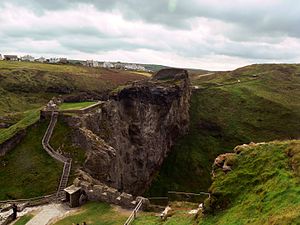
Image: Tintagel. People in the 12th century thought this was an Arthurian site.
Selasa, 30 Agustus 2011

Battle in the Early Middle Ages: Expertise and controversy


"Historian on the Edge" provides us with an expert summary of his views on early medieval warfare.

I say "expert" rather than "authoritative" because as he points out, there are no authorities on this subject, only controversialists.

Highly recommended for students in my upcoming fourth-year seminar.

Image:  Conan as barbaric warrior.

Jumat, 26 November 2010

More good reading from Phil Paine: "identity," slavery, and genocide

The misuse of identity:

...I tend to get most on my high horse when I feel that some stu­pid or wicked notion is being smug­gled into our sub­con­scious by a turn of phrase or an implied definition.

This is exactly the case with the cur­rently accepted use of the word iden­tity. You see this word used all the time, and phrases like “iden­tity pol­i­tics” are assumed to have an eas­ily rec­og­niz­able mean­ing. I’ve just been read­ing a spate of archae­o­log­i­cal papers which rou­tinely refer to “iden­tity” inter­change­ably with eth­nic­ity. These papers, from a vari­ety of aca­d­e­mics, con­stantly repeat phrases like “nego­ti­at­ing their iden­tity” — inane jar­gon which the field has bor­rowed from soci­ol­ogy, and which is now firmly entrenched. Archae­ol­ogy is impov­er­ished by this kind of rub­bish, and drifts away from sci­en­tific rigour.

When some­one casu­ally refers to reli­gious affil­i­a­tion, or to eth­nic­ity, or nation­al­ity, or gen­der, as being their “iden­tity,” there is an implicit assump­tion that mem­ber­ship in large, for­mally defined or orga­nized groups of peo­ple is the essen­tial char­ac­ter­is­tic of an “identity.”

Now, I find this a pro­foundly wrong, and extremely offen­sive assump­tion. Your iden­tity, as far as I’m con­cerned, and as I’ve believed through­out my life, is that which makes you uniquely your­self. My “iden­tity” is com­posed of those things which refer to me and only me, expe­ri­ences that occured to me alone, pas­sions and ambi­tions that are mine, pri­vate sym­bols that only I under­stand, inner expe­ri­ences that belong only to me. These unique, indi­vid­ual char­ac­ter­is­tics form, all together, my Iden­tity. No char­ac­ter­is­tic that I share with some arbi­trary group of other human beings, or that is demanded of me by some col­lec­tive mush, or imposed on me by some pro­claimed Author­ity, can con­sti­tute my iden­tity. Cer­tainly no group that I am merely asso­ci­ated with by acci­dent of birth can ever be my iden­tity. I find the idea that any­one would con­sider their iden­tity to be, say, Nor­we­gianess, or their skin colour, a pro­foundly dis­gust­ing notion. It is to aban­don indi­vid­u­al­ity entirely, to crush and erase iden­tity, not to describe it.

This is a par­tic­u­larly creepy kind of creep­ing col­lec­tivism. The mean­ing of the word iden­tity has been dis­torted, per­verted, inverted. I don’t believe such things are ran­dom acci­dents. There are always pow­er­ful forces that seek to oblit­er­ate respect for, and recog­ni­tion of, the indi­vid­ual human being. If you can pur­suade peo­ple that their “iden­tity” is noth­ing more than their mem­ber­ship in a col­lec­tive blob, that there is noth­ing specif­i­cally notable or sig­nif­i­cant about them­selves, then half the work of enslave­ment has been accom­plished.
Amartya Sen has made a similar point in a recent book Identity and Violence, but his point was that reducing people to a single group identity led not just to enslavement, but genocide.

Similarly, this, from Chimamanda Adichie:


Update: Guy Halsall, anxious to elbow his way into this august company of great minds, recommends that anyone interested in this topic read his book Barbarian Migrations and the Roman West, 376 - 568, especially chapters 2 and 14; I would add that you might also want to be interested in barbarian migrations and "the fall of the Roman Empire." Seriously, though, I read Guy's book last month and it is quite fine, and the theme of multiple identities (as opposed to singular, essentialist ones) is surely there. This is not quite what Phil was talking about, but it is interesting and advances the historical debate on the "transformation" of Rome.

Selasa, 26 Oktober 2010

"History tells us nothing of the sort:" One historian's reaction to some discouraging political events

A lot of my friends are appalled and cast down by the just-past local elections in Ontario (including me), but my Brit friends are even more discouraged by the Tory resurrection (and for good reason).   In the case of Guy Halsall, events inspired this blog post, which I excerpt here not so much for its current political stance, but for its interesting remarks on the philosophy of history.  The bold emphasis is mine.
More to the point, as concerns me today, the teleology of the longue durée takes short-term sets of events and experiences, like the common man’s involvement in the baronial reform movement (by the way, I’m not trying to claim the Barons’ Revolt really was some sort of democratic revolution; it is just a suitable example to use for this thought-exercise) and turns them either into blips or dead-ends or ‘steps’ on the road to a major change, depending upon how the course of history is interpreted from a particular vantage point. Both are mistaken ways of seeing. That the common freeman of Leicestershire, hit by the royalist backlash after Evesham, drew no comfort from the fact that ‘only’ 400 years later Parliament would overthrow and behead a king, and introduce a constitutional monarchy, goes without saying. To turn his and his allies’ efforts into a dead-end or a blip because they failed is similarly teleological. The triumphalist grand narrative denies the pain and anguish of lived experience; the ‘dead end’ approach denies us hope. Indeed, maybe it is intended to deny us hope: don’t try and challenge the natural, the ‘right’ order of things. “History tells us …” How often do we hear that phrase? But history tells us nothing of the sort. Ever. So they failed. Try again (as Žižek is fond of quoting); fail again; fail better.

The approach rules out (as I have also argued before) the irony of history. It leads us to the absurdities of, to take just one egregious example, Peter Heather’s arguments that ‘The Goths’ were a people with a coherent set of aims (on the basis that at some later point, some people called Goths ended up with a kingdom within what had been the Roman Empire). In the hundred years preceding the deposition of the emperor Romulus in 476 it is well-nigh impossible to identify anyone who was actually trying to bring down the Roman Empire, rather than trying to re-establish the imperial political system of the fourth century, with them in a controlling position. A great deal of the history of the creation of what we see as the new political and social world of the ‘Middle Ages’ is in fact the history of people trying to recreate the Roman Empire. Napoleon may have realised that the game was up late in the evening of June 18th 1815 but when he signed the Treaty of Tilsit a few years earlier, or when he married Maria Louisa of Austria, or when his son was born, he and his followers can be forgiven for thinking that he (and they) had won. What interests me about the generations around 600 is that the motor for change, as it appears to me at the moment at any rate, is an awareness that they were living through a new phase: that the old world of Rome had gone (note that it had taken the best part of a century after Romulus’ deposition, and some fairly horrible wars, to establish this point). They were trying to figure out how to respond to this, new situation, with (naturally, but perhaps more obviously than usual) little idea of where they were going.

You might well have guessed where I am going with these meandering thoughts. It looks to me that we are at a point where those of us on the Left might well think that the game is up, that that’s it, we lost. If we can draw lessons from the way we think about history, though, I think we might make several important points. One is that many people do not seem (surely?) to realise the implications of what is happening, so there is still a battle to be fought and won. Another is that the game isn’t up yet; or rather that it only is if we give up on it. Cameron and his order-paper-waving right-wingers may think they have won, and that they can go ahead and dismantle the welfare state, and sell its opportunities off to themselves and their chums in the private sector (in effect returning us to a 21st-century form of feudalism) but they can be stopped. And they must be stopped. But that is down to all of us. The alternative is that everything – every little change, every little baby-step, to improve the lot of the ordinary person – that people have fought and died for over the past seven and a half centuries becomes a dead-end, a curious blip that right-wing historians will be able to point to as showing the futility of challenging the ‘natural’ order. Every backlash against fairness, every move against the Welfare State, the National Health Service, free education and so on, will be made into a step on the road of Progress. Is that the history we want to bequeath to future generations?

If we work hard, this may not be the Waterloo of the Welfare State but the Ligny** of the Right. The alternative is not worth thinking about. It’s not over yet, and (to return to my earlier metaphor) David Cameron is no Lord Edward.

...

** For those less interested in Napoleonic military history than me, the battle of Ligny was Napoleon’s last victory, fought two days before Waterloo. Napoleon, it has to be said, played a blinder in the Waterloo campaign up until the battle itself. Such is the irony of history.