
Tampilkan postingan dengan label Deeds of Arms series. Tampilkan semua postingan

Rabu, 05 Oktober 2016

Review of Will a Frenchman Fight? ed. Steven Muhlberger Deeds of Arms, 4.

I'm grateful for this positive review but I wish the reviewer had said more about the main theme of the book, the often conflicting demands of military effectiveness and individual honor in the minds of men at arms of the time.
Muhlberger, Steven, ed. and trans. Will a Frenchman Fight?. Deeds of Arms, 4. Wheaton, IL: Freelance Academy Press, 2015. Pp. viii, 102. $24.95. ISBN: 978-1-937439-17-0.

Reviewed by Katherine Hodges-Kluck
University of Tennessee, Knoxville
kthomp41@vols.utk.edu
Will a Frenchman Fight? is Steven Muhlberger's third contribution to the Deeds of Arms Series. This sourcebook focuses on the great chevauchée, or raid, led by Thomas of Woodstock, first earl of Buckingham, through French territory in 1380-81. The book opens with an 18-page introduction, followed by selections of Froissart's Chroniques and Cabaret d'Orville's 1429 Chronicle of the Good Duke. As Muhlberger explains, Cabaret received his information from the French knight Jean de Châteaumorand, who recollected the events of his youth. Together, therefore, these chronicles provide two contemporary perspectives on the raid. The book concludes with a short bibliography for further reading.
The 1380-81 chevauchée was a response to duke of Brittany Jean de Montfort's call for aid after he was exiled for opposing the French king's attempts to exert royal jurisdiction over the ducal succession in Brittany. Will a Frenchman Fight? does an excellent job of highlighting the precarious situation which de Montfort faced. Out of favor with Charles V of France and charged with treason, the duke turned to the English for assistance, only to be thwarted by his own lords who refused to accept foreign support against their fellow countrymen. The introduction and primary sources in Will a Frenchman Fight? highlight these overlapping and frequently conflicting layers of leadership and allegiances, which in turn shaped France's military response to the rebellious de Montfort and his would-be English allies.
Muhlberger's introduction begins by outlining some of the major events of the four decades leading up to Buckingham's raid, including the Black Death, the English victory at Poitiers, the capture of the French king Jean II, and the Jacquerie rebellion. Muhlberger effectively demonstrates the economic pressures that shaped Edward III's and Parliament's military decisions on the one hand, and Charles V's struggles to "re-establish royal authority" in France on the other (5). The rest of the introduction then breaks down the sequence of events for the chevauchée and discusses the varied motivations of the French and English soldiers involved in it. The author assumes some basic knowledge of the first phase of the Hundred Years War, and the major players involved. It is not until midway through the introduction, for instance, that the reader learns that Buckingham is the "son of the King of England" (13), and only in the color plate of Buckingham's coat of arms in the middle of the book that the reader finds the earl's full name and titles.
The primary source section of the book presents the events of the chevauchée in chronological order, following the English on their march through enemy territory, their largely unsuccessful attempts to engage their enemy in battle during the winter months, and finally their retreat back to the coast. The primary texts have been thoughtfully selected to highlight the nuances of the complicated political, as well as tactical, situations posed by the English presence in France. As the book's title suggests, the sources shed light on "a variety of different kinds of combat and different motives for fighting" (3). In particular, they depict the tensions between 1) open pitched battles like those of Crécy and Poitiers, which favored the English; 2) the pragmatic but unpopular scorched-earth tactics employed by both the French and the English armies at the expense of the French populace; and 3) the desire of individual knights and squires on both sides of the conflict to demonstrate chivalric honor through individual combat.
The sources are divided into eight sections, throughout which chapter numbers and titles from the original texts are included as subheadings. Six of the sections are drawn from Froissart, while the remaining two (which are relatively short by comparison) are from Cabaret's chronicle. In the first section, titled "Buckingham's Campaign Begins," Froissart describes the exchange of ambassadors between Brittany and England, and Edward III's subsequent plans for an armed expedition into France. The chronicler discusses the deployment of troops, the effects of international alliances on events, and the capture of prisoners of war. The next section, "The Confrontation at Troyes," describes the skirmishes between French and English forces outside that city. The third section, "The Deeds of Arms at Toury and Marchenoir," follows the English army's travels into Brittany and the reception that the English received in various towns along the way, a reception that ranged from lukewarm to outright hostile. This section also includes Froissart's account of the death of Charles V. In "Buckingham in Brittany," Froissart shows the complicated political situation facing Jean de Montfort. He also describes the siege of Nantes and the coronation of the child king, Charles VI. The next passage, "The Siege of Nantes," is drawn from Cabaret's chronicle. It describes how the French defenders of the city used a variety of tactics to drive back and defeat the English besiegers. The next two selections, both titled "The Deeds of Arms at Vannes," give first Froissart's and then Cabaret's descriptions of individual combats between some of the knights and squires of the two armies. The final section, "Nicholas Clifford and Jean Boucinel," turns again to Froissart's text, outlining the peace concluded between Jean de Monfort and Charles VI, the English retreat out of Brittany, and an individual chivalric combat between Clifford and Boucinel.
While English translations of portions of Froissart's Chroniques have long been available, Cabaret's chronicle is less familiar to English readers, and this book makes a welcome contribution by including passages from it (though one wishes they were longer). Muhlberger's translations are clear and appealing to readers of all levels. This book should be a popular one for use in college classrooms, as it is accessible, attractive, affordable, and offers many topics of potential discussion.
The weaknesses of the book are largely structural. There is no index, and although Muhlberger defines specialized terms such as a outrance within the text (17), a glossary of such terms, as well as of important names, would make the book more user-friendly. Moreover, the two maps that the book reproduces (France at the Treaty of Brétigny in 1360 and at the death of Charles V in 1380), while in full color, are antiquated--one dates to 1877--and rather difficult to read. The book would benefit from a map that clearly plotted the route taken by the English army during the raid and the locations of important cities and skirmishes specifically mentioned in the text. It would also be useful to have in-text references to the images in the color plates at the center of the book.
Ultimately, this source reader presents a detailed view into an exciting yet lesser-known episode of the Hundred Years' War. Rather than placing attention on the famous battles like Crécy, Poitiers, and Agincourt, Will a Frenchman Fight? shows the more common side of war: one marked by short skirmishes, inconclusive raids, prolonged sieges, individual desire for honor, bad weather and disease, and the vicissitudes of fortune and politics.
******
Senin, 23 Mei 2016

Reviews of Royal Jousts and the Combat of the Thirty (De Re Militari)

Muhlberger, Royal Jousts at the End of the Fourteenth Century & The Combat of the Thirty (Sposato) De Re Militari
MAY 23, 2016
Royal Jousts at the End of the Fourteenth Century, Deeds of Arms series 1
The Combat of the Thirty, Deeds of Arms series 2
ed. and trans. by Steven Muhlberger
(Freelance Academy Press, 2012) i- viii, 88 pp., $24.95; ii- viii, 83 pp., $24.95
Over the past fifteen years Steven Muhlberger has established himself as one of the leading authorities on medieval chivalry. His scholarly oeuvre has not only made an important contribution to the larger field, but in many ways has blazed a new trail through his focus on case-studies of particular events, individuals, and texts. [1] The two works reviewed herein, Royal Jousts at the End of the Fourteenth Century and The Combat of the Thirty, fit this mold and are part of a series on formal deeds of arms (faits d’armes) published by Freelance Academy Press, one that has already received the approbation of scholars. [2] These two volumes, and the series as a whole, will be especially attractive to scholar-teachers who can use them to great effect in the classroom, while also offering a useful introduction for graduate students and researchers who wish to study for the first time formal deeds of arms and their important role in the chivalric culture of late medieval Europe.
In the first volume in the series, Royal Jousts, Muhlberger examines four historical jousts held in 1389-1390. Three of the jousts were organized by the French and one by the English: the Joust at St. Denis (May 1389), the Joust accompanying Queen Isabella of Bavaria’s entry into Paris (August 1389), the Joust at St. Inglevert (March-April 1390), and the Joust at Smithfield near London (October 1390). These jousts were meant to celebrate both armes (arms, i.e., prowess, bravery, valor, etc.) and amour (love). In addition, they served the propagandistic purposes of two young kings, Charles VI of France and Richard II of England, who sought to both secure a lasting peace between their kingdoms after decades of war and to encourage and reward the chivalric energy and violence of their knights and men-at-arms. These two seemingly contradictory impulses could be reconciled in such formal combats.
The first part of Royal Jousts consists of an introduction and succinct historical study of the jousts. Muhlberger aptly sets the stage for each and duly notes their larger implications. Indeed, Muhlberger usefully points out that formal deeds of arms, including jousts, “were taken extremely seriously [by contemporaries:] they were war, diplomacy, or domestic politics in a different form”, suggesting that they were far more than simply a means to satisfy the romantic fancy of a small segment of late medieval society. (12) Muhlberger also includes a critical, albeit concise, discussion of the relatively limited available sources, emphasizing caution in their use: “we should not[…] mistake interest and enthusiasm for diligent, accurate reportage”. (3) The limitations of these sources are all the more important because the accounts of these jousts, especially the joust at St. Inglevert, have generally been utilized by scholars to “stand[…] in for every unrecorded jousting match of the later Middle Ages”. (6) Muhlberger’s English translations of the various texts that discuss each of the four jousts and an appendix, which attempts to score the 137 courses run by the French champions at St. Inglevert, complete the volume.
In the second volume, The Combat of the Thirty, Muhlberger examines a different kind of formal deeds of arms, a pre-arranged battle between two groups of strenuous warriors. In this particular battle, generally known as the Combat of the Thirty, two groups of thirty men fought in an open field in Brittany on March 27, 1351. Each group represented one of the garrisons of two nearby castles (Josselin and Ploermel) and the battle was apparently occasioned by the promise of the captain of one of the sides that “we will go to an open field and there we will fight as long as we can endure it”. (1) The Combat of the Thirty was in many ways a decidedly local (i.e., Breton) affair, while at the same time serving as a microcosm of the larger conflict between the French and English during the Hundred Years War, although it was not officially sanctioned by the leadership on either side. Indeed, the Combat of the Thirty divided opinion among contemporaries, while at the same time acquiring a lasting (and contested) legacy that has continued to the present.
The Combat of the Thirty is organized in a fashion similar to Royal Jousts. The first part consists of a brief, but illuminating historical introduction to the Combat of the Thirty and its place in both the history of the Hundred Years War and of Brittany as a region. Muhlberger also attempts to answer several sensible questions: “Why did sixty men risk themselves in a fight to the finish on that spring day in Brittany six and a half centuries ago? Why did it attract attention and praise in its time? Why does it interest us still?”. (2) His answers shed light on some of the nuances of chivalric culture in the mid-fourteenth century and the important role formal deeds of arms played in it. The introduction also includes a useful discussion of the extant and often conflicting sources that treat the Combat of the Thirty. The second part of the volume contains Muhlberger’s translations of these texts. Finally, the volume also contains two appendices. In the first, Muhlberger reconstructs, as much as is possible, a list of the combatants on both sides, as well as their heraldic devices. Historians of the Hundred Years War will no doubt recognize several of the participants, especially Robert Knolles, Hugh Calveley (Calverley), Jean de Beaumanoir, and Yves (Yvain) Charruel. The second appendix, composed by Douglas Strong, offers a short analysis of the armor of the English and Breton combatants.
In summary, Royal Jousts and The Combat of the Thirty will offer researchers, scholar-teachers, and students alike a stimulating and enlightening introduction to two different kinds of formal deeds of arms: jousts and a pre-arranged battle between two groups of chosen combatants. Muhlberger’s historical introductions and analysis in both volumes are succinct and informative. Likewise, the translations in both works are approachable and accurate. These translations will prove especially useful in the classroom, not least because they will allow students to compare different accounts of the same events. They will also serve as an entry point for those interested in investigating these formal deeds of arms in greater detail, even if specialists and non-specialists alike will lament the lack of footnotes and more expansive analysis. These very minor points, however, take nothing away from the overall quality of the volumes. Finally, this reviewer would be remiss to not give credit to both the author and the publisher for producing two books that are beautifully illustrated and, more importantly, eminently affordable.
Peter W. Sposato
Indiana University Kokomo
psposato@iuk.edu
Footnotes:
[1] Prominent among Muhlberger’s other publications on chivalry are: Jousts and Tournaments: Charny and the Rules for Chivalric Sport in Fourteenth-Century France (Chivalry Bookshelf, 2002); Deeds of Arms: Formal Combats in the Late Fourteenth Century (Chivalry Bookshelf, 2005); and Charny’s Men-at-Arms: Questions Concerning the Joust, Tournaments, and War (Freelance Academy Press, 2014).
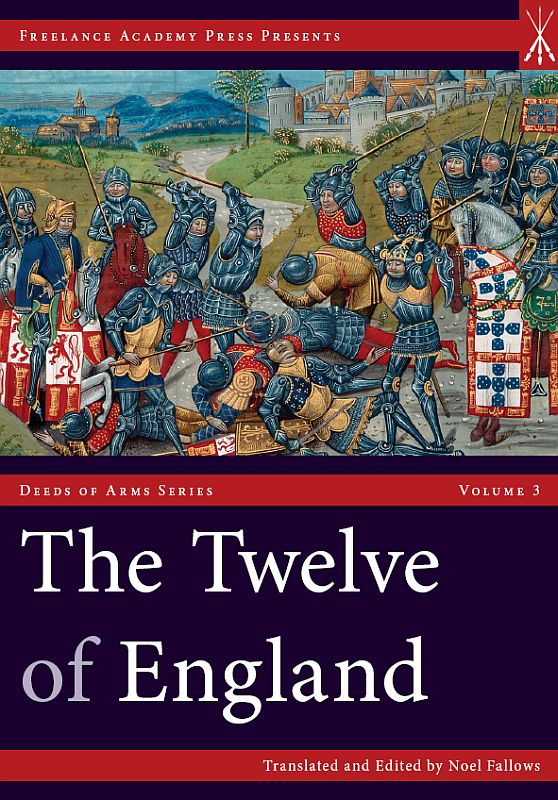
[2] The series includes: Noel Fallows, The Twelve of England, Deeds of Arms 3 (Freelance Academy Press, 2013) and Steven Muhlberger, Will a Frenchman Fight, Deeds of Arms 4 (Freelance Academy Press, 2015). For the positive reception of The Twelve of England, see the review by Dr. Samuel Claussen on the De Re Militari website- http://deremilitari.org/2016/04/noel-fallows-the-twelve-of-england-claussen/.

Rabu, 11 September 2013

Twelve of England


The Deeds of Arms series, which I edit for Freelance Academy Press, has just issued its third volume, the Twelve of England. This is perhaps the most famous chivalric story in the Portuguese tradition, and the volume was prepared by the leading scholar of Iberian chivalry, Noel Fallows. I am very happy that I had the chance to work with him. Those who want to know more can look here: