Senin, 14 Maret 2016

The music of the 80s is now classic for a certain age group

Stary Olsa from Belarus play Another Brick in the Wallby Pink Floyd, using medieval instruments.

Note that great armor!

Then there is the Harp Twins doing Metallica's One: Thanks to Nicholas at http://quotulatiousness.ca/ for putting me on this track.

Rabu, 09 Maret 2016

CBC's "The Current" visits Newfoundland and Labrador

The morning public affairs show on CBC Radio One is uniformly excellent.

Today "The Current" talked about the changes in the lifestyle of people in Newfoundland and Labrador resulting from the collapse of oil, gas, and mining revenues. Not exactly unprecedented, that collapse, and the resulting economic uncertaintly in NL has happened time and again over the last 500 years. Newfoundlanders move to where the jobs are, as best they can.

But they don't forget home, and many of them return for the short term or the long.

One younger Newfoundlander quoted John Crosby, a past prominent NL politician of national stature: "You can tell the Newfoundlanders in heaven. They are the ones who want to go home." I laughed and laughed -- that quip brought Crosby back to life.

I also noticed that the famous Newfoundland dialects seem to be fading out -- if the young and middle-aged interviewees are typical

Senin, 07 Maret 2016

I always liked that name

Ian Anderson, leader of the band Jethro Tull, speaks of his regrets over the band's name (in Billboard):
Anderson adds that recording and touring under his own name now also allows him to shed some guilt he's felt since February of 1968, when the group's booking agency gave Jethro Tull the name of an 18th century British agriculturist after several other monikers were rejected.

"If you'd asked me 20 years ago did I regret anything about my musical career, my answer then, as it is today, has always been the name of the band," Anderson admits. "I can't help but feel more and more as I get older that I'm guilty of identity theft and I ought to go to prison for it, really. It's almost as if I watched old Jethro Tull at the cash machine and leaned over his shoulder as he put his credit card into the machine to check out his PIN and filched his credit card form from his back pocket as he walked away and then fleeced his bank account. It doesn't make me feel very good. I never paid much attention in history class, so I didn't realize we'd been named after a dead guy until a couple of weeks later."

Senin, 29 Februari 2016

Humbaba!

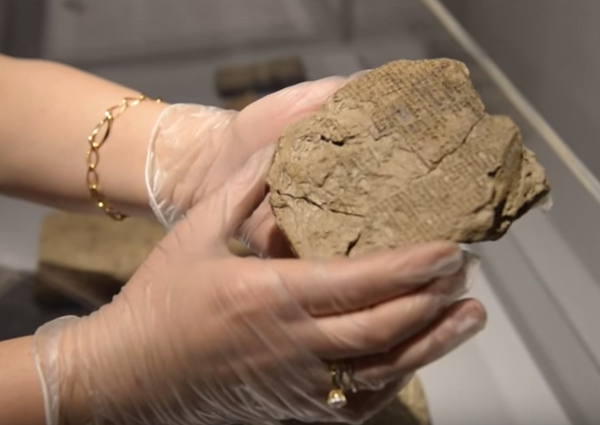
Missing pieces of the Epic of Gilgamesh found! Open Culture says:
That’s a pretty good deal for these extra lines that not only add to the poem’s length, but have now cleared up some of the mysteries in the other chapters. These lines come from Chapter Five of the epic and cast the main characters in a new light. Gilgamesh and his companion Enkidu are shown to feel guilt over killing Humbaba, the guardian of the cedar forest, who is now seen as less a monster and more a king. Just like a good director’s cut, these extra scenes clear up some muddy character motivation, and add an environmental moral to the tale.

Minggu, 28 Februari 2016

How many at the combat of 30?

As many of my readers know, there was an arranged battle or deed of arms between two garrisons in Brittany in March 1352. The garrison commanders supported different claimants for the ducal title. The civil war was part of the wider Hundred Years War between rival claimants to the kingdom of France, and like the wider war it was going no place. Out of boredom or frustration, the commanders agreed to have an even number of their men meet halfway between the castles and fight to the finish – death or captivity. But what was that even number? And what was the total number of participants?

Well, 30+30 equals 60, right?

The problem is that various accounts imply that there were 30 men on a side in addition to the commander himself. Were there 31 on a side for a total of 62?

About 100 years ago, H.R.Brush edited the most detailed account, a product of Brittany and therefore written by someone well acquainted with the battle, and he concluded that there were 30 participants on either side. In my article, my chapter in the book deeds of arms, and in my source reader on the combat, I followed Brush.

But, at about the same time that I finished my source reader (called the Combat of 30, volume 2 of my series Deeds of Arms) , Michael Jones wrote an article called "Breton soldiers from the battle of the 30 (26 March 1351) to Nicopolis (25 September 1396)," which appeared in Adrian R. Bell et al., eds., The Soldier Experience in the 14th century (Boydell Press, 2011). Jones was very interested in the careers of Bretons in the first half of the Hundred Years War, and the best examples he could find were the men at the combat of the 30. He followed them as closely as he could, and he was able to find a quite a bit about them, at least about those on the pro-French side.

And he came to the conclusion that there were 31 on a side.

I have not gone through his list systematically hecking It against Brush's (in Modern Philology).

I'd love to farm this out to Will McLean but alas he is not available.

Jumat, 26 Februari 2016

The sounds of the past

I stumbled across two interesting blog posts this past week, both concerned with recovering or reconstructing ancient languages. Back in 2010, Open Culture ran a piece on ancient Akkadian (an early Mesopotamian language, one of the first written down anywhere). A short piece of the Epic of Gilgamesh was included. Have a look! And while you are at it, read up on the completion of the Akkadian dictionary produced by the Oriental Institute in Chicago -- over the last 90 years.

Best thing about the dictionary? If you are content to have it in electronic form, it's FREE, FREE, FREE!And if you have a bundle to spend, you can have it in a very nice printed set.

Now there is scholarship for you.

About the same time, I ran across this article on ancient Greek music. Everyone who cares to know it knows that the ancient Greeks were world champions in their time in both painting and in music. But in both cases, just about none of it is left.

Just about!

Back in 2013, the BBC ran (in its business section!?) a detailed piece on how some of that music must have sounded (at least in a minimal "unplugged" form).

Revelation (for me at least): "In ancient Greek the voice went up in pitch on certain syllables and fell on others (the accents of ancient Greek indicate pitch, not stress)."

Wow! Does this mean that speaking ancient Greek was similar to singing?

If you are really interested in Viking archaeology...

or early medieval Poland, consider this:


Buko, Andrzej, ed. Bodzia. A Late Viking-Age Elite Cemetery in Central Poland. East Central and Eastern Europe in the Middle Ages, 450-1450. Leiden: Brill, 2015. Pp. xxxi, 624. $293.00. ISBN: 978-90-04-27829-5.

A lavish and detailed work aimed at a wide audience, published even before the excavation report. But the publishers have narrowed down that audience, as the  reviewer, Neil Price, points out:


However, given such an impressive catalogue of achievement, there sadly remains one truly glaring problem, which is not the fault of editor or contributors: as ever with Brill's otherwise excellent early medieval volumes, this book is priced far beyond the pockets of students, academics or even libraries [SM]. If it really does cost nearly three hundred dollars to viably produce a volume like this, then one wonders if a pdf on Open Access might honestly be a better solution, or at least breaking it up into two or three more affordable paperbacks.