Dana Kramer-Rolls says on Facebook: Dr. Ben Carson got into some trouble by saying that black slaves were immigrants, too. But I heard poetry and wondered what Maya Angelou would have made of it. I'm not her, but here is my take.They came as immigrants, Stolen by invaders, sold by their kings.They came as immigrants, Chained in the holds of ships, the living and the dead.They came as immigrants, Sold, beaten, families torn apart.They came as immigrants,The religion of their mothers mocked and forbidden.They came as immigrants,Now the chains were broken, but they were still lynched, shot.And then it began again.They come as immigrants.Fleeing invaders, fleeing the bombs.They come as immigrants, Washed up on shores, the living and the dead.They come as immigrants,Their religion mocked, families torn apart.They come as immigrants,They think they are safe, but still they are beaten and shot.Will it ever end?
Tampilkan postingan dengan label immigration. Tampilkan semua postingan
Tampilkan postingan dengan label immigration. Tampilkan semua postingan
Rabu, 08 Maret 2017
Rabu, 02 November 2016
Big Canada
From Today's Globe and Mail. I ask, was Big Canada even possible?
See this.
See this.
Whenever the idea of dramatically increasing immigration comes up, that Sir Wilfrid Laurier line is sure to be trotted out. You know the one: The 20th century will belong to Canada. The actual quote was that just as the 19th century had been the century of the United States, so Canada would “fill the 20th century.” The phrase is always invoked as an indictment against Canada’s present, and its smallness of vision. Laurier told us that one day we’d be big man on campus. And yet here we are, all these years later, somewhere between the 10th and 16th largest economy on earth.
In his 1904 speech to Ottawa’s new Canadian Club, Laurier engaged in more than a bit of hyperbole. It’s an occupational hazard of politics, in any era. But in the years before the First World War, many people really did believe that Canada was on its way to becoming one of the world’s best-governed and richest countries, and one of its most populous.
The first part of that prophecy – call it Model Canada – came to pass. Canada is a world leader when it comes to peace, order, good government and prosperity. But the second prediction – Big Canada – never happened. For some people, it remains a missed opportunity, like a ship that never sailed, but still could.
The thing is, Big Canada is a 20th-century idea. In the 21st century, it doesn’t compute. It’s an anachronism, like going online in 2016 and trying to book passage from the Old Continent to the New World in steerage class, on a steam-powered ocean liner.
But in the 19th and early 20th centuries, the age of hyper-nationalism, Big Canada made a great deal of sense. The size of one’s population mattered. It was one of the attributes that allowed countries to survive, and avoid being conquered by their neighbours. Population was military power. And a little more than 100 years ago, it was widely believed that the British Empire’s centres of population and power would soon be fast-growing Canada and Australia, not Britain.
If that had come to pass, it might have changed history. Back in 1914, the Kaiser would have been reluctant to go to war if Britain and her dominions, instead of having fewer people than the German Empire, had far more.
And in 1939, if Adolf Hitler told his generals of his plan to fight France, Britain and the 100-million strong Dominion of Canada, they would have overthrown him. The Nazis would have had no hope of victory against the overwhelmingly superior wealth and population of the British Commonwealth, led by that industrial colossus, the arsenal of democracy, Big Canada. It’s fun to dream about what might have been. But the problems a much more populous Canada might once have solved are themselves locked in the past.
The main question today for Canadians and their governments should be what can be done to make us and our fellow citizens, and generations to come, safer, freer, happier and wealthier.
The Trudeau government is on the right path in at least asking how to boost incomes in the long run. At the same time, on Monday the government put its recently acquired obsession with Big Canada on hold, at least for now, when Immigration Minister John McCallum sidelined the recommendations of the advisory council on economic growth, and announced the immigration target for next year will be 300,000, the same as this year.
The research shows an at-best tenuous connection between population growth and economic success – and the government’s own polling shows voters expressing little appetite for the large increases in immigration needed to bring about Big Canada, several decades from now.
In his 1904 speech, Laurier pointed out that the Canada of his day was already more populous than “many of the nations of Europe who have filled history with their fame and renown.” His list included Switzerland, Denmark, Norway and Sweden. A century later, these countries, along with Canada, are among the handful leading the world in quality of life. And Canada already has more people than all of them combined. Ontario’s Greater Golden Horseshoe alone has as many people as Sweden.
Can Torontonians of the future be made more prosperous and happier than the Swedes, simply by ensuring that, in a few decades, Toronto and its suburbs have three or four times as many people as Sweden? Can a Canada that currently has one-ninth the U.S. population be made better off simply by raising our population to, say, one-seventh that of our neighbour?
Other than setting this country up to jump into a time machine to refight the battles of the last century, it’s not clear what Big Canada is supposed to accomplish.
Minggu, 16 Oktober 2016
Canadian ideals, 1957
This is how the Minister of Citizenship and Immigration greeted a new Canadian citizen in 1957:
Dear Madam,
I wish to take this opportunity of congratulating you personally upon the attainment of Canadian Citizenship. By this certificate of citizenship you have been granted the rights and privileges of the citizen of Canada. These rights and privileges entitle you to freedom of speech, religion, thought and action, the right to vote as you choose, and the right to be secure in your possessions.
Your citizenship carries with it the obligation of defending your adopted country in time of need, of living in peaceful brotherhood with your fellow Canadians, and of doing your part in the preservation of Canadian ideals and institutions.
I extend to you a warm welcome on this solemn occasion and I invite you to share with us the ancient liberties of a free people living together in harmony, under a democratic government which recognizes the rights of all its citizens.
Ellen L. Fairclough,
Minister
Note: this certificate of citizenship (?) looks like a letter from the Minister and has no date. Note that the Queen is not mentioned. Nor is the recipient named.
Minggu, 09 Oktober 2016
Purge those evil foreigners
From the Guardian:
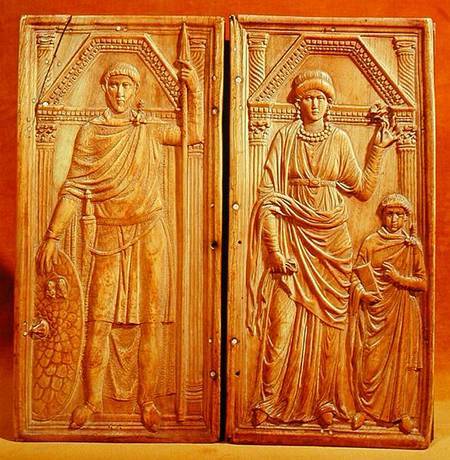
Image: Stilicho, an obvious evil foreigner.
Leading foreign academics from the LSE acting as expert advisers to the UK government were told they would not be asked to contribute to government work and analysis on Brexit because they are not British nationals.It's the end of the British Empire, at the hands of its own people. Late Roman historians, think of this.
The news was met with outrage by many academics, while legal experts questioned whether it could be legal under anti-discrimination laws and senior politicians criticised it as bewildering.
“It is utterly baffling that the government is turning down expert, independent advice on Brexit simply because someone is from another country,” said Nick Clegg, the Liberal Democrats’ EU spokesman.
“This is yet more evidence of the Conservatives’ alarming embrace of petty chauvinism over rational policymaking.”
Sara Hagemann, an assistant professor at the London School of Economics who specialises in EU policymaking processes, EU treaty matters, the role of national parliaments and the consequences of EU enlargements, said she had been told her services would not be required.
Image: Stilicho, an obvious evil foreigner.
Rabu, 17 Agustus 2016
Not quite so welcome
Canada has got a lot of praise recently for its generous attitude towards admitting Syrian refugees. And rightfully so.
But Canadians are not so keen on another group: rich, mainly Chinese immigrants who have been moving into the Vancouver area for years and driving up real estate prices to a more than merely remarkable extent. That real estate boom (and a somewhat different boom in places like Toronto) has a major effect on the national economy as a whole. And it makes it easy to blame foreigners for this unbalanced, potentially perilous situation.
Of course, the word racism comes up, in part because British Columbia has a history of excluding Asian immigrants.
But it's not a simple situation. A recent article in the Globe and Mail discussed at length the fact that different groups of Chinese immigrants don't get along with each other; older immigrants and their children and grandchildren don't feel any great solidarity with new immigrants from other regions.
Here is one Globe and Mail article. There are plenty more. Like this one about the not exactly rich, not necessarily immigrant.
Minggu, 24 April 2016
Canada’s multiculturalism: A circle, ever edging outwards, by JOHN RALSTON SAUL
Canada’s multiculturalism: A circle, ever edging outwards
JOHN RALSTON SAUL
Special to The Globe and Mail Published Friday, Apr. 22, 2016 1:15PM EDT Canada is now the only Western democracy in which there is no serious argument among the citizenry or politicians over the importance of immigration. Canadians understand that immigration is not migration. It must be seen as the first step toward citizenship. And the sooner an immigrant becomes a citizen, the better.
The main complaint after the arrival of the first 25,000 Syrian refugees seems to be that more of them should have been citizen sponsored because it is harder to settle those who are government assisted. So we now need more refugees, but in that first category.
Incidentally, I believe the term should be citizen sponsored, not privately sponsored. Private implies self-interest or commerce. This is all about citizen engagement.
Seen from outside the country, our attitude toward immigration and citizenship often seems to make Canada an outlier – problematic, a contradiction, sleepwalking to disaster, even unacceptable as a real nation-state
. Over the last month in several European countries, I found that many people, of all backgrounds, educations and beliefs, were quicker than ever to say Of course, you can believe in these things. You have a big country. You’re a new country.
Neither is true. We aren’t big. For the last hundred years most immigrants have gone to a handful of big cities. And we aren’t new. As a settler society we are the product of 400 years, most of it spent going through the same economic, political and social dramas as other Western countries. We are the oldest continuous democratic federation in the world – beating Switzerland by a few months. We are the second- or third-oldest continuous democracy of any sort in the world – 168 years without breaking up, without a civil war, a coup, an absolute monarch, a dictator.
Our cities are built where Indigenous peoples prospered for thousands of years. As I pointed out in A Fair Country, back in 2008, First Nations and Métis peoples far outnumbered settlers into the second half of the 19th century. So Canada at its best is very much the product of the long relationship with Indigenous peoples, their approaches and philosophies; and above all, their concepts of inclusion and belonging, which today we would call immigration and citizenship. If the central characteristic of Canada is its complexity, this also is an outcome of our long relationship with Indigenous peoples. In particular we owe a great deal to the example of the Métis Nation, the very model of living complexity.
None of this lessens the reality that, for more than a century as immigrant power grew, the Indigenous-settler relationship was betrayed and great evil was done. But that in turn cannot erase the Indigenous influence on our society. That Indigenous reality is now reasserting itself. The Supreme Court of Canada’s decision April 14 that re-establishes Métis and non-status Indian rights is yet another example of this.
Today, repairing the relationship with Indigenous peoples is the single most important test for Canadians. We now seem ready to play our part as their allies, but must remind ourselves every day that central to reconciliation is concrete restitution. Many of us keep coming back to the words of Chief John Kelly – “as the years go by, the circle of the Ojibway gets bigger and bigger. Canadians of all colours and religions are entering that circle. You might feel that you have roots somewhere else, but in reality, you are right here with us.”
When I find myself explaining to Europeans why our system of inclusion and diversity more or less works, I inevitably go back to those non-racial Indigenous ideas which leave space for multiple identities and multiple loyalties, for an idea of belonging which is comfortable with contradictions, which shifts humans from their autocratic role as masters of the universe to one more integrated into the place itself. This is an approach to values which is the opposite of the European-U.S. understanding of the monolithic citizen melted into a pot of national uniqueness.
All of which matters today because Canada is out on the cutting edge, doing things other countries are not. We know that the leaders of the three most powerful European countries have declared multiculturalism a failure. Which I suppose is supposed to mean that Canada is or will be a failure. But we should also know that what they mean by multiculturalism has more or less involved the abandonment of what they inaccurately call migrants into ghettos; that they imagine it involves the breaking up of society into unrelated pods, producing in the worst cases police no-go zones and failed schooling. The author of a recent biography of Tony Blair presents the former British prime minster as preferring “multiculturalism” over the “integration of immigrant communities.” We know this is not at all what multiculturalism is supposed to mean. And our opinion should be worth something since we are seen as the inventors and the experimental centre of the concept.
Our great weakness as Canadians is that we have been lazy when it comes to explaining what our experiment consists in. Our excuse could be that it is, after all, an experiment. That is not good enough. The atmosphere out there in most Western countries is one of tired elites, many of them caught up in bourgeoning campaigns of fear. Canadians know all too well how contagious these are. Our last prime minister started down that road, which is one of the reasons he is out of a job. And we know well the confused, divisive atmosphere in the United States – the discourse of walls and security. The current British Prime Minister believes he must get the immigration levels down. The French Prime Minister has just called for the banning of headscarves on students in universities. Even German Chancellor Angela Merkel, having made a great ethical gesture in 2015 to welcome one million Syrian refugees, now finds that, because Germany does not have an overarching immigration-citizenship policy and structure, it is a nightmare to organize their settlement. The result has been a political backlash. And yet we must admire the risk that Germans have taken and their determination to make it work.
What’s more, we must not confuse the massive political and ethical failure of most European governments with the attitudes of large parts of the citizenry. Europe is filled with citizens throwing themselves into the crisis as volunteers. Just as the Macedonians were closing their borders, I was in the transit camp on the Athenian docks in Piraeus. At that point, they were managing a few thousand refugees. The sheds were all well organized and run by amazing volunteers – not NGOs or government. In fact, the Greeks, almost broken by their own crisis, have responded with generosity and care to the refugees’ plight, just as many citizens of Calais have stepped in to support refugees in the awful camp outside their city. In southern Italy, in Germany, there are thousands of such stories. And there are thousands of study groups, professors, NGOs, activists doing whatever they can.
But the problem is so profound that the continent is failing and governments are justifying this failure by blaming others. You could call it a massive mismanagement of the end of empires; less the uncontrollable outcome of geographic proximity and more the result of 50 years of hypocrisy when it comes to Mediterranean relationships. The Brexit movement in Britain can only be seen as a deeply romantic desire to return to another era, which itself never existed. I hear serious individuals talking about a need to recreate an alliance of the English-speaking peoples, as if we have all been sitting around for 40 years, waiting for Britain to come back to us. The most likely outcome of Britain voting to withdraw from the EU would be Scotland separating in order to stay in Europe. This is one of those do-I-laugh-or-do-I-cry moments.
There is a whispered conviction among many around the continent that the real problem is Islam; that it is not absorbable into Judeo-Christian civilization. This is the language which Christians used to use against Jews and Protestants against Catholics and vice versa. This was once the excuse in Canada for excluding Sikhs, Chinese, Japanese. And it was the excuse for trying to destroy Indigenous peoples.
Reactive panic – and crisis
The heart of the crisis lies elsewhere. Every year for seven decades Europe has been taking in large numbers of immigrants from many places. They were called many things – migrants, refugees, guest workers. The delusional assumption was that they would serve their economic purpose or be protected for a while, then go home. They didn’t. And European leaders, off the record, knew they wouldn’t.
And so, 70 years of lying to themselves has resulted in an immigration civilization profoundly unprepared for immigration. No attempt has been made by the EU or by individual European countries to develop an overarching, proactive immigration policy, with the necessary infrastructure both at home and in their embassies. In many cases they are doing better than they think, but their idea of themselves hides this success. The result now is a reactive panic; a crisis of drownings, disgraceful camps, human disorder and suffering. And there is still no hint of any desire to create a dignified, balanced immigration policy with citizenship as an essential celebratory part of the whole. It is precisely now, in the midst of the crisis, that they should be developing a positive, holistic approach. If anything, the latest EU-Turkish agreement crosses basic ethical lines and so in the long run will make matters worse.
The countdown to citizenship
Let me go back for a moment to the failure of Canadians to explain ourselves to ourselves, let alone to others. There are real risks involved in this ham-handed mutism and naive triumphalism. What’s more, it is unnecessary. The patterns of our immigration and citizenship history, at their best and their worst, are clear.
The idea of a broad government-supported immigration/citizenship policy goes back to the Indigenous welcome. That’s how the settlers survived. It was equally central to both the New France settlement strategy and system created for the Loyalist refugees fleeing in the 1780s from the American war against Britain. In February, 1848, the first law passed by the new responsible-government parliament of Canada laid out the beginnings of a modern immigration/citizenship policy. With Confederation in 1867, the government immediately created a department for immigration and citizenship, and sent agents out around the world. Rules guiding the newcomers from immigrant status to citizenship were put in place and, ever since, that process has ranged between three and five years.
By the late 19th century, citizenship ceremonies were growing in popularity. Citizenship was a choice to be celebrated publicly. Since 1900, the annual immigration numbers have ranged between 200,000 and 400,000. In 1995 we set the yearly target at 1 per cent of the population. It usually ends up at around 0.7 per cent – between 250,000 and 300,000. As a point of reference: The one million refugees taken in by Germany last year, had they been shared around the EU, would have represented 0.2 per cent of the population. In many of our embassies, over half the staff looks after immigration. We were able to handle the 25,000 Syrian refugees in a few weeks because we have a large group of public servants expert in immigration, settlement and citizenship. The first thing those refugees received on disembarking in Canada was their permanent-residency status, starting them on the countdown to citizenship.
We all know that these 400 years of policy development were tarnished and regularly knocked off track by multiple insurgencies of racism and exclusion. But each of these was gradually eliminated and the main line re-established.
The philosophical trick in all of this is that immigration and citizenship have always been treated as inseparable steps. Engagement and marriage. This means that each immigrant arrives knowing that she must think of herself as a citizen, because she soon will be a citizen. This is a philosophy which changes radically everyone’s attitude toward inclusion and integration. It means that language training is simply part of the package from the beginning, as is the expectation that new Canadians will get involved in volunteerism and politics – the two keys to an engaged citizenry.
A perpetual experiment
What of the multicultural misunderstanding?
Canadians seem to be moving toward other words – diversity, pluralism, inclusion, interculturalism – as we have sensed a growing confusion elsewhere. But the idea is really not so difficult.
I think of it as rooted in balance – a central Indigenous concept of how societies function. At its best a balance between the place, the group and the individual. You could also describe it as a balanced or positive tension between organized integration and celebrated diversity; a conviction that diversity and fairness are reflections of each other; that this requires a rigorous use of political restraint; an allergy to universal mythologies and ideologies. All of which means that we must be self-confident enough and tough enough to live with the reality of complexity.
This is the opposite of the tired European-U.S. insistence on monolithic identities. The Canadian concept of living in a perpetually incomplete experiment may seem radical to many in the Western world. And yet you could simply see it as a profoundly non-racial approach to civilization – one based on the idea of an inclusive circle that expands and gradually adapts as new people join us.
Langganan:
Postingan (Atom)
Weekly
-
This announcement speaks for itself: Dear Colleagues, After two decades teaching medieval art history and doing photography for my own use,...
-
From the Guardian: Leading foreign academics from the LSE acting as expert advisers to the UK government were told they would not be asked ...
-
A new translation of this fascinating treatise on horsemanship by a fifteenth-century king. This interview with Jeffrey Forgeng comes from...
-
 ...if you are very, very rich. (Most mss. of this age and quality are in national or university libraries and are not for sale at any price...
-
For those who found the conclusion of this post rather cryptic, here is what Bernard of Clairvaux said in his treatise In Praise of the New...
-
I have always loved maps and history. Growing up in the USA in the early 60s, the Southeast Asian war gave me the opportunity to learn geog...
-
Two experts in the Middle East have been more useful to me than most of the more prominent ones. They are Juan Cole and Joshua Landis. If yo...
-
I just discovered this book, which came out a couple of years ago, thanks to Brad DeLong, who provided a link to a pre-print to chapter 9, ...
-
An excerpt from a recent book,Thanassis Cambanis’s Once Upon a Revolution: An Egyptian Story : A few days after the end of Ramadan, on Aug...
-
During my years with the Good Duke I have run across a number of surprising and amusing personal names: Bliomberis Loup and his brother, fo...