I talked last year about my selection being haphazard; haphazard the selection is again. I note that the blog tended to suffer because I have been so busy otherwise.
Tampilkan postingan dengan label favorites 2013. Tampilkan semua postingan
Tampilkan postingan dengan label favorites 2013. Tampilkan semua postingan
Senin, 06 Januari 2014
Minggu, 08 Desember 2013
Knightly humility
One of the most notable characteristics of the medieval knight was his pride, pride that made him unwilling to back down from a challenge; pride that could lead to serious trouble through overreaching.
Sometimes, however, pride was disavowed and humility was paraded before a given knight's audience. An interesting example of how lords and high ranking warriors, men full of justifiable pride in their accomplishments and family connection – we should think – end up talking poor can be found in the Chronicle of the Good Duke.
The incident took place at the tail end of the siege of Mahdia in North Africa, a place that the French attackers simply called "Africa." There'd been a lot of fighting around this desirable city, with the French and Genoese scoring some victories but not even coming close to taking the city. In other words the confrontation was going nowhere and it was time to go.
The good Duke Louis of Bourbon decided to take counsel from his chief men and his Genoese allies.
"Sire, the city is marvelously strong as you see it is very well supplied with men; there are these Kings with very great troops who in our opinion will not move to the field and for nothing that you can do will they give battle. And they put us in delay to make us eat up all our food. Also in our ships is neither siege engines nor rock throwers nor any engine to take to the wall; our siege tower is burnt and the falcon beaks are exhausted so we don't know what to say about this."
The Duke said "there is only one thing more to do" and so the Genoese spoke about the matter to the other patrons of Genoa and the captains of the galleys came to seek a treaty with the Africans ... The Duke of Bourbon put all the chivalry French and English together to know whether this treaty was honorable or not. And standing in the Council there were the Duke of Bourbon who wished that the souldich d'Estrau -- who was one of the oldest of the Army and one of the most valiant knights one could find --should speak first and be asked his advice about it; the souldich said that there was no reason that he should speak about it first and he had not seen anything in this time that however you it was going to speak loyally that which he knew of it, and that when he had seen like this in his time according to which he did not wish to praise himself facing that this was the most remarkable thing he had found himself during his life, to have awaited in the field against the power of three Kings for two and half months assailed the town, before them without having sent remedy and since have gone to attack their tents, throwing them out by force, this is a much greater thing than the greatest battle that one could ever see. And about the treaty the souldich said further "that which those of Africa offer, it is also as honorable as if the town had been taken for you put them in truce and in servitude which they were not able to refuse even in the presence of all their power."The souldich said further,"I who am nothing but a poor Chevalier, I hold this thing as honorable as though I had been in three battles"
After the souldich, Jeannicot d'Ortenie an Englishman one of the valiant Knights known anywhere said he held to the opinion of the souldich d'Estrau that certainly he did not know about it except to repeat it. Afterwards the Lord of Clifford chief of the English came, who said when asked that he held to the statement of the the souldich and that was the opinion of the English. So it happened after that the Duke of Bourbon asked the advice of count of Eu who told him "Sire it appears to me that the things that have been done are so great and good up to now and the treaty so honorable you ought not to refuse it."
After the Lord of Couci spoke who said plainly to the Duke, "Monseigneur, the voyage is so grand and so honorable for you and for all those have been on it and one cannot say better about such power as of the three Kings and the great things which you have done. For they did not dare defy you, they have lost every day and you have had the advantage moreover have taken their lodgings from them, this amounts in honor to a good battle, and it is a bad defeat for them. After you have the treaty, so grand, by which they are so strongly enslaved whereby you are able to leave honorably as though you had taken the town. And with such power as you see before us and also, Monseigneur, your people have a lack of supplies, and there are at it many diseases from which you may lose many, because or you have been there too long; and it will be a remaining without reason for you have the best treaty that now is possible to have for you and your company." Afterwards the judgment of the Count of Eu was asked who said that after the Lord of Couci he had nothing to alter. Also the sire of Granville, who held their opinion and the sire of St. George, the sire of Castillon and all other chevaliers which there were many.
It seems to me that this is a very ambiguous situation. Has the expedition been a failure or success? The Duke of Bourbon asked around the leading lights of his Army hoping for their seal of approval on his behavior -- everyboy knows he has to leave -- which he gets. But note that they seem to be somewhat reluctant to put all their prestige behind the Duke's plans and accomplishments. So you have extremely experienced and high ranking warriors saying, "I think we accomplished a lot… But what do I know, humble Chevalier that I am?
Senin, 02 Desember 2013
Troubador poetry and chivalry
When I teach chivalry in the classroom, I do talk about its relationship to love (really! I swear!) but this remarkable website has convinced me that I have missed a bet by not just jumping in and rolling around.
This poem, for instance, evokes a whole social environment and the stinging criticism of one knight disappointed with the way life treats his kind (though it serves some of them right.)
Some of the poet's targets knew exactly who he was talking about -- them -- and knew that everyone else did, too.
At the first onset of winter, by Marcabru
This poem, for instance, evokes a whole social environment and the stinging criticism of one knight disappointed with the way life treats his kind (though it serves some of them right.)
Some of the poet's targets knew exactly who he was talking about -- them -- and knew that everyone else did, too.
At the first onset of winter, by Marcabru
At the first onset of winter,
when the acorns fall like rain the wood,
I want people to strive
towards Prowess, without hesitation,
and that they are as eager to achieve it
as if we were in the grassy season.
Well then, every lesser man complains
when he sees the cold weather and the puddles,
which make him grumble
because he has to get ready and start bargaining,
while, in the Summer, he doesn't need to be dressed
and can go around naked except for a rag.
These types resemble the badger
in the evening, when they are full and sated,
after the wine,
and, in the morning, they have lost all memory,
these ashen cowards, who swear
one has never seen such an ugly time.
Young men of handsome appearance
I see, deceived by wickedness,
because they go boasting,
they say, planning a thousand projects,
"We'll do [this], in the flowery season",
but, then, the bragging and noise stop.
They have the habits of a hound dog,
who says that, when the light comes,
he'll build a house
then, when it is there, if one urges him to deliver,
he isn't listened to, nor heard:
as far as it concerns him, wood was never worked.
Husbands, you would be the best people
in the world, but each of you turns into a lover,
which confounds you,
and the cnts have put themselves on the market,
so Youth is banned far away,
and one dubs you cuckolds for it.
The price of the profit and loss,
wherever it may have come from,
it's married men who bear it!
And I have granted it to them
for Joy is celebrated among them,
and largesse somewhat maintained.
Right or wrong, they have the upper hand,
and Youth concedes defeat!
Most young people, and the best among them,
hardly find [women] who receive them,
one of them had his hat blown away by shouted abuse
for a morsel that was thrown to him.
Kamis, 31 Oktober 2013
Living in the material world
Imagine George Harrison and Madonna singing their different versions on the same stage!
Long ago a good friend of mine, Sandra Dodd, drew my attention to a book with the title “Material World”. It was a select survey, pictorially oriented, of living conditions in about two dozen countries around the world. One notable feature was that each family brought all their property out of the house arranged it neatly, and then sat behind their pile of things to have their picture taken. The poorest country in the survey was Mali, and they had next to nothing except various pottery containers. The Americans had a great deal of stuff. The contrast was shocking, as it was meant to be.
When we moved out of Ravenhill, we became that American family. The stuff! Ye gods, the stuff!
There are a lot of excuses that can be offered. As several people have pointed out, if you live in the same location for 22 years of course you’re going to have a lot of stuff. We have a hobby, the Society for Creative Anachronism, that requires a serious player to have clothing, tents, and other props. For a while we ran a bit of a farm, with horses, sheep and poultry. But still…
Even though we are not big shoppers, not really hoarders either, not particularly rich, our move to smaller quarters, a house already full of its own furniture and appliances, put us in the position of throwing away huge and astonishing array of… Things.
We left most of our furniture and all of our major appliances for the buyers, for whom this is the first house. And still…
We were put in the onerous and to me rather depressing situation of throwing out the evidence of the past half-century or so of our lives. It was that, or apply to the federal government for a huge grant for the Muhlberger National Museum (and be rejected of course).
I have to admit that much of the stuff came down to me. Not even counting stuff in my office at the University, I had tremendous amount of paper associated with academic projects that I have either finished or abandoned. I had an amazing amount of paperwork associated with the SCA in Ontario in the 1970s and 80s (mostly). I had to very determinedly ask myself if I would ever look at this particular pile of paper again. If not, out it went.
It was more difficult in some ways to deal with the books. Again, the question asked was will any of us ever read this book again? The alternatives here were not keep or throw, but keep or find some alternative to throwing. I took boxes and boxes to the University and got rid of a great many serious and frivolous volumes there. Otherwise, they went to a thrift shop/recycling depot called Rebuilt Resources. How many of them they threw out I don’t want to know. It was hard enough to get rid of those old friends, those pocket universes, those enjoyable but not classic science fiction novels that are basically unavailable, relics of an almost lost popular culture. (The book covers, especially from the early 60s, preserve a style of abstract illustration found nowhere else!)
And when I was done with all of this, and the sale of Ravenhill was concluded, I went to my office at Nipissing University and got rid of about half the stuff that was stored there.
This whole process took a psychic toll on me. Lots of questions were raised, like what on earth was I thinking. Well, I was probably thinking that I would live forever and didn’t want to lose track of anything that happened to me, especially if it was pleasant. And after all I am a historian. The great purge forced me to wrestle with these attitudes. It shows the state that I was in during much of it that I took comfort in the idea that if we were in a car crash and killed, it would all have to go anyway. Comfort, eh?
You young whippersnappers, take a lesson from this. You might just maybe want to start cutting down your possessions now instead of having to do it at some very inconvenient time in the future.
Or at least slow down your pace of acquisition.
Minggu, 27 Oktober 2013
Worlds of Arthur, by Guy Halsall
I know Guy Halsall and correspond with him fairly frequently. I think he's a very good historian. So when he wrote a book with a riproaring commercial title like "Worlds of Arthur" it was only a matter of time before I got around to having a look.
Frankly, I don't know how commercial this book is, or how much impact it will have on even the more serious readers among the general public, namely the people who actually shell out their own money to read books on serious subjects like post-Roman Britain and King Arthur. Certainly Halsall tries very hard to reach those people, and does a much better job than most academics do on similar projects. But the book is a thorough debunking of certain ideas about Arthur and his place in history, and is already provoking a mixed reaction.
Halsall believes that trying to find the real Arthur behind the legends is entirely futile, and he classifies most efforts to do so as pseudo-history. It is possible that somebody named Arthur led British forces against Saxon invaders, but the simple truth is that we know nothing about any such person and can't reconstruct his life and career. The few written sources we have for this two-century period (410-597) does not allow us to do it and unless some miraculous discovery turns up new information (and none has appeared for many centuries) we will never find Arthur. A lot of professional historians agree with this, but I doubt that anyone has made such an uncompromising presentation of this fact – the unknowability of Arthur – as Halsall does here.
Halsall is equally interested in revising a framework that scholars of the past have imposed on our understanding of post-Roman Britain. To simplify, Halsall does not think that British history of the fifth and sixth centuries is best understood as a fight between "the Britons" and "the Saxons," a long contest which resulted in the expulsion of Britons from most of what is now England. In line with developments in other parts of Western Europe, English ethnic identity came to dominate because older identities, specifically the Roman identity, were no longer relevant to a Britain where the Roman economy and society had collapsed.
Halsall both discusses changes in our interpretation of British archaeology over the last 40 years, and offers his own reinterpretation, which he frankly labels as speculative. It's an interesting interpretation and one I find fairly persuasive, though in this period we will never have certainty.
One of the best things about this book is that Halsall discusses how people use and misuse evidence for difficult historical problems in great detail. This may put people off, but it is one of the most transparent discussions of what historians do in interpreting the often difficult to understand early Middle Ages that I've ever seen. It is not likely to be everybody's cup of tea. But have a look at this discussion of DNA evidence and how it can deceive, especially people who want to be deceived.
Even with these data, an even more serious problem concerns the move from DNA to conclusions about ethnic or political identity. Ethnic identity is multi-layered. It is deployed (or not) in particular situation as the occasion demands, and can be changed. DNA cannot give you a sense of all the layers of that person's ethnicity, or of which she thought the most important, or even if she generally used a completely different one, or when and where such identities are stressed or concealed. A male Saxon immigrant into the Empire in, say, the fourth century, would – one assumes – have DNA revealing the area where he grew up, but he would probably increasingly see himself, and act, as a Roman. Saxon origins would have little part in his social, cultural, or political life, and even less for his children, if they stay in the Empire. If he returned home with the cachet of his Imperial service, it might have been his Roman identity that gave him local status. He might even have called himself a Roman. However, if a distant male relative moved to Britain 150 years later, his DNA might be very similar but, in complete distinction, he might make a very big deal of the Saxon origins. They would, or could, propel him to the upper echelons of society. DNA tells us nothing about any of this. What is pernicious about this use of genetic data is its essentialism. It views a person's identity as one-dimensional, unchanging, and as entirely derived from that person's biological and geographical origins. In short, it reduces identity to something similar to 19th century nationalist ideas of race. Everyone sane knows that people moved from northern Germany to Britain in the fifth and sixth centuries. In that sense, these expensive analyses tell us nothing we do not already know. In their implicit reduction of identity to a form of race, masking all the other contingent and interesting aspects of cultural interaction and identity-change they risk setting back the understanding of this period by more than a century. Moreover, they provide pseudo-historical and pseudo-scientific ammunition for present-day nationalists xenophobes and racists.If you teach history, wouldn't you want your students to be exposed to such a clear discussion of a historiographical problem? One with real relevance to the present?
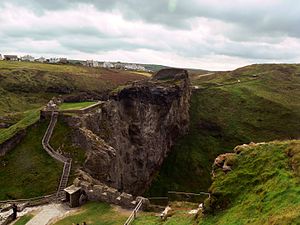
Image: Tintagel. People in the 12th century thought this was an Arthurian site.
Rabu, 23 Oktober 2013
Some of the best stuff on the internet
But it's fairly clear that hate that made the Shoah was neither an invention nor the magic of false-consciousness, but a reflection of the people themselves:
In the same poll of November 1946, one German in three agreed with the proposition that ‘Jews should not have the same rights as those belonging to the Aryan race’. This is not especially surprising, given that respondents had just emerged from twelve years under an authoritarian government committed to this view. What does surprise is a poll taken six years later in which a slightly higher. percentage of West Germans—37 percent—affirmed that it was better for Germany to have no Jews on its territory. But then in that same year (1952) 25 percent of West Germans admitted to having a ‘good opinion’ of Hitler.
Attendant to all of this was something that any student of white supremacy in America will recognize--a strong propensity toward national amnesia:
In Italy the daily newspaper of the new Christian Democrat Party put out a similar call to oblivion on the day of Hitler’s death: ‘We have the strength to forget!’, it proclaimed. ‘Forget as soon as possible!’ In the East the Communists’ strongest suit was their promise to make a revolutionary new beginning in countries where everyone had something to forget...
It's worth taking a moment to think about this "strength to forget" notion. National forgetting is always a selective endeavor. Italy had no more intention of dismissing its Roman heritage as "the past," then Americans have of dismissing George Washington as "the past." "The past" is whatever contributes to a societies moral debts. "Heritage" is everything else.
Judt is making a very disturbing argument--that postwar Europe was built on a willingness to only push deNazification but so far. There is here something not wholly dissimilar to our own reunion accomplished on an agreement to "forget" what the War was over. So far does the myth advance that Judt finds president Eisenhower lauding the Wermacht--"The German soldier fought bravely and honorably for his homeland."
We are confronted with a series of awful questions: What are the actual limits of human justice? How much of human justice, ultimately, rests on the accumulation of guns? What is one to do when the people, themselves--not sinister hidden forces are the engines of persecution? Of useful killing? Of genocide? ...
Man. Such hate. What can we do against such reckless hate. Don't study history to boost your self-esteem. Study history to lose your religion. Or maybe in the end, to gain it. I am not religious at all. But seeing the limits of all of us, you start to understand why people might appeal to some higher, more certain, more fierce, invention.
Langganan:
Postingan (Atom)