It was harder to pick them this year. In particular my selection of Arab Spring posts seems rather random even to me. But with such a huge series of events in train it might take omniscience to make the "right" choice.
Tampilkan postingan dengan label favorites 2011. Tampilkan semua postingan
Tampilkan postingan dengan label favorites 2011. Tampilkan semua postingan
Minggu, 01 Januari 2012
Rabu, 21 Desember 2011
Ron Paul, dishonest segregationist creep
When you are trying to get into a meditative state and all you can think of is how contemptible Ron Paul is, it is time to LET IT OUT!
Ron Paul seems to be this generation's Eugene McCarthy, a politician brave enough to oppose American imperialism and denounce its destructive effects, who has attracted a deal of support from young people, and who otherwise has a rather eccentric record. The American political system has niches for politicians with unusual views, and sometimes they rise out of obscurity and have a real effect.
Ron Paul is giving libertarianism (so called) a much higher profile than it has ever had. I say so-called libertarianism because Paul's brand seems to be focused entirely on assuring, through decentralization of political power, that those who have won wealth and privilege by fair means or foul, get to keep their goodies. Is that libertarianism? If so you can keep it.
Actually, there are more objectionable parts of Ron Paul's program. For instance, "liberty" doesn't reach as far as women controlling their own bodies. It seems to me that there is a religious agenda lurking behind the libertarian facade. Liberty doesn't include the First Amendment ("no establishment of religion")?
But the one that gets me where I live is Paul's opposition to the civil rights legislation of the 1960s. It mightily offends me to hear the dishonest segregationist arguments of my youth recycled in the 2010s.
Dishonest? Paul and his son and his other supporters present their opposition to racial equality in the public sphere as a simple matter of preserving freedom of association. In fact segregation in the south was a prime example of the historic winners using state power, economic domination and terror to secure the continuation of privilege won by force of arms. And calling the result liberty. Or "states' rights."
Segregation was not a matter of individual choice, it was a policy designed and enforced by the enfranchised at the expense of the disenfranchised. To talk about segregation without acknowledging that is deeply dishonest. When (apparently) young people talk about this issue in abstract terms, I think they may have been suckered. But I don't give Ron Paul the benefit of that doubt.
Jumat, 02 Desember 2011
Hard times in Attawapiskat and the government blame game

In some peculiar way, I think of Attawapiskat, a First Nations reserve, as a neighboring community, even though it is a fly in community way up on James Bay, and I can drive to Toronto or Ottawa easily on reasonably good roads. Why? Because we share the same regional CBC radio service, and for 20 years I have been hearing weather forecasts for Attawapiskat.
Currently, a lot of people are hearing about Attawapiskat and it is all bad news. People are living in shacks and tents – this is up at James Bay mind you– and the sewage situation is in a state of collapse. The band government has had to work very hard to attract the attention of senior levels of government and the general public, and now that they have, they are being blamed for bad management and wasting the money that the government gives them.
When I said the government "gives" them money, you have to remember that what the First Nations "give" in return is – Canada. People are always saying that we non-natives "give" money to natives, but you seldom hear people talking about the money senior levels of government "give" to Toronto or the Township of Bonfield, even though those "gifts" are a very significant part of the budget of both municipalities.
Our Prime Minister wants us to believe that this is all to be blamed on native mismanagement. If you want a better understanding of the roots of the problem I recommend this blog entry. Or you could just look at the band documents. Apparently the Prime Minister has not bothered yet.
Minggu, 20 November 2011
Smarter protest, please
Phil Paine, continuing this earlier post:
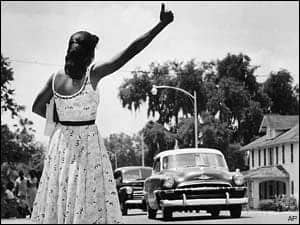
 Image: Boycotting the segregated bus system, 1955
Shakespeare didn’t have Romeo and Juliet commit suicide in the first act, and then let the remaining characters pitch tents on the stage and chat aimlessly for the remaining four acts. That was because Shakespeare was a dramatist. His aim was to move people to emotion, to make them think, to shock, horrify, or delight them. Let us, for the sake of argument, assume that he was pretty good at it. Today’s protesters could learn a thing or two from him.Read the whole thing.
As I mentioned in Part 1, the Occupy protest movement began by taking advantage of new methods (the social media), and then quickly reverted to an old formula. The advantage that social media offered was the ability to bring people together quickly to do some strategic and dramatic thing —- to surprise. The “flash mob” is the appropriate template for a protest using social media. The flash mob originated as an amusement —- one in Toronto called people to a pillow fight in front of the Eaton Centre. There have been some political protests using this technique, and these have been dubbed “smart mobs,” but their use has been very limited, so far. The key to the flash mob’s effectiveness is its ability to end as dramatically as it begins. This leaves those in authority disconcerted, and makes them look incompetent. It has the same advantage in protest that guerilla tactics can have in military conflicts.
The Occupy movement has squandered the opportunity to move into the modern age of protest. Social media were used to bring people together, but once there, power reverted to the traditionalists, and the only thing they could think of doing was squatting down and staying put. The smart mob turned into a “sit in,” a protest relic from a generation ago that is notorious for its ineffectiveness and tendency to alienate the very people that the protest is supposed to convince.
...
If you speak to these old-schoolers, it won’t be long before you hear them prattle nonsense about how they are continuing the traditions of the Civil Rights Movement in the 1950’s and 1960’s. They are deluding themselves. The Civil Rights activists were not amusing themselves. They did not go out on picnics. They were dealing with the Ku Klux Klan, and with corrupt and violent state governments in the American south. They were in constant danger. Civil Rights activists faced the serious possibility of being tortured or killed. Everything done was aimed at projecting an atmosphere of seriousness of purpose, and of clearly delineating the moral issues involved. Anyone who wants to see real protest in action could do no better than to study the events of the Montgomery Bus Boycott of 1956. Protests like this led to a gigantic transformation of American society, one of the most dramatic in world history. Take note of the fact that Martin Luther King, Jr. and Ralph Abernathy did not organize catfish fry-ups, sponsor watermelon eating festivals, or instruct their followers to dance the madison. They did not paint themselves blue. They rationally, intelligently, and bravely, calculated which actions would produce the desired results, and undertook them, making huge personal sacrifices to do so. The American public came to realise that it was the State Governments and the Klan who were the savages, the forces of chaos.
I have become progressively more annoyed with the Occupy movement because of its utter failure to heed these simple and obvious facts. We desperately need to get the American and Canadian public to understand the trouble we are in, and the dangers we face over the coming years. Intelligent protest is one of the things that has to be done. I’ve outlined some of the reasons why the protest we are seeing is not intelligent or effective. Next, in Part 3, I will discuss the types, dynamics, and structure of protest.
Minggu, 06 November 2011

Selasa, 18 Oktober 2011
The taking of Jerusalem, 1099
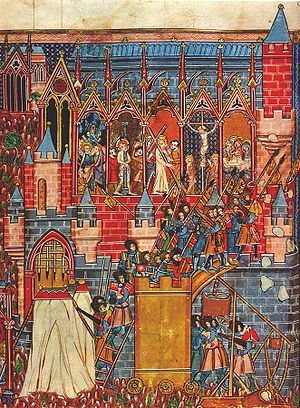
People often wonder how medieval Christians could have taken part in holy war, given Jesus's well-known pacifistic pronouncements. Here are excerpts from a lecture I gave yesterday on the taking of Jerusalem, which ended in a massacre, which touches on the issue:
Here’s what Tyerman (page 31) says about a famous Christian account of the massacre:Raymond of Aguilers… who witnessed the fall of Jerusalem in 1099, described the ensuing massacre on the Temple Mount: "it is sufficient to relate that in the Temple of Solomon and the portico crusaders rode in blood to the knees and bridles of their horses." What ever the atrocities performed that day, Raymond was quoting Revelations 14:20 "and the winepress was trodden without the city and the blood came out of the winepress even to the horse bridles."
Two further points:Comments? [No comments from students.]Here are my comments. Massacres of garrisons and the civil population of fortifications and cities that had resisted for a long time were pretty common in medieval times. According to the laws of war (or the customs of war) those who resisted, even if they were not armed and had no authority or say in the waging of war, brought the consequences of such resistance upon themselves. It was kind of a no-win situation because people who surrendered too quickly to a threat of siege might invite the revenge of their rulers if the rulers won the war eventually. But to focus on the other situation: we've already seen in this course that a siege was a hard task and a dangerous one even for the people outside. I sometimes joke that it is no real joke that sieges came down to who caught dysentery first, the people outside in their squalid camps, or the people inside crowded together in bad conditions. Besiegers died in significant numbers in a hard siege, and the numbers went up significantly if there were a number of unsuccessful assaults. Besiegers became targets for missiles thrown at them from above, and insults meant to break the morale and boost morale on the other side. When besiegers swarmed into a city through a gap in the walls or by the treachery of the tower commander, that they were not in a good mood all. All the anger fear and hardship came together in a murderous rage and perhaps a sudden feeling of invulnerability. Like hunters, they fell upon their prey, animate and inanimate.Further remark is necessary in the case of Jerusalem, however. Modern observers from the historically Christian environment often expressed wonder that the religion of peace and my kingdom is not of this world could have inspired warfare. Forgetting entirely about Muslim and Jewish accounts of the slaughter of Jerusalem, we can see just from Christian accounts that not only did nominal Christians take part in mass murder like anyone else, they felt more justified in doing so in this case because they had scriptural authority behind them. Those who took part and had read their Bible knew that this was God's will.
- Any important and popular religion contains a multitude of contradictory elements that can be used to justify all sorts of actions.
- People who study religion or are particularly pious or are opposed to some specific religion often act like a person or group can be completely characterized as "Christian" or "Muslim" or "Shiite" or whatever. Not so. Those Crusaders at Jerusalem liked to think of themselves as Christians, bound by the law of God, but also as warriors, subject to the customs of war. This should be obvious, but the way people talk, it clearly isn't.
Langganan:
Postingan (Atom)
Weekly
-
This announcement speaks for itself: Dear Colleagues, After two decades teaching medieval art history and doing photography for my own use,...
-
From the Guardian: Leading foreign academics from the LSE acting as expert advisers to the UK government were told they would not be asked ...
-
A new translation of this fascinating treatise on horsemanship by a fifteenth-century king. This interview with Jeffrey Forgeng comes from...
-
 ...if you are very, very rich. (Most mss. of this age and quality are in national or university libraries and are not for sale at any price...
-
For those who found the conclusion of this post rather cryptic, here is what Bernard of Clairvaux said in his treatise In Praise of the New...
-
I have always loved maps and history. Growing up in the USA in the early 60s, the Southeast Asian war gave me the opportunity to learn geog...
-
Two experts in the Middle East have been more useful to me than most of the more prominent ones. They are Juan Cole and Joshua Landis. If yo...
-
I just discovered this book, which came out a couple of years ago, thanks to Brad DeLong, who provided a link to a pre-print to chapter 9, ...
-
An excerpt from a recent book,Thanassis Cambanis’s Once Upon a Revolution: An Egyptian Story : A few days after the end of Ramadan, on Aug...
-
During my years with the Good Duke I have run across a number of surprising and amusing personal names: Bliomberis Loup and his brother, fo...