Tampilkan postingan dengan label American Civil War. Tampilkan semua postingan

Senin, 03 Oktober 2016

Short History of Reconstruction by Eric Foner

I have read other books by Eric Foner and have yet to find one that I didn't learn a great deal from. One of the things I learned from this one, which is a condensed version of a much larger work, is that the racial politics of the United States shows an amazing amount of continuity. Other works I have recently read have shown the discourse of immigration and religious identity now seen in the United States then was also present in the 1840s and 50s. Thinking about the 1860s and 70s shows a similar similarity between now and then. It just feels so familiar.
Years ago when I first started teaching 20th century European history and world history I came to the conclusion that for a great many people World War I did not end in 1918 – large parts of the world were still at war or at least in a chaotic condition until about 1922. I wonder if it makes sense to separate the Civil War from Reconstruction using the usual date of 1865 as a dividing line. The amount of violence that took place in various parts of the South is quite astonishing. The majority of conflicts were in fact initiated by Southern whites, and there are very few violent incidents where white casualties outnumbered black casualties.

Rabu, 24 Juni 2015

Eric Foner on the special status of South Carolina

Salon was smart enough to interview Eric Foner, the leading historian of Reconstruction in the post-US-Civil-War era. A sample.
One-hundred-and-fifty years later, we still have a problem in this country coming to terms with the existence of slavery. There’s no museum of the history of slavery in the entire United States. There’s a Holocaust museum; there’s plenty of other museums [about tragedies and atrocities], but there’s no memorial to the victims of slavery in the U.S. We have memorials to the victims of the Irish famine; why don’t we have a memorial to the victims of slavery somewhere? What I want people to learn from history is the depth and importance of slavery, and then 100 years of segregation, in shaping the way American society is today.

Senin, 02 Februari 2015

The American Civil War as a global struggle

Excerpted “The Cause of All Nations: An International History of the American Civil War”by Don H. Doyle in a recent Salon:

While the war was being fought on the battlefields of Bull Run, Antietam, and Gettysburg, another contest was waged overseas. The Confederacy sought international recognition and alliances to secure independence, and the Union was determined not to let that happen. “No battle, not Gettysburg, not the Wilderness,” one historian claimed, “was more important than the contest waged in the diplomatic arena and the forum of public opinion.” The history of Civil War diplomacy—that is, the formal negotiations among governments and the strategies surrounding them—has been told and told well. This book turns to the less familiar forum of public opinion, which was filled with clamorous debate for four years. It took place in print (in newspapers, pamphlets, and books) as well as oratory (in meeting halls, pubs, lodges, union halls, and parliaments). Wherever free speech was stifled, as it was in France, the debate continued over private dinner tables and at cafés. Whatever one’s views, there was general agreement that the American question mattered greatly to the world and to the future.

The Union and Confederacy each hired special agents, who usually operated under cover of some kind. They were typically veteran journalists and political operators whose job it was, as one of them deftly put it, to give “a right direction to public sentiment” and correct “erroneous” reports that favored the other side. Some bribed editors and hired journalists, while others published their own pamphlets, books, and even newspapers. Few were above planting rumors or circulating damaging stories, and some of what they produced can only be described as propaganda and misinformation. But that was only part of the story of what was more often a sophisticated appeal to ideology and values.

In today’s parlance the diplomatic duel that took place during America’s Civil War can be understood as a contest of smart power, the adroit combination of hard-power coercion with soft-power appeals to basic values. Hard-power diplomacy typically involves the threat or use of military force, but can also include economic coercion (blockades, embargoes) and inducements (low tariffs, commercial monopolies). The employment of soft power involves persuasion and information, but the underlying strategy is to appeal to the fundamental values and interests of the foreign country, to demonstrate that the two countries in question share common aspirations. Soft power resides in “the power of attraction,” not in crude propagandizing.

The Union won and the South lost this diplomatic duel abroad not because the Union possessed an obviously more appealing message. To the contrary, at the outset many foreigners found the South’s narrative of valiant rebellion against the North’s oppressive central government far more attractive. Slavery had never disqualified a nation from acceptance into the family of nations. The United States and most European powers had at some point sanctioned slavery with no loss of status under international law. Confederate emissaries abroad were nonetheless instructed to avoid discus.sion of slavery as the motive for secession, and they happily pointed to Lincoln’s own promises to protect slavery in the Southern states as proof that this was not the issue. Southern diplomats crafted an appeal that evoked widely admired liberal principles of self-government and free trade. The conflict, they told the world, was one arising naturally between industrial and agrarian societies, not freedom and slavery. The industrial North wanted high protective tariffs, while the agrarian South wanted free trade with Eur. Southern leaders had rehearsed their foreign policy for years, and they began their rebellion fully confident that Europe would bow to “King Cotton.” “What would happen if no cotton was furnished for three years?” South Carolina’s James Henry Hammond asked in 1858. “England would topple headlong and carry the whole civilized world with her, save the South. No, you dare not make war on cotton. No power on earth dares to make war upon it. Cotton is king.

The American crisis not only heartened the enemies of democracy; it also emboldened them to invade the Western Hemisphere, to topple governments, install European monarchs, and reclaim lost American empires. Suddenly, the Civil War rendered the Monroe Doctrine toothless. Republican regimes in Mexico, the Dominican Republic, Peru, Chile, Uruguay, Paraguay, and, not least, the United States were suddenly vulnerable to imperialist aggression, including nefarious plots to install European princes and recolonize their lands.

The most audacious of European schemes was Napoleon III’s Grand Design for  Latin Catholic empire. It began with an allied invasion of Mexico late in 1861 and led to the installation of the Hapsburg archduke Maximilian as emperor of Mexico in 1864. The Grand Design went far beyond Mexico to envision the unification of the “Latin race” in America and Europe, under the auspices of the French, and to reverse the advances of Anglo-Saxon Protestantism and egalitarian democracy in the Western Hemisphere.As its bid to win support in Britain foundered, some thought due to popular antislavery sentiment, the Confederacy sought to align itself with Napoleon III by adopting a Latin strategy that would make common cause with the French and the Catholic Church against the “Puritan fanatics” of the North. The Confederacy sent emissaries to the vatican, appealing to Pope Pius IX, the archenemy of republicanism, to bless their “holy war” against the “infidels” of the North. They also contrasted the North’s “mobocracy” to the traditions of patrician rule among the South’s European-style gentry. Southerners even encouraged Europeans to think the Confederacy might prefer a monarchical form of government, perhaps under a European prince. on several occasions Southern leaders proposed some kind of permanent league with, or protectorate under, France, Britain, or Spain. All this portended far more than mere separation under a new flag.

Southerners also took pains to emphasize they were sympathetic with European designs to restore monarchy and Catholic authority in Latin America. Confederate diplomats were instructed to repudiate the South’s earlier imperialist ambitions for a tropical empire in Latin America. They assured Europeans that with an independent South, expansion would no longer be necessary.

... At the end of the war, Eugène Pelletan, a leading French republican, expressed eloquently what the American question had meant to the world: “America is not only America, one place or one race more on the map, it is yet and especially the model school of liberty. If against all possibility it had perished, with it would fall a great experiment."

Some readers may feel such unqualified admiration of America was undeserved. The Union, everyone knows, had been painfully slow to embrace emancipation, and America’s deeply ingrained racial prejudice would long outlast slavery. These were only some of the egregious flaws in the nation foreign admirers hailed as the Great Republic.

Yet we miss something vitally important if we view Pelletan and other foreigners who saw America as the vanguard of hope as naive or misguided. Foreign admirers typically regarded the United States not as some exceptional city upon a hill, but as exactly the opposite: an imperfect but viable model of society based on universal principles of natural rights and theories of government that originated in Europe but had thus far failed to succeed there. In the 1860s they were horrified to see government of the people seriously imperiled in the one place it had achieved its most enduring success. Abraham Lincoln was hardly boasting when he referred to America as the “last best hope of earth.” His was a forlorn plea to defend America’s—and the world’s—experiment in popular government.

In the mid-nineteenth century, it appeared to many that the world was moving away from democracy and equality toward repressive govern- ment and the expansion of slavery. Far from being pushed off the world’s stage by human progress, slavery, aristocratic rule, and imperialism seemed to be finding new life and aggressive new defenders. The Confederate South had no intention of putting slavery on the road to extinction; its very purpose in breaking away was to extend and perpetuate slavery— forever, according to its constitution. Had the Confederacy succeeded, it would have meant a new birth of slavery, rather than freedom, possibly throughout the Americas, and it would have been a serious blow to the experiment in egalitarian democracy throughout the Atlantic world.

Long after the defeat of the Confederacy, enemies of liberal, egalitarian society had every reason to look back on America’s Civil War with regret. In 1933, during an after-dinner discussion in Munich, Adolf Hitler bemoaned the South’s defeat in chilling terms: “The beginnings of a great new social order based on the principle of slavery and inequality were destroyed by that war, and with them also the embryo of a future truly great America that would not have been ruled by a corrupt caste of tradesmen, but by a real Herren-class that would have swept away all the falsities of liberty and equality.” Hitler’s reading of America’s history might have been grotesquely flawed, but his outburst echoed the same refrains against the evils of “extreme democracy” and “fanatical egalitarianism” heard in the 1860s.

Kamis, 02 Juni 2011

More from Coates

He's been reading George Fitzhugh, a pro-slavery writer of the pre-Civil War era who thought most white people (but presumably not himself) would be better off as slaves than as "free workers."  In discussing this Coates makes this striking point:
 
The value in Fitzhugh writing is, for me, first and for most its sheer beauty. The metaphor of free market capitalism as cannibalism is provocative and interesting, if not particularly convincing. His enstranged usage of voice--"we" instead of "I"--and his sampling of other primary sources make for a messy work of a literature, and one I thoroughly enjoyed.

But more than that, Fitzhugh unwittingly explains the difference between a society that tolerates slavery (New York in the 1820s, for instance) and a society where slavery is the dominant system of labor (South Carolina circa 1850. for instance.) As a country, we've yet to come to grips with the fact that Mississippi was not merely a place where black people were in slaves, but a police state where the majority of its population was enslaved. By understanding that difference we start to get how a War could be fought over slavery.

Selasa, 26 April 2011

A tragic Civil War?

Ta-Nehisi Coates says no:

Yesterday, Robert Zimmerman was kind enough to link this podcast on the Civil War, and the reasons soldiers, Union and Confederate, offered up for fighting. It's a good segment which I heartily recommend, especially for those of us in the Effete Liberal Book Club. That said, one thing struck me about the conversation, which inevitably comes through any time smart people gather to discuss the Civil War. The conceded common ground was the following--The Civil War was a tragedy.

I think that ground is generally accepted by almost everyone, and for good reasons. Six hundred thousand people died in the Civil War, a shocking figure which doesn't really capture the toll that this sort of violence took on the country at large. And yet when I think about the Civil War I don't feel sad at all. To be honest, I feel positively fucking giddy.

And I don't think I'm abnormal because of this. Twenty-two thousand people died in the Revolutionary War, and we celebrate that with hot dogs and hamburgers every year. I'm sure that while Jews feel fairly horrible that the Holocaust happened, very few of them consider the fighting it took in order to liberate the death camps, "tragic." The Holocaust is tragic. Ending the Holocaust is not.

In that fashion, from my perspective, the most trenchant facts of the Civil War is not that it turned "brother against brother," or that it produced a plethora of great military minds, or even that it produced arguably our greatest leaders. In sum the most trenchant facts, for me, are as always t emanate from this:

Our position is thoroughly identified with the institution of slavery-- the greatest material interest of the world. Its labor supplies the product which constitutes by far the largest and most important portions of commerce of the earth. These products are peculiar to the climate verging on the tropical regions, and by an imperious law of nature, none but the black race can bear exposure to the tropical sun. These products have become necessities of the world, and a blow at slavery is a blow at commerce and civilization. That blow has been long aimed at the institution, and was at the point of reaching its consummation. There was no choice left us but submission to the mandates of abolition, or a dissolution of the Union, whose principles had been subverted to work out our ruin.

this:

Our new government is founded upon exactly the opposite idea; its foundations are laid, its corner- stone rests, upon the great truth that the negro is not equal to the white man; that slavery subordination to the superior race is his natural and normal condition. This, our new government, is the first, in the history of the world, based upon this great physical, philosophical, and moral truth...

And this:

You cannot make soldiers of slaves, or slaves of soldiers. The day you make a soldier of them is the beginning of the end of the Revolution. And if slaves seem good soldiers, then our whole theory of slavery is wrong.

It's really simple for me. One group of Americans attempted to raise a country on propoerty in Negroes. Another group of Americans, many of them Negroes themselves, stopped them. As surely as we lack the ability to see tragedy in violently throwing off the yoke of the English, I lack the ability to see tragedy in violently throwing off the yoke of slaveholders.

For most Americans, the Civil War is sudden outbreak of a existential violence. But for 250 years, African-Americans lived in slavery--which is to say perpetual existential violence. I don't know what else to call a system that involves the constant threat of your children, your parents, your grandparents, being sold off, never for you to see them again. That is death.

Malcolm X was fond of saying that that there was no such thing as a "bloodless revolution." I don't know if that's true, but it surely was true of black people. The Civil War is our revolution. It ended slavery, and birthed both modern America, and modern black America. 

That can never be tragic to me.

Rabu, 20 April 2011

Robert E. Lee and secession

For most purposes, I have given up on the New York Times. This article,
The General in His Study, from the opinion pages shows that they still can present exciting material.

Like many border-state families, the Lees and their friends were sharply divided on the issues. When Lee consulted his brothers, sister and local clergymen, he found that most leaned toward the Union. At a grim dinner with two close cousins, Lee was told that they also intended to uphold their military oaths. (Samuel Phillips Lee would become an important admiral in the Union navy; John Fitzgerald Lee retained his position as judge advocate of the Army.) Sister Anne Lee Marshall unhesitatingly chose the northern side, and her son outfitted himself in blue uniform. Robert’s favorite brother, Smith Lee, a naval officer, resisted leaving his much-loved berth, and Smith’s wife spurned her relatives to support the Union cause. At the same time, many of the clan’s young men, such as nephew Fitzhugh Lee, were anxious to make their mark for the South in the coming conflict, creating a distinct generational fault line.

Matters became more complicated when, on April 18, presidential adviser Francis P. Blair unofficially offered Lee the command of the thousands of soldiers being called up to protect Washington. Fearing that such a post might require him to invade the South, Lee immediately turned down the job. Agitated, he went to tell his mentor, Gen. Winfield Scott, the Army’s commander in chief. Another dramatic scene followed. Scott, though a proud Virginian, had dismissed as an insult any hint that he himself would turn from the United States. When Lee offered to sit out the troubles at his home, Arlington, the general told him bluntly: “I have no place in my army for equivocal men.” Greatly distressed, Lee returned to Arlington to contemplate his options.

Although his wife called it “the severest struggle of his life,” historians have long trivialized Lee’s decision. It was “the answer he was born to make,” biographer Douglas Southall Freeman put it. “A no-brainer,” said another. But daughter Mary’s letter, along with other previously unknown documents written by his close family and associates, belies such easy assessments. These newly found sources underscore just how complex and painful a choice it was to make.
The conventional wisdom holds, for example, that Lee disdained secession, but once his state took that step he was duty bound to follow. But these documents show that he was not actually opposed to disunion in principle. He simply wanted to exhaust all peaceful means of redress first, remarking in January 1861 that then “we can with a clear conscience separate.”

Nor was he against the pro-slavery policies of the secessionists, despite postwar portraits of the general as something of an abolitionist. He complained to a son in December 1860 about new territories being closed to slaveholders, and supported the Crittenden Compromise, which would have forbidden the abolition of slavery. “That deserves the support of every patriot,” he noted in a Jan. 29, 1861 letter to his daughter Agnes. Even at the moment he reportedly told Francis Blair that if “he owned all the negroes in the South, he would be willing to give them up…to save the Union,” he was actually fighting a court case to keep the slaves under his control in bondage “indefinitely,” though they had been promised freedom in his father-in-law’s will.
 ...
But what is most astonishing about Mary Custis Lee’s letter is that it shows how Lee made his decision despite the feelings of his own wife and children. Lee at first did not tell his immediate circle that he had resigned, and when the announcement finally came, he apologized. “I suppose you will all think I have done very wrong,” he lamented. Noting that she was the sole secessionist in the group, and that her mother’s allegiance to the Union was particularly strong, Mary described how the words left them stunned and speechless.

All those Lees fighting for the Union. I had no idea.

Thanks to Folo Watkins for alerting me.

Selasa, 12 April 2011

Myths

Ta-Nehisi Coates on black Confederate soldiers:

The claim that blacks "served on both sides," which is made at the outset, is true in the most broadest sense of the word "serve," or in much the same way that both Usain Bolt and I both "run." Some 180,000 black people fought for the Union. Krick claims twelve for the Confederacy, and I'd be very interested in those specific cases.

It's worth considering how this claim lingers. James McPherson is a Pulitizer-Prize winning historian, one of the titans of his field. Bruce Levine wrote a highly readable investigation into the charge. Historians from the Park Service have debunked the myth. There is a website specifically devoted to further debunking the myth. And yet it does not simply linger, it thrives and actually spreads to reputable places like The Takeaway. The information is widely available. We simply can't cope with it.

That black people are participants in the spread of this myth doesn't mean much to me. I'm sure somewhere there are Jews who deny the Holocaust. All this says to me is that it is extremely painful--for blacks and whites--to face up to the fact that Civil War was about the right of white people to pilfer the labor of blacks. We really need to believe that our ancestors were better than this. But they weren't. And, as proven by our inability to accept the truth, neither are we.

Rabu, 14 April 2010

American political debates and (world) history

I often have trouble restraining myself from commenting on US politics in this blog. The USA is a big, important country and no matter what definition of "world history" you adhere to, just ignoring it would wildly distort my commentary. On the other hand, we have so much American news available that it's easy to look at everything from a US point of view.

Sometimes, however, internal historical-political debates in the USA are really important for outsiders to have some acquaintance with, simply because some positions adopted by Americans are a little hard to believe. And American readers of this blog may find it interesting to consider why outsiders might feel that way.

So much for prologue. Today's example comes from the debate over health insurance reform in the USA (I consider that a more accurate term than "health care reform.")
Opponents of HIR have made all sorts of dire claims for the evil consequences of the Obama program, to the point that some of them are harking back to the policies of nullification and secession that defenders of slavery championed, in the name of liberty, in the early 19th century. Some justify their hostility by appealing not so much to "conservative" principles (since many American "conservatives" have proved to be pro-big government) but to "libertarianism."

Self-proclaimed libertarians tend to be cranky individualists, so it's hard to say how much common ground any group of libertarians have. So maybe some of you readers will find it interesting to look at a debate that has spilled out over some forums in the last little bit.

It started at Reason.com with David Boaz writing an article on the theme "There's no such thing as a golden age of lost liberty," which the editors of Reason paired with a critique by Jacob Hornberger which included this passage:

Let’s consider, say, the year 1880. Here was a society in which people were free to keep everything they earned, because there was no income tax. They were also free to decide what to do with their own money—spend it, save it, invest it, donate it, or whatever. People were generally free to engage in occupations and professions without a license or permit. There were few federal economic regulations and regulatory agencies. No Social Security, Medicare, Medicaid, welfare, bailouts, or so-called stimulus plans. No IRS. No Departments of Education, Energy, Agriculture, Commerce, and Labor. No EPA and OSHA. No Federal Reserve. No drug laws. Few systems of public schooling. No immigration controls. No federal minimum-wage laws or price controls. A monetary system based on gold and silver coins rather than paper money. No slavery. No CIA. No FBI. No torture or cruel or unusual punishments. No renditions. No overseas military empire. No military-industrial complex.

As a libertarian, as far as I’m concerned, that’s a society that is pretty darned golden.

And that really got people going. There were a number of responses, notably at Crooked Timber in this post and its many comments. I think the critics have the better arguments, but whatever you think you may find the debate itself instructive.

Let's go back to the moment to nullification and secession. Some state governors in the USA have found this an appropriate moment to celebrate or even revive Confederate History Month, while of course doing their best to disengage their proud heritage from slavery and Jim Crow. Of all the responses, this one byTa-Nehisi Coates, "The Ghost of Bobby Lee," may be one of the best possible. It's very thoughtful and no one passage can catch its high quality and complexity, but here's one I put on Facebook because I felt it had something to say about how the living use all kinds of history:

What undergirds all of this alleged honoring of the Confederacy, is a kind of ancestor-worship that isn't. The Lost Cause is necromancy--it summons the dead and enslaves them to the need of their vainglorious, self-styled descendants. Its greatest crime is how it denies, even in death, the humanity of the very people it claims to venerate. This isn't about "honoring" the past--it's about an inability to cope with the present.

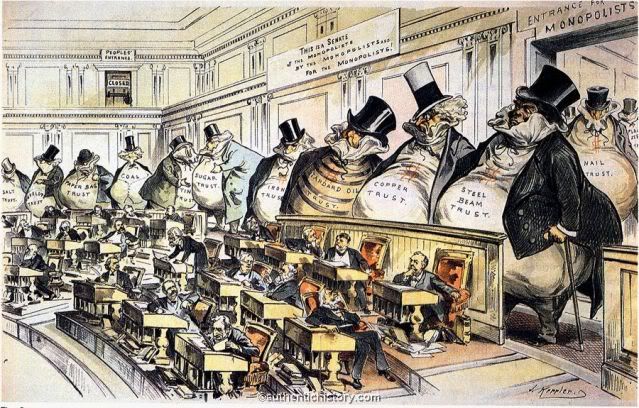
Image: Politics in the American golden age (it actually is called The Gilded Age): "Bosses of the Senate" by Joseph Keppler, 1889. Click for a larger, more legible image.

Update: a punchy cartoon comment on Confederate History Month.

Selasa, 03 November 2009

You can't trust anything these days: mixing up Kentucky and Tennessee

Patrick Neilsen Hayden at Making Light (thanks Brad DeLong):
John Keegan, author of the excellent The Face of Battle (1976) and many other books, is possibly the most widely-respected military historian alive. James M. McPherson is an eminent historian of the American Civil War; his Pulitzer Prize-winning Battle Cry of Freedom (1988) is often called the best single-volume history of that conflict.

Keegan has now published his own history of the American Civil War, and McPherson has reviewed it in the New York Times. And by “reviewed,” I mean “discredited it for the ages,” if even only a portion of the factual errors McPherson cites are in fact present in Keegan’s book.

As usual at Making Light, the comments are well worth reading, and in this case add a great deal to the topic at hand.

Selasa, 18 Agustus 2009

Dixie down

I feel compelled to post most of the material following from Brad DeLong's blog, because "The Night They Drove Old Dixie Down" is the only depiction of the Civil War, historical or fictional, that has ever made me feel any sympathy for those who fought for the Confederacy:

Thus Robbie Robertson [member of "The Band" who wrote the song in 1969] incites the ire of Ta-Nehisi Coates, who believes that we have very different memories of the Winter of '65, and don't need to invent Robertson's particular one:

Ta-Nehisi Coates: What you see above is the train of Rebels fleeing the city, as the Union troops enter from the other side. I was thinking about the Richmond yesterday, and The Band's "The Night They Drove Old Dixie Down."... I'm told that it's a great song, and I don't so much doubt this, as I doubt my own magnanimity. I'm reminded of one of my father's favorite quotes, "The African's right to be wrong is sacred." Or Aaron McGruder's line, "I reserve the right to be a nigger." I can no more marvel at The Band then a Sioux can marvel at the cinematography of "The Died With Their Boots On." I wouldn't fault the man who could, but it's not me My empathy is a resource to be rationed like all others. My right to be wrong is sacred. My right to be a nigger is reserved. I started to play the song yesterday, and stopped myself. Again, I was angry. Again, another story about the blues of Pharaoh, and the people are invisible. The people are always invisible....

The expectation that someone else will tell your story for you, will write your ballads for you, will reconcile your history for you, is foolish and vain.... I'm no Robbie Robertson, but I do carry the words of my old, magical people:

I have just returned from the city of Richmond; my regiment was among the first that entered that city. I marched at the head of the column, and soon I found myself called upon by the officers and men of my regiment to make a speech, with which, of course, I readily complied. A vast multitude assembled on Broad Street, and I was aroused amid the shouts of ten thousand voices, and proclaimed for the first time in that city freedom to all mankind. After which the doors of all the slave pens were thrown open, and thousands came out shouting and praising God, and Father, or Master Abe, as they termed him. In this mighty consternation I became so overcome with tears that I could not stand up under the pressure of such fullness of joy in my own heart. I rested to gain strength, so I lost many important topics worthy of note.

Among the densely crowded concourse there were parents looking for children who had been sold south of this state in tribes, and husbands came for the same purpose; here and there one was singled out in the ranks, and an effort was made to approach the gallant and marching soldiers, who were too obedient to orders to break ranks.We continued our march as far as Camp Lee, at the extreme end of Broad Street, running westwards. In camp the multitude followed, and everybody could participate in shaking the friendly but hard hands of the poor slaves.

Among the many broken-hearted mothers looking for their children who had been sold to Georgia and elsewhere, was an aged woman, passing through the vast crowd of colored, inquiring for one by the name of Garland H. White, who had been sold from her when a small boy, and was bought by a lawyer named Robert Toombs, who lived in Georgia. Since the war has been going on she has seen Mr. Toombs in Richmond with troops from his state, and upon her asking him where his body-servant Garland was, he replied: "He ran off from me at Washington, and went to 'Canada. I have since learned that he is living somewhere in the State of Ohio." Some of the boys knowing that I lived in Ohio, soon found me and said, "Chaplain, here is a lady that wishes to see you." I quickly turned, following the soldier until coming to a group of colored ladies. I was questioned as follows:

"What is your name, sir?" "My name is Garland H. White." "What was your mother's name?" "Nancy." "Where was you born?" "In Hanover County, in this State." "Where was you sold from?" "From this city." "What was the name of the man who bought you?" "Robert Toombs." "Where did he live?" "In the State of Georgia." "Where did you leave him?" "At Washington." "Where did you go then?" "To Canada." "Where do you live now?" "In Ohio." "This is your mother, Garland, whom you are now talking to, who has spent twenty years of grief about her son."

I cannot express the joy I felt at this happy meeting of my mother and other friends. But suffice it to say that God is on the side of the righteous, and will in due time reward them. I have witnessed several such scenes among the other colored regiments.

Late in the afternoon, we were honored with his Excellency, the President of the United States, Lieutenant-General Grant, and other gentlemen of distinction. We made a grand parade through most of the principal streets of the city, beginning at Jeff Davis's mansion, and it appeared to me that all the colored people in the world had collected in that city for that purpose. I never saw so many colored people in all my life, women and children of all sizes running after Father, or Master Abraham, as they called him. To see the colored people, one would think they had all gone crazy. The excitement at this period was unabated, the tumbling of walls, the bursting of shells, could be heard in all directions, dead bodies being found, rebel prisoners being brought in, starving women and children begging for greenbacks and hard tack, constituted theorder of the day. The Fifth [Massachusetts] Cavalry; colored, were sfill dashing through the streets to protect and preserve the peace, and see that no one suffered violence, they having fought so often over the walls of Richmond, driving the enemy at every point.

Among the first to enter Richmond was the 28th U.S.C.T. better known as the First Indiana Colored Volunteers. . Some people do not seem to believe that the colored troops were the first that entered Richmond. Why, you need not feel at all timid in giving the truthfulness of my assertion to the four winds of the heavens, and let the angels re-echo it back to the earth, that the colored soldiers of the Army of the James were the first to enter the city of Richmond. I was with them, and am still with them, and am willing to stay with them until freedom is proclaimed throughout the world. Yes, we will follow this race of men in search of liberty through the whole Island of Cuba. All the boys are well, and send their love to all the kind ones at home."

Chaplain Garland H. White,
28th USCI, Richmond, Virginia,
April 12, 1865; CR, April 22, 1865

White's letter can be found in the book A Grand Army Of Black Men (p. 175.) For the serious civil war nerd, this book, a massive collection of letters written by black soldiers during the War, is indispensable.

Then again, maybe Robbie Robertson is saying something else. Virgil Cain may say so, but we all know that the real killer of Cain's brother Abel wasn't no Yankee stranger from afar, was he?