Jumat, 09 Juli 2010
Kamis, 08 Juli 2010
Modern jousting in the New York Times Magazine

I know some of these people, and once worked as a squire at one of Shane Adams' jousting meets. The Times article rings true -- this is what Adams's bunch were doing seven years ago. And crazy as it is, there is something really medieval about a scene like this:
That evening, some of the competitors and their squires gathered at McGuire’s, a Pensacola pub and steakhouse. Everyone was sweaty and sore and more or less broke, and nobody could seem to talk about anything but horses and armor and lances. If the championships were held again tomorrow, you knew they would all be there.Of course you will read the rest.
Thanks to Al Magary for the tip.
Image: Shane Adams's Knights of Valour, from their Facebook page.
The Muslim Brotherhood's own version of Facebook
 From Arabist.net:
The National's Matt Bradley has a story on the Muslim Brotherhood's Facebook clone:
IkhwanBook joins a veritable suite of Brotherhood-affiliated (“Ikhwan” is Arabic for “Brotherhood”) websites, such as IkhwanWiki, IkhwanWeb, IkhwanGoogle – a “Cusotmized [sic] search engine specialized in searching muslim botherhood’s [sic] websites” – and IkhwanTube. Many of the sites are published in English and each of their functions is tailored to Brotherhood-related content.
The article then wonders why the Ikhwan bothers: IkhwanBook is after all technologically extremely inferior to the real Facebook, and the other sites are not that sophisticated either. And there are plenty of young Brothers on Facebook — anyone who's ever met them can expect to be friended within 24 hours, after all.
Brian Whitaker, noting the story, writes:
The interesting and slightly puzzling question is what the Brotherhood hopes to achieve by this. It's hard to imagine the Ikhwan sites gaining anything like the popularity of those they replicate, and they look like a move towards exclusivity which is generally uncharacteristic of the Brotherhood.
I think both Matt and Brian miss the point slightly. The first reason for having all these sites — and believe me, there are a LOT of Ikhwan sites out there, practically one for every governorate of Egypt plus many more on specific issues before you reach the Facebook and Wikipedia clones — is that there simply is enthusiasm to build them. Beyond the apparent correlation one notices between tech-savvy and religious inclination (just visit any of the computer malls on Midan Sphinx in Cairo), there are a lot of young talented programmers in Egypt who would love to show their enthusiasm for the gamaa by building websites for it. And there are a lot of young people in the Brotherhood, no matter how elderly the leadership is, for whom these websites may be a way of expressing their views as well as gain practice in the art of political and religious rhetoric.
The second reason is that this resonates with the groupthink and in-group mentality that the Muslim Brotherhood cultivates. These sites won't replace Facebook or Wikipedia, they are a virtual gated community (gated, that is, by strong symbolic references and imagery that are likely to alienate those not already versed in the Ikhwan universe) for like-minded people, where they can create a more orderly version of the sites that they copy and where the membership is self-selecting. The Muslim Brothers tend to socialize together, marry within each others' families, work together (or for each other) and a whole lot more. It's a support group as much as a political organization. It makes sense that, online, they will tend towards a closed ecosystem — alongside the open internet, not instead of it.
It's just the way online forums thrive: through community-building. That's true for computer geeks and religious geeks
.
Oh, MAN! More stumbling
...over marvelous online resources.
Namely, the Digital South Asia Library, which contains a complete version of the extraordinary A Historical Atlas of South Asia; and just when I had a use for this.
Namely, the Digital South Asia Library, which contains a complete version of the extraordinary A Historical Atlas of South Asia; and just when I had a use for this.
Rabu, 07 Juli 2010
PBS Newshour
I have said some harsh things about American journalism on this blog, so I feel an obligation to praise it when I find a good example coming out of the USA. I am very impressed by the honesty and hard work that goes into the former Knight-Ridder news service which is now called McClatchy, but some of you already know that. Now I have a second example --the PBS television Newshour.
What I find noteworthy in this daily broadcast is the fact that they devote long segments to the in-depth investigation of material that would not make it onto, or not be handled well by, too many other news outlets. Tonight for instance they spent at least five minutes and maybe closer to ten interviewing the French finance minister. That was followed by the last segment of the night, five or 10 minutes on the imminent publication of Mark Twain's autobiography, which he embargoed for a century. Both were very good, and given enough time on the screen to make the reports more than just trivia.
What I find noteworthy in this daily broadcast is the fact that they devote long segments to the in-depth investigation of material that would not make it onto, or not be handled well by, too many other news outlets. Tonight for instance they spent at least five minutes and maybe closer to ten interviewing the French finance minister. That was followed by the last segment of the night, five or 10 minutes on the imminent publication of Mark Twain's autobiography, which he embargoed for a century. Both were very good, and given enough time on the screen to make the reports more than just trivia.
Selasa, 06 Juli 2010
Somewhere, universities remain relevant and important

And that place is called... Iran.
A battle over the largest university in Iran, according to Radio Free Europe/Radio Liberty, also shows the divisions within the Iranian establishment. Here is part of a long article:
A dispute over control of one of the world's largest universities has turned into a fight between government bodies that is exposing deep fissures within the Iranian establishment.
At the center of the tug-of-war is Azad University: its leadership, board, 1.4 million students, and tens of billions of dollars in assets.
On one side are hard-liners within the Iranian establishment, most prominently President Mahmud Ahmadinejad, who appears ready to punish Azad University for its alleged support for opposition candidates in the 2009 presidential election. Supporting Ahmadinejad is the Supreme Council of Cultural Revolution (SCCR), whose resolution to alter the Azad University's charter, replace its current head of Azad University, and change its governing board was recently approved by the president.
On the other side are the conservatives within the same establishment, mainly former President Ali Akbar Hashemi Rafsanjani, who co-founded the university in 1982 and now the heads its board of trustees. Also supporting the conservatives are parliamentary speaker Ali Larijani, and Abdollah Jasbi, the university head who is up for replacement and is a close Rafsanjani ally.
Matters came to a head on June 19 when the university's board secured a temporary injunction that prevented the SCCR from enforcing its revision of the university's charter.
The next day, a bill was rushed through the 270-member parliament that effectively circumvented the government takeover of Azad, by allowing universities to endow their properties to the public.Azad University's board had previously decided to endow the properties of the university, which has 357 branches and satellite campuses throughout the country.
The legislative move was quickly met with demonstrations outside parliament by Ahmadinejad loyalists.
In the wake of the heated protests, 100 legislators made a counter move by voting for emergency discussion of legislation that would support the SCCR's authority in the matter. This, in turn, could result in a bill that would effectively overturn the endowment bill passed on June 20. The counter move led to an uproar in parliament, with legislators exchanging insults.
Now it is up to the Guardians Council, which must approve the legislation, to decide on the matter, and for Supreme Leader Ayatollah Ali Khamenei to weigh in. The result could either strengthen Ahmadinejad and his allies or give some leverage to his rivals who are trying to curb his influence.
High Stakes
The fight has already been ugly at times. During the June 22 protesters outside parliament, which included members of the Basij militia, threatened to place the parliament "under fire" unless it backed away from its bill.
And that's just the various factions of conservatives fighting each other!
Image: picture taken from Wikimedia Commons. The photographer is named, believe it or not, Mani Parsa. Talk about your archetypal name!
Amerigo, Amerigo
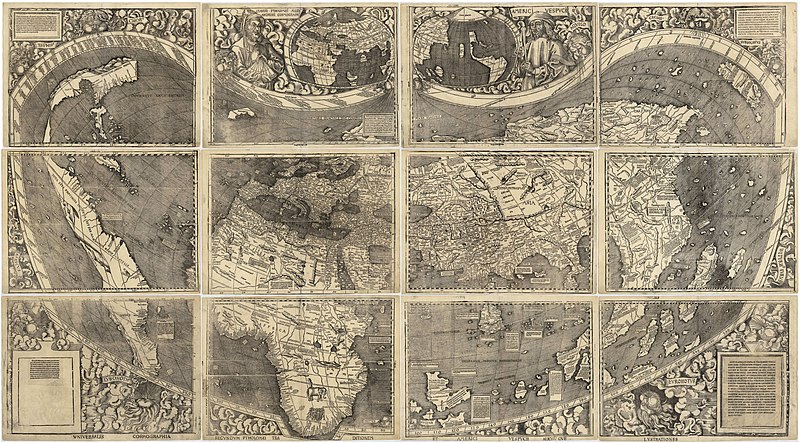
A cool, detailed article on the naming of America. Thanks to Boston.com and Explorator for this one.
The expanding horizons began with Vespucci. In his letter, he reported sailing west across the Atlantic, like Columbus. After making landfall, however, he had turned south, in an attempt to sail under China and into the Indian Ocean — and had ended up following a coastline that took him thousands of miles almost due south, well below the equator, into a region of the globe where most European geographers assumed there could only be ocean.
When Ringmann read this news, he was thrilled. As a good classicist, he knew that the poet Virgil had prophesied the existence of a vast southern land across the ocean to the west, destined to be ruled by Rome. And he drew what he felt was the obvious conclusion: Vespucci had reached this legendary place. He had discovered the fourth part of the world. At last, Europe’s Christians, the heirs of ancient Rome, could begin their long-prophesied imperial expansion to the west.
Ringmann may well have been the first European to entertain this idea, and he acted on it quickly. Soon he had teamed up with a local German mapmaker named Martin Waldseemüller, and the two men printed 1,000 copies of a giant world map designed to broadcast the news: the famous Waldseemüller map of 1507. One copy of the map still survives, and it’s recognized as one of the most important geographical documents of all time. That’s because it’s the first to depict the New World as surrounded by water; the first to suggest the existence of the Pacific Ocean; the first to portray the world’s continents and oceans roughly as we know them today; and, of course, the first to use a strange new name: America, which Ringmann and Waldseemüller printed in block letters across what today we would call Brazil.
Why America? Ringmann and Waldseemüller explained their choice in a small companion volume to the map, called “Introduction to Cosmography.” “These parts,” they wrote, referring to Europe, Asia, and Africa, “have in fact now been more widely explored, and a fourth part has been discovered by Amerigo Vespucci....Since both Asia and Africa received their names from women, I do not see why anyone should rightly prevent this from being called Amerigen — the land of Amerigo, as it were — or America, after its discoverer, Americus."
Langganan:
Postingan (Atom)
Weekly
-
This announcement speaks for itself: Dear Colleagues, After two decades teaching medieval art history and doing photography for my own use,...
-
From the Guardian: Leading foreign academics from the LSE acting as expert advisers to the UK government were told they would not be asked ...
-
A new translation of this fascinating treatise on horsemanship by a fifteenth-century king. This interview with Jeffrey Forgeng comes from...
-
 ...if you are very, very rich. (Most mss. of this age and quality are in national or university libraries and are not for sale at any price...
-
For those who found the conclusion of this post rather cryptic, here is what Bernard of Clairvaux said in his treatise In Praise of the New...
-
I have always loved maps and history. Growing up in the USA in the early 60s, the Southeast Asian war gave me the opportunity to learn geog...
-
Two experts in the Middle East have been more useful to me than most of the more prominent ones. They are Juan Cole and Joshua Landis. If yo...
-
I just discovered this book, which came out a couple of years ago, thanks to Brad DeLong, who provided a link to a pre-print to chapter 9, ...
-
An excerpt from a recent book,Thanassis Cambanis’s Once Upon a Revolution: An Egyptian Story : A few days after the end of Ramadan, on Aug...
-
During my years with the Good Duke I have run across a number of surprising and amusing personal names: Bliomberis Loup and his brother, fo...