Tampilkan postingan dengan label Mali. Tampilkan semua postingan
Tampilkan postingan dengan label Mali. Tampilkan semua postingan
Sabtu, 21 Februari 2015
Jumat, 23 Januari 2015
Senin, 03 Februari 2014
Some Malian Tuareg music over at NPR

I don't know how long this music from Tinariwen will be available, but there is quite a bit of their recent release at this NPR site.
Rabu, 30 Januari 2013
Better -- and authoritative -- news from Tiimbuctu
Excerpt of a statement from the international scholarly organization most concerned with manuscript preservation:
From Tombouctou Manuscripts ProjectThere is much more detail in the full statement.
(http://www.tombouctoumanuscripts.org)
Huma (Institute for humanities in Africa)
University of Cape Town
Since the start of this week there are reports about the destruction of library buildings and book collections in Timbuktu. It sounds as if the written heritage of the town went up in flames. According to our information this is not the case at all. The custodians of the libraries worked quietly throughout the rebel occupation of Timbuktu to ensure the safety of their materials. A limited number of items have been damaged or stolen, the infrastructure neglected and furnishings in the Ahmad Baba Institute library looted but from all our local sources – all intimately connected with the public and private collections in the town - there was no malicious destruction of any library or collection.
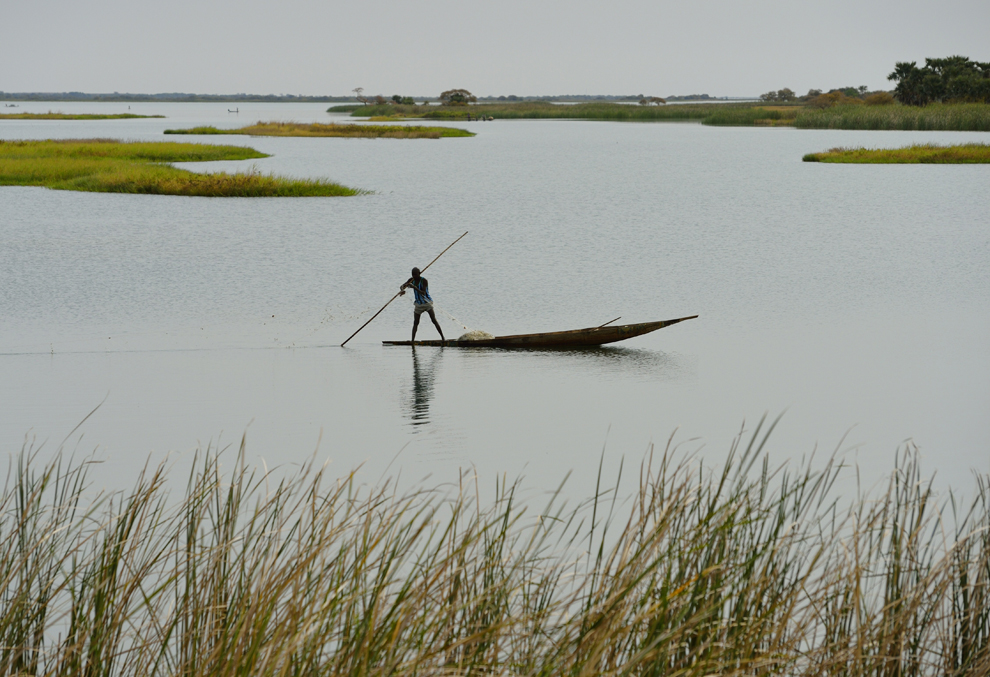
Mali -- a peaceful scene on the River Niger
Senin, 28 Januari 2013
The uncertain fate of Timbuktu's manuscripts
http://world.time.com/2013/01/28/mali-timbuktu-locals-saved-some-of-their-citys-ancient-manuscripts-from-islamists/
The original report was much worse, saying that tens of thousands of the most historic manuscripts had been burned by retreating Islamist rebels. We'll see.
The original report was much worse, saying that tens of thousands of the most historic manuscripts had been burned by retreating Islamist rebels. We'll see.
Senin, 21 Januari 2013
The threat to Malian music – and everything else worthwhile
From the Independent:
This is a tragic twist for a people whose faith revolves around the more tolerant strands of Sufism. For all its poverty, Mali has traditionally been open to outsiders. It is a nation where women are prominent and musicians more closely entwined with everyday life than perhaps any other place on earth. Music has long been part of the social and political fabric, from praise singers who, for centuries, passed on the oral history to the state-funded bands used to bond the nation after independence.
When I first went there almost a decade ago, it was for the famous Festival in the Desert, some 50 miles from Timbuktu and a symbol of reconciliation after a previous Tuareg uprising. It took three days to get there; Westerners reaching the event were treated like old friends. Days were spent sheltering from fierce sun in tents, chatting over cups of sweet tea and biscuits. At night, those amazing musicians who have taken Malian music around the globe performed in front of turbaned tribesmen on camels while burning braziers lit up the desert. An unforgettable experience.
Where once there was music and dancing, today there is misery and deprivationMore here.
Kamis, 17 Januari 2013
Tuareg music
The group Tinariwen performing in 2006.
Kamis, 12 April 2012
Minggu, 08 April 2012
Phil Paine on bad news from Timbuktu
Phil reports:
I have a personal interest in Timbuktu (see blog for Mar 7, 2006), so I have followed, as best as I can, the recent events in Mali that affect it. After the fall of Gaddafi’s regime, several hundred young Tuareg who had been serving as mercenaries in his army have returned to Niger and Mali. Along with them came a large stock of weapons. This re-ignited the low-level civil war which had come to an apparently satisfactory peace settlement in 2009. Disatisfaction with the response to this renewal of violence seems to have triggered a coup d’état by the country’s military against the democratically elected government. As a consequence of the instability following the coup, the “National Movement for the Liberation of Azawad” (MNLA) quickly occupied the three largest northern towns (Gao, Timbuktu and Kidal) and declared an independent state of Azawad, cleaving away the thinly populated northern half of Mali.
Few events in the last few years have depressed me as much. Mali had lifted itself by its bootstraps from an intensely repressive Marxist dictatorship, heavily involved in the slave trade, to become West Africa’s most promising democracy. Now that promise is evaporating.
More here: http://www.philpaine.com/?p=4439
Langganan:
Postingan (Atom)
Weekly
-
This announcement speaks for itself: Dear Colleagues, After two decades teaching medieval art history and doing photography for my own use,...
-
From the Guardian: Leading foreign academics from the LSE acting as expert advisers to the UK government were told they would not be asked ...
-
A new translation of this fascinating treatise on horsemanship by a fifteenth-century king. This interview with Jeffrey Forgeng comes from...
-
 ...if you are very, very rich. (Most mss. of this age and quality are in national or university libraries and are not for sale at any price...
-
For those who found the conclusion of this post rather cryptic, here is what Bernard of Clairvaux said in his treatise In Praise of the New...
-
I have always loved maps and history. Growing up in the USA in the early 60s, the Southeast Asian war gave me the opportunity to learn geog...
-
Two experts in the Middle East have been more useful to me than most of the more prominent ones. They are Juan Cole and Joshua Landis. If yo...
-
An excerpt from a recent book,Thanassis Cambanis’s Once Upon a Revolution: An Egyptian Story : A few days after the end of Ramadan, on Aug...
-
I just discovered this book, which came out a couple of years ago, thanks to Brad DeLong, who provided a link to a pre-print to chapter 9, ...
-
During my years with the Good Duke I have run across a number of surprising and amusing personal names: Bliomberis Loup and his brother, fo...