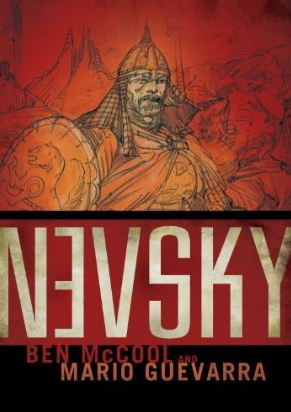
In our time artists have a lot of choices of which genre they will use to tell stories that inspire them. One common strategy has been to take tales that originate in comic books or graphic novels and fill them out by using all the resources of the movies. The Marvel superhero saga dominates film production these days. A somewhat different example can be seen in the transformation of a popular graphic novel,300, into a film whose artistic roots are unapologetically in comics.
Here we have an example of other artists going the other direction: taking an epic film and turning it into a book that can be held in one's hands. I would be interested, sometime down the pike, to know how successful, commercially and artistically, this project is, how popular it turns out to be with the target audience.
This is certainly a labor of love. It is a faithful rendering of the 1938 film Alexander Nevsky, one of the most famous products of Sergei Eisenstein's filmmaking genius. There is no effort to disguise how much the authors owe to the original version of this story. In fact, quite a bit of space is devoted to telling the reader about both the historical Alexander Nevsky and his interpreter, Eisenstein.
Alexander Nevsky was a 13th-century Russian warrior who was remembered for fighting for Mother Russia against two dangerous enemies, and East (the Mongol Golden horde) and West (the Teutonic Knights). In the late 1930s the story seemed both relevant and useful to Eisenstein and the Soviet regime that employed and often abused him. Japan loomed in one direction, Nazi Germany in the other. Whatever the facts of the historical Nevsky, he was needed as a symbol of Russian/Soviet determination in the face of daunting odds.
A story of great courage and heroism defeating treason and cruelty was right up Eisenstein's alley. If you like your heroes unsullied and your enemies black as black can be, Eisenstein is your man. The successful conjuring up of such figures makes the movie unforgettable once you see it. And the stark contrast is clearly what has inspired the two creators to take on this remarkable project.
Of course, the success of Nevsky will depend to a very great extent on its artistic appeal to aficionados of the genre. I'm not really in that crew. To my eye it looks pretty good. The art combines rich colors, heavy shading, and the occasional use of odd angles to emphasize some aspect of a scene.
I have to wonder whether this book will result in a new audience finding Eisenstein's films.
