Tampilkan postingan dengan label television. Tampilkan semua postingan

Minggu, 20 November 2016

American Gods, Supernatural, and Jesus

Recently I have been reading American Gods by Neil Gaiman, as well as watching the TV show Supernatural, which has been on for pretty close to 15 years now. I am finding both of them quite enjoyable. They have strong similarities, specifically they both take place in America (Trump's America?) where behind the scenes of ordinary life (a pretty dreary ordinary life mostly in the country or very small towns) biblical or pagan gods, culture heroes, and etc. pursue their own agendas, generally with bad effects on human beings who stumble across them.
American Gods has a high reputation and it is very entertaining and well-written. The specific plot of the story is that many of the ancient gods of European or Middle Eastern origin are trying desperately to make a living, generally by running some kind of scam. They are old and weak because nobody much believes in them anymore more and sacrifices are hard to come by.
There is one very noticeable weak point in American Gods, and that is the complete absence of Jesus in the storyline. When the human hero of the story comes across these gods and goddesses, many of them talk about how things are not nearly as good as they were back in the old days. They are upset about the current condition and talk about it in some detail. But Jesus never comes up. Churches, priests, ministers, huge suburban ministries with a strong television presence likewise. Jesus should be there in that landscape, but he isn't, not even as a figure on whom to blame the sad plight of the old gods. It is fully in line with the tone and logic of American Gods that the old guys should take a new human ear as an opportunity to pour out their troubles.
Supernatural is a bit different. A lot of biblical and semi-biblical mythology is strongly present in the main plot line. You can kind of understand how the makers of the TV series might back off from including any commentary whatsoever on Jesus.
But it is very odd that a novelist who likes think of himself as innovative, would censor himself in this way. Or is there some other explanation for his strong desire to ignore the most important American God?
Sabtu, 04 Juni 2016

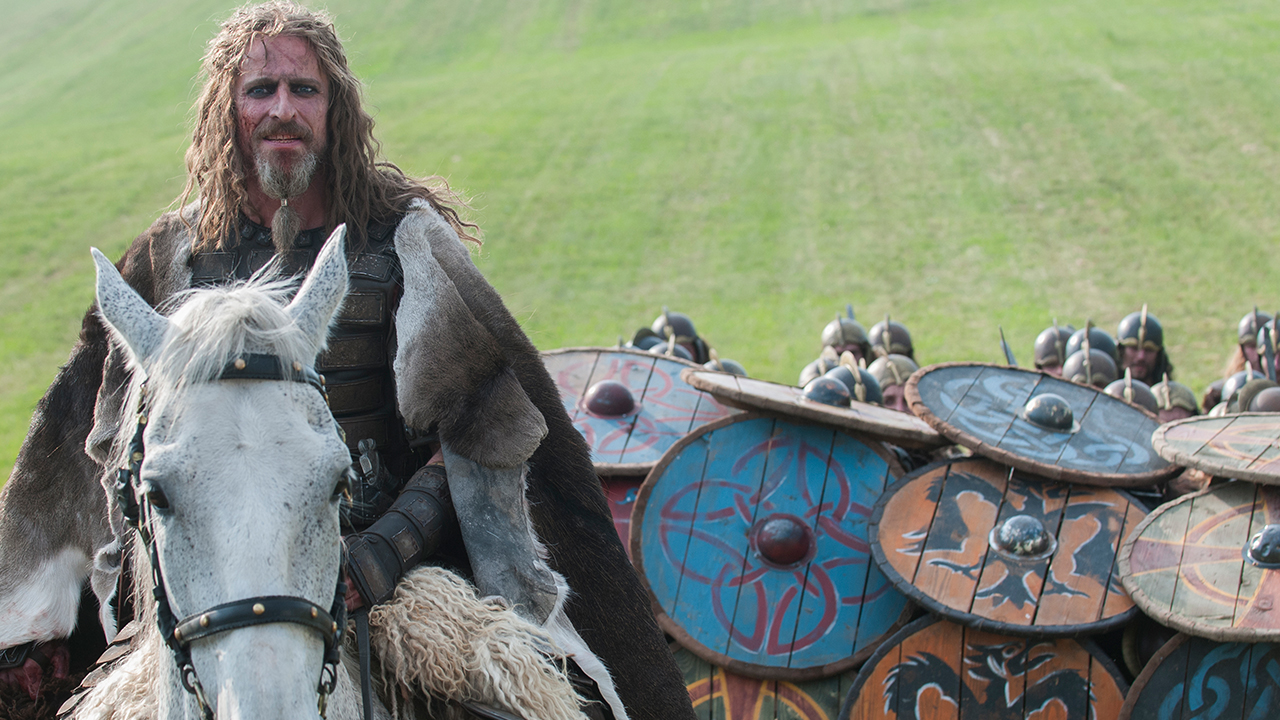
Not a horned helmet among them

A couple or three weeks ago I had a look at the Last Kingdom, a TV series depicting the period of Alfred the Great and his wars with the Danes. I was referred by friends to a critique of the authenticity of this film put on YouTube by a man named Lindy Beige. Mr. Beige is repeatedly offended by the fact that ninth century warriors wore soft leather armo and all sorts of inexplicable fur and leather accessories. And even the kings are dirty. One of them wears the same clothes for 10 years!

Fair enough – but I have to say that I found the series inexplicably good. When was the last time you saw a commercial video depiction of the Vikings that has nobody wearing horned helmets? In my case I think I can say "never!"

It's also surprising to me that the treatment of Alfred the Great, a man who was very eccentric in terms of his own time, is reasonably believable.

Mr. Beige says sense somewhere in his critique that he has no trouble with the plot or the acting of the last kingdom. Indeed? And you want more?

Kamis, 02 Juni 2016

Sabtu, 21 Mei 2016

Ripper Street and steampunk

I talked recently about the Canadian show Murdoch's Mysteries as an entertaining exploration of late Victorian Toronto, which is not exactly steam punk but close enough.

I am now watching Ripper Street, which like the Canadian series is about the late 19th century and is not exactly steampunk but shares Murdoch mysteries fascination with new technology and science.

The fascination of a variety of creative people with the modernity of the late 19th century and the early 20th is fascinating to me!

Sabtu, 16 April 2016

Murdoch's Mysteries: we live in a new and incredible age

For about a decade, CBC has been broadcasting an interesting murder mystery series set in Edwardian Canada, or rather, Edwardian Toronto. I have been watching reruns of the show over the last two or three weeks and like most series television, it is much more enjoyable when seen that way.

It would be easy enough to call the show "steampunk" except that the technology that sets the pace in the show is electricity. Murdoch, the lead character, is a Toronto detective who is enthusiastic about modern technology -- x-ray machines, electrical automobiles, movie cameras -- and uses it very effectively to solve crimes. In the course of his adventures he also runs into many leading figures of the time – Alexander Graham Bell, Henry Ford, Tesla, Marconi, Andrew Carnegie, Winston Churchill. He does not run into Sherlock Holmes, but he does run across somebody who thinks he is Sherlock Holmes.

I am also impressed by the depiction of the city of Toronto. Toronto circa 1899 is shown as being multi-cultural and multi-ethnic, wrestling with a variety of political, racial, and social conflicts, which are reasonably realistically portrayed. One of the main characters, for instance, gets in trouble for promoting contraception, which is illegal at the time. Other characters are properly shocked by this and there is a bit of a riot.

I think there may be more in-jokes in the series than I'm picking up. Two days ago I saw an episode where I was pretty sure two characters were modelled after Toronto's Ford brothers. The characters were not politicians, but they looked like the Fords and their personal interactions with each other matched what I know of the Fords.

All too often we think that people in the past were old-fashioned fuddy-duddies. In some places in some areas that is undoubtably true. But in other times people -- or many of them – are seized by an awareness of modernity. One of the great virtues of Murdoch's Mysteries is that it reminds us of that fact. "We live in a new and incredible age," says one character, and she is quite right.

Kamis, 16 April 2015

"The gleaming cities of Earth...

...Where peace reigns, and hatred has no home."

These are the last lines of the episode "Muse" from the series "Star Trek: Voyager." The episode is characteristic of the series as a whole.


Voyager is not the most popular series in the Star Trek franchise. Like some of the other series – maybe all of them – it started out rather weak, and with characters that were not particularly well developed. But I have seen the series twice now and I think that once the series got rid of the character Kes and brought Seven of Nine into the story, about halfway through, it got a lot better. Sure, there are some fairly dumb and typically dumb stories, but there is some very good science fiction as well.


The episode "Muse" is an example of how serious television, if the creators take it seriously themselves,  can give writers and directors and actors space do all sorts of interesting stuff. The existence of Netflix shows us how some series work very well as they build on previous strengths.
 The characters of Voyager are very good examples of this. They aren't brilliantly done, but they are increasingly good as things progress. The character of the doctor by Robert Picardo and Seven of Nine by Jeri Ryan come to mind. In both cases, incomplete human beings turn into something else as they mature, and as is repeatedly emphasized by the development of the series as a whole, they have to be accepted by the flesh and blood human beings as equals. I think Ryan, whom many people think got the job sheerly on the basis of astonishing physical beauty, had a very tough assignment here and did it very well.

In the case of "Muse" we see an alien culture that seems to have developed to an era similar to archaic Greece. A local poet rescues one of the members of the Starfleet expedition and uses her story to create a drama far away better than anything that has existed in his culture before. It's not really a very believable story when it comes down to it  but it does make you think about how astonishing the effect of early Greek drama must've been. Classicists know this, but how often has this been explored on TV or in any other popular genre of fiction?

The quote I used for a title for this post indicates a final characteristic worth noting. It is spoken by the poet of the alien culture who has visualized Earth as the home of peace and perfection. According to the series, he's absolutely right. The 24th century according to the writers of the series is a time when the most optimistic dreams we have for our future have come true. Sometimes that optimism seems a bit overdone, but I would say that the whole dramatic interest of the series is that it argues that even when peace and concord have come to Earth, there will still be plenty of problems in applying all our best ideas to real-life situations.