Tampilkan postingan dengan label ancient history. Tampilkan semua postingan

Minggu, 07 Agustus 2016

The Loeb Classical Library saves civilization


The Loeb Classical Library is a bit over one hundred years old. It was meant to be useful to a wide group of readers -- each volume has not just the original text but also a facing translation into English. As you can imagine many people who had an excellent classical education scorned the project. The poet John Talbot is one of the defenders of the LCL:
I have a little apocalyptic fantasy that involves the collection of Loebs in my local library. It’s a complete set, from Homer’s rosy-fingered dawn to the twilight of Ammianus Marcellinus. The very sight of it is reassuringly tidy: all the sprawling energies of a thousand years of Greek and Roman thought and song, distilled and compacted into these snug matching volumes, the Greek bound in olive drab, the Latin in scarlet. Run your fingers over the spines. Here are The Classics.
Then comes a nuclear holocaust. My local library, like others around the world, is mostly pulverized, but an accident involving molten rubber preserves the case of Loebs intact within a sealed airtight cavity beneath the rubble. Centuries elapse and deposit their layers of sediment. Above ground, the descendants of the survivors plod on, speaking a crude version of English, and when their vestigial civilization is at last stable enough to permit cultivation of the liberal arts, their curiosity turns to the prior civilization, ours, whose evident sophistication is attested only in the occasionally exposed ruin, or in fragments of excavated texts. Of this second category, a half-page of Danielle Steele, the corner of a Dunkin’ Donuts advert, and the odd shred of Paradise Regained are all scrutinized, edited, and interpreted with equal zeal. The fragments are exasperating: they imply a vast literature, and behind it a teeming culture, all tantalizingly out of reach.
Until one day when excavation unseals that underground cavity, and for the first time in so many centuries, sunlight falls on those green and red spines. The whole Loeb Classical Library, dedicated to preserving whatever could be salvaged from an even earlier lost civilization, has itself survived intact. The excavators fall upon the cache and discover not only the English (which they can mostly make out, though it appears to them as remote as Chaucer to us) but also, to their astonishment, on the facing pages, two strange, even more ancient languages, one with an unfamiliar alphabet. Amid a storm of speculations it is posited that the English is the key to the other two tongues, and in time a latter-day Champollion steps forward and reconstructs the grammar of Latin and Greek. His successors, pioneer scholars of the recovered ancient languages, are at first awestruck—what are these voices speaking out of the dust?—and then electrified, as they begin to read and assimilate Homer and Sophocles and Lucretius and Augustine. These voices must be emulated; the standards are daunting but stimulating; though ancient, they point the way to something new. Academies are organized for teaching the new languages; young souls (they will become poets and historians and scientists) are once again smitten by the songs of Sappho and Catullus, the grave brilliance of Thucydides and Tacitus, the searching effervescence of Plato’s Socrates and Aristotle’s dogged earthbound inquisitiveness. The post-apocalyptic world shrugs off its torpor, hums with ideas and energy and hope. I suppose what I mean by all this is that it is good to know that the Loeb Classical Library is there, patiently waiting, in case any civilization (not least our own present one) should require a renaissance.

Minggu, 12 Juni 2016

Forbes gets it right about Catal Huyuk ( Çatalhöyük)

Twenty-five years ago, when I was first teaching ancient history, I spent a whole lecture of the Anatolian site of Catal Huyuk as an example of an early city. The settlement was called a village in most accounts, but it looked like a city to me. I was following a very persuasive and accessible discussion by Jane Jacobs, who may not have been an anthropologist but knew a thing or two about the development of cities.

Today I ran across an article in Forbes which covered the peculiar burial customs of the people of CH. What caught my eye, though, was the clear statement that Catal Huyuk is "One of the world’s earliest cities [7500 BC, population 10,000]." Hurray! Jane justified! I can't link to the images somehow; look at some good ones by following the link above.

Senin, 29 Februari 2016

Humbaba!

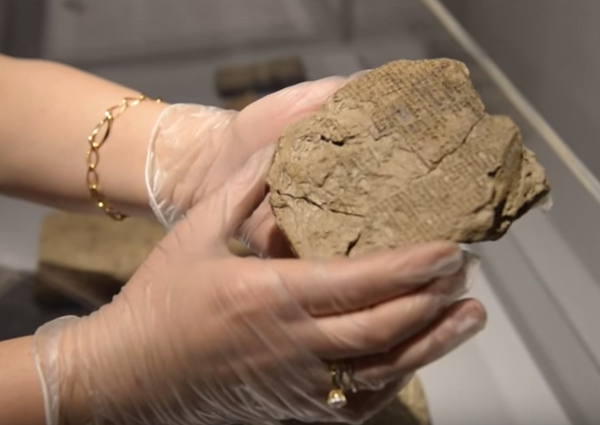
Missing pieces of the Epic of Gilgamesh found! Open Culture says:
That’s a pretty good deal for these extra lines that not only add to the poem’s length, but have now cleared up some of the mysteries in the other chapters. These lines come from Chapter Five of the epic and cast the main characters in a new light. Gilgamesh and his companion Enkidu are shown to feel guilt over killing Humbaba, the guardian of the cedar forest, who is now seen as less a monster and more a king. Just like a good director’s cut, these extra scenes clear up some muddy character motivation, and add an environmental moral to the tale.

Jumat, 26 Februari 2016

The sounds of the past

I stumbled across two interesting blog posts this past week, both concerned with recovering or reconstructing ancient languages. Back in 2010, Open Culture ran a piece on ancient Akkadian (an early Mesopotamian language, one of the first written down anywhere). A short piece of the Epic of Gilgamesh was included. Have a look! And while you are at it, read up on the completion of the Akkadian dictionary produced by the Oriental Institute in Chicago -- over the last 90 years.

Best thing about the dictionary? If you are content to have it in electronic form, it's FREE, FREE, FREE!And if you have a bundle to spend, you can have it in a very nice printed set.

Now there is scholarship for you.

About the same time, I ran across this article on ancient Greek music. Everyone who cares to know it knows that the ancient Greeks were world champions in their time in both painting and in music. But in both cases, just about none of it is left.

Just about!

Back in 2013, the BBC ran (in its business section!?) a detailed piece on how some of that music must have sounded (at least in a minimal "unplugged" form).

Revelation (for me at least): "In ancient Greek the voice went up in pitch on certain syllables and fell on others (the accents of ancient Greek indicate pitch, not stress)."

Wow! Does this mean that speaking ancient Greek was similar to singing?

Senin, 18 Mei 2015

Yes, the ancient Egyptians were odd

From Discovery News:
Animals Mummified by the Millions in Ancient Egypt

About a third of the X-rayed and CT scanned artifacts do in fact contain complete and remarkably well preserved animals. Another third contain partial remains. The rest is simply empty.

Highlighted in a BBC documentary, the “mummy scandal” was exposed as scan of beautifully crafted animal mummies showed linens padded out with various items.

“Basically, organic material such as mud, sticks and reeds, that would have been lying around the embalmers workshops, and also things like eggshells and feathers, which were associated with the animals, but aren’t the animals themselves,” Lidija McKnight, an Egyptologist from the University of Manchester, told the BBC.

Experts believe as many as 70 million animals were‭ ‬ritually slaughtered by the Egyptians to foster a huge mummification industry that even drove some species extinct.‭ ‬

How Different Cultures Made Their Mummies

There were four kinds of animal mummies: pets that died of natural causes before their mummification and were buried with their owners; sacred beasts, worshiped and pampered in life, and buried in elaborate tombs at their death; animals serving as food for their owners in the afterlife; and religious offerings, which were the majority.

Having miserable, short lives, these poor animals were simply bred to become votive mummies — offered to the gods in a gesture similar to the way people light candles in churches today.

The practice began as early as‭ ‬3,000 B.C. and reached its zenith from about‭ ‬650‭ ‬B.C. to‭ ‬200‭ ‬A.D., when millions of animals like dogs and cats were raised by temple priests and mummified.‭

According to the researchers, there was an element of demand outstripping supply which may have accounted for some mummies not containing a complete animal.

Ancient Dogs Found Buried in Pots in Egypt

“There simply wouldn’t have been enough to go round,” McKnight told Discovery News.

“More importantly, the ancient Egyptians believed that a small fragment of bone or material associated with the animals or a sacred space contained sufficient importance to be offered as a gift to the gods,” she added.

McKnight believes the procedure shouldn’t be seen as a forgery or scam as the pilgrims likely knew they were not burying a fully mummified animal.

“It simply wouldn’t have mattered what they contained as long as they were a suitable offering to the gods. Often the most beautifully wrapped mummies don’t contain the animal remains themselves,” she said.

Kamis, 12 Februari 2015